In short
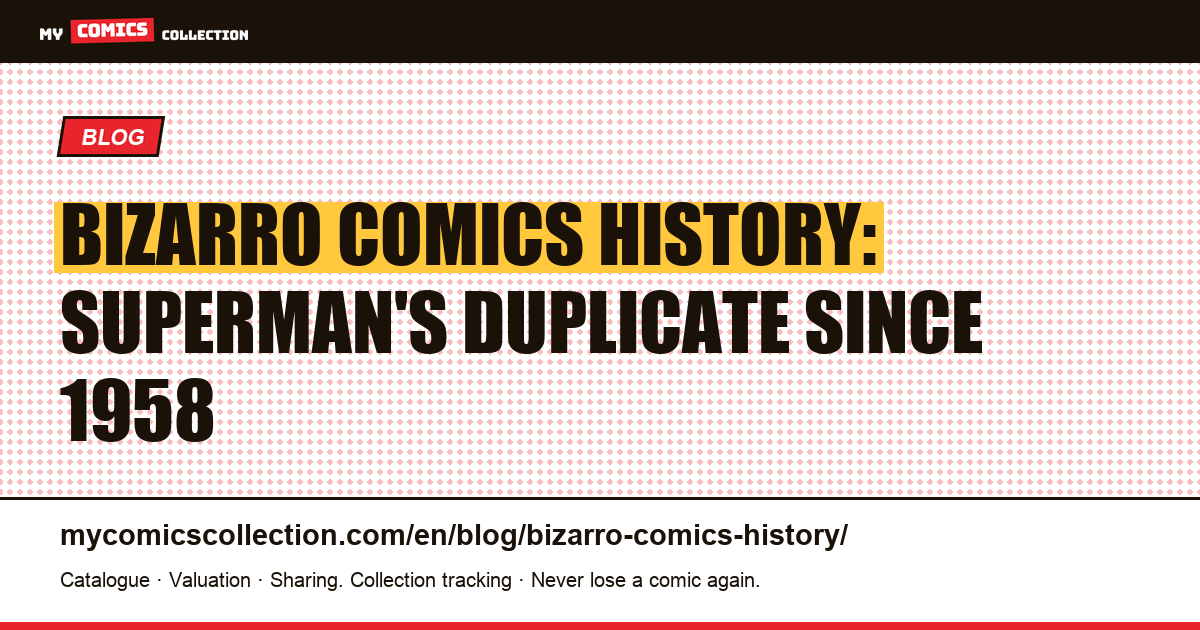
Bizarro first appeared in Superboy #68 (1958), created by Otto Binder and George Papp as a flawed duplicate of the teenage hero. The adult version arrived in Action Comics #254 (1959) and built the cube-shaped world Htrae, the setting of an Adventure Comics feature from 1961 to 1962. Alan Moore and Curt Swan closed the Silver Age version in 1986, John Byrne rebuilt him as a clone in The Man of Steel #5, and Forever Evil (2013 to 2014) recast him as Lex Luthor's imperfect Kryptonian clone.
Bizarro is a joke that keeps turning into a tragedy. He starts as a mistake in a laboratory, becomes a running gag with his own planet, dies on the page in 1986 and returns as a clone, an experiment, Luthor's bodyguard and a hero in other people's stories. What follows traces that line from one era to the next, so you can tell which Bizarro you are holding before you open the book.
For this Bizarro timeline we confirmed the writers, artists and cover dates of the issues named, from the 1958 Superboy story to the 2018 Outlaws run. Our reading of why each version matters is commentary, and no panels or dialogue are reproduced.
A botched copy of a teenager (1958)
The debut sits in Superboy #68 (October 1958), with Otto Binder scripting and George Papp drawing. A duplicating ray accident copies Superboy, and the copy is a childlike, flawed double with chalky skin and childlike behavior. He befriends a blind girl named Melissa, who accepts him only because she cannot see him, and when he collides with a fragment of the machine, which acts on him like blue kryptonite, the explosion restores her sight.
That origin is the reason the character has lasted. The first Bizarro is a victim: he does not choose to harm anyone, he follows his own logic with sincerity, and the story ends on loss. Later writers kept returning to that emotional core, so the tragedy that sits under every comic version was in the character from the first page.
The collector's note is that this is the teenage Bizarro, not the figure most people picture. He lives in a Superboy story and disappears at its end, which makes #68 a valuable debut but a poor guide to what the character becomes in the books that follow.
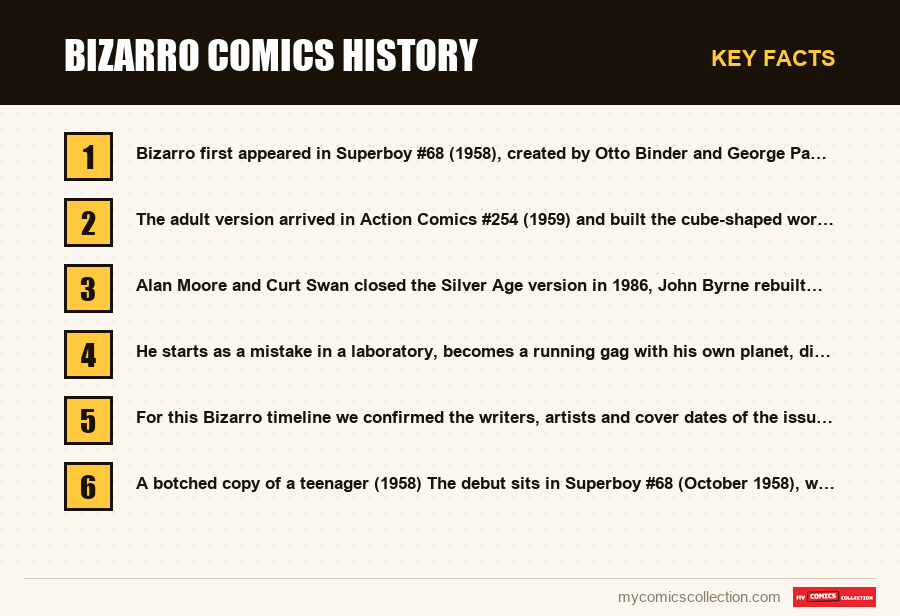
The adult Bizarro and a world of his own (1958 to 1962)
Before the comic book version existed, the Superman newspaper strip ran "The Battle With Bizarro" in 1958, written by Alvin Schwartz, with an adult Bizarro marked by a letter "B." The comics followed in July 1959 with Action Comics #254, where Binder brings the adult character into the books and puts an "S" on his chest. Across #254 and #255, Bizarro #1, made by Lex Luthor's duplicating ray, arrests Luthor and causes havoc in Metropolis, and this Bizarro goes on to create Htrae, a cube-shaped planet populated by Bizarros.
The idea then grows into a feature. Adventure Comics ran a Bizarro World series in fifteen issues, #285 to 299, from June 1961 to August 1962. It gives the planet its own rules, with a world that reverses Earth's customs, and it places Superman's circle in the middle of it: in #287 (1961) Jimmy Olsen is trapped on Htrae. A few years later Superman's Pal Jimmy Olsen #80 (1964) turns the young reporter into a Bizarro, a detail that shows the format had become part of the family books' stock of stories.
What changes for the character here is scale. In 1958 Bizarro is one pitiable creature; by 1962 he is a population with laws, geography and a vocabulary of inversion. The reversal rule, that he does the opposite of what is sensible and says the opposite of what he means, became a reusable story frame that any writer on the Superman titles could pick up.
A recurring presence in the Superman family (1962 to 1985)
Between 1959 and 1984 Bizarro appears about forty times across the Superman titles, which makes him a regular rather than an occasional guest. Superman #202, dated December 1967 and January 1968, is an 80-page giant devoted entirely to him, and in World's Finest Comics #181 (1968) radiation from an exploding celestial body turns Htrae egg-shaped and normal, stripping the Bizarros of their powers.
These years are the comic-relief Bizarro at his most fixed. He is dangerous by accident, funny by design, and always on the edge of being sympathetic. The pleasure for a collector lies in the supporting materials: the giants, the backups and the odd cross-over issues give a better sense of the era than any single story does, and the Silver Age look of Papp and the artists who followed him is part of the attraction.
It is also the period that explains why the character was so easy to retire. A creature built on a joke needs a clear rule, and once the rule had been used for a quarter of a century, the next step was either to deepen him or to end him. DC chose to end him, with unusual care.
The farewell (1986)
The Silver Age Bizarro dies in two connected stories published in 1986. Bizarro's last Silver Age stand comes in Superman #423, the first half of a two-part Alan Moore story, with Curt Swan on pencils and George Pérez finishing the art. There Bizarro, who has already destroyed his own world so that he can arrive on Earth as an adult, lays waste to Metropolis and then ends his life with blue kryptonite, the inverse of a living Superman. The same story is continued in Action Comics #583, which Kurt Schaffenberger inked.
In DC Comics Presents #97 (1986), Mister Mxyzptlk, empowered by a Phantom Zone sorcerer, destroys Bizarro World. Two versions of the same ending, published the same year, give the Silver Age character a finish. That makes Bizarro a character retired by his own era with a send-off, rather than one simply erased by the reboot that followed.
If you read just one issue of the farewell, make it Superman #423, and read Action Comics #583 with it. For the wider story of the writer, see the Alan Moore author page.
A clone in the post-Crisis world (1986 to 2005)
The post-Crisis version surfaces in The Man of Steel #5 (1986), where John Byrne writes and draws and Dick Giordano inks. In that issue Dr. Teng's cloning machine copies Superman's DNA, producing an imperfect duplicate with identical rather than opposite powers, and the character's death restores Lucy Lane's sight, an element borrowed from Superboy #68. The new Bizarro is a lab accident that follows the Silver Age blueprint in spirit and changes its science.
From there the post-Crisis Bizarros multiply. Further flawed copies follow: the Project Changeling clone, a genetically engineered Bizarro II, and the Bizarro made by Dabney Donovan. Bizarro II belongs to the "Bizarro's World" substory that runs through the 1994 Superman titles, Action Comics Annual #8 (1996) revives Bizarro, and in Superman Forever #1 (1998) Donovan's version abducts Luthor's baby daughter and dies in an explosion. The same year, Adventure Comics 80-Page Giant #1 (1998), by Tom Peyer and Kevin O'Neill, featured a surviving Bizarro.
In September and October 2000, Action Comics #769 and #770 gave the Joker his own Bizarro: having stolen Mxyzptlk's powers, the Joker creates a childlike version. This tells you how elastic the character had become: the name was now attached to any inverted copy, and the editorial question was no longer whether Bizarro could appear but whose double he would be.
Do you collect this series?
Track what you own, what you are missing and what your collection is worth. 7-day trial.
Start my trial →
A blue-sun planet, Match and a Bizarro Supergirl (2007 to 2010)
In Action Comics #855 to 857 (2007), Bizarro builds a new cube planet under a blue sun, uses his "Bizarro Vision" to make fresh Bizarros, and kidnaps Jonathan Kent. The three issues follow closely on the Zod arc Last Son in the same series, which the General Zod guide covers, so the two stories sit side by side on a shelf of mid-2000s Action Comics.
The 2007 Teen Titans issues, vol. 3 #42 to 46, feature Match, a clone of Conner Kent who degenerates into a Bizarro-like form, and Supergirl vol. 5 #53 to 56 (2010) gives the idea a female version in a Bizarro Supergirl. The mid-2000s therefore show the character at his widest: a pocket of the Superman books where a duplicate could be a mirror for any of the family.
Forever Evil and a Bizarro raised by Luthor (2011 to 2014)
After the 2011 relaunch, Bizarro arrives in Forever Evil, the 2013 to 2014 event with the main miniseries by Geoff Johns and David Finch. There are two experiments in it: Subject A-0, a bullied teenager named Bobby who is turned into a monster and killed by Luthor, and Subject B-0, Luthor's imperfect attempt to clone a Kryptonian, freed from LexCorp to protect him. B-0 takes the name Bizarro, Mazahs, the Earth-3 Luthor, kills him, and Luthor begins cloning a new Bizarro, a project he says will take five years.
The related Villains Month issue, Superman vol. 3 #23.1, titled Bizarro, was written by Sholly Fisch with art by Jeff Johnson and Andy Smith. The tone of this period is closer to the 1958 original than to the Silver Age comedy: a Bizarro who exists to protect one man, and a story that treats the loss seriously.
Rebirth and the Outlaws (2016 onward)
In the Rebirth era the character returns in Red Hood and the Outlaws vol. 2, in issues #2, #14 and #49 and a variant cover for #22 (2018). A Bizarro found in a train car joins the Outlaws. He dies from a sickness, Luthor resurrects him, and he later kills Trigon and rules Hell.
This is the opposite end of the road from the 1958 teenager: a Bizarro who is a hero, a ruler and a teammate, in a book about other characters. If you want to see how far the premise can stretch, it is the run to read after the farewell of 1986.
The key issues across Bizarro's history
- Superboy #68 (1958): Bizarro's debut, by Otto Binder and George Papp.
- Action Comics #254 (1959): the adult Bizarro and Bizarro #1, written by Otto Binder.
- Adventure Comics #285 (1961): the start of the fifteen-issue Bizarro World feature.
- Superman #202 (1967 to 1968): the all-Bizarro 80-page giant.
- Superman #423 (1986): the end of the Silver Age Bizarro, by Alan Moore and Curt Swan.
- The Man of Steel #5 (1986): the post-Crisis clone, by John Byrne.
- Action Comics #855 (2007): the blue-sun cube planet arc begins.
- Superman vol. 3 #23.1 (2013): the Villains Month Bizarro issue, by Sholly Fisch with Jeff Johnson and Andy Smith.
How to follow Bizarro in a collection
Start by deciding which Bizarro you want. The 1958 and 1959 issues give the origin and the adult character, Superman #423 gives the ending, and The Man of Steel #5 gives the modern foundation. For the Silver Age feature, the Adventure Comics run is best read in small doses, because each episode repeats the same inverted logic.
Numbering is the main trap. Superboy #68 and Superman #202 are from different decades and different formats, Action Comics #254 and #855 are separated by nearly fifty years, and the Villains Month Superman #23.1 is a special rather than part of the main numbering. Check the year before you buy, and use the best Bizarro comics guide as a shortlist.
Frequently asked questions
Look to Superboy #68 from October 1958, by Otto Binder and George Papp. In it a duplicating ray accident produces a flawed copy of the teenage hero. The adult Bizarro arrives later, in Action Comics #254 from July 1959, also written by Binder.
Bizarro World is the cube-shaped planet Htrae, home to the Bizarros. It is developed in the Adventure Comics feature that ran fifteen issues, #285 to 299, from June 1961 to August 1962, and later revisited in other Superman stories. The society reverses Earth's customs, which gives the character a world of his own.
In Superman #423 (1986), Alan Moore and Curt Swan have Bizarro attack Metropolis before ending his own life with a piece of blue kryptonite. DC Comics Presents #97 (1986) gives a second ending, in which Mister Mxyzptlk, empowered by a Phantom Zone sorcerer, destroys Bizarro World.
In The Man of Steel #5 (1986), written and drawn by John Byrne, Bizarro is an imperfect clone made from Superman's DNA by Dr. Teng's cloning machine, with identical rather than opposite powers. His destruction restores the sight of Lucy Lane, Lois's sister, an echo of Melissa in the 1958 story.
Recent appearances include Forever Evil (2013 to 2014) by Geoff Johns and David Finch, where Subject B-0 is Lex Luthor's flawed Kryptonian clone, and Red Hood and the Outlaws vol. 2 in the Rebirth era, in issues #2, #14 and #49, where a Bizarro joins the Outlaws.
Holding a copy of Superboy #68 or another Bizarro key issue? Estimate its condition and market position before you decide what to do with it.
Estimate my comic