
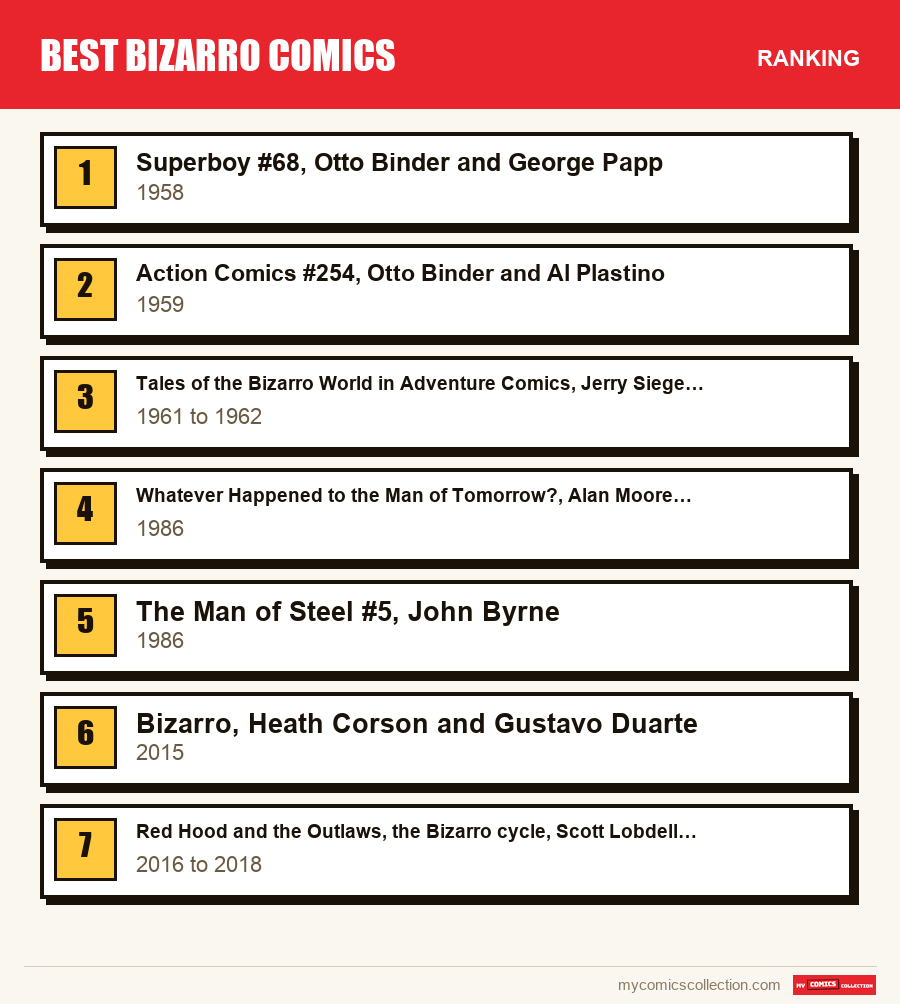
To find the best Bizarro comics, read Superboy #68 (October 1958) first, where Otto Binder and George Papp create Superboy's botched double. Then move on to Action Comics #254 (July 1959), the Tales of the Bizarro World feature in Adventure Comics, and John Byrne's The Man of Steel #5 (December 1986), followed by the 2015 Bizarro miniseries and the Red Hood and the Outlaws cycle.
Bizarro is a deliberate contradiction: a copy of Superman that inverts every rule, and one that successive writers have turned now into farce, now into tragedy. This double nature complicates the choice of an entry point, because the same chalky figure can serve a family comedy in 2015 or a laboratory drama in 1986.
As always in this guide, only verified facts (creators, issue numbers, dates) are stated; the analysis is our own, with no reproduction of protected art or dialogue.
His first appearance
Bizarro first appears in Superboy #68, cover-dated October 1958. Writer Otto Binder and artist George Papp sign this story in which a duplicator ray experiment produces, from the young Clark Kent, a copy with chalky skin and clumsy movements. At this stage he is a teenager: the adult version only arrives with Action Comics #254, cover-dated July 1959, again from Binder's pen, with Al Plastino on art.
One detail sheds light on the rest of the character's career. In the 1958 story, the teenage Bizarro disappears at the end of the tale, and does not return in that form. In other words, the figure who haunts collections is born from a story that closes on a melancholy note, and it is this tone that some later writers have sought to recapture.
1: Superboy #68, Otto Binder and George Papp (1958)
This story lays the foundations of what Bizarro will become. A duplicator ray engenders an imperfect double of Superboy, rejected by the people of Smallville; he befriends Melissa, a blind girl, then destroys himself along with the remains of the device, whose effect mimics blue kryptonite. The explosion restores the girl's sight. The creature is thus presented first as a victim, not as an adversary.
Ambiguity is the whole substance of this issue: Bizarro does not seek to harm and follows his inverted logic with disarming sincerity. It is for the reader who wants to understand the emotional origin of the character before his comic variations, and for the collector who wants to pin down the exact birth date of one of the Superman family's lasting antagonists. Read it in a period single issue if you want the Silver Age feel, otherwise in a retrospective collected edition: the point holds within this one issue.
2: Action Comics #254, Otto Binder and Al Plastino (1959)
This July 1959 issue introduces Bizarro in his adult form and gives him the logic that the following years will develop. He then becomes a recurring character in the Superman family titles: he counts about forty appearances between 1959 and 1984, which makes him a continuous thread of the Superman library rather than a one-off flash.
The interest for the reader is to see how Binder turns a figure of pathos into a gag machine: the "everything backwards" formula becomes a reusable narrative frame, which Superman, Lois, and Jimmy take on in turn. This issue is for anyone who enjoys the Silver Age for its inventiveness more than its realism. For reading, pair it with Superboy #68: the two issues answer each other, and comparing the two artists, Papp then Plastino, shows how much the same character changes in look from one line to the next.
3: Tales of the Bizarro World in Adventure Comics, Jerry Siegel and John Forte (1961 to 1962)
Starting with Adventure Comics #285, cover-dated June 1961, a whole feature is devoted to the Bizarros' planet, a cube-shaped world called Htrae. The feature runs from #285 to #299 (August 1962), fifteen issues in all, and its launch is written by Jerry Siegel, the co-creator of Superman, with John Forte on art. The first episode, titled The Shame of the Bizarro Family!, sets up the Bizarro family and its backwards humor.
What these pages bring is a change of scale: Bizarro stops being a guest in Superman's world and gets his own mythology, with its laws, its inhabitants, and its vocabulary. They suit the reader looking for pure fantasy and the collector drawn to the secondary features of the anthologies of the day. How should you read them? In small doses: each episode is self-contained, and the repetition of the inverted logic wears thin quickly if you binge all fifteen issues at once. Note also that the giant issue Superman #202 (December 1967 to January 1968) is devoted entirely to Bizarro and reprints stories from earlier issues, which offers a more convenient way in than hunting down the original single issues.
4: Whatever Happened to the Man of Tomorrow?, Alan Moore and Curt Swan (1986)
Published in Superman #423 and Action Comics #583 (September 1986), this farewell to the pre-Crisis on Infinite Earths Man of Steel is written by Alan Moore and drawn by Curt Swan, with inks by George Pérez and Kurt Schaffenberger. A note on rank: Bizarro is only one of the antagonists of this ensemble story, but his appearance fills the first chapter, where he destroys his own world, crashes down on Metropolis, then ends his own life, before the key to the puzzle appears in the sequel.
For the character, the contribution is the closing of a cycle: the Silver Age Bizarro finds an exit that gives the 1958 invention a tragic dimension it only had in flashes. Who is it for? The reader who wants to see what can be done with inverted logic when it is taken seriously. Read both parts back to back, in a collected edition, without trying to draw any continuity from them: the story presents itself as out of continuity.
Do you collect this series?
Track what you own, what you are missing and what your collection is worth. 7-day trial.
Start my trial →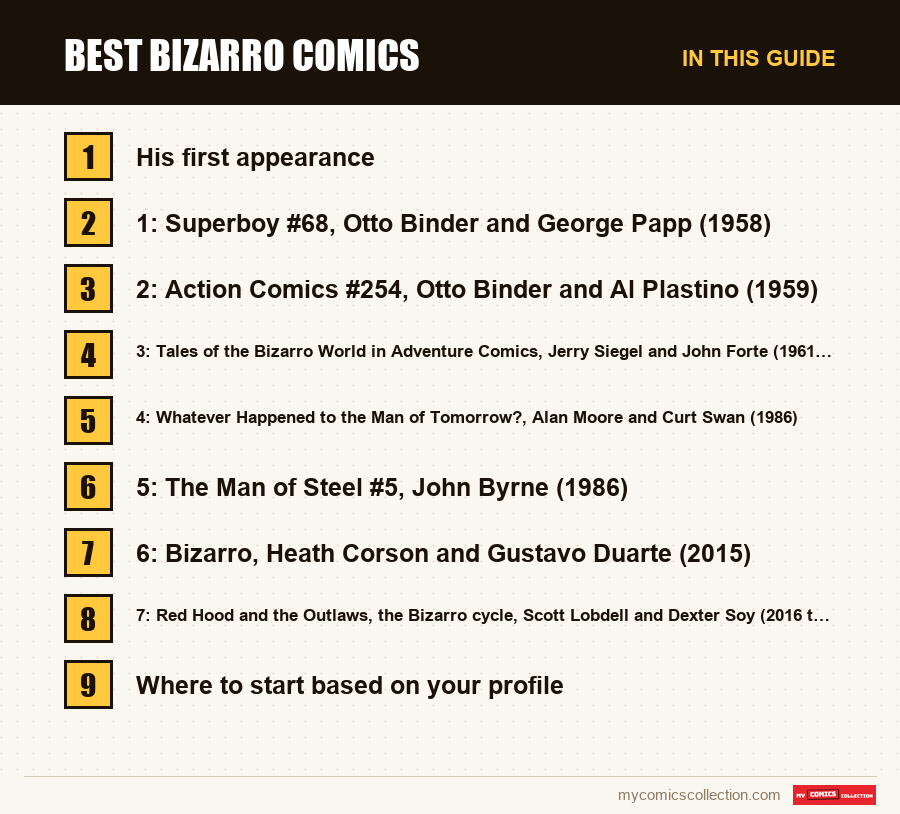
5: The Man of Steel #5, John Byrne (1986)
After the reboot of the DC universe, John Byrne reintroduces the character in issue #5 of his miniseries The Man of Steel, cover-dated December 1986. The issue, titled The Mirror, Crack'd..., is written and penciled by Byrne with inks by Dick Giordano. Bizarro is no longer a creature of fantasy from a cube-shaped planet: he is a defective clone built by Lex Luthor, with the help of Dr. Teng, as part of a Superman duplication project.
This Bizarro is mute, of limited intelligence, and kidnaps Lois Lane. He dies by crashing into Superman, and his dust restores Lucy Lane's sight, a direct echo of the outcome of the 1958 story that the attentive reader notices immediately. The contribution is a dark and compact retelling, which proves the character survives every reboot. It suits the reader who wants a modern, brief Bizarro, and the collector interested in the pivotal issues of the post-Crisis era. To place Luthor in this story, our history of Lex Luthor in comics details his reinventions.
6: Bizarro, Heath Corson and Gustavo Duarte (2015)
Launched in 2015, this six-issue limited series is written by Heath Corson and drawn by Gustavo Duarte, with Pete Pantazis on colors. The plot is a road movie: Jimmy Olsen is tasked by Clark Kent with escorting Bizarro across the United States to drop him off at the Canadian border, which Jimmy presents to him as an upside-down America. The two pals stumble from one disaster to the next, and the writer himself described his project as an American road movie for two characters.
What the series brings to the character is an all-ages tone, with no continuity to know: Bizarro becomes an endearing innocent, while Jimmy plays the straight man. It is for the reader who wants to smile, or who is looking for a title to share with a child. It reads in an afternoon, in its six-issue trade paperback, and its highly stylized art is a change from the realistic drawing in the rest of the Superman library.
7: Red Hood and the Outlaws, the Bizarro cycle, Scott Lobdell and Dexter Soy (2016 to 2018)
In the Red Hood and the Outlaws series launched in 2016 for DC Rebirth, Scott Lobdell scripts Bizarro's arrival alongside Jason Todd and Artemis: issue #2 shows them finding a clone in a tube aboard a train stolen by Black Mask. The collected edition Bizarro Reborn, which gathers issues #12 to #18 and Annual #1, is written by Lobdell and drawn by Dexter Soy; the series has several other artists over its run.
The contribution is a Bizarro as a team member, capable of sacrifice: he falls ill, saves his teammates, then returns thanks to Lex Luthor as a highly intelligent being, property of LexCorp. This path is for Jason Todd readers more than for Superman purists. Read the Bizarro Reborn volume first, which gathers the heart of the story, then go back to the earlier issues if the team appeals to you. For the hero who takes Bizarro in, our history of Jason Todd in comics gives the full context.
Where to start based on your profile
Your entry point depends less on your taste for Superman than on what you expect from a Bizarro. Here are four paths, from the shortest to the fullest.
- You want to understand the character in an afternoon: read Superboy #68, then The Man of Steel #5. These two issues answer each other and sum up his tragic fate.
- You love the Silver Age: add Action Comics #254 and the Tales of the Bizarro World episodes, starting with Adventure Comics #285.
- You want humor with no prerequisites: Corson and Duarte's Bizarro series reads without knowing Superman.
- You follow Jason Todd: go straight to the Red Hood and the Outlaws cycle and its Bizarro Reborn collection.
If you are starting on Superman in general, open the reading guide instead, then come back to Bizarro once the rest of the family feels familiar.
The key issues to know
For a collector, the issues that matter around Bizarro fall into categories by the nature of their importance: birth, expansion, reboot, reinvention. No amount is given here, because prices move; the method is to compare copies of the same grade and the same edition.
- Superboy #68 (October 1958): the first appearance, by Binder and Papp.
- Action Comics #254 (July 1959): the arrival of the adult version, by Binder and Plastino.
- Adventure Comics #285 (June 1961): the start of the Tales of the Bizarro World feature, by Siegel and Forte.
- Superman #202 (December 1967 to January 1968): the giant all-Bizarro issue, made up of reprints.
- Superman #423 and Action Comics #583 (September 1986): Moore and Swan's farewell to the pre-Crisis Man of Steel.
- The Man of Steel #5 (December 1986): the post-Crisis return, by Byrne.
- Bizarro #1 (2015): the opening of Corson and Duarte's series.
- Red Hood and the Outlaws (2016) #2: the appearance of the clone alongside Jason Todd.
For each of these issues, note the series, the cover month, and the type of edition against the listing: a 1958 single issue and its facsimile show the same number without being equal. Rely on several completed sales for the same grade rather than a single listing, and keep the Silver Age single issues for the end of your list if your budget is tight, because those are the ones whose condition varies the most.
Frequently asked questions
Bizarro is born in Superboy #68 (cover-dated October 1958), with a story by Otto Binder and art by George Papp. He is a teenager at that point. The adult version arrives in Action Comics #254, cover-dated July 1959, written by Binder and drawn by Al Plastino.
To understand the character, read Superboy #68 then The Man of Steel #5, two issues that answer each other twenty-eight years apart. For a lighter tone, pick the 2015 Bizarro series, by Heath Corson and Gustavo Duarte, which requires no prior knowledge of Superman.
The Tales of the Bizarro World feature starts in Adventure Comics #285, cover-dated June 1961, with Jerry Siegel on script and John Forte on art. It presents the cube-shaped planet Htrae and runs through #299, fifteen issues published up to August 1962.
It depends on the era. The Silver Age makes him a disruptor more clumsy than cruel, the 1980s a clone built by Lex Luthor, and the Red Hood and the Outlaws series a teammate of Jason Todd. The character switches sides depending on the writer, which is why it is worth reading several versions.
Not for the 2015 Bizarro series, which requires no prior knowledge. For The Man of Steel #5 or the Moore and Swan story, it is better to know Lex Luthor, Lois Lane, and Jimmy Olsen. The blog's Superman reading guide gives you the order of the volumes.
Do you own a Superboy #68, an Action Comics #254, or an Adventure Comics from the Bizarro World feature? Have the copy appraised based on its grade and its edition.
Estimate my comic