In short
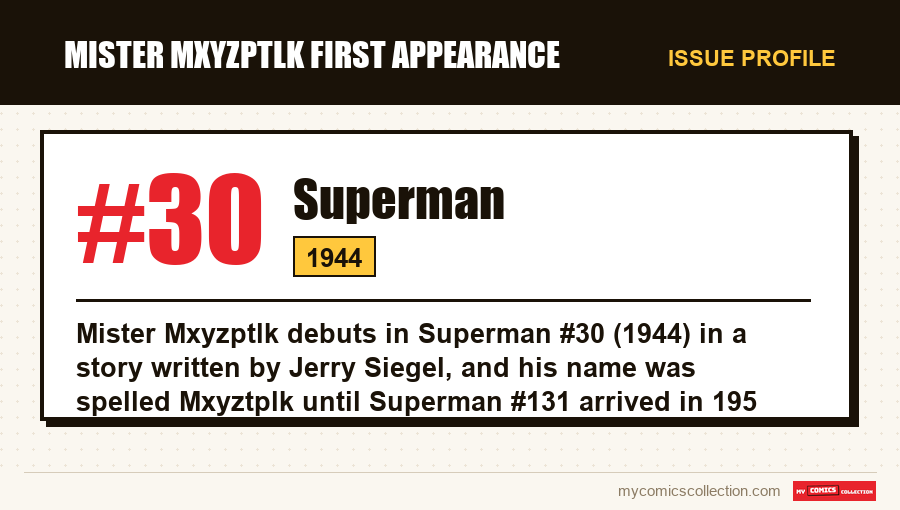
Mister Mxyzptlk first appears in Superman #30, a bimonthly issue from 1944, in the story "The Mysterious Mr. Mxyztplk." Jerry Siegel wrote the character's debut and Ira Yarborough drew it. The name was originally spelled without the "p" in the middle; it became Mxyzptlk in Superman #131 in 1959. He is an imp from the fifth dimension who plays pranks on Metropolis, and Superman can send him home by tricking him into saying his name backward.
Mxyzptlk is the rare comic book villain whose menace is a joke, and the joke has lasted longer than most serious threats. For collectors the question is more specific than the character's fame suggests: which issue holds the debut, how did the name change, and what separates the 1944 imp from the many later versions?
The credits, the cover year and the issue numbers in this guide were checked against published reference material. How a collector should weigh this debut and inspect a copy is our own analysis, with no price and no quoted line from the story.
The issue itself: Superman #30 in 1944
Superman #30 belongs to the series that began with an issue dated summer 1939. The first five issues were quarterly, and from #6 the series became bimonthly. Issue #30 sits well inside the bimonthly period, so its cover date covers a two-month window of 1944 rather than a single month. Use the year as the safe element in a listing and be skeptical of a seller who states a single month with confidence.
The debut is a story within the issue, titled "The Mysterious Mr. Mxyztplk" with the original spelling. It runs as a back-up feature, not the issue's lead. That detail shapes how you read a listing: a description that suggests the imp is the headline of the book overstates his place in the newsstand copy.
One more detail is worth knowing. Because comic books were produced well ahead of their cover dates, the imp appeared in print first in the Superman daily newspaper strip, written by Whitney Ellsworth and drawn by Wayne Boring. A reader who looks for the earliest printed appearance in a broad sense will find the strip, while a collector who looks for the first comic book appearance will find #30. This guide follows the comic book.
Credits on the 1944 issue
Jerry Siegel wrote "The Mysterious Mr. Mxyztplk," and Ira Yarborough drew it. Siegel is also the co-creator of Superman with the artist Joe Shuster; the 1944 back-up, though, pairs Siegel with Yarborough at the drawing board.
This matters for anyone writing a catalog entry or a certified label request. If you enter a credit field for this story, put Jerry Siegel as writer and Ira Yarborough as artist. Do not fill the field from memory, and compare any listing that names a different artist against the story itself.
Context helps place the issue. By the mid-1940s the Superman feature was produced by a team: Wayne Boring, who had been an assistant to Shuster, had become a major artist on the series by 1942, and issue #23 in 1943 was the first Superman story written by someone other than Siegel. A book of this period is the product of an operation as much as of two named individuals.
How the imp is introduced
Mxyztplk is presented as an imp from the fifth dimension. He arrives in Metropolis and begins a run of pranks, with Superman as the unwilling audience. The story uses a series of staged incidents to show the imp's power: among them, he jumps from a window and fakes his own death, unsettling a hero who had believed flight was his alone. The point of the sequence is that this opponent cannot be fought with strength.
The rule that defines him appears right away. If the imp says his name backward, or is tricked into spelling it backward, he is sent back to his own dimension for 90 days in the original setup. Superman defeats him by getting him to spell a word that turns out to be his own name in reverse. The weakness is a verbal trick, and that gives the character his identity: a being with nearly unlimited power who loses to a bit of wordplay.
For a collector this introduction is useful as a description of what the issue contains, since the same structure repeats for decades: a prank, a growing problem, a trick, and a banishment. The 1944 version is the template, and later writers adjusted its terms.
The name: Mxyztplk and Mxyzptlk
The spelling is the best-known trap in this part of the market. The debut story is titled with the original form, Mxyztplk, and that form stays in use until 1959. The now-standard Mxyzptlk, with two letters transposed, takes over in Superman #131 in 1959.
The practical consequence is for searching. A catalog or a marketplace listing that uses only the modern form may fail to turn up copies described in the older style, and the reverse is also true. Search both spellings, and search the issue number with the year. When you record a copy in your own collection, use the form that matches the book you hold and note the other.
It also matters when you speak about the character's history. The 1944 imp and the 1959 imp share a name that is spelled differently, and many readers treat them as the same character without realizing that the spelling had moved in between.
Why #30 is a key
The issue is a debut of a character who stayed in the Superman line for decades. He turned into the series' best-known comic foil, and he returns in several later periods of Superman's history. A first appearance from the Golden Age, especially of a supporting figure with long-lasting recognition, is a natural target for collectors who want a complete Superman rogues' gallery.
The key status also has limits. Superman #30 is a back-up debut, and it does not carry a heavy dramatic moment. Its importance is historical and completist. A collector who wants a showpiece for display may prefer one of the Golden Age books whose covers are famous; a collector who wants every first appearance in Superman's world will put #30 on the list.
The book is also a useful comparison point against the better-known debuts of the same decade. If you are weighing it against other Superman Golden Age keys, the guide to Golden Age Superman key issues lays out the set in order.
Do you collect this series?
Track what you own, what you are missing and what your collection is worth. 7-day trial.
Start my trial →
The imp over the decades
The Silver Age brought changes of look and tone. By the mid-1950s his costume had changed to an orange outfit. When DC later organized its stories into a multiverse, the purple-suited imp was associated with Earth-Two and the orange-costumed one with Earth-One.
Action Comics #273, from February 1961, has a cover by Curt Swan and sends Superman to the fifth dimension to oppose the imp's campaign for mayor. In that story Superman uses super-breath to blow the imp's food all over him, and the imp loses the election. It is a good example of how the character shifted from a prankster in Metropolis to a figure in his own fantastical world.
After Crisis on Infinite Earths reset the line in 1985 and 1986, the terms changed. The conditions for sending him home became new in each story instead of a single fixed rule. Alan Moore's Superman: Whatever Happened to the Man of Tomorrow? from 1986 gives a darker version, who is killed when Superman sends him to the Phantom Zone.
The 2011 relaunch gave him a new origin as a wizard-jester of the fifth dimension. In DC Rebirth the pre-relaunch Mxyzptlk is revealed to be the mysterious "Clark Kent" who appears in that era's stories. Each of these is a different character history, and none replaces the 1944 debut.
Reprints, look-alike issues and numbers that get mixed up
The first confusion is with Superman #131. That 1959 issue is where the spelling shifts, and a seller who focuses on the spelling may describe it as the "first" appearance of the modern name. It is the issue of the spelling change, not the debut.
The second confusion is with Action Comics #273, a Silver Age story with a cover by Curt Swan. It is a worthwhile issue, but it is not a debut.
The third is the newspaper strip. A page of the strip may be described as the character's first appearance, and in print terms it can be. A collector of comic books should read such a listing carefully and decide whether the item is a comic book or a strip.
If you see a modern collection described as containing the debut, check the contents page of that book against the issue number and the year.
What to check before buying a copy
A 1944 comic book is made of wartime paper, and the first thing to examine is the paper. Look for tanning, brittleness, edge chips and spine splits. Then check the structure: whether the staples are original, whether the cover is attached firmly, and whether the centerfold is secure.
Wartime comics from 1944 often carry restoration. Color touch, tear sealing, spine work and added pieces can all be present. Ask whether any has been done, and when the copy is certified, read the label's notes. A restored book can still be worth owning, but it belongs to a different comparison group from an unrestored one.
On a slabbed copy, read four items on the label: series, issue 30, the 1944 date and the key note. Compare these with the book itself. Because the key feature here is a back-up story, some labels use the spelling Mxyztplk and others the modern one, and neither is a defect.
For a copy outside a slab, ask the seller to photograph the back cover, the staples and a few inside pages along with the front. Interior paper is the part of a Golden Age book that photographs reveal poorly, so ask about page quality in words as well as in pictures. Then compare the copy only with other copies of Superman #30 in the same grade and the same restoration status.
Where it fits in a Superman collection
A set of Superman Golden Age keys can be built around the character's own timeline: Action Comics #1 for the debut, Superman #1 for the title, and the issues that introduce supporting figures. Superman #30 fits in the third group. It adds a foe who is defeated by a trick rather than by force.
The companion guides to Action Comics #1 and to Superman as a collecting area help place #30 relative to the heavyweight books and to the more affordable tiers of the hobby. The Superman hub lists the other issues covered on the site.
For records, enter the series, the number, the cover year and the spelling variant you see on the book. If you own the Silver Age and later appearances too, note which spelling each uses. A short note of this kind saves time when you return to a collection after years.
Frequently asked questions
He first appears in Superman #30, a bimonthly issue from 1944, in the story "The Mysterious Mr. Mxyztplk." It is a back-up story, not the lead feature. Jerry Siegel wrote it and Ira Yarborough drew it. The imp had appeared earlier in the Superman newspaper strip, because comic books were produced well ahead of their cover dates.
The original spelling was Mxyztplk, used in the 1944 debut and through the Golden Age. In Superman #131 in 1959 it became Mxyzptlk, with two letters swapped. Search catalogs and marketplaces for both forms, since older listings may use either and some use only one.
Ira Yarborough drew the debut story, "The Mysterious Mr. Mxyztplk," from a script by Jerry Siegel. Siegel is best known as the co-creator of Superman with Joe Shuster. For a credit field on this issue, enter Siegel as writer and Yarborough as artist of the back-up story that introduces the imp.
No. Superman #131, from 1959, is the issue in which the spelling changes from Mxyztplk to Mxyzptlk. The character had been in print since 1944. A seller who calls #131 the first appearance of the modern spelling is describing a naming change, not a debut.
Check the paper for tanning and brittleness, the spine and staples for splits or replacements, and the label or description for restoration. Confirm the series, the issue number and the 1944 date, and expect either spelling of the name. Judge it against #30 copies of matching grade and restoration.
Own Superman #30 or another Golden Age Superman issue? Enter the series, number and condition to compare it with current listings.
Estimate my comic