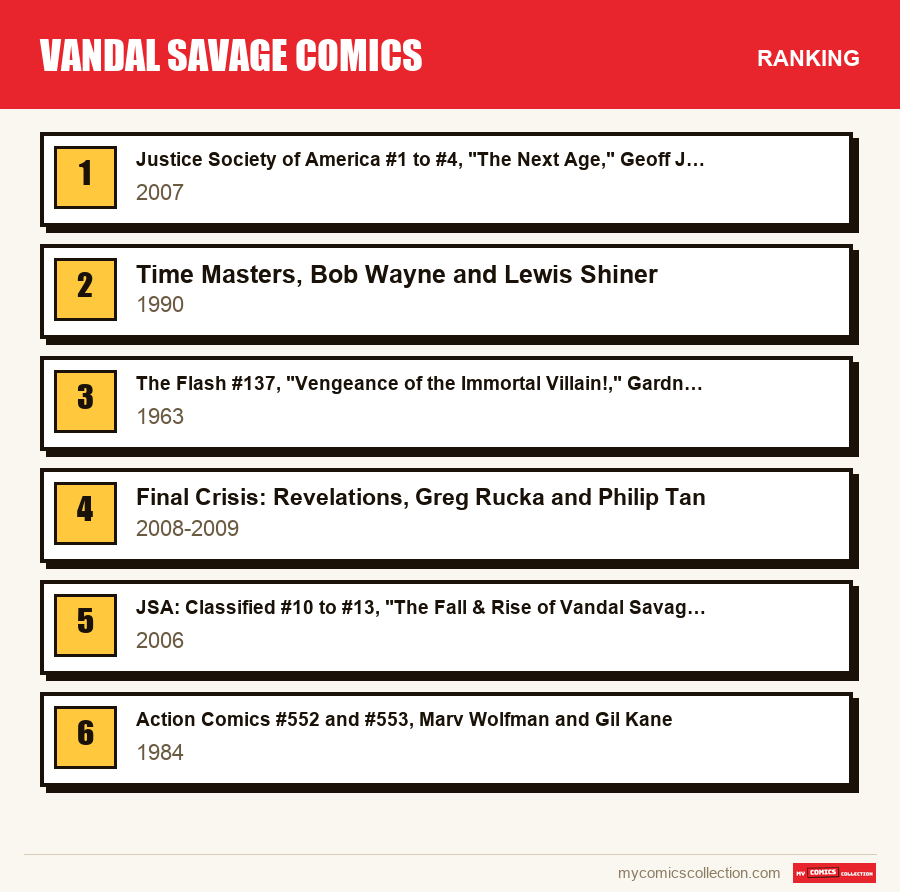
The best Vandal Savage comics to start with are Justice Society of America #1 to #4 (2007), where Geoff Johns puts him at the head of the Fourth Reich, then Time Masters (1990) and Flash #137 (June 1963). His first appearance is Green Lantern #10, cover-dated Winter 1943, created by Alfred Bester and Martin Nodell. Finish with Final Crisis: Revelations by Greg Rucka and Philip Tan (2008-2009).
Vandal Savage is a rare kind of antagonist: he has no signature enemy, because he has had time to make nearly all of them. Born in the stories of the Golden Age, he moves through DC's eras and changes faces more often than a hero changes costumes, which is exactly what makes him hard to read. Here are six stories where he is the pivot, ranked from most accessible to most demanding, along with how to read them without having followed eighty years of publishing.
As always in this guide, only verified information (creators, issue numbers, dates) is stated as fact; the analysis is our own, with no reproduction of protected artwork or dialogue.
His first appearance
Vandal Savage debuts in Green Lantern #10, cover-dated Winter 1943, with Alfred Bester writing and Martin Nodell drawing. Titled "The Man Who Wanted the World," the story shows a prehistoric man made immortal by a meteorite's fall; Alan Scott, the Golden Age hero, sends him to the bottom of an apparently bottomless pit. The character comes back anyway, which sets the principle for his whole career: you can't get rid of a man who doesn't die.
He then joins the enemies of the Justice Society in All Star Comics #37, in 1947, where he is part of the Injustice Society and targets Hawkman. That detail matters to a collector: the 1943 Savage is a Golden Age criminal, designed for the costumed heroes of the 1940s, and his role as a Justice Society adversary dates from that era. He would return twenty years later, remodeled by another writer.
1: Justice Society of America #1 to #4, "The Next Age," Geoff Johns and Dale Eaglesham (2007)
For a reader today, this is the most direct entry point. Geoff Johns writes the four issues that relaunch the Justice Society in 2007, with Dale Eaglesham on art; they are cover-dated February to May 2007. The Fourth Reich, a neo-Nazi group, runs through the whole arc, and Savage uses it as a tool: he leads it because its members are easy to manipulate. The story presents him as a strategist who exploits other people's ideology without believing in it.
What this arc brings to the character is a clear definition of the danger he represents: a man who sees human societies as instruments. It suits readers who know little about the Justice Society, since these four issues also serve as an introduction to the team. To read it without hunting down single issues, look for the trade paperback titled The Next Age, which collects all four. This run fits into its writer's career, detailed in the bibliography linked above.
2: Time Masters, Bob Wayne and Lewis Shiner (1990)
The eight-issue miniseries, published from February to September 1990, is the character's broadest playground. Bob Wayne and Lewis Shiner write it. Rip Hunter and his team take on the Illuminati, a vast conspiracy led by Vandal Savage; the goal is to alter history so that this secret society never comes into being. The tone aims to be more realistic than Rip Hunter's original adventures, with him trading the costume for jeans and a T-shirt, and the series ends with a hero stranded in prehistory, the very era in which Savage was born.
The strength of this story is that it takes advantage of the character's immortality instead of just suffering it: Savage is everywhere, in every era, and the team of time travelers has to chase him. It suits readers who enjoy time-travel stories and can handle a denser tone than the 2007 run. Eight single issues make for a weekend read; to buy it, search by its year, 1990, and by its creators, Bob Wayne and Lewis Shiner.
3: The Flash #137, "Vengeance of the Immortal Villain!," Gardner Fox and Carmine Infantino (1963)
In the June 1963 issue, Gardner Fox and Carmine Infantino bring Savage back into the Silver Age universe. He gets a revised origin: Savage becomes a man of about 50,000 years, whose original name is Vandar Adg. In the story, he goes after the retired Justice Society, and Barry Allen travels to Earth-2 to help Jay Garrick free the captured members.
This story matters for two reasons. It puts Savage back in the spotlight after two decades, and it deepens the link between the two Earths that The Flash #123 had opened two years earlier. It speaks to Silver Age fans, and to anyone wondering why the character's age jumps from the prehistory of 1943 to some 50,000 years in 1963. For a collector, it is also an issue where Flash meets the heroes of Earth-2, which feeds demand independent of the character. Artist Carmine Infantino delivers one of his landmark Flash jobs here.
4: Final Crisis: Revelations, Greg Rucka and Philip Tan (2008-2009)
Greg Rucka writes the five issues of this miniseries, Philip Tan draws them, and Jeff De Los Santos and Jonathan Glapion ink them. It was published from October 2008 to January 2009. Sister Wrack, head of the Religion of Crime, impales Savage on the Spear of Destiny, which reveals that he is Cain. Savage then leads his followers to Gotham to take revenge on the Spectre, the author of the curse that weighs on him.
The story adds a mythological layer: Savage becomes the Cain of the Bible, which gives him a scope that earlier stories never had. The Spectre is his opponent, and Renee Montoya picks up the Spear after the fight; for that character, see our Spectre guide. The story is aimed at readers who know Final Crisis, since the event takes place on the day the Anti-Life Equation is launched. Without that prior reading, some scenes lose their context. The mark of Cain later passes to Renee Montoya in Detective Comics #863 (May 2010).
Do you collect this series?
Track what you own, what you are missing and what your collection is worth. 7-day trial.
Start my trial →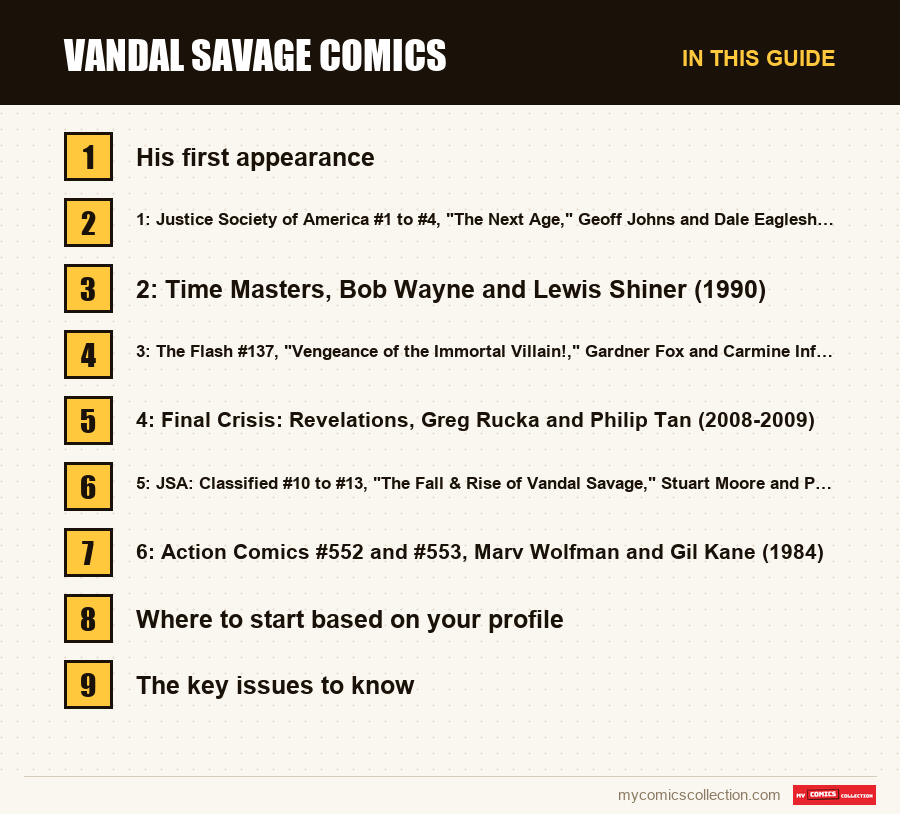
5: JSA: Classified #10 to #13, "The Fall & Rise of Vandal Savage," Stuart Moore and Paul Gulacy (2006)
The 2006 arc puts the character at center stage, as its title announces. Stuart Moore writes and Paul Gulacy draws. It runs four chapters, #10 to #13, published in the standalone-story series JSA: Classified. That series works as a crossroads for guest creators: it doesn't require you to know the continuity of the moment, which makes it easier to jump in.
What this arc offers is a portrait: the title promises a fall followed by a return, and the story confronts Savage with his own history. It suits anyone who has already read the 2007 arc and wants to dig deeper. Since it is a four-issue story from a monthly series, it can be read in one sitting in an afternoon.
6: Action Comics #552 and #553, Marv Wolfman and Gil Kane (1984)
These two issues, cover-dated February and March 1984, are written by Marv Wolfman and drawn by Gil Kane. They run in Action Comics, then Superman's showcase title, but the story belongs to Savage and his old enemy, the Immortal Man. The latter assembles the Forgotten Heroes to stop Savage, which pits two immortals against each other. The titles of the two chapters, "Another Time! Another Death!" and "The World at Time's End," signal an end-of-the-world story.
Its interest is historical: it sets Savage against his opposite, the Immortal Man. It serves the reader already familiar with the character and curious about his role in the DC of 1984. It is not an entry point, since it assumes you know the Forgotten Heroes. See the Marv Wolfman page to place this work within the rest of his career.
Where to start based on your profile
If you're new to Vandal Savage, open Justice Society of America #1 to #4: four issues, a villain at work and a team introduced along the way. Follow it with Time Masters to see the character on the scale of history.
If you collect the Golden Age and Silver Age, look at Green Lantern #10, All Star Comics #37 and Flash #137: they are the three milestones of the early decades. Each issue answers a distinct reason to buy; identify it before settling on your target grade. The Hawkman guide, offered above, sheds light on the Justice Society side.
If you like stories built on the long haul, Time Masters and Action Comics #552-553 each play on the character's age, one with time travelers, the other with an opposing immortal. If you prefer stories with a thesis, read Final Crisis: Revelations for the mythological angle, then JSA: Classified for the portrait. And if your interest extends to the whole DC universe, save Action Comics #552-553 for last, because it demands the most background knowledge.
The key issues to know
The list follows publication order. Green Lantern #10 (Winter 1943) is the first appearance, by Alfred Bester and Martin Nodell. All Star Comics #37 (1947) brings him into the Injustice Society. The Flash #137 (June 1963) revises his origin for the Silver Age.
Action Comics #552 and #553 (February and March 1984) pit him against the Immortal Man, and Time Masters #1 (February 1990) opens the Wayne and Shiner miniseries. JSA: Classified #10 (May 2006) opens the Moore and Gulacy arc, Justice Society of America #1 (February 2007) opens the Fourth Reich arc, and Final Crisis: Revelations (2008-2009) makes him Cain.
To value a copy, start from condition and grade, compare sold listings of comparable issues, and separate demand driven by a first appearance from demand driven by a mere arc. Our Golden Age key issues page gives the general framework.
Frequently asked questions
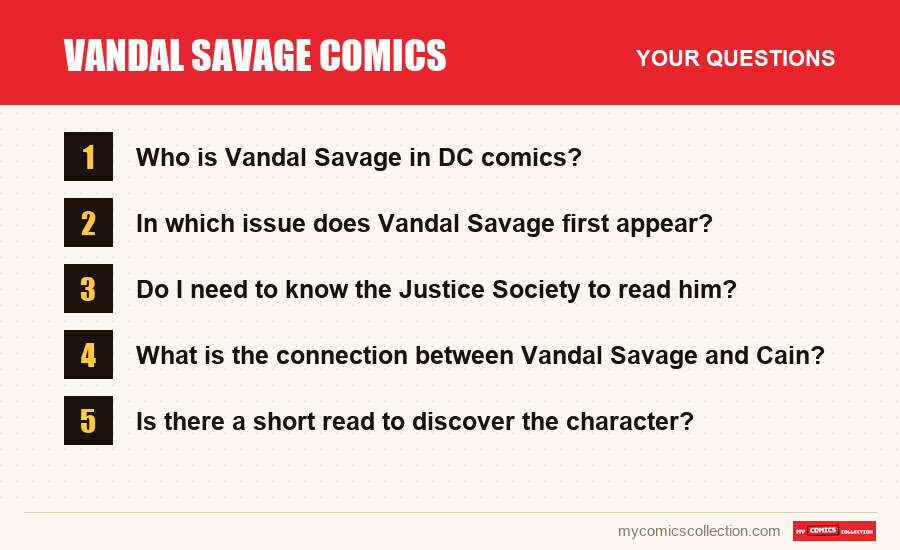
Vandal Savage is an immortal who has fought DC's heroes since 1943. He appears in Green Lantern #10 (1943) and mostly opposes the Justice Society, Flash and Green Lantern. Modern stories also identify him as Cain, notably in Final Crisis: Revelations.
In Green Lantern #10, cover-dated Winter 1943, by Alfred Bester and Martin Nodell. He joins the Injustice Society in All Star Comics #37 in 1947, then returns in the Silver Age in The Flash #137 (June 1963), by Gardner Fox and Carmine Infantino, with a revised origin.
Not to get started. Justice Society of America #1 to #4 (2007), by Geoff Johns, introduces the team at the same time as the villain. However, Action Comics #552-553 and Final Crisis: Revelations assume more DC background and read better after the first stories.
In Final Crisis: Revelations (2008-2009), by Greg Rucka and Philip Tan, the Spear of Destiny reveals that Savage is Cain. He then seeks revenge on the Spectre, the author of his curse. The mark of Cain later passes to Renee Montoya, in Detective Comics #863 (May 2010).
Yes: Justice Society of America #1 to #4, four issues in 2007, or the The Next Age trade paperback. If you like stories across time, Time Masters (eight issues, 1990) shows Savage in several eras. Both can be read without in-depth prior knowledge of the character.
Do you own a Green Lantern #10, a Flash #137 or a Justice Society issue? Get it appraised before deciding whether to keep it or sell it.
Appraise my comic