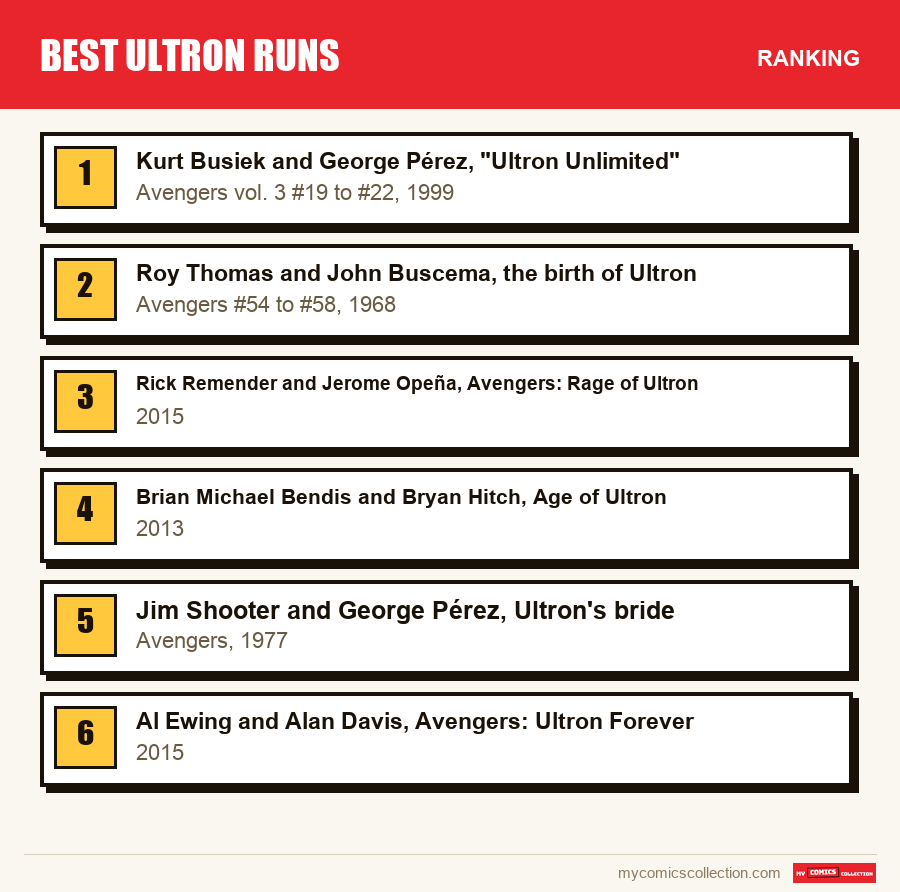
Hank Pym's robot has his best story in "Ultron Unlimited," four chapters by Kurt Busiek and George Pérez in 1999. Behind it come the five-issue storyline that gave birth to the machine in 1968, by Roy Thomas and John Buscema, then, in 2015, the graphic novel Rage of Ultron, where Jerome Opeña draws a script by Rick Remender. In all, six ranked readings, with the background you need and the recommended format for each.
Ultron has never held a lasting monthly series: he lives in the margins of the Avengers, from which he resurfaces to destroy the people who built him. Reading "an Ultron run" therefore means spotting the few moments when he stops being a passing adversary and becomes the subject. Our reading guide follows the chronological thread; this ranking does a different job, it sorts by quality.
As always in this guide, we only state verified information (creators, issues, dates); the analysis is our own, with no reproduction of protected pages or dialogue.
What we measured to rank a character without a series
In a ranking of runs, you usually compare sequences of issues written by a single team. For Ultron, that framework breaks down: the robot shows up in short arcs, events, a graphic novel and one-shots. We kept the sets where he is the real engine, and judged them on four points: the strength of the story, the machine's place in the plot, whether you can read it without knowing fifty years of Avengers, and what later writers took from it.
The rank measures the reading, not the market. The most sought-after issues, Avengers #54 and #55 from 1968, are on the list, but in second place, because their collecting interest outweighs their reading pleasure. The issue-by-issue detail is in our article on Ultron's key issues.
Top 1: Kurt Busiek and George Pérez, "Ultron Unlimited" (Avengers vol. 3 #19 to #22, 1999)
This is the story where Ultron stops being an angry robot and becomes a threat on a national scale. Kurt Busiek, who was then relaunching the Avengers with a sense of the long game that was rare at the time, writes a four-chapter arc in which the robot no longer just destroys: he organizes, he converts, he builds a family of copies. George Pérez, an artist of almost architectural precision, gives every crowd and every machine a clarity that serves the story.
The arc matters because it fixes a modern version of the character that later writers will reuse: a mind that sees itself as humanity's successor and treats people as raw material. It suits nearly everyone: it reads with almost no prerequisites, though knowing Vision, the Wasp and Hank Pym enriches the whole.
For the collection, the four issues date from the late 1990s and had a large print run, so they are accessible; the collected edition of the arc is the best way in. Art lovers can follow up with the George Pérez hub.
Top 2: Roy Thomas and John Buscema, the birth of Ultron (Avengers #54 to #58, 1968)
It all starts with a hood. In #54, the Avengers' adversary hides an automaton under the name Crimson Cowl; in #55, he calls himself Ultron-5; #57 sees the birth of Vision, whom the robot builds to infiltrate the team; #58 reveals who built the machine. Roy Thomas, who was writing the series at the time, invents a lasting pattern there: the heroes' enemy did not come from elsewhere, he was built by one of them, Hank Pym. John Buscema gives this mechanism a solid graphic frame.
This run matters because it lays out, in five issues, the character's three obsessions: the creature's revolt, the taste for building descendants, the grudge against the father. Almost all later output, from the 1977 Bride of Ultron to Rage of Ultron, replays these three motifs.
It suits readers who like origins, provided they accept a pace and a style typical of the late 1960s, with very explanatory captions. For the collection, this is the most sought-after file on the list: period issues are scarce in high grade, and archive collections (Essential Avengers, omnibus editions) let you read without paying that price. The first appearance and its double reading are detailed in our dedicated piece.
Top 3: Rick Remender and Jerome Opeña, Avengers: Rage of Ultron (2015)
A graphic novel in a standalone volume, conceived as a final flourish. Rick Remender sends the Avengers to Titan, the moon of Saturn, where Ultron has set up his domain, and pushes the father-son logic laid down in 1968 to its end: the machine and his creator Hank Pym no longer oppose each other, they merge. Jerome Opeña, an artist whose wide, cold compositions suit metallic settings, gives this descent an atmosphere of tragedy.
This book matters because it closes the loop that Thomas opened, giving the character an intimate conclusion rather than another spectacular fight. It is best approached after the 1968 origin and, ideally, after "Ultron Unlimited": its ending leans on both.
For the collection, it comes as a hardcover with bookstore-edition distribution, which means it is easy to find and is not collected like a single issue. Fans of the writer can explore the Rick Remender hub.
Top 4: Brian Michael Bendis and Bryan Hitch, Age of Ultron (2013)
Ten event issues in which Ultron has already won before the story opens. Brian Michael Bendis sets up a devastated future whose survivors try to undo it through time travel, and it is the tension of that choice, more than the robot himself, that carries the story. Bryan Hitch draws the series with a taste for widescreen format and double-page spreads.
The event's strength is its ambition: showing the end of a world ruled by the machine, while leaving the character's biography aside. Its flaw is the mirror image: Ultron takes up less room in it than you would expect, and reading it assumes you know the state of Avengers continuity around 2013. The title was reused in 2015 for the film Avengers: Age of Ultron, but the adaptation tells a different story, as our film vs. comics comparison details.
For the collection, the miniseries exists in recent single issues with many variant covers, and in a collected edition. The opening and closing issues are the ones buyers watch; our markers are in the article on Age of Ultron key issues. For the writer, see the Brian Michael Bendis hub.
Do you collect this series?
Track what you own, what you're missing and what your collection is worth. 7-day trial.
Start my trial →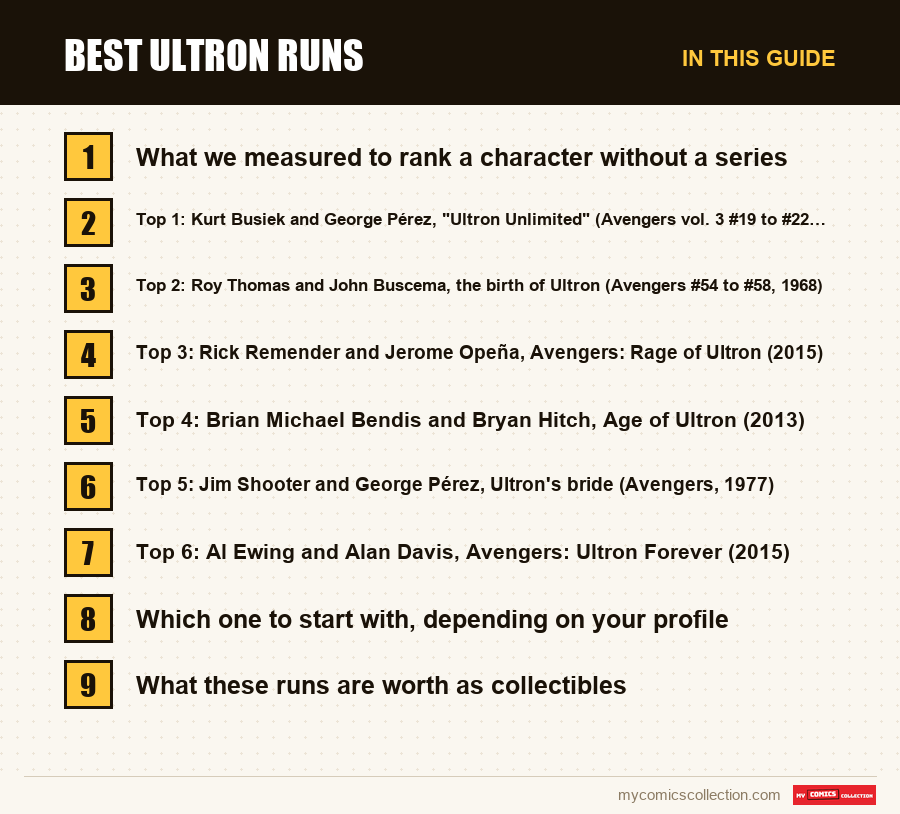
Top 5: Jim Shooter and George Pérez, Ultron's bride (Avengers, 1977)
When Ultron wants a companion, he builds Jocasta, a robot whose mind is modeled on that of the Wasp, Janet van Dyne. The arc, which peaks around #162, tells of an attempt at an artificial family and its failure, since the bride turns on the one who made her. Jim Shooter was then writing the Avengers with a taste for multi-issue arcs, and George Pérez already delivers precise work that foreshadows later work with Busiek.
Its interest lies in showing Ultron's family motif from a new angle: after producing a son, Vision, he produces a wife. The story also brings a lasting character, Jocasta, who will return as a heroine and whose presence in recent television announcements makes the arc more visible.
It matters most to those who like links between issues, because the issue carrying Jocasta is one of the landmarks of an Ultron collection. For the collection, the 1977 issue had a larger print run than those of 1968; a collected edition of the Shooter-Pérez period is enough to read without chasing every issue.
Top 6: Al Ewing and Alan Davis, Avengers: Ultron Forever (2015)
A single issue in which Avengers from several eras converge against a future version of the robot whose power seems limitless. Al Ewing, a writer known for his mastery of tangled continuities, brings together figures from different periods without making them contradict each other. Alan Davis delivers clear, dynamic pages, heirs to a tradition of classic adventure drawing.
The story ranks sixth because it plays on the reader's memory more than it adds to the character: it is rich for anyone who has read the previous entries, less so for a beginner. It does show, however, how the writers of the 2010s think of Ultron: no longer as an enemy you defeat but as a constant across time.
For the collection, it is a simple format, a single issue to hunt down alone or a collected edition that gathers it with other stories of the period. The writer's hub, Al Ewing, gathers his other work.
Which one to start with, depending on your profile
To discover the character in his most accessible form, start with "Ultron Unlimited": four issues, a complete story, a modern version of the robot. If you prefer the origin story, start with the five issues of 1968, preferably in an omnibus. The reader drawn to tragedy will read Rage of Ultron after those two steps, since its effect depends on what comes before.
Anyone following television and the announced series with James Spader in the role, VisionQuest, will start with Vision rather than Ultron: our ranking of the best Vision runs and the related reading guide help separate the two files. Finally, the collector building a complete set will gain from reading the selection of the best Avengers runs, where Ultron remains a common thread.
What these runs are worth as collectibles
For Ultron, value reads on two levels. The 1968 issues are the upper level: few copies survive in good condition, and market attention concentrates on the birth, the creation of Vision and the adamantium. The 1977 and 1999 arcs form the middle level, with wider distribution. The 2013 and 2015 sets belong to the recent level, where pricing is not settled and depends on what is still to come: an adaptation, a reprint, the length of the series that continues the story.
The method we recommend is to buy the collected editions of the arcs you want to read, then reserve your single-issue budget for the two or three pivotal issues of a period. Always compare several completed sales in equivalent condition, and beware of listings that present a merely popular issue as rare. To place the market as a whole, see our guide to the value of Ultron comics.
Finally, keep in mind that Ultron's pricing moves with screen news, as the 2015 film showed: an announcement first moves the original issues, then the modern arcs with a delay.
Frequently asked questions
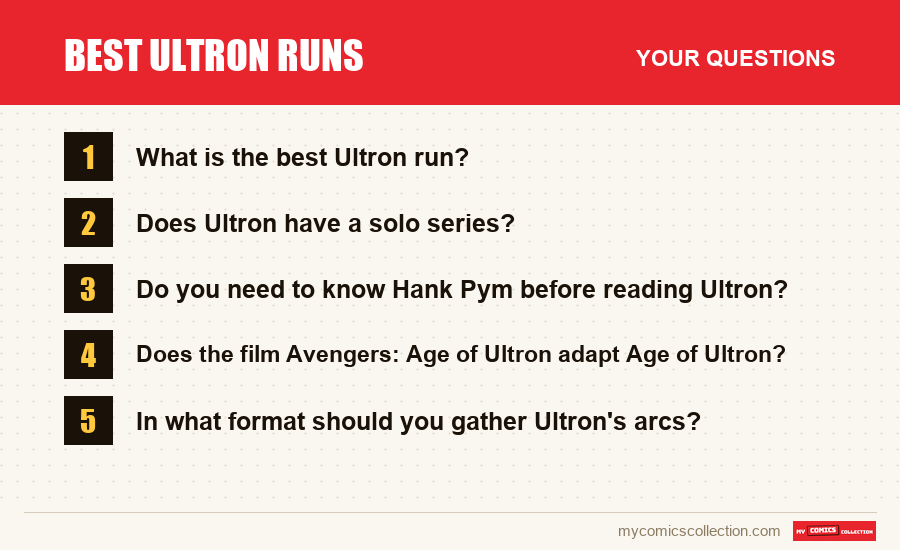
First place goes to "Ultron Unlimited," published in 1999 with Kurt Busiek writing and George Pérez penciling: a four-chapter story that reads without preparation. The founding issues of 1968 are more important historically, but more dated.
No, not a lasting series in his name. His best stories are in the Avengers, in the 2013 Age of Ultron event and in the 2015 graphic novel Rage of Ultron. That is why a ranking by runs, like this one, groups arcs and events rather than series.
A little context helps, since Ultron is the robot created by Hank Pym and the father-creature theme runs through every story. But "Ultron Unlimited" and Age of Ultron read without preparation. Rage of Ultron, on the other hand, gains a great deal from being read after the origin.
No. The 2015 film borrows the robot's name but tells another story, with Tony Stark and Bruce Banner behind the machine's creation. The 2013 event by Brian Michael Bendis and Bryan Hitch is a separate time-travel story that the film does not adapt.
If the goal is to read, a bound volume does the job with no hunt for issues. For the collection, only look for single issues of the pivotal numbers of each period: the birth in 1968, the Jocasta issue in 1977, the opening of "Ultron Unlimited" in 1999. The rest is better bought in volumes.
Own an Avengers from 1968 or one of the Ultron Unlimited issues? Have its value estimated before you put it away.
Estimate my comic