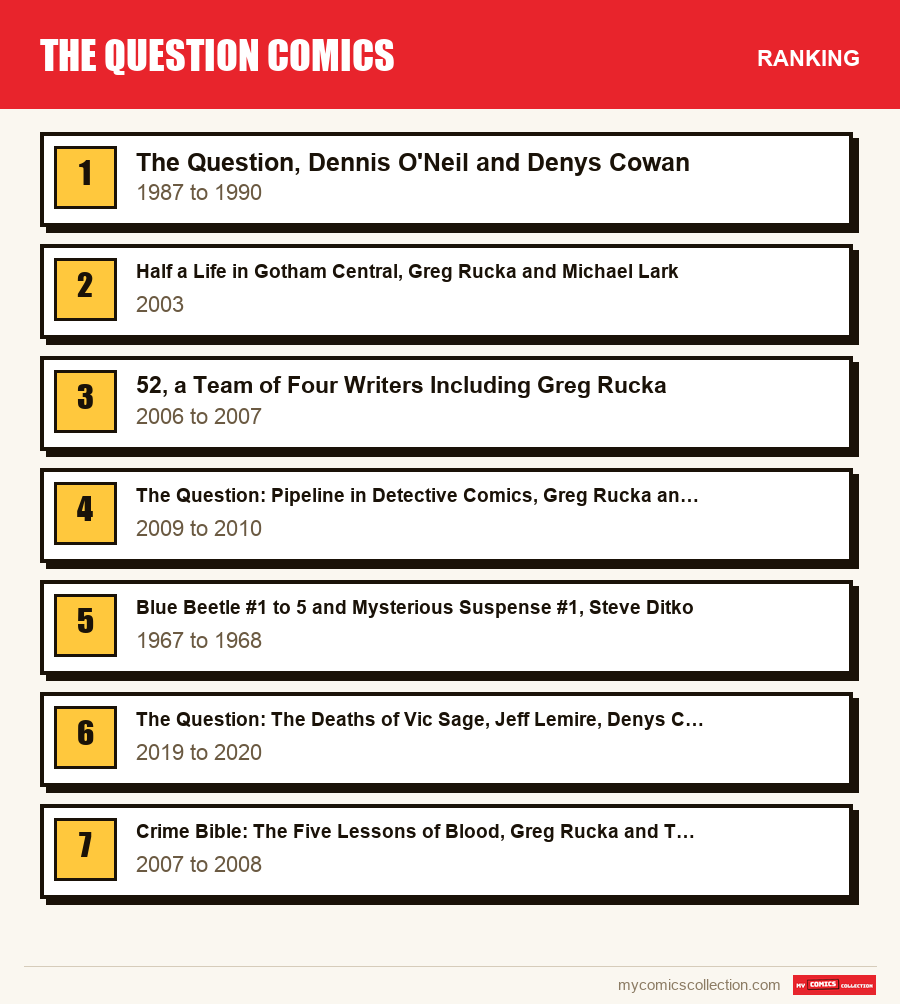
For the best Question comics, start with Dennis O'Neil and Denys Cowan's The Question series (1987 to 1990), which turns Vic Sage into a faceless vigilante in Hub City. For Renee Montoya, who inherits the mask, continue with Gotham Central (2003), then the weekly 52 (2006 to 2007) and the Pipeline backup feature in Detective Comics (2009). Steve Ditko's Charlton debut (1967) remains the source.
The Question is the detective with the smooth, featureless face, a mask worn by two people: Vic Sage, created by Steve Ditko, and later the cop Renee Montoya. That double legacy makes it tricky to pick an entry point, because the two bearers of the mask don't tell the same kind of story, and the best tales are spread across more than fifty years.
As always in this guide, we only state verified facts (creators, issue numbers, dates); the analysis is our own, with no reproduction of protected art or dialogue.
His First Appearance
The Question first appears in Charlton Comics' Blue Beetle #1, cover-dated June 1967, written and drawn by Steve Ditko. The character is an investigative reporter, Vic Sage, who pulls on a featureless mask to investigate where the police stop. Ditko then gave him a three-part lead feature in Mysterious Suspense #1 from October 1968, which he wrote and drew.
Charlton ended its line of heroes at the end of 1967; the mask only returned when DC Comics, by then the owner of the catalog, slipped it into Crisis on Infinite Earths in 1985. His first life therefore lasted barely more than a year, and his real career began in 1987.
1: The Question, Dennis O'Neil and Denys Cowan (1987 to 1990)
The series launches in February 1987, written by Dennis O'Neil and drawn by Denys Cowan, with Rick Magyar on inks; it runs thirty-six issues. From issue #1, Hub City establishes itself as a city rotten to the core, where Vic Sage investigates under the mask and works at the KBEL station. Around him are Myra Fermin, wife of the corrupt mayor Wesley Fermin, and Aristotle "Tot" Rodor, a former professor who designed the mask. Lady Shiva makes an appearance in the very first issue.
What the series brings to the character is considerable: it gives him an ongoing starring role and fully integrates him into the DC Universe. It suits any reader who loves urban crime fiction, moods of a decaying city, and nearly silent fight scenes. The first issues form an opening arc, then the series alternates with shorter stories: read issues #1 to 6 in one sitting, then pick and choose as the mood strikes. This entry should come first, because it supplies every key to the character.
2: Half a Life in Gotham Central, Greg Rucka and Michael Lark (2003)
A note on ranking: Renee Montoya is not yet The Question in this arc, but she is its heroine, and it shows the woman who will take up the mask. Written by Greg Rucka and drawn by Michael Lark, it fills issues #6 to 10 of Gotham Central, a forty-issue police series published from February 2003 to April 2006. Renee Montoya is outed as gay at the precinct, with the tensions that causes in her work, and then Two-Face becomes obsessed with her and holds her captive.
This story gives her dramatic depth: you come to understand why the Gotham cop will one day leave the force to take up a mask. It won the 2004 Eisner Award for Best Serialized Story. It fits the reader who wants a crime story without superpowers and who cares about Montoya before the mask. Read it in the series' collected edition and save the rest of Gotham Central for later: the arc is the heart of her journey, but it remains one chapter of an ensemble work.
3: 52, a Team of Four Writers Including Greg Rucka (2006 to 2007)
The series ran weekly from May 10, 2006, for a year, and four writers took turns on it, with Rucka leading the thread that concerns us, alongside Johns, Morrison, and Waid. Keith Giffen drew the layouts, and Joe Bennett and Eddy Barrows were among the artists. A note on ranking: the series is an ensemble piece, and the adventures of Montoya and Vic Sage form only one of its threads. Rucka wrote that thread in particular.
Vic Sage, dying of lung cancer, trains Renee Montoya, with help from Richard Dragon, so she can take over his role. The duo then crosses paths with Batwoman, the Crime Bible prophecy, and the Intergang gang in Gotham. What it contributes is the handoff: the mask changes hands, and the character gets a second life. This path suits the reader who already follows the DC universe of the period. If you only want Montoya, find her chapters in the collected editions; if you read the whole series, the other threads give you the backdrop of the era.
4: The Question: Pipeline in Detective Comics, Greg Rucka and Cully Hamner (2009 to 2010)
Starting with Detective Comics #854 (August 2009), Greg Rucka and artist Cully Hamner give Montoya a backup feature alongside the main story, titled Elegy, which Rucka writes with J.H. Williams III on art. The Pipeline chapters run eight pages each. The collected edition is also titled The Question: Pipeline.
What the backup feature brings to Montoya is a solo investigation under the mask, tighter than the sweeping canvas of 52. It suits the reader who wants to watch Montoya investigate alone, with Hamner's very clear linework. Read it in the collected edition rather than in single issues: the eight-page chapters need to be read back to back, and reading straight through better conveys the rhythm of the buildup.
Do you collect this series?
Track what you own, what you are missing and what your collection is worth. 7-day trial.
Start my trial →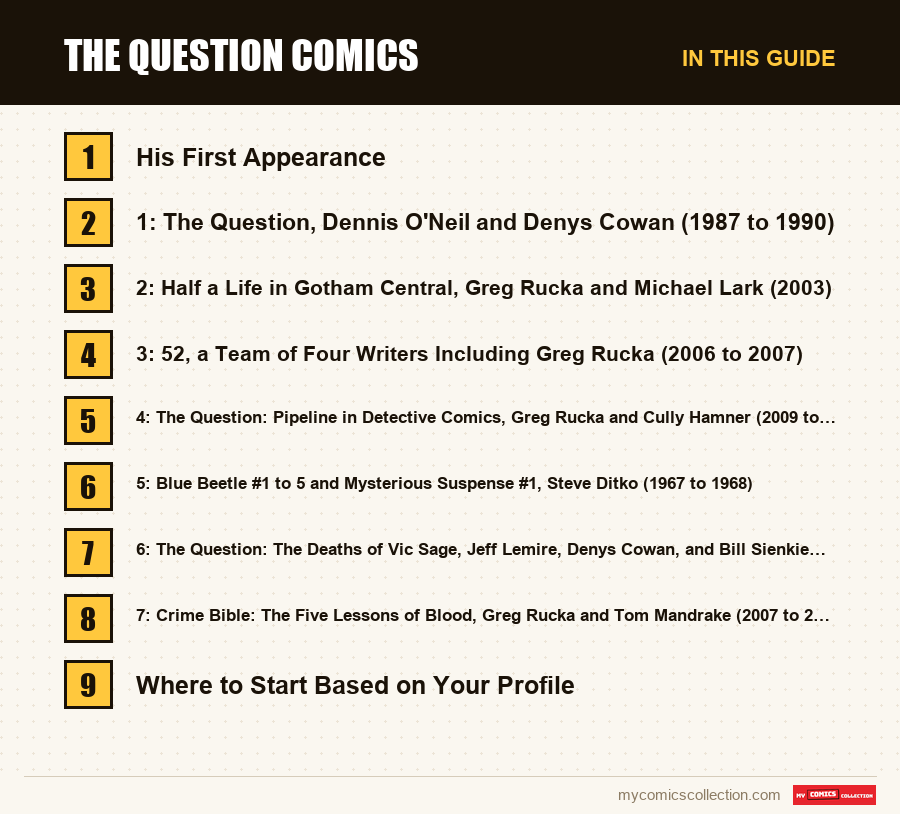
5: Blue Beetle #1 to 5 and Mysterious Suspense #1, Steve Ditko (1967 to 1968)
The origin stories are by Steve Ditko: Blue Beetle #1 (June 1967) establishes the character, Mysterious Suspense #1 (October 1968) makes him a lead hero, and Blue Beetle #5 (November 1968), the last issue of the series, features him once more. The art is spare and expressive, and each story reads in a few minutes.
What it contributes is the template: the faceless investigator, the figure DC's writers would revive twenty years later. This entry suits the comics history buff and the collector looking for Charlton landmarks. Look for it in a reprint rather than in period single issues, whose condition demands real expertise.
6: The Question: The Deaths of Vic Sage, Jeff Lemire, Denys Cowan, and Bill Sienkiewicz (2019 to 2020)
This four-issue miniseries, published under the DC Black Label imprint, is written by Jeff Lemire. Denys Cowan, the artist of the 1987 series, returns on pencils; Bill Sienkiewicz inks the first issue, dated January 2020, and draws the covers. Vic Sage, under the mask, is drawn into a conspiracy that runs from the political circles of Hub City to its underground tunnels.
The miniseries offers a retrospective look: it reunites Vic Sage, Tot Rodor, Myra Fermin, and Richard Dragon in the Hub City setting. It targets the reader who has already worked through the 1987 series and wants a contemporary epilogue. Read it in the collected edition, after entries 1 and 3: Cowan's return to the character hits harder when you know the first series.
7: Crime Bible: The Five Lessons of Blood, Greg Rucka and Tom Mandrake (2007 to 2008)
This five-issue miniseries extends 52: Renee Montoya, now The Question, takes on the Religion of Crime. Greg Rucka writes the series, whose first issue, dated December 2007, is drawn by Tom Mandrake; other artists take over on the following chapters.
What it contributes is turning Montoya into a heroine in her own right: she is no longer Vic Sage's student, she leads a solo quest against a criminal cult. This read suits anyone who has read 52 and wants to know what becomes of Montoya next. It reads in one afternoon, in the order of the five issues, saving the 2009 Detective Comics for afterward.
Where to Start Based on Your Profile
Your entry point depends on which mask you want to follow. Here are four paths.
- You want Vic Sage and nothing else: read the 1987 O'Neil and Cowan series, then Jeff Lemire's The Deaths of Vic Sage.
- You want Renee Montoya: follow the order Gotham Central (Half a Life), 52, Crime Bible, then Detective Comics #854 and following.
- You love comics history: start with Ditko's stories at Charlton, before moving on to the 1987 series.
- You're new to DC: pick up the 1987 The Question: it reads without knowing the rest of the universe.
If you're torn between the two masks, keep in mind that Vic Sage is a city investigator, while Renee Montoya goes from the police force to the mask. For the Gotham context around Montoya, check out the best Batman runs.
The Key Issues to Know
About half a dozen issues mark The Question's path. For each one, check the cover date and the printing before judging a listing.
- Blue Beetle #1 (June 1967): the first appearance of The Question, at Charlton, by Steve Ditko.
- Mysterious Suspense #1 (October 1968): his first starring role, by Steve Ditko.
- The Question #1 (February 1987): the launch of DC's series by O'Neil and Cowan, with Rick Magyar on inks and Lady Shiva as a guest.
- Gotham Central #6 to 10 (2003): the Half a Life arc, a landmark for any Renee Montoya collector.
- Crime Bible: The Five Lessons of Blood #1 (December 2007): the first issue of the miniseries devoted to Montoya.
- Detective Comics #854 (August 2009): the first chapter of Pipeline, by Rucka and Hamner.
Ditko's two single issues date from the 1960s: their condition deserves particular attention. Issues from the 2000s are judged mostly by print run. To place these landmarks within the whole Charlton catalog, see also Blue Beetle key issues at Charlton.
Frequently Asked Questions
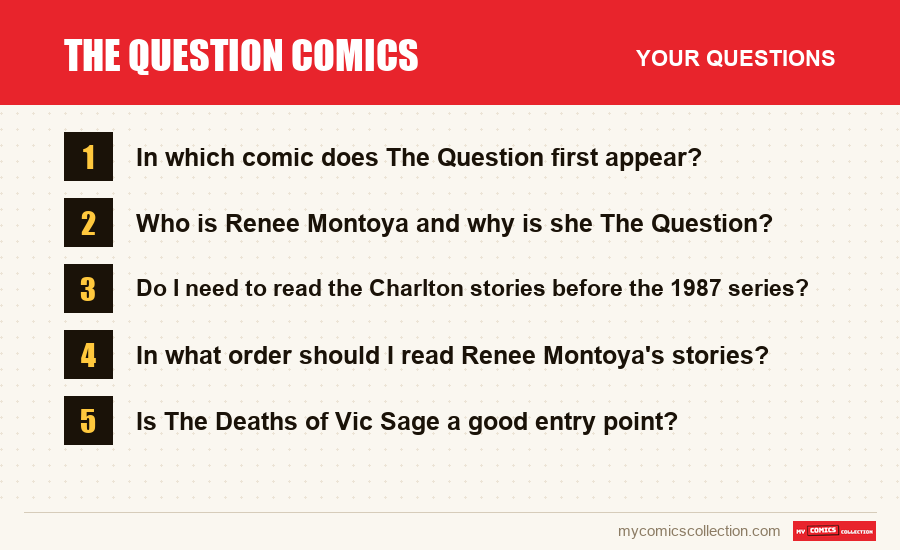
The Question first appears in Blue Beetle #1, published by Charlton Comics and cover-dated June 1967. Steve Ditko created him. He got his first lead story in Mysterious Suspense #1 from October 1968, also by Ditko, before DC bought the Charlton characters.
Renee Montoya is a Gotham cop and a heroine of Gotham Central. In 52, Vic Sage, dying of lung cancer, trains her and hands her the mask. She then holds the role in Crime Bible (2007 to 2008) and in the Pipeline backup feature in Detective Comics (2009).
No. Dennis O'Neil and Denys Cowan's series reads fine without knowing Charlton: it introduces Hub City, Vic Sage, Tot Rodor, and Myra Fermin right from issue #1 of February 1987. Steve Ditko's stories are a bonus for the history buff, not a prerequisite.
Follow publication order: Gotham Central #6 to 10 (2003), the 52 series (2006 to 2007), Crime Bible: The Five Lessons of Blood (2007 to 2008), then Detective Comics starting with #854 (2009). Each step sheds light on the next without requiring you to read all of Batman.
It's better suited to the reader who already knows the 1987 series. Jeff Lemire reunites with Denys Cowan, the original artist, and with Hub City characters like Tot Rodor and Richard Dragon. For a first taste of the character, open O'Neil and Cowan instead.
Do you own a Charlton Blue Beetle or issue #1 of the 1987 series? Get your copy appraised before making any decision.
Appraise My Comic