The characters redeemed with Blue Beetle in 1983 served as a model for Watchmen, one of the most widely read graphic novels in the history of the medium. Alan Moore had proposed a narrative that would have destroyed them; the publisher, who had just acquired them and intended to use them, refused. Moore therefore created equivalents. Ted Kord, the powerless inventor of the insect-shaped ship, has an instantly recognizable decal, and the same goes for most of his colleagues.
It is a direct and abundantly documented connection, which explains why these second-rate figures matter today well beyond their own notoriety, and why their names come up in discussions where they would otherwise have no reason to appear.
This article retraces what happened, establishes the connections, explains what the refusal paradoxically produced for the best, and what this changes for a reader or collector today.
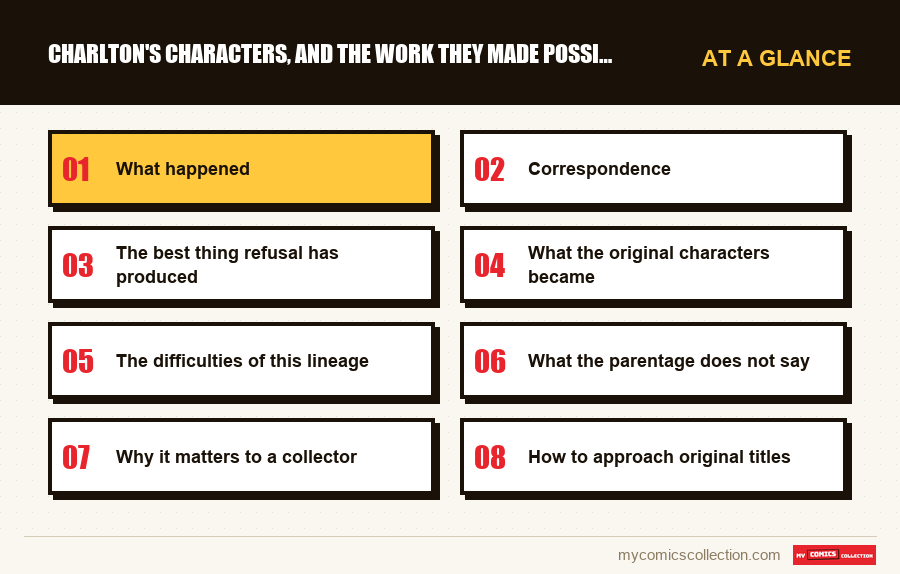
What happened
The chain of events is simple, and every link counts.
A small publishing house in Pennsylvania had been publishing a set of so-called “action” heroes since the 1960s: a powerless inventor, a man transformed by an atomic explosion, an investigator with a masked face, a peace officer with expeditious methods, a woman capable of blending into the shadows.
This house ended up ceasing its activities, and a major publisher bought its entire catalog in the early 1980s. The characters therefore changed owners overnight, and the newcomer intended to integrate them into his own shared universe rather than letting them sleep.
An author then proposes a story that would use these newly acquired figures: a story that would tear them to pieces, morally and physically. The publisher refuses, for a perfectly understandable reason: we do not destroy what we have just bought.
The author then creates equivalents, retaining the premises of each but inventing a past, a psychology and flaws that belong only to him. The story became one of the most commented on texts in the medium, and the original characters quietly continued their careers elsewhere, under their new brand.
Correspondence
The powerless inventor
Ted Kord becomes a vigilante in a nocturnal bird costume, with the same profile: no superhuman abilities, a flying device of his own making, a technical skill that replaces strength.
This is the most literal match of the six.
Man transformed by the atom
The character with almost unlimited powers becomes a blue figure detached from humanity. This is the most radical transformation of the lot.
The blank-faced investigator
Its equivalent retains the featureless mask and moral rigidity, pushed to the point of absolute intransigence.
The others
The expeditious peace officer, the shadowy woman and the strategist with superhuman reflexes each have their own decal, with varying variations.
The best thing refusal has produced
It would be easy to present this refusal as a circumvented obstacle. It's the opposite: he made the work possible.
A story using existing characters would have been constrained by their history, their established tone, and by what the editor would be willing to do to them. Every decision would have been negotiable, and the most radical would not have passed.
With new creations, the author could do anything: make them die, make them despicable, give them a past that contradicts everything expected of a hero. No continuity constrained him, no legal department defended an asset.
The refusal also produced a less obvious effect. A reader who knows the original characters immediately recognizes the patterns, but a reader who doesn't knows them loses nothing. The work works without reference, which would not have been the case if she had used the existing figures.
This probably explains its longevity. A text which dismantled specific characters would today be dated; this one dismantles an idea.
What the original characters became
What follows is instructive, and it reverses what one would expect.
Preserved from dismantling, these characters were integrated into the universe of their new publisher. The powerless inventor found, a few years later, his most beloved period there: in a register of team comedy that nothing predicted.
In other words, refusal saved them twice: he spared them narrative destruction, and he left them available for a treatment which made their reputation.
The comparison is striking. Decals have become major figures in the medium but remain locked in a single and closed narrative. The originals continued to live, evolve, die and come back: at the cost of much less notoriety.
Each got what the other didn't, and that's a direct consequence of a business decision made for entirely different reasons.
What this opens as a gateway. A reader who knows the graphic novel already knows, without knowing it, the structure of the original group: the profiles, the balance of power, the distribution of powers.
Approaching these characters after the fact therefore produces an unusual effect: that of meeting the models after having known the portraits. Several readers describe this as the most interesting experience they have had with this segment.
The difficulties of this lineage
An overwhelming reputation
The graphic novel is so well known that the original characters are often presented as its drafts, which they are not.
A distorted retrospective reading
Discovering the originals after the transfers leads to looking for similarities everywhere, even where there are none.
Scattered titles
The origin stories are spread across several Little House series, difficult to identify and never collected as a whole.
Uneven quality
These series from the 1960s are current production, with its successes and its weaknesses. Expecting graphic novel level leads to disappointment.
Collecting this series?
Track what you own, what you are missing and what your collection is worth. 7 day trial.
Start my trial →What the parentage does not say
A precaution is necessary, because this type of origin story easily turns into legend.
The original characters are not sketches. They were created twenty years earlier, in a different context, with different intentions: to entertain a young readership in a cheap monthly series format. They were never intended as a rough draft of anything.
The decals are not simple copies either. What the author did with them (gave them a past, a psychology, moral flaws) has no equivalent in the originals. The resemblance is in the premises, not in the treatment.
Finally, not all characters in the graphic novel have a direct role model, and some correspondences are looser than others. Presenting the list as a term-to-term equivalence would be excessive.
The correct formulation is therefore modest: a set of characters provided a structural starting point, which is already considerable, and implies nothing more.
Why it matters to a collector
This connection has market consequences that deserve to be addressed.
It gives the original titles a documentary interest that they would not otherwise have. A second-tier superhero series from the 1960s is modestly collected; the same one, identified as the source of a major text, attracts buyers who would never have been interested in it.
However, it does not produce an outbreak. The mechanism is too indirect: the public for graphic novels is immense, but it only goes back very marginally to the sources. An intellectual lineage does not move a market the way an adaptation does.
What it produces, on the other hand, is more durable: a weak but constant demand, insensitive to fashion, driven by readers who seek to understand rather than possess.
How to approach original titles
Three pieces of advice for anyone who wants to get back on track without getting discouraged.
After the graphic novel, not before. The opposite order would be absurd: no one reads the sources of a work before the work. The interest is precisely in the retrospective recognition.
By accepting the level of current production. These are monthly series of their time, with the conventions of the moment. They read like documents as much as stories.
Without seeking completeness. A few issues of each character are enough to grasp what the graphic novel got out of them. Bringing it all together is a whole other project.
What this case teaches about editorial decisions
A broader observation, which goes beyond this file.
The decision to refuse was purely commercial: to protect a newly acquired asset. At that time, no one was trying to improve a work: they were trying not to damage an investment.
However, the result was better for everyone. The work gained its freedom, the characters their survival, and the publisher both at the same time. A constraint imposed for the wrong reasons produced a better book, which happens more often than we admit.
It is a useful corrective to the usual creation narrative, where constraint is presented as an obstacle and total freedom as an ideal. Many of the medium's most cited works owe something to rejection.
What to record
On these titles, two fields are worth mentioning, and the second is unusual.
The original publisher and year. These characters appeared under two successive imprints, and their stories have since been reprinted. Without these two mentions, a number does not designate a specific object.
The reason for purchase. This is the relevant field here: do we buy this issue for the character, for the lineage, or to complete a series? These three motivations concern different objects and do not call for the same state requirements.
Someone buying to understand a lineage may settle for a very used copy; someone who collects the character cannot. Noting the intention avoids paying for a state you didn't need.
Frequently asked questions
For a perfectly rational reason: he had just bought these characters and intended to integrate them into his universe. We do not destroy what we have just acquired. The decision was a commercial one, with no artistic considerations, and yet it produced a better outcome for everyone.
Absolutely not, and this is the most common misinterpretation. They were created twenty years earlier to entertain a young readership in cheap monthly series, unrelated to what came after. The resemblance concerns the premises (an inventor without power, a man transformed by the atom) never the treatment.
No, and that is precisely what makes it strong. The work works entirely without reference, which would not have been the case if it had used existing figures. Knowing the patterns adds a layer of recognition, without changing understanding.
Much less than a screen adaptation. The mechanism is too indirect: the public for graphic novels is immense but only goes back marginally to the sources. What parentage produces is a small but constant demand, driven by readers who seek to understand rather than possess.
After reading the graphic novel, never before: the interest is in the retrospective recognition. A few numbers of each character are then enough to understand what has been learned from them; aiming for completeness is a completely different project, and on series that are scattered and difficult to identify.
To understand, or to collect
Both intents relate to the same numbers and do not invoke the same state requirements.