
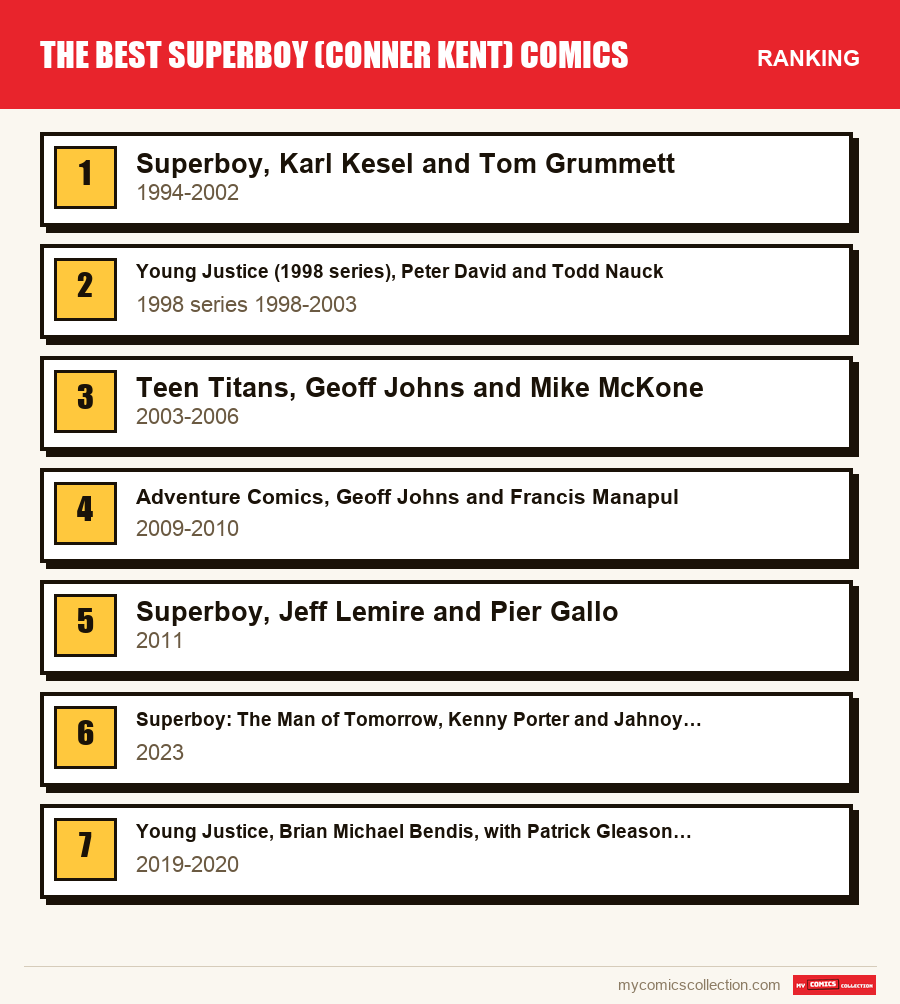
To find the best Superboy (Conner Kent) comics and where to start, open the Superboy series by Karl Kesel and Tom Grummett (1994), before Young Justice (Peter David, Todd Nauck, 1998) and Teen Titans (Geoff Johns, Mike McKone, 2003). His origin is in The Adventures of Superman #500 (June 1993), where he appears in a short story written by Karl Kesel and drawn by Tom Grummett. The recent reads come after.
Conner Kent is a clone born in the 1990s, which gives him a curious status: he has neither Superman's seniority nor Robin's history, but thirty years of series under his name or a place on a team. That creates a sorting problem. Many of the issues he appears in are team issues, crossovers or stunts, and the ranking below only keeps those where he holds the center, or a clear share of the group, saying each time which applies.
As always in this guide, only verified facts (creators, issue numbers, dates) are stated as fact; the analysis is our own, with no reproduction of panels or copyrighted dialogue.
His first appearance
Superboy is born in The Adventures of Superman #500, cover-dated June 1993. The contents are a long main story followed by four short stories all titled "First Sighting...": each shows one of the contenders to succeed Superman. The Superboy one is written by Karl Kesel, drawn by Tom Grummett and inked by Doug Hazlewood, with Glenn Whitmore on colors. The other three are credited to Louise Simonson and Jon Bogdanove for Steel, Roger Stern and Butch Guice for the Eradicator, and Dan Jurgens and Brett Breeding for the Cyborg Superman.
This construction detail matters to a reader: Superboy does not debut in a story of his own, but in a group showcase, a bit like a new runner introduced on the starting line. The concept was settled in 1992 at a meeting of the Superman editorial team, and it was handed to Kesel and Grummett, who would stay with it for a long time. In the story, the boy is a clone made by Project Cadmus, originally endowed with tactile telekinesis.
Do not look in this issue for a complete story: it is a collecting and reading landmark, to be bought for the place it holds in the "Return of Superman" more than for its text. To understand what follows, turn instead to the series that bears his name, presented just below.
1: Superboy, Karl Kesel and Tom Grummett (1994-2002)
The Superboy series begins in February 1994 with "Trouble in Paradise!", written by Karl Kesel, drawn by Tom Grummett and inked by Doug Hazlewood. Conner settles in Hawaii, far from Metropolis. The series runs one hundred issues through 2002; Kesel and Grummett leave after issue #26, return at #50, leave again after #80, then sign the finale of issue #100 together.
It gives Conner what a character born inside an event cannot have: a setting, allies and a tone. It is the best read for understanding why the character appeals, with his teenage humor and his adventure-serial energy. One issue marks a conceptual date: issue #60, from April 1999, applies the "Hypertime" concept to the character.
How to read it: in blocks. The twenty-six issues by the two creators form a first block, then each of their returns (issues #50 and #100) opens another. Issue #0, from October 1994, is an origin detour that you read after issue #1, not before. It will please anyone who accepts a monthly series of one hundred issues, with its uneven episodes.
2: Young Justice (1998 series), Peter David and Todd Nauck (1998-2003)
The series is born from the one-shot Young Justice: The Secret (June 1998), written by Todd Dezago and drawn by Todd Nauck, which creates the team. The first issue of the regular series appears in September 1998 under the title "Young, Just Us": Peter David writes, Todd Nauck draws, and the central trio brings together Robin (Tim Drake), Superboy and Impulse. The series runs until 2003.
It is not a book about Conner alone, but he is one of its three pillars, and it is where he becomes a more nuanced character. Peter David sets up a teenage comedy driven by the friendship among three very different boys, a clone, the third Robin and a very fast young hero. To understand what Conner becomes in the following years, this read is essential; it suits the reader who prefers humor and a light tone to big cosmic battles.
For the collection, the June 1998 one-shot and issue #1 from September 1998 make a logical pair, because one creates the team and the other launches the series. Our page on the best Bart Allen comics extends the reading on the Impulse side, and the writer Peter David has his own page.
3: Teen Titans, Geoff Johns and Mike McKone (2003-2006)
Issue #1 of the new Teen Titans series is cover-dated September 2003. Geoff Johns writes, Mike McKone draws, and Conner is approached there to join a new team, after the story Titans/Young Justice: Graduation Day. Conner holds his place from arc to arc, up to "Titans Tomorrow" (#17-19), inside a tight-knit group.
Here, Conner is no longer at the center, he is one of the faces of a team, and that is what makes the series useful: you see the character hold his rank within an ensemble. Conner's appearances extend to the issues contemporary with Infinite Crisis, in 2006, and the read goes in order.
It suits the reader who prefers teams to loners, and who wants to understand why a generation of readers links Conner to the Titans. Our Teen Titans reading guide helps place the series.
4: Adventure Comics, Geoff Johns and Francis Manapul (2009-2010)
In the first issue of Adventure Comics, from October 2009, a story titled "Superboy, The Boy of Steel" leads the issue. Geoff Johns writes it, Francis Manapul draws it, and a team story, "Long Live the Legion", completes the contents. Conner is the hero of a title of his own there, after his death in Infinite Crisis in 2006 and his return in Final Crisis: Legion of 3 Worlds in 2008.
The series takes the character after his death and return. Issue #7, from April 2010, titled "What Did Black Lantern Superboy Do?", is written by Tony Bedard and drawn by Travis Moore; it sits in the shadow of Blackest Night. This read suits anyone who already knows the Titans and wants to see what Johns does with him alone; it is not for the beginner, who would lack landmarks on the hero's death and resurrection.
Do you collect this series?
Track what you own, what you are missing and what your collection is worth. 7-day trial.
Start my trial →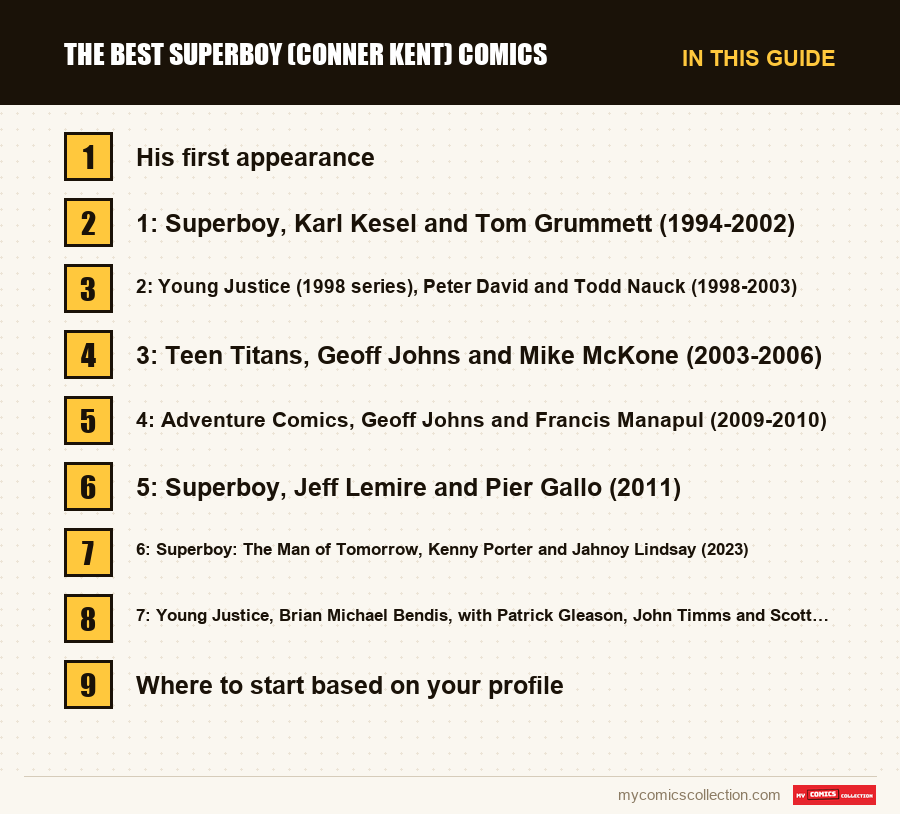
5: Superboy, Jeff Lemire and Pier Gallo (2011)
The 2011 series opens in January with "Smallville Attacks!", Jeff Lemire on writing and Pier Gallo on art, and it runs eleven issues. The first arc, which gives its title to the first collected volume, brings Conner back to Smallville and its neighbors, before the series opens up to other young heroes of the DC universe.
It is the shortest of the reads offered here. It suits the reader who wants a self-contained Superboy in few issues. Our page on Jeff Lemire places the writer within the rest of his output.
6: Superboy: The Man of Tomorrow, Kenny Porter and Jahnoy Lindsay (2023)
The series Superboy: The Man of Tomorrow begins in June 2023 under the pen of Kenny Porter, with Jahnoy Lindsay on art and colors. It gives Conner Kent a title in his own name again after the team years of Brian Michael Bendis and Patrick Gleason.
It aims at the reader discovering Conner today who prefers a recent title, without three decades of history to catch up on. Since recent issues are easier to find, it is a simple entry point for a new reader.
7: Young Justice, Brian Michael Bendis, with Patrick Gleason, John Timms and Scott Godlewski (2019-2020)
The 2019 Young Justice series is published in DC's Wonder Comics imprint, from January 2019 to November 2020, for twenty issues. Brian Michael Bendis writes, first alone, then with David F. Walker from issue #13, with Patrick Gleason, John Timms and Scott Godlewski on art. Conner Kent is reintroduced there alongside the other original members.
He is one member among others there, which explains the last place. The read is worth it for those who loved the 1998 trio and want to find these characters under another pen. You can also check the pages devoted to Brian Michael Bendis and Patrick Gleason.
Where to start based on your profile
If you are new to Conner, read entry 1, which gives the tone, then entry 2, which gives the friendships. If you are looking for the golden age of young teams, start with the 1998 Young Justice, follow with the 2003 Teen Titans, and keep issue #1 of each series as an anchor. If you want a short read, the 2011 and 2023 series are the easiest to finish.
If you collect DC events, add Infinite Crisis #6 (2006), which tells his death, and Final Crisis: Legion of 3 Worlds (2008), which brings him back: they are not Conner stories, but they mark the boundaries of his publishing life. If you follow Superman, reading the four "First Sighting..." stories in issue #500 remains a nice record of how DC presented its four candidates in 1993. To place Conner in the rest of the universe, see the history of Superman.
The key issues to know
These landmarks are read without any price figure: for each issue, look at whether it founds the character, a team or a turning point, since the collecting interest is concentrated there.
- The Adventures of Superman #500 (June 1993): the birth of Conner, by Karl Kesel and Tom Grummett.
- Superboy #1 (February 1994): start of the Kesel and Grummett series.
- Superboy #60 (April 1999): first application of "Hypertime" to the character.
- Young Justice: The Secret #1 (June 1998) and Young Justice #1 (September 1998): creation of the team, then launch of the series.
- Teen Titans #1 (September 2003): Geoff Johns and Mike McKone relaunch the title.
- Infinite Crisis #6 (May 2006): death of Superboy, in a story by Geoff Johns.
- Adventure Comics #1 (October 2009): Conner has a title of his own again.
For all these issues, a method beats a price: compare several listings of the same issue, check that it is the series you want, and note the artist. Our page on the major Superman crossovers places these events within the whole period.
Frequently asked questions
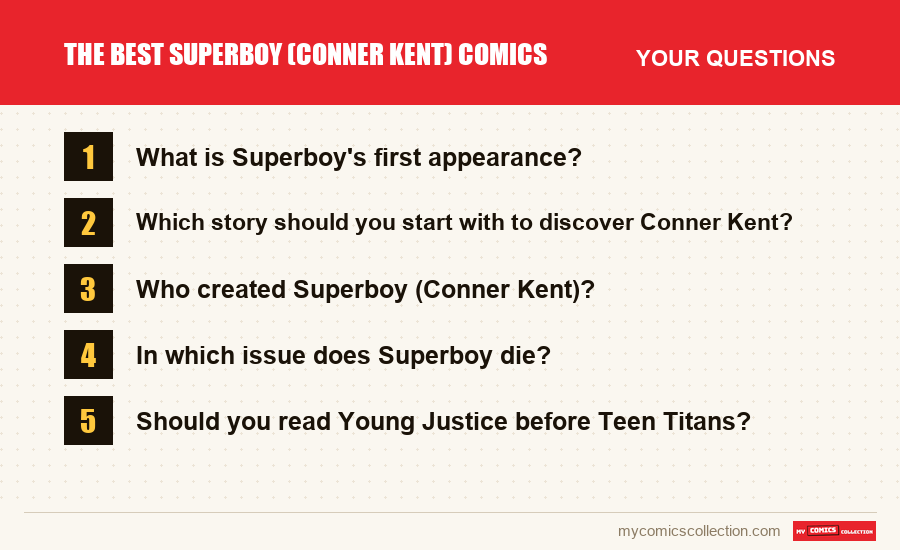
Conner Kent debuts in The Adventures of Superman #500, cover-dated June 1993, in a short story written by Karl Kesel, drawn by Tom Grummett and inked by Doug Hazlewood. The issue also presents three other contenders to succeed Superman.
Start with the Superboy series by Karl Kesel and Tom Grummett, whose issue #1 dates from February 1994. Continue with the Young Justice gang in 1998, then Teen Titans in 2003. If you prefer a recent entry point, go for the 2023 series by Kenny Porter and Jahnoy Lindsay.
Karl Kesel and Tom Grummett. The character appears in The Adventures of Superman #500 (June 1993), after a concept settled in 1992 by the Superman editorial team. The two creators return to the Superboy series several times and sign issue #100 together in 2002.
In Infinite Crisis #6, "Touchdown", cover-dated May 2006. The issue is written by Geoff Johns and drawn by several artists: Phil Jimenez, Jerry Ordway, George Pérez and Ivan Reis. The character reappears in Final Crisis: Legion of 3 Worlds, in 2008.
It is not mandatory, but it is recommended. Young Justice (1998) sets up the friendship among Superboy, Robin and Impulse, and issue #1 of Teen Titans (2003) follows the story Titans/Young Justice: Graduation Day. Both read in publication order.
Do you own a copy of The Adventures of Superman #500 or of the Superboy series? A free appraisal helps you place it.
Appraise my comic