
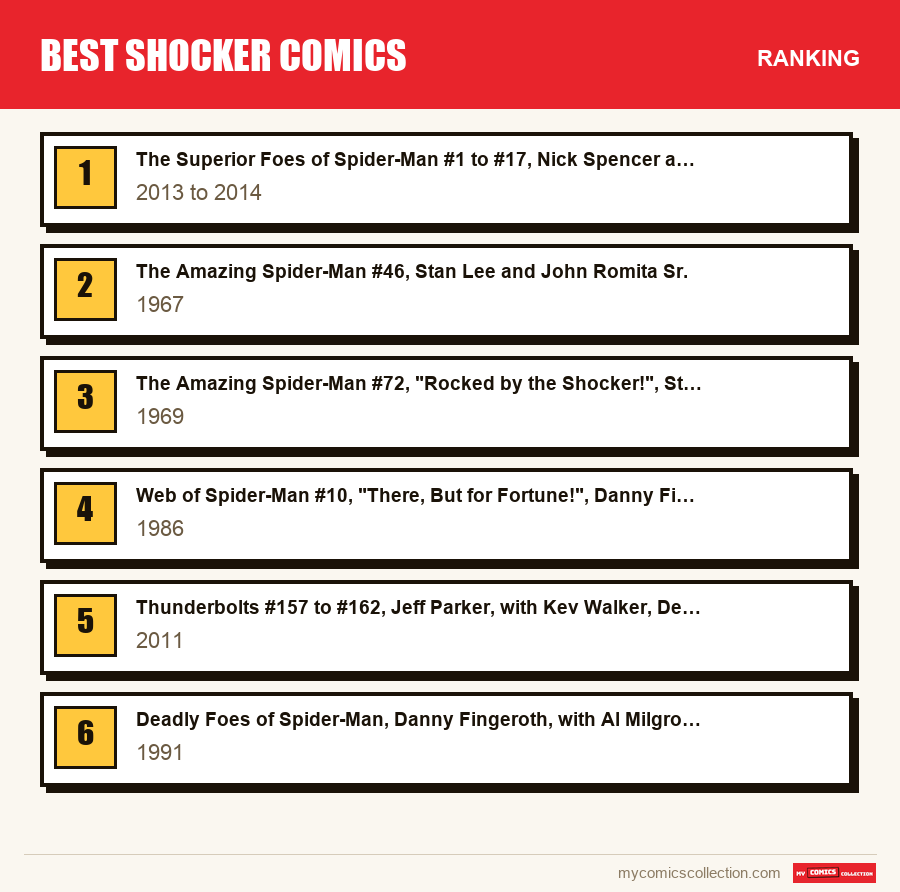
The best Shocker comics start with The Superior Foes of Spider-Man by Nick Spencer and Steve Lieber (2013 and 2014), where Herman Schultz becomes a funny, lovable character. Then go back to his first appearance in The Amazing Spider-Man #46 (March 1967), created by Stan Lee and John Romita Sr., and to his return in #72 (May 1969). The rest of the ranking runs from 1967 to 2011.
Herman Schultz wears no mask and has no superhuman strength: he wears a quilted suit and two gauntlets that fire shock waves. He is a burglar turned inventor, a technician of crime who counts on his gear more than on his courage. That vulnerability explains why writers have so often used him as a foil, and why a few of them have managed to turn him into a real character. This guide ranks six reads and tells you what order to approach them in.
As always in this guide, only verified information (creators, issue numbers, dates) is stated as fact; the analysis is our own, with no reproduction of protected panels or dialogue.
His first appearance
The Shocker was born in The Amazing Spider-Man #46, cover-dated March 1967, under the title "The Sinister Shocker!" Stan Lee wrote it and John Romita Sr. drew it. The issue has a distinction for its day: it tells the character's complete origin in a single issue. Herman Schultz is a burglar, a safecracker; in prison he builds vibrating gauntlets, escapes with them, then decides to make a living as a costumed criminal.
The costume is worth a closer look. John Romita Sr. has explained that he was thinking of a cushion and a quilt when he designed it, hence the padded diamond shapes that protect the wearer from his own vibrations. It is a very recognizable visual choice, and it is why the Shocker stands apart from a Vulture or a Rhino at a glance on a cover.
For a collector, #46 is the issue to hunt: the character is introduced, wins the first round, then loses when Spider-Man pins his thumbs down with webbing so he cannot trigger the gauntlets. The story has been reprinted in several collections, including the volume 2 Omnibus and the volume 3 Epic Collection (Spider-Man No More), so you can read it without buying the single issue. The editorial context of those years is covered in our guide to the Silver Age of Amazing Spider-Man.
1: The Superior Foes of Spider-Man #1 to #17, Nick Spencer and Steve Lieber (2013 to 2014)
This is the series that made the Shocker a reader favorite. Nick Spencer writes, Steve Lieber draws, and James Asmus co-writes #10. The series runs seventeen issues, published from the summer of 2013 to the end of 2014, and launched as part of the Superior Spider-Month event. Boomerang leads a team that includes Herman Schultz, along with Speed Demon, Overdrive and the Beetle. The theft of a Silvermane head that Boomerang believes does not exist sets off a cascade of betrayals.
What this series gives the character is a personality. The Shocker is no longer a passing adversary; he is a man who would love to pull off a job and keeps having the credit stolen by an unreliable boss. Boomerang even tries to push him off a bridge after realizing that Schultz has found out about his ties to the Chameleon; Schultz survives. Later, the team buries him alive, and it is Hydro-Man who comes to pull him out.
It suits even someone who has never opened a Spider-Man single issue, since the plot stands completely on its own. Count on three trade paperbacks (Getting the Band Back Together for #1 to #6, The Crime of the Century for #7 to #11, Game Over for #12 to #17) or the Omnibus that gathers all seventeen issues. Steve Lieber's very readable line serves the comedy of a gang of screwups that Nick Spencer builds.
2: The Amazing Spider-Man #46, Stan Lee and John Romita Sr. (1967)
This issue deserves a place among the reads too, not only among the purchases. It lays down everything that makes the Shocker what he is: a criminal with no natural powers, who wins as long as nobody knows how he works and loses as soon as the hero figures out his gauntlets. The idea of webbing that jams the triggers is simple and clear, and it explains why the character remains a mid-tier adversary in the hero's rogues gallery.
What it offers: the template of the "technician" villain, the one who depends on his equipment. Who it is for: anyone who wants to see the raw state of the character before his modern reinterpretations, or who follows Romita Sr.'s art from his early days on the series. How to read it: in one sitting, since it is a self-contained story, and you do not need #45 or #47 to grasp the essentials.
3: The Amazing Spider-Man #72, "Rocked by the Shocker!", Stan Lee, with John Romita Sr., John Buscema and Jim Mooney (1969)
Cover-dated May 1969, this issue brings the Shocker back two years after his debut. The story is written by Stan Lee; the art is shared, with John Romita Sr. providing the cover and John Buscema lending a hand on the pencils, with Jim Mooney on inks. The burglar breaks into Captain Stacy's home and steals a clay tablet, which drags the hero into a case where Peter Parker's loved ones are directly involved.
The interest of this issue lies in how it ties the adversary to Peter's circle: Gwen Stacy's father is the victim of the theft, and the Shocker stops being a mere safe robber and becomes a threat close to the hero's private life. It is aimed at the reader who wants a second look at the character in the Silver Age. It stands on its own, but it is best read soon after #46, to measure what two years changed in the tone of the series.
4: Web of Spider-Man #10, "There, But for Fortune!", Danny Fingeroth and Jim Mooney (1986)
Cover-dated January 1986, this issue is written by Danny Fingeroth and drawn by Jim Mooney. Spider-Man helps Dominic Fortune find his former companion, Sabbath Raven, while stopping the Shocker from carrying out a contract on Fortune's life. For the mission, Schultz has built vibration units into his entire suit, and no longer only into the gauntlets. The character thus changes his gear, a sign that he keeps tinkering with his equipment.
What it offers: a version of the Shocker who works on commission, for a client, and no longer for his own account. Who it is for: readers of Web of Spider-Man and those who enjoy issues where Spider-Man crosses paths with another hero, here Dominic Fortune. How to read it: as a standalone issue, with no prerequisites.
Do you collect this series?
Track what you own, what you are missing and what your collection is worth. 7-day trial.
Start my trial →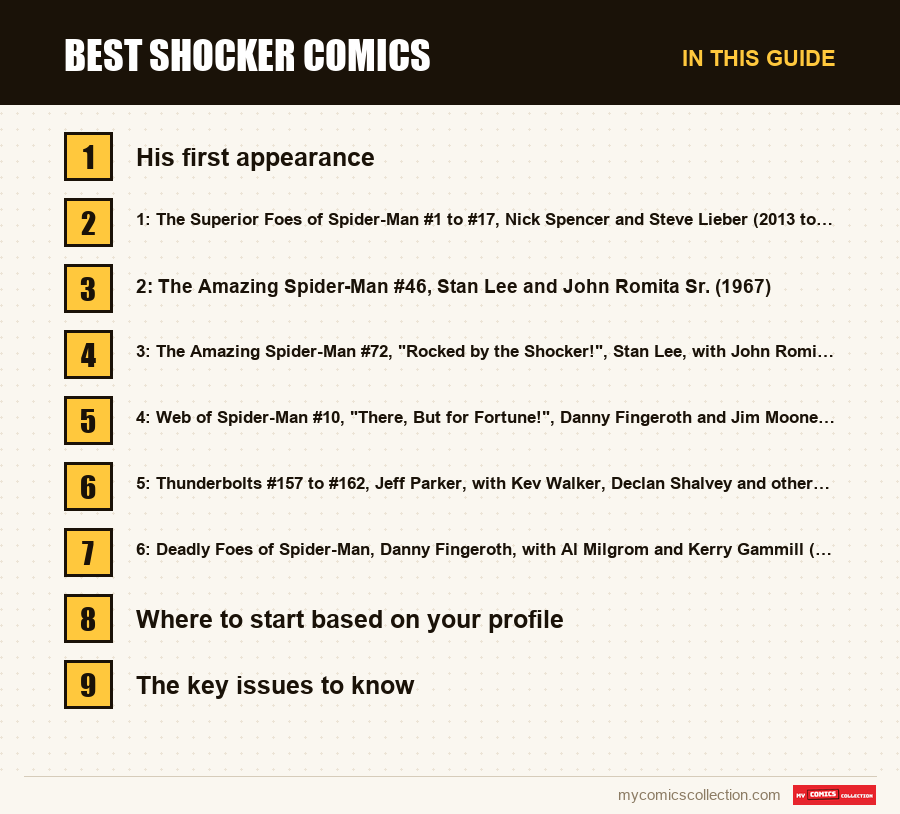
5: Thunderbolts #157 to #162, Jeff Parker, with Kev Walker, Declan Shalvey and other artists (2011)
In this stretch of Thunderbolts, Jeff Parker writes every issue and several artists take turns, including Kev Walker on #157 and #158 and Declan Shalvey on some of the following ones. The Shocker is a regular member of the team in these issues, which cross over with the Fear Itself event starting with #158. One of them, #159, is an anthology issue: it brings together several artists, including Declan Shalvey on a story called "Underbolts."
What it offers the Shocker: a spot on a team, so a setting where he does not have to carry the story alone but where he still exists. It is aimed at the Thunderbolts reader who wants to see the character in a different light, not at someone looking for a story centered on him. A useful caveat: the Shocker is not the hero of these issues, he is one member among others, and the arc reads better if you already know the team.
6: Deadly Foes of Spider-Man, Danny Fingeroth, with Al Milgrom and Kerry Gammill (1991)
Four single issues, from May to August 1991, come out under Danny Fingeroth's pen. Al Milgrom is the main artist, with Kerry Gammill alongside him at the start. It brings together several Spider-Man adversaries, including Boomerang, the Beetle, Speed Demon, the Rhino and Hydro-Man. The Shocker appears in the first three issues, haunted by the fear of being Scourge's next target.
What it offers the character: the portrait of a nervous criminal who fights not for fun but to survive. Who it is for: the reader who already knows Superior Foes and wants an ancestor of that gang-of-screwups tone. How to read it: in one sitting, in four issues, or through the trade paperback published in 1994 and again in 2011, depending on what you can find.
Where to start based on your profile
If you are new to Spider-Man, open The Superior Foes of Spider-Man: the series is funny, complete and has no prerequisites. If you read in publication order, start with #46 from 1967, move to #72 from 1969, then jump to Web of Spider-Man #10 in 1986 to see how the following decade reinvented him. If you mostly follow teams of criminals, pick up Thunderbolts #157 to #162, with Deadly Foes as a companion.
If you collect period issues, #46 is the centerpiece; #72 is its natural companion and is easier to find within a Silver Age collection. If you want to understand the hero's rogues gallery as a whole, pair it with our selection on the Rhino, which offers another example of a brute-force villain, then with our Spider-Man reading guide.
The key issues to know
The obvious key is The Amazing Spider-Man #46 (March 1967), his first appearance and origin. #72 (May 1969) comes next in order of interest: the character's return, with a cover by John Romita Sr. In The Avengers #228 and #229 (February and March 1983), written by Roger Stern with Al Milgrom on art, the Shocker is among Egghead's Masters of Evil in the Hank Pym trial storyline; his role there is that of an enforcer, not the central character, but it is a milestone in his career outside the pages of Spider-Man. For the writer, see our page on Roger Stern.
In Amazing Spider-Man #642 to #647 (2010), the Shocker is among the adversaries brought together in the Origin of the Species arc; he is not the star, so these are issues to buy for the arc rather than for him. The Superior Foes of Spider-Man #1 (2013) is, finally, the most obvious modern entry point. Buying method: first decide what you are after (the character, the era, or a creator), check the condition of the spine, corners and edges, ask for sharp photos, and compare several completed sales before settling, rather than stopping at a single listing.
Frequently asked questions
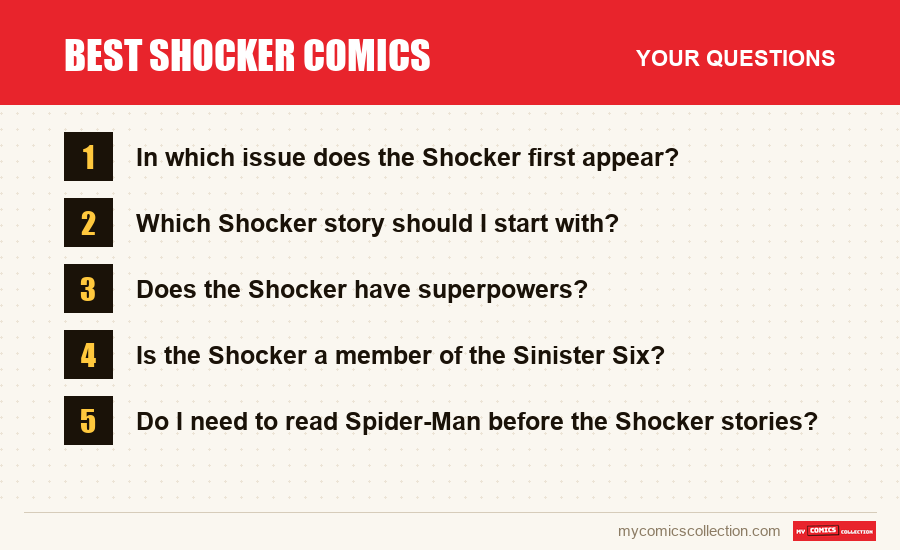
In The Amazing Spider-Man #46, with a cover date of March 1967. Stan Lee wrote it and John Romita Sr. drew it. The issue also tells his origin: Herman Schultz invents his vibrating gauntlets in prison, uses them to escape, then fights Spider-Man.
With The Superior Foes of Spider-Man, written by Nick Spencer and drawn by Steve Lieber across seventeen issues (2013 and 2014). It reads with no prerequisites, puts the Shocker at the center of a team led by Boomerang, and is available in three trade paperbacks or one omnibus.
No. Herman Schultz is a former burglar turned inventor. His gauntlets project vibrations or shock waves, and his quilted suit protects him from their effects. Issue #46 shows him defeated when Spider-Man jams the triggers with webbing.
He has joined several villain teams, including the Sinister Six in some versions. In Superior Foes, he belongs to a similar group led by Boomerang. He has also appeared with the Masters of Evil and in Thunderbolts. His history as a teammate is one of his constant traits.
Not for most of them. The 1967 issue #46, Web of Spider-Man #10 and Superior Foes are self-contained reads that make sense without preparation. Thunderbolts needs a bit of team context, which the earlier issues provide, and Deadly Foes is better read after Superior Foes, whose tone it foreshadows.
Do you own an Amazing Spider-Man #46 or a #72? Get it appraised before you sell or insure it.
Appraise my comic