
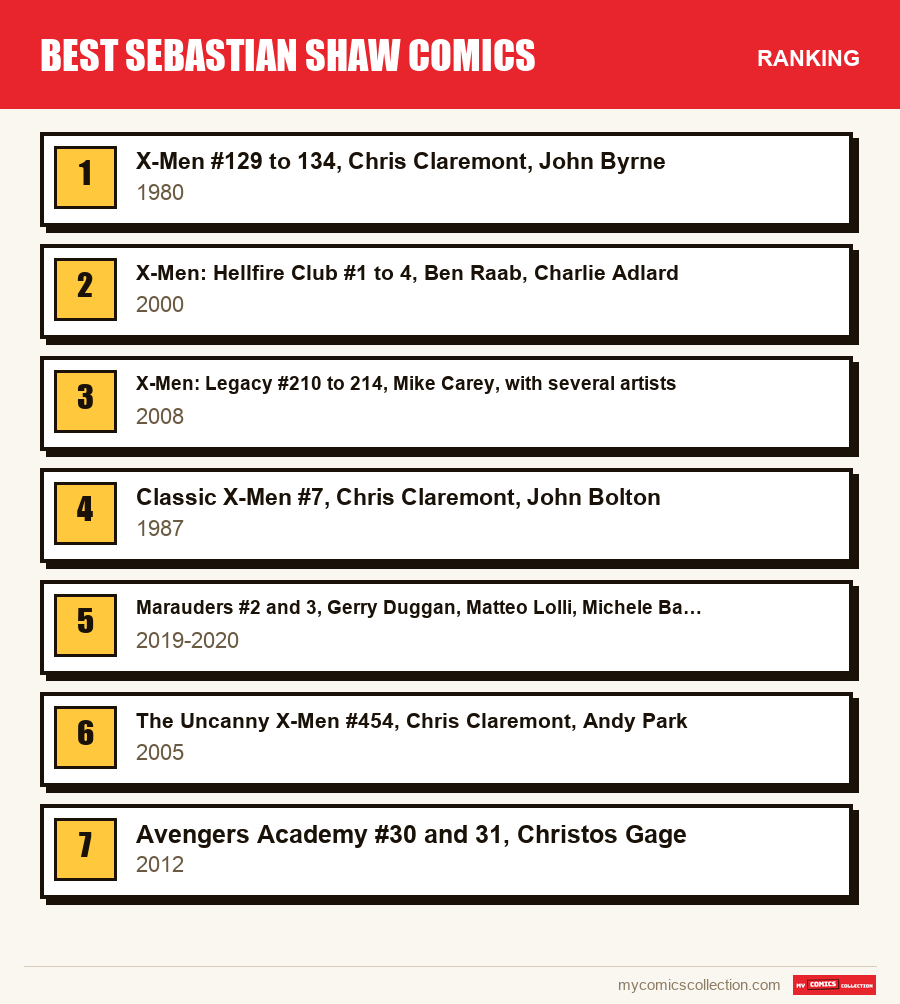
The best Sebastian Shaw comics begin with X-Men #129 to 134 (1980) by Chris Claremont and John Byrne, where he first appears as the Black King of the Hellfire Club. Continue with the miniseries X-Men: Hellfire Club (2000) by Ben Raab and Charlie Adlard, then X-Men: Legacy #210 to 214 (2008) by Mike Carey. For his modern era, read Marauders #2 and 3 (2019-2020) by Gerry Duggan.
Sebastian Shaw is an industrialist and a strategist: he runs the Hellfire Club's Inner Circle from his seat as Black King, funds Sentinel programs, and absorbs the energy of the blows aimed at him. He is a drawing-room antagonist who prefers a contract to a brawl, and that is exactly what complicates sorting his stories: many mention him, few put him at the center. Here are seven reads where he truly matters, with what each one offers and how to approach it.
As always in this guide, only verified information (creators, issue numbers, dates) is stated as fact; the analysis is ours, with no reproduction of protected pages or dialogue.
His first appearance
Sebastian Shaw's first page is in X-Men #129, from January 1980, by Chris Claremont (writing) and John Byrne (art), within the Dark Phoenix Saga. John Byrne gave the character the features of the British actor Robert Shaw, who died in 1978.
The Hellfire Club is born in the same issue: it is a society of the New York elite whose Inner Circle maneuvers against the X-Men, and Shaw is its commanding figure. To place this issue within the team's run, see the key issues of the Dark Phoenix Saga; the artist is profiled in the list of creator pages at the top of the article.
How we ranked the seven reads
Shaw is often a supporting player: a financier called in for one scene, then set aside. We kept only the stories where he drives the plot, as the main opponent, as the central stake, or as an indispensable ally of circumstance. When he is only a passenger, as in House of X #6, the issue appears further down among the key issues, with his role spelled out, outside the ranking. The order starts with the read that is a must and ends with the most incidental.
1: X-Men #129 to 134, Chris Claremont, John Byrne (1980)
From January to June 1980, Chris Claremont and John Byrne stage the Hellfire Club's debut against the X-Men. Shaw is not present in every issue of the sequence, but he is its mastermind: the club's agents first fail against the team, then the X-Men infiltrate the club in issues 132 to 134, while Mastermind works on Jean Grey in the same stretch.
What the read offers is essential: you see Shaw in his original register, the schemer who directs from the top of an organization, and the Hellfire Club reveals itself as a full-fledged structure, with its ranks and its failures. It is the foundation on which every later read rests.
Who is it for? Everyone, and above all the reader approaching the 1980 Uncanny X-Men for the first time. How should you read it? In one sitting, with issue 135, which extends the sequence. The profile of Emma Frost, his partner at the club, appears in the list at the top of the article.
2: X-Men: Hellfire Club #1 to 4, Ben Raab, Charlie Adlard (2000)
Four issues, from January to April 2000: Ben Raab handles the script, Charlie Adlard the art. The issue titles follow a thread: Witch Hunt, Toll the Bell Liberty, For Want of a Soul, then Also Sprach Sebastian for the last one. The story traces the club's history through its great families, including the Shaws, the Worthingtons, the Braddocks, the Harknesses, and the Greys, and Shaw takes center stage in the final issues.
The miniseries offers what is missing elsewhere: a genealogy of power. You understand where the club comes from, why Shaw fits in as the heir to a lineage, and what his place represents. It is the most instructive way in for anyone who wants to know the character beyond his fights.
Who is it for? The reader who enjoys secret-history stories. How should you read it? In four issues, after pick 1, since it assumes you have seen Shaw in action.
3: X-Men: Legacy #210 to 214, Mike Carey, with several artists (2008)
Mike Carey writes this five-issue run, dated June to September 2008 and collected as Sins of the Father, with several artists including Scot Eaton. Shaw holds a device called the Cronus machine, an object tied to a family line: his father had designed a protective version of it by reverse engineering, which defends Sebastian as long as it stays close and active. In issue 211, Sunspot worries about the deaths the device has caused inside the club; in issues 213 and 214, Shaw and Gambit find themselves allied in an operation against the assassins, then against the device itself, which the two men destroy.
The read gives Shaw a role that is rare for him, that of an ally of circumstance: the Black King defends his own interest at the same time as that of Charles Xavier, whose mind comes under Mister Sinister's influence before breaking free. To understand the figure of Sinister, see our Mister Sinister reading guide.
Who is it for? The reader who wants an ambiguous Shaw, neither quite an enemy nor quite a friend. How should you read it? As five consecutive single issues, or with the Sins of the Father trade paperback.
4: Classic X-Men #7, Chris Claremont, John Bolton (1987)
Issue 7 of Classic X-Men, dated March 1987, reprints an issue from the team's early days and adds new pages to it. The backup story, drawn by John Bolton from a script by Chris Claremont, is titled Out with the Old! and stages the Hellfire Club's internal tensions: it deals with Shaw's seizure of power within the Inner Circle.
The read offers what no 1980 story told: the past of a character who until then had only a present. It places Shaw and Emma Frost in a power play against the club's former masters and explains the bond that unites them.
Who is it for? The reader who enjoys retrospective supplements. How should you read it? On its own, as a short episode, after reads 1 and 2. It sits in an issue of a reprint series, which makes it easy to spot in a shop.
Do you collect this series?
Track what you own, what you are missing and what your collection is worth. 7-day trial.
Start my trial →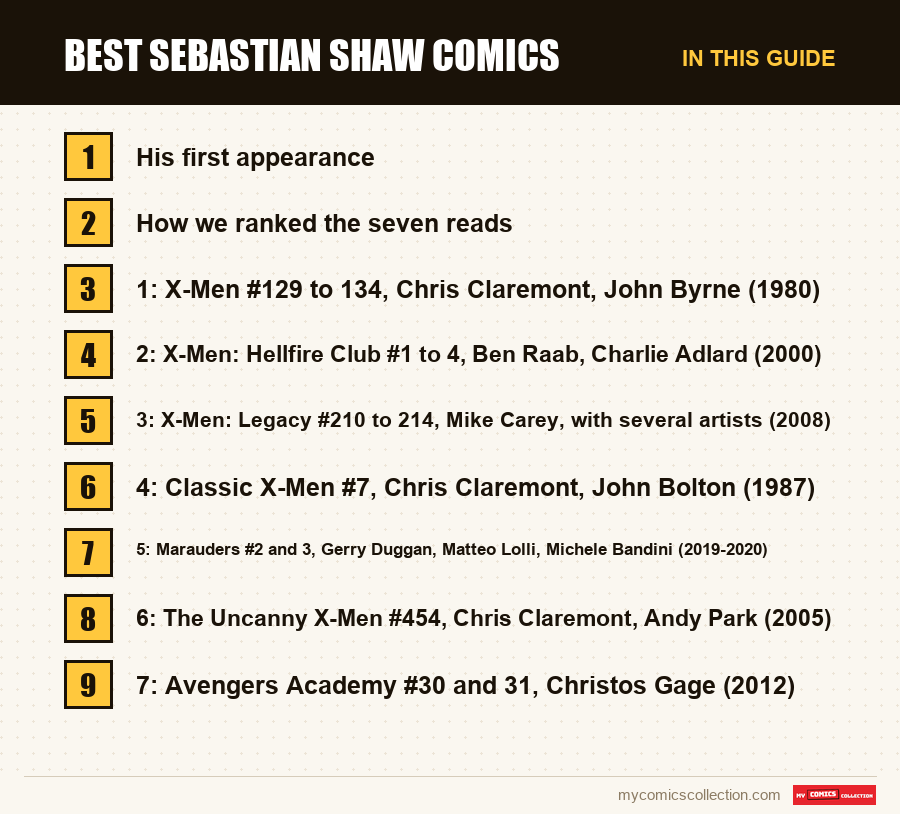
5: Marauders #2 and 3, Gerry Duggan, Matteo Lolli, Michele Bandini (2019-2020)
Gerry Duggan writes both issues; Matteo Lolli draws issue 2 and Michele Bandini draws issue 3. Issue 2 revolves around the clash between Shaw and Emma Frost, which the arrival of Kate Pryde as the new Red Queen interrupts just as they were about to come to blows. Issue 3 shows Shaw trying to bring back his son Shinobi to make him his Black Bishop, as part of the Hellfire Trading Company, the club's commercial arm.
The read offers a Shaw of the Krakoa era, who trades his role as adversary for that of a businessman settled into an official mutant order. The contrast with pick 1 is the reason it is worth your time.
Who is it for? The reader of the Hickman period, who wants to follow the character through the new status quo. How should you read it? In two issues, after House of X, which we cover in our key issues of House of X.
6: The Uncanny X-Men #454, Chris Claremont, Andy Park (2005)
Dated March 2005, this issue is the third and final part of Chasing Hellfire!. Chris Claremont writes, Andy Park draws, and Jon Sibal inks. In Paris, Donald Pierce and his cleanup crew attack the X-Men, Sage, and Shaw, then the club's Lord Imperial. Shaw, mortally wounded, kills Pierce with a last effort, then clashes with Sage, who tells him he is no longer worth saving. Sage then names Sunspot as the new Lord Imperial.
The interest of this issue is the end of a reign: you watch Shaw lose control of the club he was running. It also delivers the unveiling of Sage's double game.
Who is it for? The reader of the Claremont era who is back on Uncanny X-Men. How should you read it? With the two issues that precede it in the arc, to grasp how the threat builds.
7: Avengers Academy #30 and 31, Christos Gage (2012)
Christos Gage writes this two-parter, and Tom Grummett draws issue 30, dated July 2012. Shaw escapes his detention at the academy, absorbs the energy of those who try to stop him, beats Madison Jeffries and Hercules, knocks out Tigra, then takes on the students. His motivation turns out to be revenge against Emma Frost, who had erased his memories.
We place it last: the story unfolds in an Avengers series, and Shaw is a passing antagonist there, though the main one in issue 30. It shows what he is worth physically, away from his offices.
Who is it for? The Avengers Academy reader and the appearance hunter. How should you read it? In two issues, with no particular preparation.
Where to start based on your profile
If you are discovering Shaw, start with pick 1, then pick 2: you get his first appearance and the genealogy of his power, in five issues and one miniseries. If you follow the X-Men of Krakoa, jump straight to Marauders #2 and 3 and to House of X #5 and 6, where he sits on the Council. If you like industrial espionage plots, pick 3 is the densest.
If you collect the 1980s, look for Classic X-Men #7 in addition to the original series, then check out the best New Mutants runs, where the club has branches. For the highlights of the Claremont period, refer to the list at the top of the article.
The key issues to know
On the collecting side, you start with the 1980 issue that introduces Shaw, then follow the issues that shift his position at the club. Nothing is priced here; compare copies of the same grade and the same printing, watched over a long period.
- X-Men #129 (January 1980): first appearance of Sebastian Shaw, by Chris Claremont and John Byrne. It is the starting reference.
- X-Men #132 to 134 (1980): the X-Men's infiltration of the Hellfire Club, with Shaw at the head of the Inner Circle.
- Classic X-Men #7 (March 1987): John Bolton's retrospective story on Shaw's seizure of power.
- The New Mutants #75 (May 1989): Shaw is ousted from the club there by Magneto, Selene, and Emma Frost. He is the subject, not the hero.
- The Uncanny X-Men #454 (March 2005): the end of his reign as Lord Imperial.
- House of X #6 (October 2019): the Quiet Council meets, with Shaw at its side. Jonathan Hickman writes and Pepe Larraz draws; Shaw is one member among others there, hence his absence from the ranking.
- X-Men: The Hellfire Murder #1 (July 2026): Shaw, host of a masked Hellfire Club gala, is found dead there. The issue is written by Saladin Ahmed and Erica Schultz, with several artists.
Before buying, double-check the series title and issue number printed on the cover and in the indicia. For X-Men #129, make sure you have the actual 1980 issue and not a reprint.
Frequently asked questions
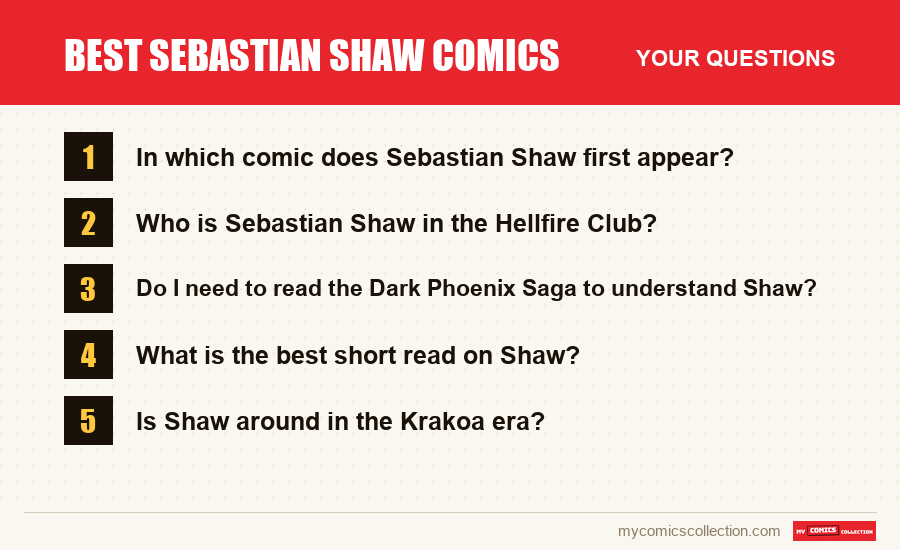
The January 1980 issue that introduces Shaw is X-Men #129; Chris Claremont wrote it and John Byrne drew it. The issue opens the part of the Dark Phoenix Saga devoted to the Hellfire Club and introduces the Inner Circle that Shaw leads.
He is the Black King of the Inner Circle, a title he holds in 1980 and loses several times before returning to it. A wealthy industrialist, he absorbs the energy of the blows he takes. The story of his seizure of power is told in Classic X-Men #7, by Claremont and Bolton.
The saga is not mandatory, but it is the best way in: Shaw appears in issues 129 to 134 of 1980, at the peak of his power. If you read it, continue with issue 135. The key issues of that saga serve as landmarks to find your bearings.
The miniseries X-Men: Hellfire Club, from January to April 2000, runs four issues. Ben Raab writes it, Charlie Adlard draws it, and Shaw dominates the final issues. It can be read on its own, without knowing the Dark Phoenix Saga, which makes it accessible.
Yes: House of X #6 places him on the Quiet Council, and Marauders #2 and 3, by Gerry Duggan, show his opposition to Emma Frost and his plan involving his son Shinobi. It is the most direct way to follow the character in Jonathan Hickman's status quo.
Do you own a copy of X-Men #129 or another Hellfire Club issue? Get a free estimate.
Estimate my comic