
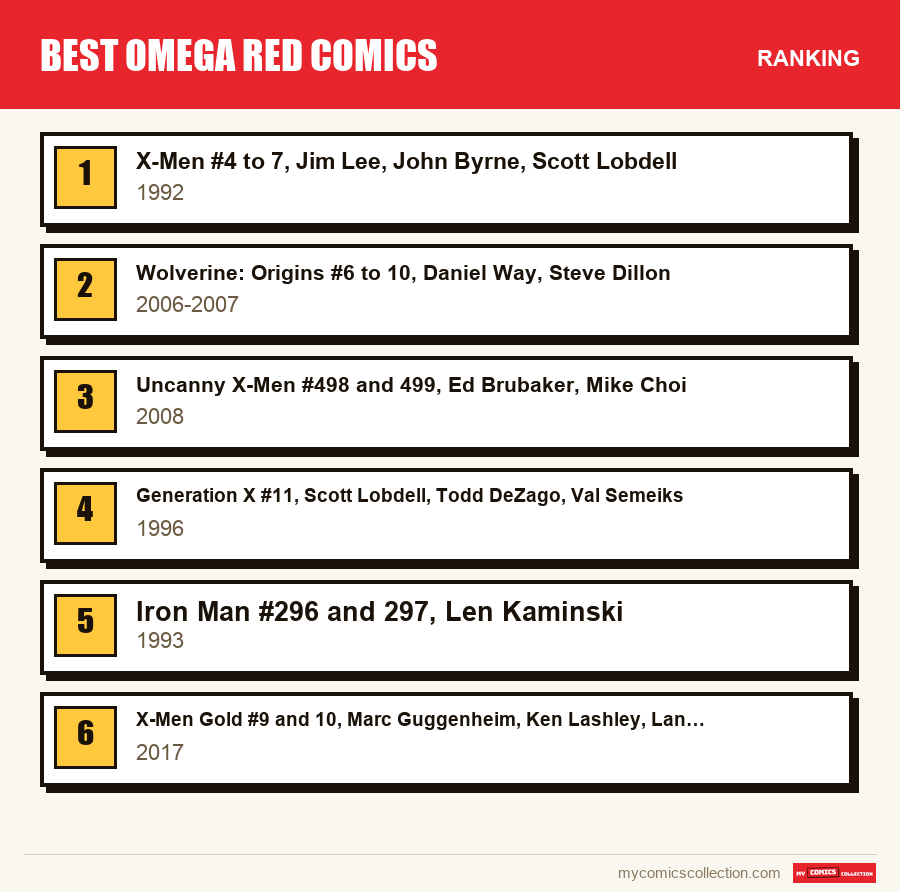
The best Omega Red comics start with X-Men #4 (January 1992), his first appearance, where Jim Lee and John Byrne introduce him, and continue through issues 5 to 7. Next comes Wolverine: Origins #6 to 10 (2006-2007) by Daniel Way and Steve Dillon, which ties the character to the carbonadium synthesizer. Finish with Uncanny X-Men #498 and 499 (2008) by Ed Brubaker, then Generation X #11 (1996) if you want his Arkady Rossovich backstory.
Arkady Rossovich is a Soviet soldier whose arms carry carbonadium tentacles and whose body gives off spores that drain the life of anyone who comes near. He mostly turns up in other characters' books, often to claim a device that Wolverine, Sabretooth, and Maverick took from him back when they worked together as a team. This guide is therefore strict and keeps only six reads where he genuinely matters to the plot, with what each one offers and how to approach it.
As always in this guide, only verified information (creators, issue numbers, dates) is stated as fact; the analysis is ours, with no reproduction of protected pages or dialogue.
His first appearance
Omega Red debuts in X-Men #4, cover-dated January 1992, in the series relaunched in 1991. Jim Lee plotted and drew the issue, John Byrne scripted it, and Scott Williams inked it. The issue establishes everything that will define the character: a former Soviet agent, a personal link to Wolverine, Sabretooth, and Maverick, and a physical menace of a new kind, metallic filaments able to snatch away life energy.
In these early issues, Omega Red has just been brought back to life by the Hand, and he is hunting for a way to stabilize his body, a device he believes Wolverine holds. The immediate follow-up, through issue 7 of April 1992, widens the fight to the whole team. To place this start within the run of the series, see our guide to X-Men key issues.
How we ranked the six reads
Omega Red is a supporting antagonist in most of his appearances: a rival called in for a fight scene, then set aside. We kept the stories where he carries the stakes, either because he is the main opponent or because the plot revolves around his history. An episode like X-Men #18 and 19, where the former soldier crosses paths with another enemy, is described further down among the key issues, with his role spelled out, but it does not appear in the ranking. The order runs from the essential read to the one that can wait.
1: X-Men #4 to 7, Jim Lee, John Byrne, Scott Lobdell (1992)
These four issues, from January to April 1992, are the character's official introduction. Issue 4 is plotted and drawn by Jim Lee and scripted by John Byrne; in issue 7, titled Inside...Out!, Jim Lee keeps the plot and the art, with Art Thibert on inks, while Scott Lobdell writes the dialogue. The arc follows Omega Red's hunt for Wolverine, and issue 6 puts him face to face with an old score to settle with Wolverine, Sabretooth, and Maverick.
What this arc offers is fundamental: you learn why Omega Red's hatred has a specific object, a device rather than a simple thirst for revenge, and you see how his tentacles and spores work. It is also a good example of the period when the X-Men series, launched in 1991, leaned on Jim Lee's artwork.
Who is it for? Anyone opening the Omega Red file, before any of his later returns. How should you read it? In one sitting, from issue 4 to issue 7, without trying to catch up on the series beforehand. The landmarks of the period are gathered in the history of X-Men comics.
2: Wolverine: Origins #6 to 10, Daniel Way, Steve Dillon (2006-2007)
Daniel Way writes and Steve Dillon draws this five-issue run, published between late 2006 and early 2007 and collected in the volume Savior. Issue 8, dated January 2007, makes Omega Red the main antagonist: he kidnaps Jubilee and holds information about where the carbonadium synthesizer is, which Maverick had sold to a buyer. Flashbacks show an ambush in Berlin forty years earlier, which leads to the death of Janice Hollenbeck.
What the read offers: the three men's shared past stops being a backdrop and becomes an espionage plot, with a synthesizer as the object of desire. The tone is drier than in the 1990s, and Dillon's linework gives Omega Red a weight that is less spectacular and more brutal.
Who is it for? The Wolverine reader who wants to understand the real motive behind the hunt. How should you read it? With the Savior trade paperback, after a glance at Wolverine's past in our history of Wolverine comics.
3: Uncanny X-Men #498 and 499, Ed Brubaker, Mike Choi (2008)
Ed Brubaker writes both of these 2008 issues; Mike Choi draws issue 498, and issue 499 is drawn by Mike Choi with Ben Oliver. In Russia, Colossus, Wolverine, and Nightcrawler escape from a government official who, to defend himself, releases his prisoner: Omega Red. He kills his jailer, then turns on the three men. Issue 499 closes out the fight, which the three X-Men win in Russia.
The read brings back an enemy from the 1990s in a series with an adult tone, built around a breakout on Russian soil. It is short and useful for anyone who wants to see Omega Red serve a tighter team story.
Who is it for? The Uncanny X-Men reader of the Brubaker era, and anyone who prefers a two-issue Omega Red. How should you read it? As two consecutive single issues, knowing that both belong to a larger arc whose ending lands here. The series' landmarks appear in the key issues of Uncanny X-Men; the writer has his own page, Ed Brubaker.
Do you collect this series?
Track what you own, what you are missing and what your collection is worth. 7-day trial.
Start my trial →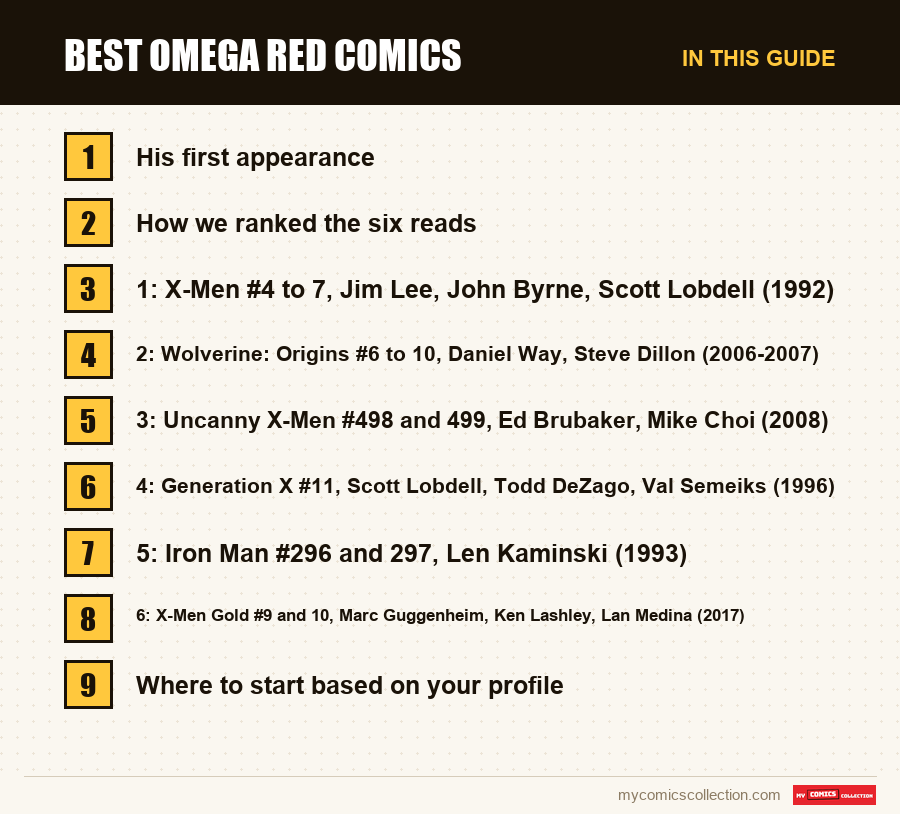
4: Generation X #11, Scott Lobdell, Todd DeZago, Val Semeiks (1996)
Dated January 1996, this issue is the second part of the Death Wail story, which opened in issue 10 of December 1995. Scott Lobdell provides the plot and writes with Todd DeZago, and Val Semeiks draws, with a cover by Chris Bachalo. Omega Red hits the team of young mutants with his spores and takes them out of the fight, except for Chamber, who faces him alone near a dam and stops him.
The issue offers a look back at his origins. In a parallel story, Sean Cassidy and Inspector Deveraux pick up the trail of Arkady Rossovich, which gives the character a name and a past outside his fights with Wolverine. It is the most informative read on the man behind the menace.
Who is it for? The reader curious about origins, and the Generation X reader. How should you read it? With issue 10, which comes right before it, since they form a single story. Chamber's team is the one from the 1994 series by Scott Lobdell and Chris Bachalo.
5: Iron Man #296 and 297, Len Kaminski (1993)
Len Kaminski writes these two issues from September and October 1993, and Kevin Hopgood draws issue 296, inked by Steve Mitchell. Tony Stark, then in a wheelchair, pilots the armor remotely against MODAM and A.I.M.; the fight is interrupted by Omega Red, who is after MODAM's head. Issue 297 pits Iron Man against the character.
The read offers something unusual: an Omega Red outside the X-Men universe, caught up in an espionage feud that goes back to a time when MODAM was called Olinka Barankova. It stands apart from the Wolverine stories and works as a curiosity for the Iron Man reader.
Who is it for? The 1990s Iron Man collector, and anyone hunting for Omega Red appearances outside the X-Men. How should you read it? As two issues, with no preparation other than the name MODAM.
6: X-Men Gold #9 and 10, Marc Guggenheim, Ken Lashley, Lan Medina (2017)
Marc Guggenheim writes these two 2017 issues: Ken Lashley draws issue 9 and Lan Medina draws issue 10. Issue 9 shows Omega Red's resurrection, and issue 10 sends Colossus and Magik to Russia to help a stranger, whom they find in the former soldier's hands. His return is temporary: for it to become permanent, he needs Magik's powers.
What it adds is a new driving force for the character: Omega Red is no longer a hunter of Wolverine but a man trying to stay alive by relying on a teleporter. We place it last because the character depends on another hero in order to exist, whereas the earlier reads let him drive the action.
Who is it for? The Colossus and Magik reader, whose profile appears in the best Colossus comics. How should you read it? As two consecutive issues, in the X-Men Gold series.
Where to start based on your profile
If you are discovering the character, read X-Men #4 to 7, then issues 498 and 499 of Uncanny X-Men: you get the beginning and an efficient comeback in under ten single issues. If you read Wolverine, add Wolverine: Origins #6 to 10 and the page on the Wolverine vs. Sabretooth showdowns, because the story of the stolen device is the key to their rivalry.
If you like origin stories, read Generation X #10 and 11. If you collect the Jim Lee period, gather issues 4 to 7 of the 1991 series, checking whether you have the newsstand edition or the direct market edition, since this title existed in both forms. Finally, if you follow Iron Man or Colossus, entries 5 and 6 are your natural entry points.
The key issues to know
On the collecting side, two landmarks are enough here: the 1992 issue that launches the character, then the episodes where his story takes shape. No figures are given; compare copies of the same grade and the same edition, tracked over a long period.
- X-Men #4 (January 1992): first appearance of Omega Red, created by Jim Lee and John Byrne. It is the character's starting reference and the one collectors look for first.
- X-Men #18 and 19 (March and April 1993): Fabian Nicieza writes and Andy Kubert draws. Omega Red fights the Soul Skinner in a frozen Russian city, loses to him, then turns on the X-Men. He is one player among several there, not the engine of the arc, which is why these issues are absent from our ranking.
- Iron Man #296 (September 1993): his arrival in the fight against MODAM.
- Generation X #11 (January 1996): the telling of his past as Arkady Rossovich.
- Wolverine: Origins #8 (January 2007): Omega Red as the main adversary, with the kidnapping of Jubilee.
- Uncanny X-Men #499 (2008): the conclusion of the Russian showdown.
Before buying, double-check the issue number and series title printed on the cover as well as in the indicia, then ask yourself whether it is the newsstand edition or the direct market edition. Our page on the key issues of Weapon X helps place the era in which the conflict over Wolverine plays out.
Frequently asked questions
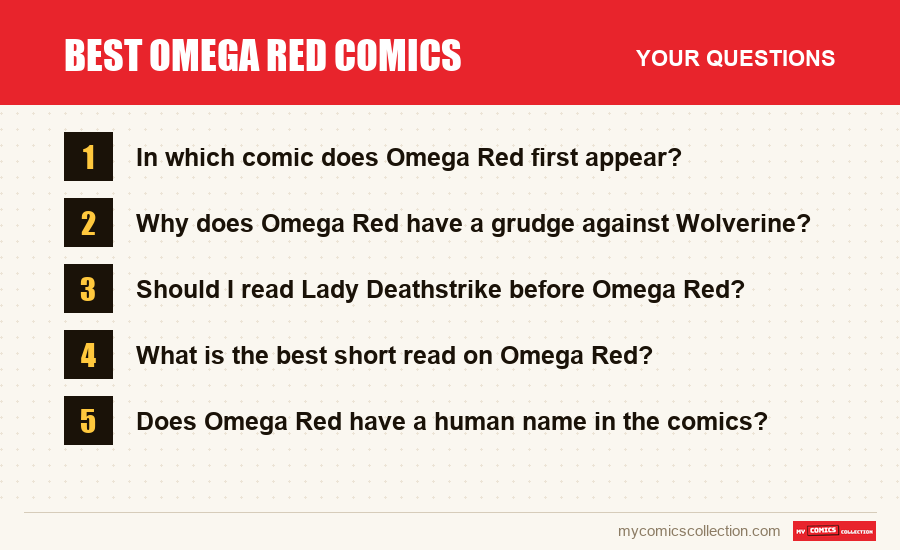
Omega Red makes his first appearance in X-Men #4, dated January 1992, of the series launched in 1991. The plot and art are by Jim Lee, the script by John Byrne, with Scott Williams on inks. The arc continues through issue 7, dated April 1992.
In the espionage stories, a device called the carbonadium synthesizer stabilizes his body. Wolverine, Sabretooth, and Maverick took it from him back when they worked together. Omega Red's grudge comes from that dependence, which Wolverine: Origins #6 to 10 explores at length.
No, the two characters can be read independently. What they share is that both are Wolverine enemies chasing one specific object, adamantium for her, the synthesizer for him. If you like one, reading the other is a natural next step: see the page on the best Lady Deathstrike comics, in the list at the top of this article.
Issues 498 and 499 of Uncanny X-Men, published in 2008, form a brief run in which he plays a leading role. Ed Brubaker writes them, Mike Choi draws them, with Ben Oliver on issue 499. They can be read without knowing the rest of the series.
Yes: his name is Arkady Rossovich. His past is laid out in Generation X #11, dated January 1996, in a flashback where Sean Cassidy and Inspector Deveraux pick up his trail. The issue is written from a plot by Scott Lobdell and drawn by Val Semeiks.
Do you own a copy of X-Men #4 or another Omega Red issue? Get a free estimate.
Estimate my comic