
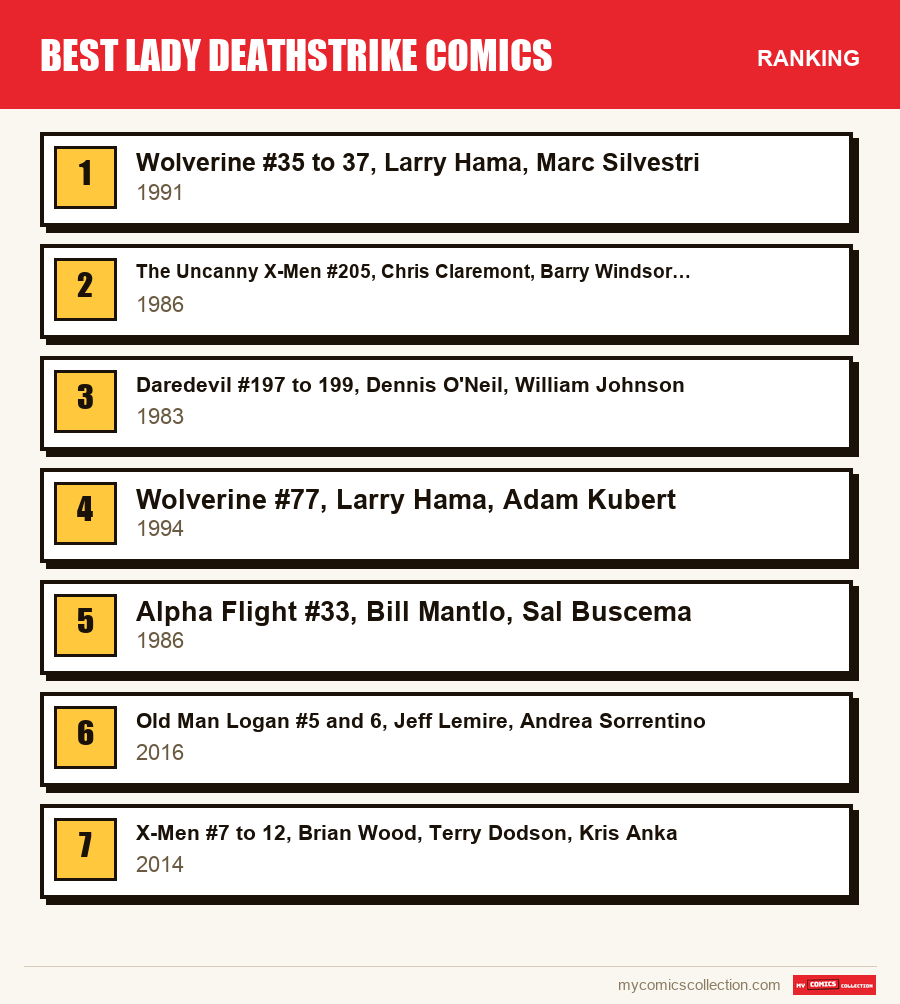
To find the best Lady Deathstrike comics and where to start, begin with Daredevil #197 to 199 (1983), where Yuriko Oyama appears under Dennis O'Neil's pen, then Alpha Flight #33 (1986), where she takes her war name, and The Uncanny X-Men #205, which makes her a cyborg. Follow with Wolverine #35 to 37 (1991) by Larry Hama and Marc Silvestri, then Wolverine #77 (1994), where her vendetta changes nature.
Yuriko Oyama runs through forty years of Marvel with one constant obsession: the adamantium that bonds Wolverine's skeleton, born of her father's work. Her presence is irregular, often backing up another enemy, which forces a harsh sort. Seven reads follow, all chosen because Yuriko weighs on the plot, with what each adds and how to approach it.
As always in this guide, only verified facts (creators, issue numbers, dates) are stated as fact; the analysis is our own, with no reproduction of protected pages or dialogue.
Her first appearance
Yuriko Oyama debuts in Daredevil #197, dated August 1983, written by Dennis O'Neil and drawn by William Johnson. She does not yet carry the name Lady Deathstrike: she is an ally of Daredevil, come to free her lover Kira and to avenge the mistreatment of her father, Kenji Oyama, known as Lord Dark Wind. This former kamikaze pilot is associated with the process that bonds adamantium to bone, which makes him the distant source of everything that follows for Wolverine.
The name Lady Deathstrike arrives later, in Alpha Flight #33, dated April 1986, by Bill Mantlo and Sal Buscema. This distinction matters for your collection: the 1983 single issue carries the appearance of Yuriko, the 1986 one carries the character as the public knows her.
To place the 1983 arc within the series, read the page on the first Daredevil series; the issue's writer is profiled on the Dennis O'Neil page.
How we ranked the seven reads
Lady Deathstrike is a Wolverine antagonist before she is a series heroine, and she often appears in the second row, behind a broader threat. We kept only stories where she plays a driving role: main adversary, instigator of the plot or anchor of the stakes. The crossovers where she is only reinforcement, like Messiah Complex, are cited below in the key issues, but not ranked. We go down from the most accessible read to the most optional.
1: Wolverine #35 to 37, Larry Hama, Marc Silvestri (1991)
These three single issues of the second Wolverine series, dated January to March 1991 and titled Blood and Claws, are written by Larry Hama and drawn by Marc Silvestri. This is Lady Deathstrike's arrival in Wolverine's solo series, and the story is conceived as a hunt: the plot sends Wolverine and Puck back to 1937, in Civil War Spain, with the enemy on their heels.
What the arc gives is valuable: it provides the character with an adversary who is not just a metal body, but someone pursuing a goal with the mind of a tracker. It also shows why she remains a lasting Wolverine antagonist, despite a role that might seem confined to team pages.
Who should read it? Anyone who wants Lady Deathstrike in full action, without knowing the previous years. How to read it? In three issues, in one go. The context of the period is described in our history of Wolverine comics.
2: The Uncanny X-Men #205, Chris Claremont, Barry Windsor-Smith (1986)
Chris Claremont writes and Barry Windsor-Smith draws this May 1986 single issue, which tips Yuriko into another form. Spiral, who runs a body-modification shop in Mojo's dimension, installs cybernetic upgrades on Yuriko; it is the issue where she appears as a cyborg, and Windsor-Smith designs her look.
Wolverine, caught in an ambush, gets out only with the help of a young ally from Power Pack, Katie, alias Energizer. The interest is twofold: you see the shift from sword fighter to war machine, and the improbable meeting between the X-Men's universe and that of a team of child heroes.
Who should read it? Anyone who wants to understand the origin of Yuriko's current look. How to read it? On its own, as a complete episode, or following entry 5. The references of the era are cataloged in the key issues of Uncanny X-Men.
3: Daredevil #197 to 199, Dennis O'Neil, William Johnson (1983)
The arc runs from August to October 1983. Dennis O'Neil writes the three single issues and William Johnson draws them, with several inkers taking turns. Yuriko allies with Daredevil to free Kira and avenge her father, she guides him to the island where she kills Lord Dark Wind, and Bullseye is tied into the plot.
We rank it behind the Wolverine stories because the character does not yet have a war name or a cyborg face, but it sets the motif that will drive her: grief and family vengeance, born of the mistreatment her father suffered and of his death.
Who should read it? The Daredevil reader, and anyone who loves origins. How to read it? In three consecutive issues. To place Daredevil in this period, see the major artists of the series.
4: Wolverine #77, Larry Hama, Adam Kubert (1994)
This January 1994 issue is titled The Lady Strikes!, with Larry Hama on script and Adam Kubert on art. Lady Deathstrike comes to claim Wolverine's adamantium, but learns he lost it in his fight with Magneto. She then abandons her vendetta on seeing his natural bone claws.
The single issue counts because it flips the logic of hatred: the adversary who had only one reason to exist finds herself deprived of a target. The character evolves instead of replaying the same scene.
Who should read it? The Wolverine reader of the 1993-1994 period, who knows about the loss of the adamantium. How to read it? After Hama's issues on the loss of the adamantium, or on its own as an epilogue. See also the Wolverine crossovers.
Do you collect this series?
Track what you own, what you are missing and what your collection is worth. 7-day trial.
Start my trial →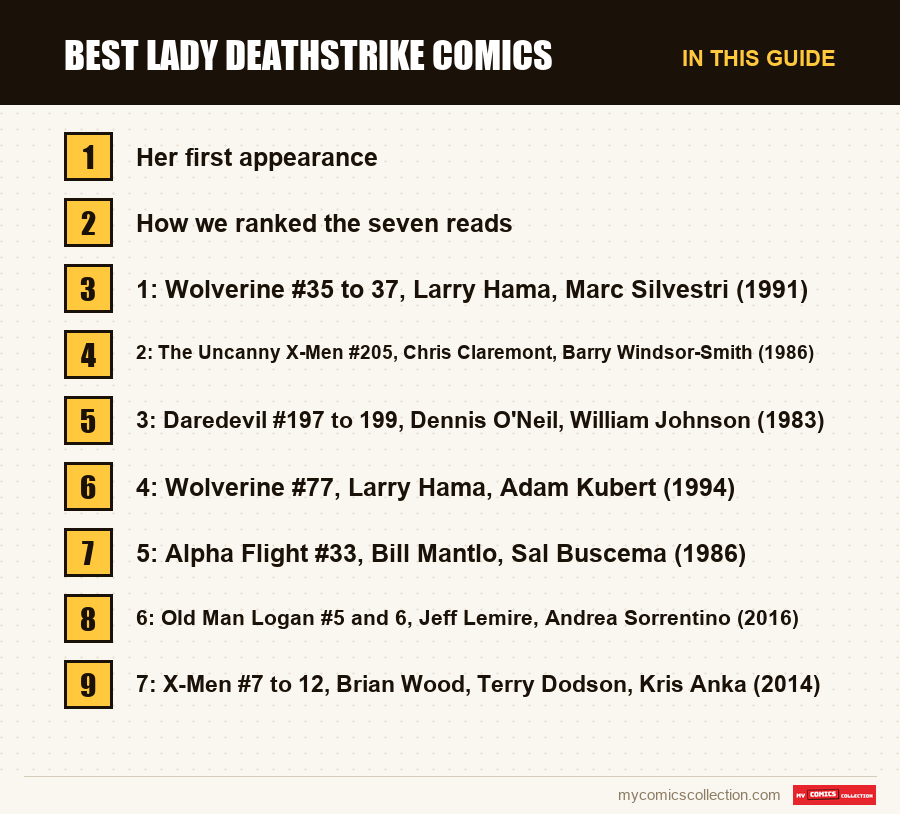
5: Alpha Flight #33, Bill Mantlo, Sal Buscema (1986)
Dated April 1986 and concluded in issue #34, this two-parter launches Lady Deathstrike under her name, in a samurai costume designed by Bill Mantlo and Sal Buscema. Heather Hudson comes to ask Wolverine for help, and the enemy's threat falls on her. She is beaten by Wolverine and by Heather, now Vindicator.
The story mainly serves as the anchor for the name: it sketches an adversary in the image of her Japanese references, before Claremont makes her cybernetic shortly after. The single issue is useful to Alpha Flight collectors as much as to X-Men readers.
Who should read it? The first-appearance hunter, and anyone interested in the Canadian heroes. How to read it? In two issues. For the context of the Canadian series, see Alpha Flight #1.
6: Old Man Logan #5 and 6, Jeff Lemire, Andrea Sorrentino (2016)
In the Old Man Logan series relaunched in 2016, Jeff Lemire writes and Andrea Sorrentino draws. Issues #5 and #6 open the Killhorn Falls arc, a town in the Northwest Territories cut off from the world most of the year, where Logan ends up prevailing over Lady Deathstrike.
She therefore returns as an antagonist in a survival setting very far from the classics, with Sorrentino's dark, chopped style. The story shows a colder, more mechanical face of the character.
Who should read it? The Old Man Logan reader who wants to see her outside her usual landmarks. How to read it? With the Bordertown volume, which collects these issues and the following ones. For the series as a whole, see our Old Man Logan reading guide and the Jeff Lemire page.
7: X-Men #7 to 12, Brian Wood, Terry Dodson, Kris Anka (2014)
The six-issue Muertas arc brings Lady Deathstrike back in the 2013 X-Men series, scripted by Brian Wood, with Terry Dodson and Kris Anka on art. Her consciousness ends up in the body of Ana Cortes, then in that of Reiko, and the plot gets mixed up with Arkea's search for a new Sisterhood.
We placed it last: the arc is uneven, and the conclusion disappointed many readers. It has the merit of exploring a new idea, that of a mind without a body, which takes Lady Deathstrike out of her warrior role. X-Men fans of the 2010s will find a complement there.
Who should read it? The completist reader of the team series, not the beginner. How to read it? Through the Muertas collection, after getting to know the character through entries 1 to 4. The X-Men hub gives the framework.
Where to start based on your profile
For an evening, choose Wolverine #35 to 37 (entry 1): three issues, a central enemy, no prior reading. The Daredevil reader will start from the 1983 arc (entry 3), then move on to entry 5. Anyone interested in the cybernetic look will go straight to the Claremont and Windsor-Smith single issue (entry 2).
A Wolverine reader who knows about the loss of the adamantium will read entry 4 as an epilogue. For a recent read, Old Man Logan (entry 6) is the easiest to access, and Muertas (entry 7) requires some existing landmarks on the character.
The key issues to know
Three things need to be told apart: the moment Yuriko appears, the one where she receives her name, and the one where she changes form. Each is a different single issue, and none gets mistaken for the others.
- Daredevil #197 (August 1983): Yuriko Oyama, by Dennis O'Neil and William Johnson.
- Alpha Flight #33 (April 1986): the name Lady Deathstrike and the samurai costume.
- The Uncanny X-Men #205 (May 1986): the shift to cyborg, with Barry Windsor-Smith.
- Wolverine #35 (January 1991): the arrival in Wolverine's solo series.
- Wolverine #77 (January 1994): the vendetta changes nature.
- New X-Men vol. 2 #44 (January 2008): she leads the Reavers during Messiah Complex.
- Weapon X vol. 3 #1 (June 2017): her capture by the new Weapon X team.
Before a purchase, always check which printing you are holding and the condition of the spine: on single issues from the 1980s, yellowed paper and crushed corners show up faster than in a recent period.
Frequently asked questions
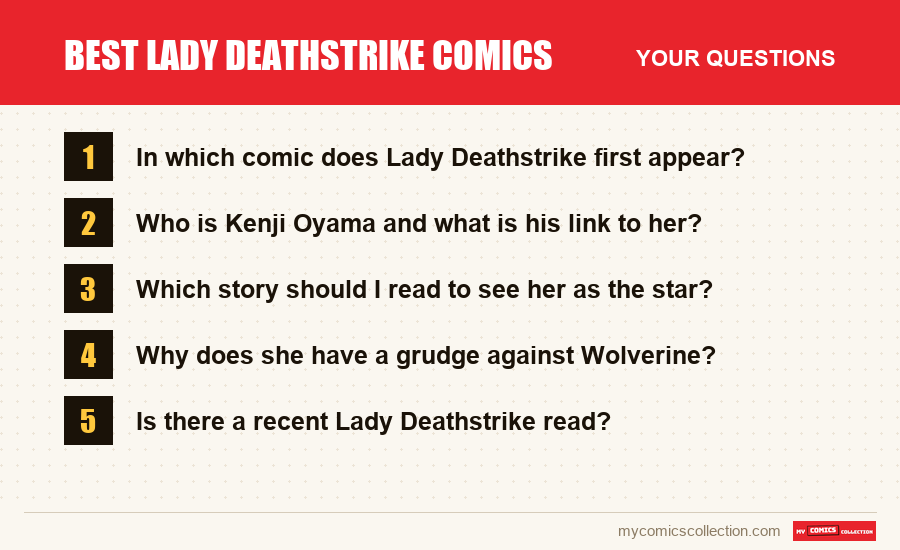
Yuriko Oyama debuts in Daredevil #197, dated August 1983, by Dennis O'Neil and William Johnson. The name Lady Deathstrike appears in Alpha Flight #33, in April 1986. She becomes a cyborg in The Uncanny X-Men #205, in May 1986.
Kenji Oyama, nicknamed Lord Dark Wind, is Yuriko's father and a former kamikaze pilot. He is associated with the process that bonds adamantium to bone. In Daredevil #197 to 199 (1983), Yuriko kills him on his island after guiding Daredevil to him.
The mini-saga of Wolverine #35 to 37, by Larry Hama and Marc Silvestri (January to March 1991), is the most accessible: three issues, a chase, no prior knowledge needed. The 1986 single issue by Claremont and Windsor-Smith then completes the origin of her cybernetic look.
She pursues Wolverine's adamantium in memory of her father, whose work is tied to that metal. Wolverine #77 (January 1994) flips the situation: Logan lost his adamantium after his fight with Magneto, and she ends her vendetta on seeing his bone claws.
Yes. Old Man Logan #5 and 6, by Jeff Lemire and Andrea Sorrentino (2016), has her fight Logan at Killhorn Falls, and the Muertas arc of Brian Wood's X-Men series (2014) changes her form. The 2017 capture appears in Weapon X vol. 3 #1.
Is a 1980s Daredevil or Wolverine single issue sitting in your boxes? Have it appraised before deciding what to keep.
Appraise my comic