
The best Moon Girl comics start with Moon Girl and Devil Dinosaur #1, released in November 2015, where Lunella Lafayette debuts under the pen of Brandon Montclare and Amy Reeder, with Natacha Bustos on art. Then read the trade paperbacks BFF (#1-6) and Cosmic Cooties (#7-12), followed by the Fantastic Three arc (#25-30). To get to know Devil Dinosaur, go back to Jack Kirby's 1978 series.
Moon Girl is one of the most distinctive heroines in recent Marvel history: a gifted little girl, more interested in her machines than in the codes of superheroics, flanked by a red tyrannosaur from another time. Her story reads on two levels, because Devil Dinosaur belongs first to Jack Kirby's imagination. This guide ranks six reads and tells you in what order to approach them, in collected editions as well as single issues.
As always in this guide, we only state verified information (creators, issue numbers, dates); the analysis is our own, with no reproduction of protected artwork or dialogue.
Her first appearance
Lunella Lafayette first appears in Moon Girl and Devil Dinosaur #1, on sale November 25, 2015. The series is written by Brandon Montclare and Amy Reeder, and drawn by Natacha Bustos: this trio created Lunella; Amy Reeder also produces the cover. Lunella is presented there as a nine-year-old child, a genius, an Inhuman, and she shares a mental link with Devil Dinosaur.
The dinosaur, for his part, has existed for a long time. Jack Kirby created him in Devil Dinosaur #1, dated April 1978, a nine-issue series that ran from April to December 1978: Kirby is the writer and artist on all nine issues. He pairs him with Moon-Boy, a member of the Small-Folk tribe who saves Devil from the Killer-Folk. The 2015 series presents itself as a standalone sequel to Kirby's Moon-Boy and Devil Dinosaur story: you can read it without having opened the 1978 single issues, but you recognize the starting idea better, that of a loyal monster and a tiny companion.
The two copies therefore have two different collecting histories. The 1978 issue belongs to the Bronze Age, with yellowed paper, fragile spines and corners that crease; the 2015 issue is a modern single issue, where you mostly look at the spine, the edges and the gloss of the cover. If that past interests you, our guide to Jack Kirby's body of work places Devil Dinosaur within the whole of his output.
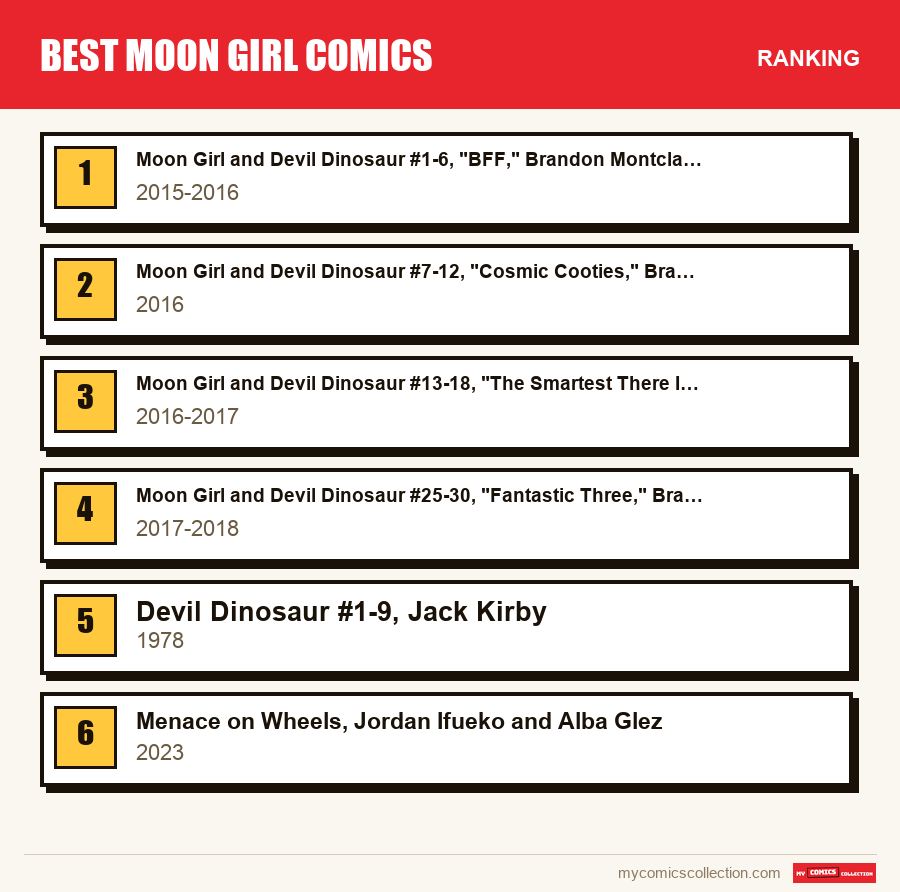
1: Moon Girl and Devil Dinosaur #1-6, "BFF," Brandon Montclare, Amy Reeder and Natacha Bustos (2015-2016)
This is the natural entry, and it fits in a single trade paperback: BFF gathers the first six issues. The volume sets up what will make the series distinctive, namely a heroine whose first reflex is to tinker, measure and solve, and a gigantic animal who serves both as her bodyguard and her confidant. Natacha Bustos, the series' main artist, gives the series its face from this first volume.
What the arc brings to the character: everything, since Lunella did not exist before it. It is aimed at readers who want a complete story without knowing the continuity of the rest of the universe, at parents looking for a shared read, and at collectors who want to own the opening of the series. Read it in order, from #1 to #6: each issue sets up the next, and reading in a collected edition spares you from chasing scattered single issues.
2: Moon Girl and Devil Dinosaur #7-12, "Cosmic Cooties," Brandon Montclare, Amy Reeder and Natacha Bustos (2016)
The second trade paperback widens the circle. In #10, Kamala Khan, Ms. Marvel, separates Moon Girl and Kid Kree during a clash and gives her a device to call her if things go wrong. This scene is worth it for what it says about Lunella's place in the Marvel universe: she is treated as a young recruit whom an elder is watching over, not as a mere guest in a children's series. Fans of the young heroine from Jersey City will find a direct link here with our selection devoted to Kamala Khan.
This volume is aimed at those who liked BFF and want to see the character leave her neighborhood. It reads without preparation, but better after the first trade paperback: Kid Kree crosses her path here. Save this read for the second stage, once the heroine is established.
3: Moon Girl and Devil Dinosaur #13-18, "The Smartest There Is," Brandon Montclare, Amy Reeder and Natacha Bustos (2016-2017)
The title of this third volume says a lot: it pushes Lunella's scientific side to a confrontation with the Doombots, Doctor Doom's robots. In #18, Ms. Marvel is among the heroes who step in against them. The appeal lies in the scale: the series proves it can host the big names of the universe without losing its own voice.
This story suits the reader who wants to see Lunella face a threat the size of a Marvel classic, but who stays attached to the warm tone of the beginning. Read it after Cosmic Cooties. If you follow the publisher's historic antagonists, the history of the Fantastic Four, where Doom holds a central place, gives this volume more relief.
4: Moon Girl and Devil Dinosaur #25-30, "Fantastic Three," Brandon Montclare and Natacha Bustos (2017-2018)
This arc brings Moon Girl into Fantastic Four territory. Lunella recruits the Thing and the Human Torch against the Super-Skrull, leans on the robot H.E.R.B.I.E. and brings back Devil Dinosaur, wearing a team uniform. The title, Fantastic Three, announces an improvised trio around Lunella.
It suits readers who already know Reed Richards and his circle: the pleasure comes from the contrast between a child prodigy and seasoned heroes. It is also a good entry point for anyone discovering the series through the Fantastic Four. To place these characters before reading, browse the Fantastic Four reading guide.
Do you collect this series?
Track what you own, what you are missing and what your collection is worth. 7-day trial.
Start my trial →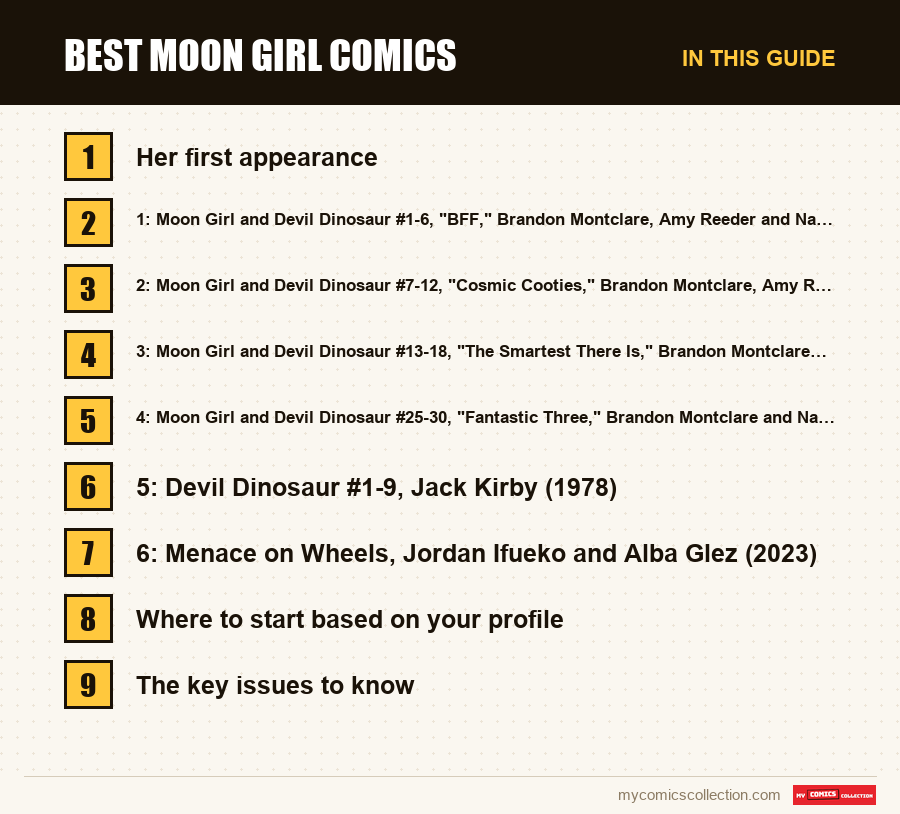
5: Devil Dinosaur #1-9, Jack Kirby (1978)
One day you have to go back to the source. Kirby describes a prehistoric world where Devil, a red tyrannosaur, and Moon-Boy face the Killer-Folk and other threats. The line work is Kirby's from the late 1970s: oversized framing, a sense of spectacle that makes every panel monumental. It is not the same read as the 2015 series, which is modern and humorous; it is the soil of Devil's imaginary world.
This entry is aimed at Kirby fans, at curious Bronze Age readers and at those who want to measure what the 2015 series borrows from its model. Read it after finishing BFF: the contrast in tone sheds light on the choices of Montclare, Reeder and Bustos. To go deeper on the creator, see our guide Jack Kirby: where to start.
6: Menace on Wheels, Jordan Ifueko and Alba Glez (2023)
This five-issue miniseries, written by Jordan Ifueko and drawn by Alba Glez, accompanies the Disney Channel animated series that aired from February 2023 to March 2025. It serves as a gateway for young readers who discovered Lunella on screen, with Diamond White voicing the heroine and Fred Tatasciore voicing Devil Dinosaur.
The miniseries is aimed at readers who arrive through animation and want a short story, in five issues, with no prior reading. It does not replace the 2015 series, of which it is a late extension. Worth owning as a complement if you collect tie-in products from the adaptation.
Where to start based on your profile
You are discovering the character. Take the BFF trade paperback, then Cosmic Cooties. Two volumes cover the first twelve issues and are enough to tell whether the series suits you.
You are coming from the animated series. Start with Menace on Wheels, which keeps the tone of the screen, then go back to the 2015 series to find Lunella in her original version.
You like Jack Kirby. Start from Devil Dinosaur #1-9, then read BFF to see how a 2015 team picks up his idea.
You follow Ms. Marvel or Miles Morales. Read Cosmic Cooties for Kamala Khan. The three-part story where Miles Morales, the X-Men and the Avengers help Lunella against the High Evolutionary will interest you too; you will find the context of the young Spider-Man in our history of Miles Morales.
You collect single issues. Aim first for the 2015 #1, then the issues tied to the publisher's events, detailed below.
The key issues to know
The list is short, because the series has only one opening turning point and a few crossovers. For each issue, method matters more than the label: compare several completed sales, check the real condition from photos, and do not pay the "key" argument before you understand what it covers.
- Moon Girl and Devil Dinosaur #1 (November 2015). The opening of the series and the first appearance of Lunella Lafayette. There are several covers, including a variant drawn by Trevor Von Eeden; identify the one being offered to you before comparing prices.
- Devil Dinosaur #1 (April 1978). The birth of Devil and Moon-Boy under Jack Kirby's pen. It is the Bronze Age key issue of this universe; check the paper, corners and spine, because single issues from this era age poorly.
- Moon Girl and Devil Dinosaur #10. The meeting with Ms. Marvel, useful to Kamala Khan readers.
- Moon Girl and Devil Dinosaur #25. The opening of the Fantastic Three arc, which places Lunella alongside the Thing and the Human Torch.
- The Unbelievable Gwenpool #25. Moon Girl, Devil and Power Pack appear in it: a crossover to know if you follow Gwenpool.
- The events Monsters Unleashed, Secret Empire (via Secret Warriors) and Infinity Wars. Lunella appears in them; in Infinity Wars, she briefly merges with Squirrel Girl to become "Moon Squirrel."
To value a specific copy from the list, first establish its condition, then compare completed sales for the same cover and the same printing. The appraisal form helps you lay down that baseline.
Reading in trade paperback or single issues
The 2015 series runs forty-seven issues, collected in eight main trade paperbacks: BFF, Cosmic Cooties, The Smartest There Is, Girl-Moon, Fantastic Three, Save Our School, Bad Dream and Yancy Street Legends. Thicker editions, titled The Beginning, Full Moon, Bad Buzz and Place in the World, gather the same material by the dozen issues.
For a reader, the trade paperback is the sensible choice: the arcs are designed to be read in one go, and the artists who joined Natacha Bustos on certain issues are credited alongside her there. For a collector, the single issue keeps real interest for the #1 and for event crossovers; the in-between volumes are filled in through the trade paperbacks. Keep in mind that the end of the series was announced with #47: stopping your collection at that issue gives you a closed set that is easy to shelve.
A concrete storage tip: modern single issues keep best in acid-free bags with a rigid backing board, standing in short boxes. The 1978 copies, more fragile, handle repeated handling poorly; if you own any, store them away from light and only page through them with care. For a panorama of the universe where this series sits, the Avengers hub gathers our guides on the team and its neighbors.
Frequently asked questions
Start with Moon Girl and Devil Dinosaur #1, on sale in November 2015, or with the BFF trade paperback that gathers #1-6. This first volume sets up Lunella Lafayette, her bond with Devil Dinosaur and the tone of the series. No prior reading is needed.
Yes. Jack Kirby created Devil Dinosaur in issue #1 dated April 1978, in a nine-issue series that ran until December 1978. He also created Moon-Boy. The 2015 series picks up these two characters and pairs them with Lunella Lafayette, in a standalone sequel to Kirby's story.
Moon Girl was created by writers Brandon Montclare and Amy Reeder, who also designed the character, with Natacha Bustos on art. She debuts in Moon Girl and Devil Dinosaur #1, on sale in November 2015. Natacha Bustos remains the series' main artist throughout its forty-seven issues.
The 2015 series runs forty-seven issues, launched in November 2015 and concluded in 2019 with #47. It is collected in eight trade paperbacks, from BFF to Yancy Street Legends. A five-issue miniseries, Menace on Wheels, follows in 2023.
The Disney Channel animated series, aired from February 2023 to March 2025, adapts the comic's duo but targets a younger audience; Lunella is a thirteen-year-old middle schooler there. To compare, read the 2023 miniseries Menace on Wheels, then the 2015 series.
A Moon Girl #1 or a 1978 Devil Dinosaur in your pile? Have its condition assessed before you put it away.
Estimate my comic