
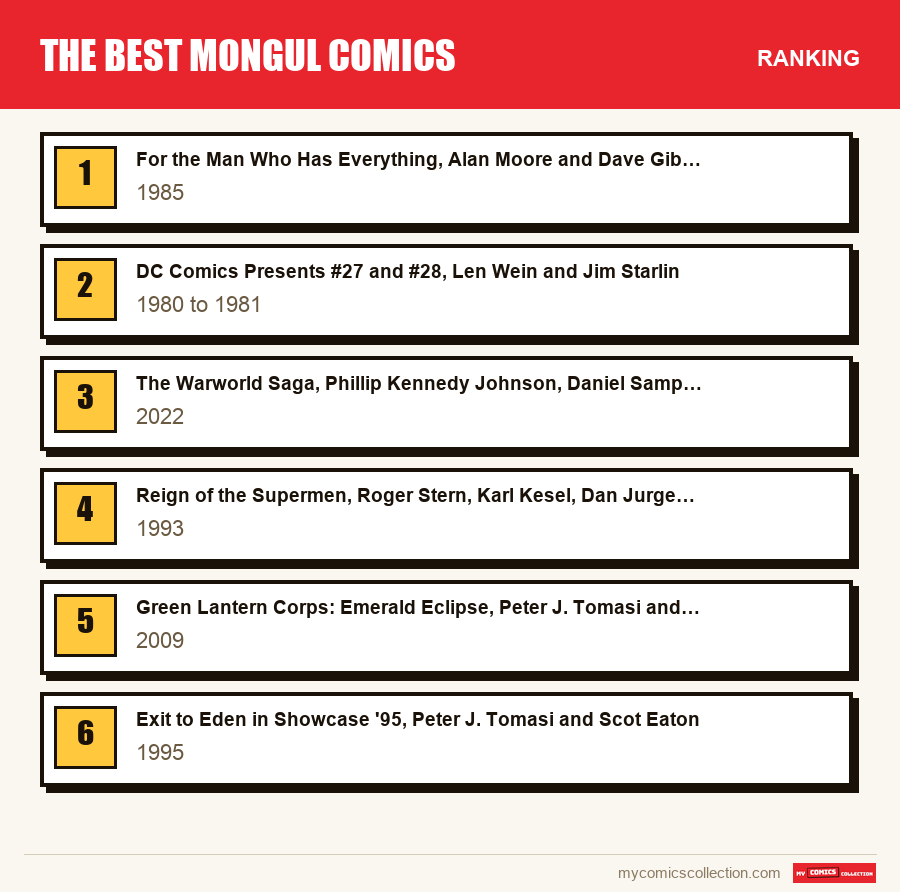
To discover the best Mongul comics, start with Superman Annual #11 (1985), the story For the Man Who Has Everything by Alan Moore and Dave Gibbons. Then go back to his debut in DC Comics Presents #27 (November 1980), by Len Wein and Jim Starlin, and move on to Phillip Kennedy Johnson's Warworld Saga (2022), which puts him back at the center of the action. The 1993 and 2009 stories round out the picture.
Mongul is a space tyrant who rules Warworld, a planet turned into a war machine and an arena. His reading appeal rests on a paradox: this supporting character from a single universe has taken the lead in several Superman and Green Lantern stories between 1980 and 2022, without those stories forming a continuous series. You have to pick your entry points carefully.
As always in this guide, we only state verified facts (creators, issue numbers, dates); the analysis is our own, with no reproduction of protected artwork or dialogue.
His first appearance
Mongul is born in DC Comics Presents #27, dated November 1980, in a story titled The Key That Unlocked Chaos!. Writer Len Wein and artist Jim Starlin created this conqueror together; Dick Giordano and Frank McLaughlin inked the issue. The series DC Comics Presents teams Superman every month with another character from the DC universe: here, Martian Manhunter shares the billing.
This debut also sets up Warworld, the tyrant's mobile fortress, and issue #28 of December 1980, subtitled Warworld!, continues the plot with the same Wein and Starlin duo. A useful detail for the series collector: these two issues belong to DC Comics Presents, not to the main Superman series, so you need to hunt for them under that title.
1: For the Man Who Has Everything, Alan Moore and Dave Gibbons (1985)
In Superman Annual #11, Alan Moore writes the story, which Dave Gibbons draws and Tom Ziuko colors. Batman, Robin and Wonder Woman visit Superman at the Fortress of Solitude for his birthday and find him frozen: an alien plant, the Black Mercy, has plunged him into a dream in which Krypton never exploded. Mongul is behind the trap, and the plant ends up turning on him too: he in turn slips into a dream of conquest.
What the story adds to the character is a measure of his cruelty: Mongul is not a brute who simply hits harder, he is a strategist who picked the cruelest weapon against a man who has lost everything. The story fits in a single issue: a Superman beginner can pick it up with no preparation. It was nominated in 1986 for the Kirby Award for best single issue, then adapted into an episode of Justice League Unlimited in 2004. Read it in a collected edition, then compare it with the DC Comics Presents issues to gauge the difference in tone between 1980 and 1985.
2: DC Comics Presents #27 and #28, Len Wein and Jim Starlin (1980 to 1981)
The origin two-parter tells of Superman's encounter with an enemy unlike any other: a space monarch who runs his artificial planet like an arena. Issue #27 pairs Superman and Martian Manhunter against this newcomer. In #28, Supergirl joins her cousin to take on Warworld itself.
The value of this two-parter is historical as much as narrative: it has Starlin's artwork, serving an unapologetic space setting, and the first version of Warworld. It suits the reader who wants to see the character in his raw state and the collector chasing the debut of a lasting antagonist. The read is quick: two episodes, one complete story, no continuity to know. Mongul reappears afterward in DC Comics Presents #36 (August 1981) and #43 (March 1982); the collection Superman vs. Mongul (2013) gathers issues #27, #28, #36 and #43.
3: The Warworld Saga, Phillip Kennedy Johnson, Daniel Sampere and several artists (2022)
Phillip Kennedy Johnson opens the saga in Action Comics #1036 (2022), with Daniel Sampere on art, and closes it with the one-shot Superman: Warworld Apocalypse #1, the same year. Superman, weakened, leads a team drawn from the Authority, including Natasha Irons, Midnighter and O.M.A.C., to Warworld to free the tyrant's slaves. Facing them, the Mongul of this era rules over a world of slaves.
Several artists then take turns after Sampere, through the final one-shot. What it brings to the character is a return to the foreground: Mongul once again drives an entire saga, and the final showdown with Superman settles his fate. This read is for the modern-series reader who wants a complete saga in about a dozen chapters, and for the collector following recent releases. Read it in issue order, ending with the one-shot, or pick up the saga's collected editions.
4: Reign of the Supermen, Roger Stern, Karl Kesel, Dan Jurgens, Louise Simonson and Gerard Jones (1993)
After The Death of Superman, four Superman series and one issue of Green Lantern tell of the arrival of several claimants to Superman's mantle. Roger Stern scripts Action Comics #687 to #691, Karl Kesel The Adventures of Superman #501 to #505, Dan Jurgens Superman #78 to #82, Louise Simonson Superman: The Man of Steel #22 to #26, and Gerard Jones writes Green Lantern #46 (October 1993), drawn by M. D. Bright with Romeo Tanghal on inks.
A note on ranking: this ensemble arc does not belong to Mongul, who plays the partner of the Cyborg Superman. Together they destroy Coast City, then Mongul helps build Engine City on its ruins to recreate Warworld; Green Lantern #46 shows Hal Jordan discovering the disaster and attacking the city. This chapter gives Mongul a scale of threat not seen elsewhere in this ranking, and it explains why Coast City weighs so heavily in Green Lantern mythology. It is for the reader of the big 1990s crossovers. To place this period in the collector market, see our collecting guide to The Death of Superman.
Do you collect this series?
Track what you own, what you are missing and what your collection is worth. 7-day trial.
Start my trial →
5: Green Lantern Corps: Emerald Eclipse, Peter J. Tomasi and Patrick Gleason (2009)
In Green Lantern Corps volume 2, issues #33 to #38 (2009), Peter J. Tomasi and Patrick Gleason make Mongul II, the first one's son, the Lanterns' main adversary. Mongul, who is then commanding the Sinestro Corps, throws his troops at Daxam. Sodam Yat, the Daxamite hero, finds himself at the heart of events, and the arc sets up the Blackest Night saga.
What this cycle adds to the character is a cosmic version of the tyrant: he no longer rules only an arena planet, he leads an army of fear. It is for the Green Lantern reader who wants to see a Superman adversary at work in his own universe, rather than for the Superman purist. It reads in one sitting in a collected edition. For background on the organization Mongul then leads, our history of Sinestro in comics details the founding of the Yellow Corps.
6: Exit to Eden in Showcase '95, Peter J. Tomasi and Scot Eaton (1995)
This two-part story, published in Showcase '95 #7 and #8 (September 1995), is written by Peter J. Tomasi and drawn by Scot Eaton. It revisits Mongul's origins, tied to the planet Debstam IV, and shows how his tyrant's power turns against those he governs, up to the birth of his two children.
The appeal is that it gives Mongul an origin and a more human face than the conqueror of the 1980s: we see his childhood, a family, then the drift of a power that destroys what it governs. His two children, who will become Mongul II and Mongal, appear in #8. The story is for the reader who has already read three or four entries on this list and wants to understand the genealogy. It lives in a 1995 anthology: look for the two period issues, and compare their condition carefully, since an anthology often keeps less well than a regular series.
Where to start based on your profile
The right entry point depends less on your taste for Superman than on what you expect from a space tyrant. Here are four paths.
- You want one complete story: read Moore and Gibbons's Superman Annual #11. It stands on its own.
- You want the character's debut: follow with DC Comics Presents #27 and #28, then the 1995 two-parter Exit to Eden for his origin.
- You read recent sagas: pick up Phillip Kennedy Johnson's Warworld Saga, which does not require reading the 1980s first.
- You follow Green Lantern: go straight to Emerald Eclipse, then to Green Lantern #46 to understand why Coast City matters so much in that series.
If you are new to Superman in general, open the reading guide instead, then come back to Mongul once his circle of adversaries feels familiar. To compare with other enemies of the Superman family, also look at the best General Zod comics and the Bizarro ones.
The key issues to know
Six issues are enough to map out Mongul. Before buying any of them, note the cover date and the printing, then compare them with the copy you are eyeing.
- DC Comics Presents #27 (November 1980): the first appearance of Mongul, with Martian Manhunter, by Wein and Starlin. It is the reference landmark for a character collector.
- DC Comics Presents #28 (December 1980): Warworld and Supergirl, the direct follow-up to his debut.
- Superman Annual #11 (1985): the Moore and Gibbons story, the most accessible entry point; check that it is the original annual and not a reprint.
- Showcase '95 #8 (September 1995): the appearance of Mongul's children, including the one who will become Mongul II.
- Green Lantern #46 (October 1993): Hal Jordan facing Engine City, a landmark at the crossroads of two series.
- Action Comics #1036 (2022): the start of the Warworld Saga, with the one-shot Superman: Warworld Apocalypse #1 as its conclusion.
For the two 1980 issues and the 1985 annual, examine the condition corner by corner in the photos, since they are the oldest on the list. To place these landmarks in the broader library, see Superman key issues.
Frequently asked questions
Mongul appears in DC Comics Presents #27, dated November 1980, written by Len Wein and drawn by Jim Starlin. The issue, titled The Key That Unlocked Chaos!, teams Superman with Martian Manhunter. Warworld, the tyrant's planet, is established in this two-parter, which continues in issue #28 of December 1980.
No. For the Man Who Has Everything reads on its own, since the story lays out its own starting situation, and the 2022 Warworld Saga can be followed without knowing the 1980s. The 1993 and 2009 stories, however, are better read with the context of Coast City or the Sinestro Corps.
Mongul II is the original Mongul's son. His first traces go back to Showcase '95 #8 (September 1995), where he appears as a child with his sister Mongal. You mostly find him in Green Lantern Corps #33 to #38 (2009), where he leads the Sinestro Corps from Daxam.
Yes, if you like modern sagas: it runs from Action Comics #1036 (2022) to the one-shot Superman: Warworld Apocalypse #1, with Phillip Kennedy Johnson writing and several artists, including Daniel Sampere. It reads in a collected edition and puts Mongul at the center of the plot from the first episode.
Start with Green Lantern Corps #33 to #38 (Emerald Eclipse, 2009), by Peter J. Tomasi and Patrick Gleason. Then add Green Lantern #46 (October 1993), where Hal Jordan discovers a destroyed Coast City. These two reads show Mongul at work in the Lanterns' universe.
Do you have a DC Comics Presents #27 or a Superman Annual #11 in your boxes? Get them appraised before considering a sale.
Estimate my comic