
The best Mojo comics to start with are Longshot #1-6 (1985-1986), by Ann Nocenti, Art Adams, and Whilce Portacio, where his debut comes in issue #3 (November 1985). Continue with Excalibur: Mojo Mayhem (December 1989), by Chris Claremont and Art Adams, then X-Men #10 and #11 (1992), by Jim Lee and Scott Lobdell. For a recent take, open NYX #1-10 (2024-2025), by Collin Kelly and Jackson Lanzing.
Mojo rules the Mojoverse as a tyrannical TV network boss, and his best stories share one trait: he is the one driving the plot. This guide ranks five reads where he is the central villain, from 1985 to 2025, and leaves out the issues where he only shows up as a background figure.
As always in this guide, we only state verified facts (creators, issue numbers, dates); the analysis is our own, with no reproduction of protected art or dialogue.
His first appearance
Mojo makes his debut in Longshot #3, cover-dated November 1985. The character was created by Ann Nocenti, on writing, and Art Adams, on art, who designed him based on Nocenti's directions. The miniseries runs six issues, from September 1985 to February 1986, and Whilce Portacio handles the inks.
The Mojoverse is born in the same series, as a world dominated by a tyrannical network boss, and Longshot is a slave who escapes it. Mojo therefore does not arrive in an ordinary superhero story: he is the setting and the engine of an escape story. This position as master of an entire world explains the very different forms his appearances have taken since.
For a collector, the landmark is unambiguous: issue #3 of the miniseries. If you want to see Mojo at his debut, with the creators who conceived him, there is no other starting point than that one, and all six issues have been collected in a trade paperback.
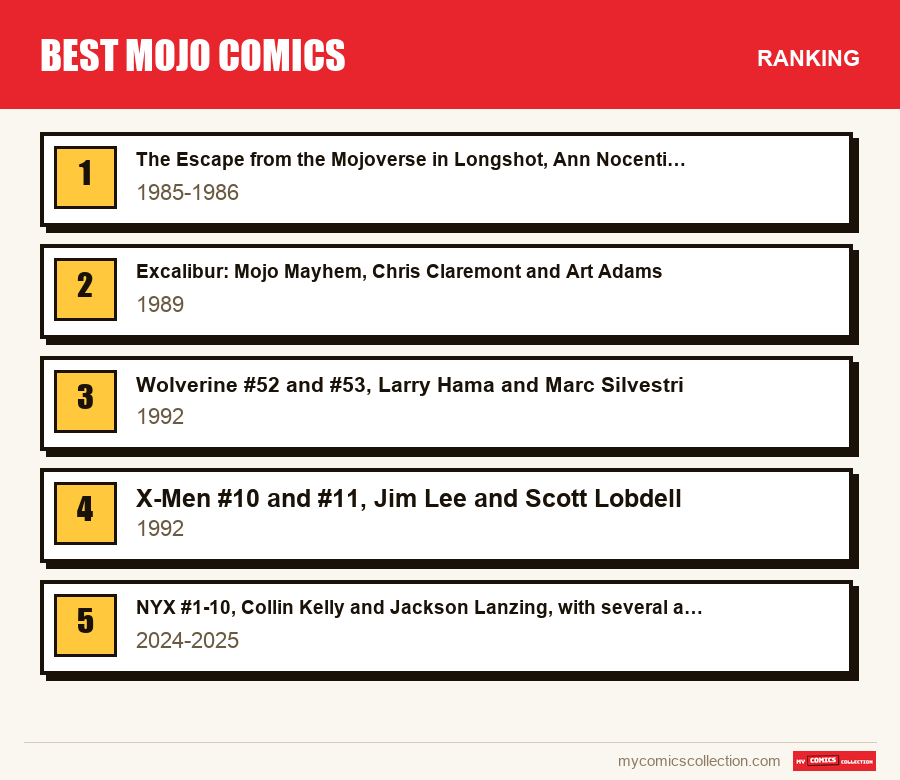
1: The Escape from the Mojoverse in Longshot, Ann Nocenti, Whilce Portacio, and Art Adams (1985-1986)
Ann Nocenti writes, Art Adams pencils, and Whilce Portacio inks a six-issue miniseries, published from September 1985 to February 1986. Longshot, a slave who escaped the Mojoverse, breaks free of Mojo's grip, and Mojo becomes the main antagonist of the series from his entrance in issue #3. The story establishes the world and the tyranny that organizes it.
The contribution to the character is foundational: Mojo appears as a tyrannical network boss, and this framework sets up a satirical reading of the entertainment world that remains a key to the stories that follow. Adams's highly detailed art gives the Mojoverse an instantly recognizable visual identity.
The read suits any reader who wants to understand Mojo at the source, and it stands on its own: six issues, with no knowledge of the X-Men required. To extend it, move on to Uncanny X-Men Annual #10 by Chris Claremont and Art Adams, where Longshot joins the X-Men and where Mojo, the villain of the story, turns the team into children.
2: Excalibur: Mojo Mayhem, Chris Claremont and Art Adams (1989)
This one-shot, cover-dated December 1989, is written by Chris Claremont and penciled by Art Adams. Mojo is the main villain. The X-Babies, a miniature version of the X-Men imagined by Claremont and Adams, escape from his universe to Earth and cross paths with Kitty Pryde, which ties the story to Excalibur.
What you gain is a lighter side of Mojo: the tyrant becomes the engine of an adventure where the miniature X-Men take center stage. The single issue shows that Mojo can be written as something other than a pure menace.
It suits Excalibur fans and those who like late-1980s humor. To place the series and its team, the best Excalibur runs offer a full tour. The format is that of a prestige-format book: once you have it in hand, it reads in a single sitting.
3: Wolverine #52 and #53, Larry Hama and Marc Silvestri (1992)
Larry Hama writes and Marc Silvestri draws these two issues, cover-dated March and April 1992. Wolverine teams up with Mystique and Spiral, and Mojo kidnaps Jubilee. The second part sees the trio face Mojo to rescue her.
The appeal lies in the meeting of two registers: the world of the Wolverine series and the extravagance of the Mojoverse. Mojo leaves his usual turf to come after a young mutant in the present day, which changes the scale of the plot. The pages devoted to Larry Hama and Marc Silvestri place them within their body of work.
This read suits Wolverine readers and anyone following Jubilee; for it, our guide to the best Jubilee comics completes the picture. Because the story spans two issues, read them back to back rather than looking for a single copy.
4: X-Men #10 and #11, Jim Lee and Scott Lobdell (1992)
Jim Lee plots and draws, Scott Lobdell writes the dialogue: X-Men #10 and #11, from July and August 1992, form a two-part story, accompanied by a backup story about Maverick. Dazzler alerts the X-Men in an attempt to save Longshot from Mojo. In issue #11, the team helps a clone of Mojo overthrow the true ruler of the Mojoverse.
The story turns Mojo into a power struggle: you do not just fight him, you try to dislodge him from his throne. It is also one of the issues where you can best see how Lee uses big, spectacular pages.
These two issues interest the reader of 1990s X-Men and the collector of Jim Lee issues. For the series' background, the page on X-Men #1 (1991) tells the story of its launch. Read #10 then #11 back to back, since the story unfolds across both issues.
Do you collect this series?
Track what you own, what you are missing and what your collection is worth. 7-day trial.
Start my trial →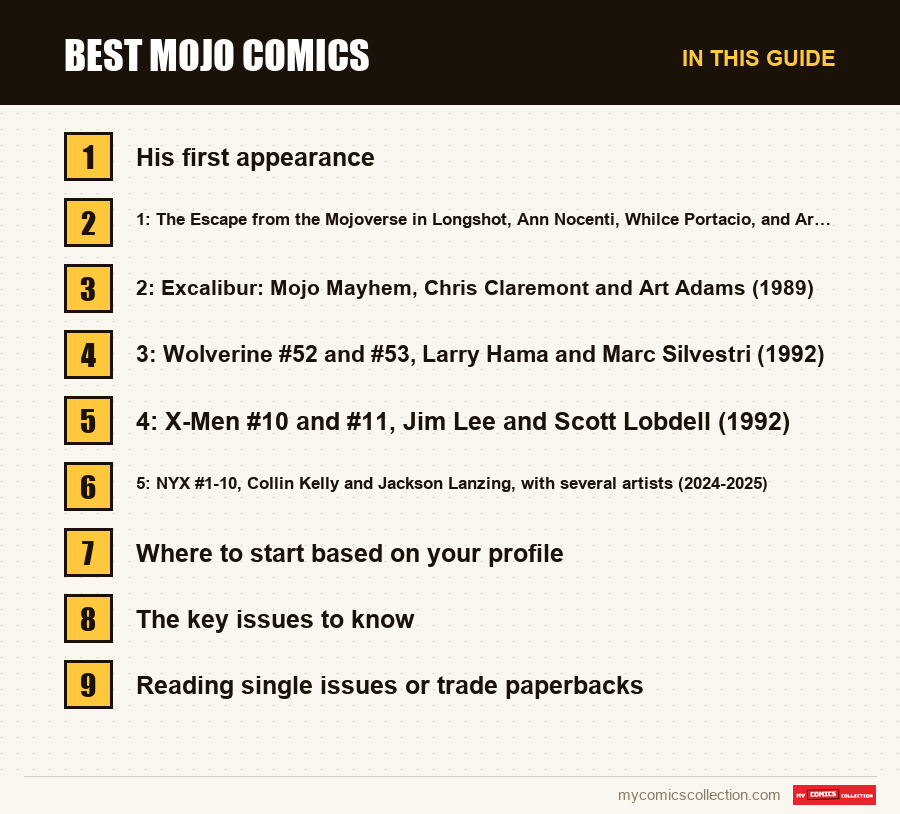
5: NYX #1-10, Collin Kelly and Jackson Lanzing, with several artists (2024-2025)
Collin Kelly and Jackson Lanzing write all ten issues of NYX, published monthly from July 2024 to April 2025, with Francesco Mortarino on art for most of the run and two other artists on some issues. In the first part, Laura Kinney, a.k.a. Wolverine, investigates a criminal group led by Mr. Friend, a mutant corpse manipulated by Mojo, who turns out to be the real boss. Mojo then directly takes control of Local, a member of the team.
In issue #9, Mojo bargains with Doom's emissary, Volta, at the X-Men's abandoned Treehouse, over the last Krakoan seed, then kills Volta. In issue #10, he uses the seed's power, channeled by Local, to turn New York into "Mojo City," before being defeated. The story treats Mojo as a real threat, far from the burlesque of 1989.
This series suits today's reader, anyone following Ms. Marvel, whose beginnings our page on Ms. Marvel #1 (2014) recalls, and anyone who wants a Mojo set within the Krakoan period. It reads in ten issues, or as a trade paperback.
Where to start based on your profile
The reader looking for the origin will open Longshot #1-6, six issues that explain the Mojoverse. Someone who prefers the 1990s will pick Wolverine #52 and #53, then X-Men #10 and #11, two two-parters where Mojo is front and center and where the styles of Silvestri and then Lee are easy to compare.
The reader in a hurry for current stories will start with NYX #1-10, which builds on the Krakoan period. The humor fan will choose Excalibur: Mojo Mayhem. To read in publication order, follow the ranking list: 1985, 1989, 1992 twice, then 2024.
The key issues to know
The main landmark is Longshot #3 (November 1985), Mojo's first appearance, flanked by Longshot #1 (September 1985) and #6 (February 1986), which close out the miniseries. Next come New Mutants Annual #2 and Uncanny X-Men Annual #10, two annuals featuring Mojo at the time of Longshot's arrival among the X-Men.
Later, Excalibur: Mojo Mayhem (December 1989), Wolverine #52 (March 1992), and X-Men #10 (July 1992) serve as the milestones of the 1990s. Exiles #73 and #74 (February 2006) offer a detour through parallel worlds, and NYX #1 (July 2024) the recent return, with issues #9 and #10 as the peak.
Between these milestones, other appearances round out the bibliography without earning a spot in the ranking. X-Men #6 and #7, in 1992, come just before Jim Lee's two-parter, and X-Force #60 and #61, from November and December 1996, pit Cable's team against the master of the Mojoverse. The one-shot X-Babies: Murderama #1, cover-dated January 1998, extends the comedic side opened in 1989. In the mid-2000s, Uncanny X-Men #460 and #461 (August 2005) bring the tyrant back to the flagship series. In 2015, X-Force #12 and #15, from the fourth volume of the series, introduce and then dismantle Yellow Eye, the agency he runs. He also crosses paths with Howard the Duck in issue #9 of the sixth volume, in September 2016, proof that his satirical register travels well outside the mutant universe. These issues mostly interest the completist who wants to follow every return of the character.
For each key issue, favor the same printing and the same condition so you can compare: a 1985 miniseries is judged on the freshness of its spines and corners, a prestige-format book on its spine, and a recent series on the identity of its cover. A trade paperback is not a single issue: it is a reading tool, and it does not replace the collectible piece. If one of these issues is in your boxes, the free estimate gives you a first frame of reference.
Reading single issues or trade paperbacks
For the 1985 series, a trade paperback gathers all six issues and saves you from hunting them down one by one. The 1992 two-parters are found as single issues, to be read in order, while the NYX series exists as ten issues or as a volume.
So separate two goals: reading Mojo, for which trade paperbacks are enough, and assembling his bibliography, for which you need to hunt for single issues one by one. If you are just starting out, buy the reading first, then the pieces you love.
Frequently asked questions
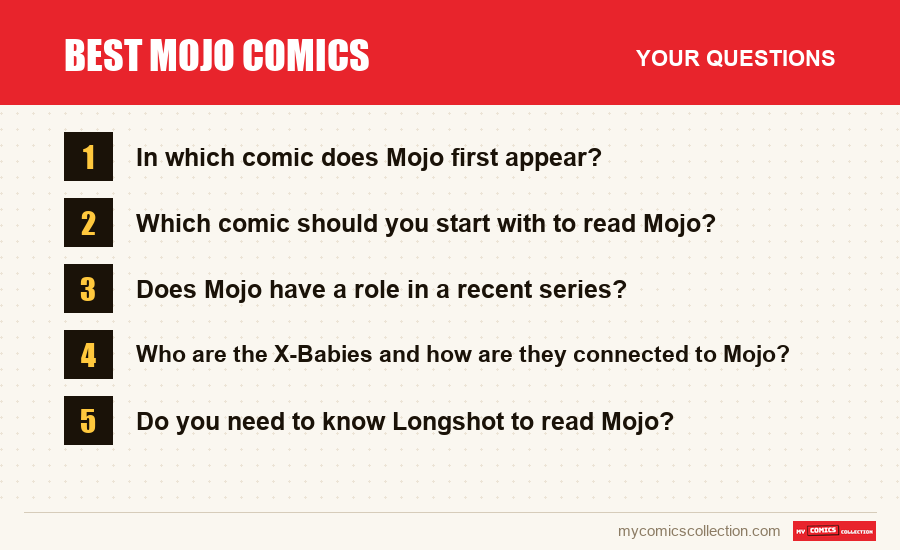
Mojo first appears in Longshot #3, cover-dated November 1985, created by Ann Nocenti on writing and Art Adams on art. The miniseries runs six issues, from September 1985 to February 1986, and also introduces the Mojoverse, the world Mojo dominates and from which Longshot escapes.
Start with Longshot #1-6 (1985-1986), by Nocenti, Adams, and Portacio, which can be read with no prerequisites and establishes the Mojoverse. Follow up with Wolverine #52 and #53, by Larry Hama and Marc Silvestri (March and April 1992), then X-Men #10 and #11, by Jim Lee and Scott Lobdell.
Yes, in NYX, ten issues published from July 2024 to April 2025 by Collin Kelly and Jackson Lanzing. Mojo manipulates a mutant corpse there, takes control of Local, then tries to turn New York into "Mojo City" with the last Krakoan seed.
The X-Babies are a miniature version of the X-Men, imagined by Chris Claremont and Art Adams. They live under Mojo's thumb, and Excalibur: Mojo Mayhem (December 1989) shows their escape to Earth, where they meet Kitty Pryde.
It is preferable, since both characters are born in the same 1985 miniseries. Longshot is the slave who escapes the Mojoverse, and Mojo is the tyrant who pursues him. Stories like X-Men #10 and #11 revolve around a rescue of Longshot.
Is a Longshot, Wolverine, or X-Men single issue sitting in your boxes? Get a first reference point before deciding what to keep.
Estimate my comic