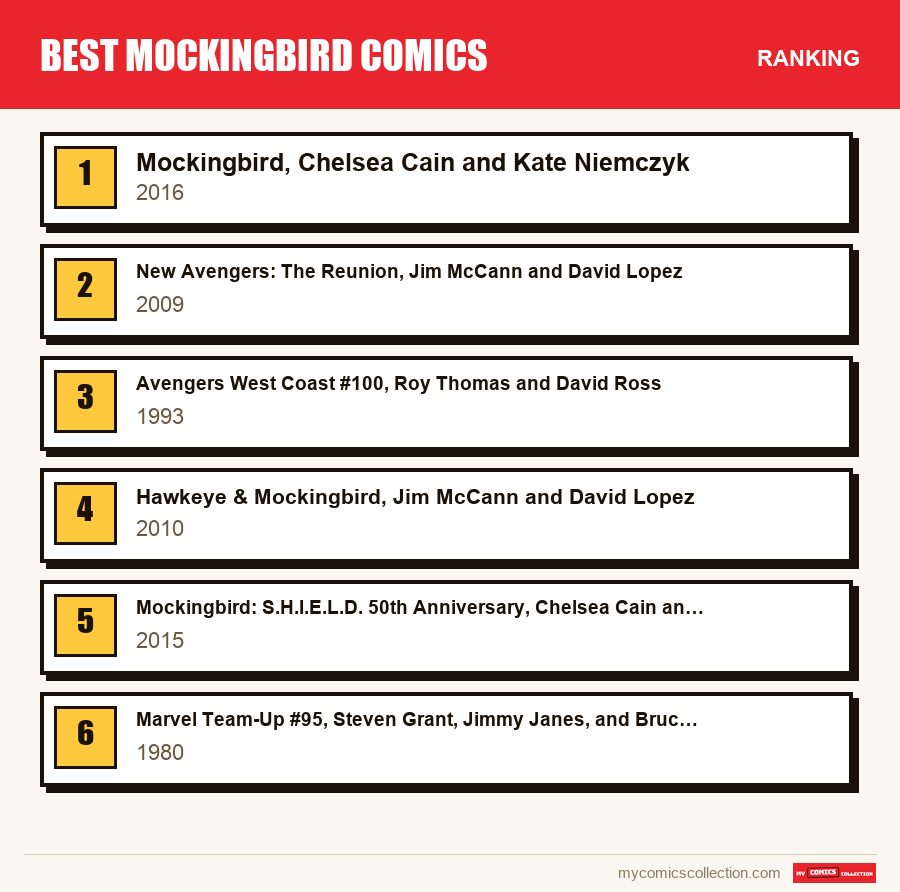
The best Mockingbird comics start with Chelsea Cain and Kate Niemczyk's Mockingbird (2016, eight issues), then work backward to New Avengers: The Reunion (2009) and Hawkeye & Mockingbird (2010), both by Jim McCann and David Lopez. Her defining story is Avengers West Coast #100 (1993). For key issues, her first appearance is Astonishing Tales #6, cover-dated June 1971.
Barbara "Bobbi" Morse has switched sides, names, and costumes more often than most heroes of her generation. She has been a biologist working alongside Ka-Zar, a S.H.I.E.L.D. spy, a vigilante hunted by her own superiors, Hawkeye's wife, a West Coast Avenger, then a sacrificed character, replaced by an alien impostor and finally found again. That instability makes her hard to read in order, because her best stories are scattered over five decades and in titles that almost always carry someone else's name.
As always in this guide, we state only verified facts (creators, issue numbers, dates); the analysis is our own, with no reproduction of protected art or dialogue.
Her first appearance
Barbara Morse debuts in Astonishing Tales #6, cover-dated June 1971. The story is a Ka-Zar tale, written by Gerry Conway and drawn by Barry Smith. She plays a supporting role there: a scientist with a doctorate in biology who becomes the love interest of the jungle hero. The issue matters more to the collector than to the reader.
The character was in fact conceived by Len Wein and Neal Adams. Their Man-Thing story was meant to run in Savage Tales #2 (July 1971), but the magazine was canceled. It only appeared in Astonishing Tales #12, cover-dated June 1972, an early appearance that counts. The next steps read like a list of milestones: Astonishing Tales #18 (June 1973) shows her as S.H.I.E.L.D. Agent 19, Marvel Super Action #1 (January 1976) under the name Huntress, and Marvel Team-Up #95 (July 1980) finally gives her the name Mockingbird.
For your collection, keep one rule in mind: Bobbi's first appearance and Mockingbird's first appearance are not in the same issue, and nine years separate them. The list that follows includes only stories where Bobbi is the center of attention; her team books come afterward.
1: Mockingbird, Chelsea Cain and Kate Niemczyk (2016)
The 2016 series runs eight issues, with Chelsea Cain writing and Kate Niemczyk drawing, and colors by Rachelle Rosenberg. Launched in March 2016, it is the entry point that puts Bobbi in the lead for a full series, and you can read it without having opened a single issue from the 1980s.
The tone mixes humor with an unease that builds from issue to issue. The first chapters play on the daily life of a spy who carries her past like a bag that is too heavy; the rest tightens the plot around a darker discomfort. Kate Niemczyk draws expressive characters, with a clean line that supports the shifts in tone well.
Who is it for? Readers who have no desire to learn forty years of continuity, and anyone intrigued by the character since her screen adaptations. How to read it? In order, from #1 to #8. The first collection, I Can Explain, gathers the 2015 one-shot and issues #1 to #5; the second, My Feminist Agenda, collects issues #6 to #8 along with two issues of New Avengers. For a single-issue collector, the short, finished series is easy to complete: eight issues, not one more, with a #1 to track down first, since it is the one casual readers look for.
2: New Avengers: The Reunion, Jim McCann and David Lopez (2009)
This miniseries follows Secret Invasion, the 2008 saga written by Brian Michael Bendis and drawn by Leinil Francis Yu. In that event, a fake Mockingbird, actually a Skrull, wins Clint Barton's trust before being unmasked and killed by him. The real Bobbi is found later aboard a Skrull ship, and Iron Man brings her back to Barton. The Reunion tells what happens next.
Jim McCann writes, David Lopez draws. Bobbi teams up with Barton, then operating under the Ronin identity, against Monica Rappaccini of A.I.M. Bobbi explains that, together with former S.H.I.E.L.D. colleagues who suffered the same abductions, she created the W.C.A. The second issue specifies that a Skrull had taken her place shortly before Ultron kidnapped her: the story thus answers the question Bendis's event leaves open, namely how long the impostor had been in place.
It is the best read for understanding what the character lost and what she rebuilds. It suits readers who know Bendis's saga, or who are willing to skim it. How to read it? Right after Secret Invasion, whose series versus comics guide recaps the main lines, then head to Hawkeye & Mockingbird, entrusted to the same creative duo.
3: Avengers West Coast #100, Roy Thomas and David Ross (1993)
This issue is cover-dated November 1993. Roy Thomas writes, David Ross draws. It is the issue where Bobbi sacrifices her life to save Hawkeye from Mephisto, an act that gives the character her tragic dimension and that, fifteen years later, makes her return so meaningful.
The series title at that point is Avengers West Coast, since the cover title changed with #47, dated August 1989. The run ends two issues later, with #102 in January 1994, scripted by Dan Abnett. Reading #100 without context is possible, but the emotional weight depends on what the reader already knows about the couple.
Who is it for? Readers interested in death and resurrection as storytelling engines of the 1990s. How to read it? After the couple's beginnings (see the section on team books) and before Secret Invasion. For a collector, the issue is a key piece of the series in its own right: it closes a character's arc, it marks the series' hundredth issue, and it can be found as a period single issue. Our guide to the series' key issues places this one within the full run of 102 issues.
4: Hawkeye & Mockingbird, Jim McCann and David Lopez (2010)
The series runs six issues, from June to November 2010. Jim McCann writes, David Lopez draws. Barton and Bobbi, both tied to the W.C.A., face the ghosts of Bobbi's past, starting with the Phantom Rider, the man whose death had already strained their marriage in the 1980s.
It is a spy story with romantic stakes, far tighter than the team books of the 1980s. Who is it for? Readers who want to see the couple at the center of a regular series rather than in an ensemble cast. How to read it? After The Reunion. The collection Ghosts, published in January 2011, gathers the six issues with the special Enter the Heroic Age.
Do you collect this series?
Track what you own, what you are missing and what your collection is worth. 7-day trial.
Start my trial →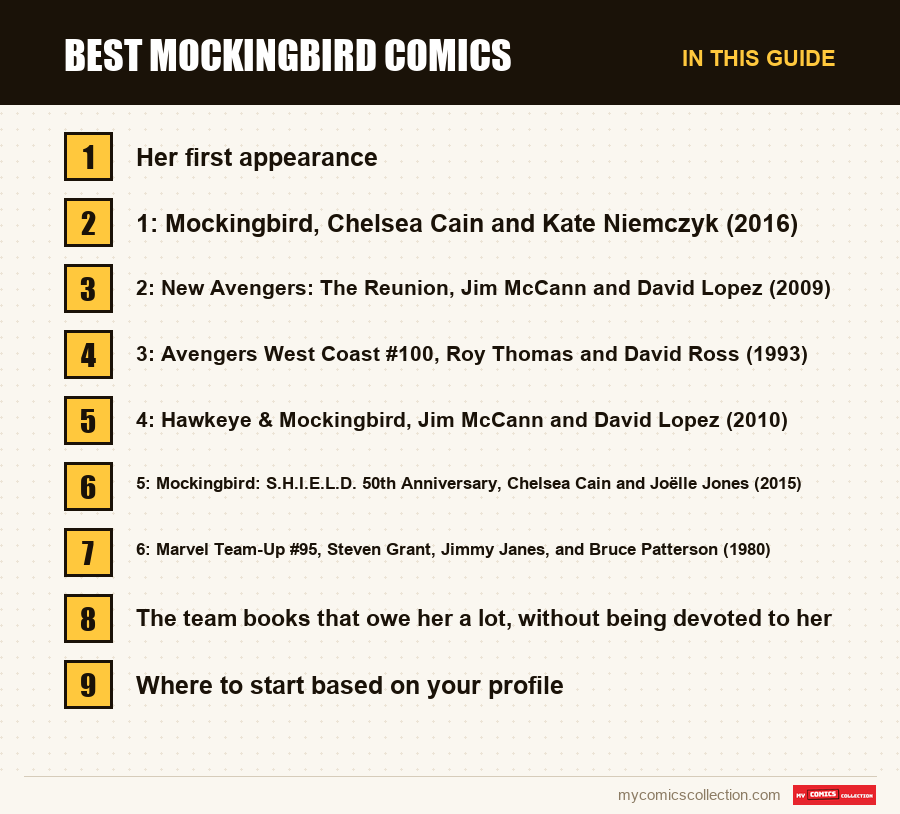
5: Mockingbird: S.H.I.E.L.D. 50th Anniversary, Chelsea Cain and Joëlle Jones (2015)
This September 2015 one-shot brings together Chelsea Cain, writing, and Joëlle Jones, drawing. It introduces Red Widow and serves as a gateway to the 2016 series: it reminds a newcomer who Bobbi is. The story is short, lively, and closer to a test run than a major adventure.
That is exactly its appeal. Who is it for? Readers who want to try Chelsea Cain's voice before committing to eight issues. How to read it? As the opener of the 2016 series, whose first collection reprints it. For a collector, it works as a de facto issue zero: it precedes the series, and so it shelves with it, even though the cover carries a S.H.I.E.L.D. anniversary title.
6: Marvel Team-Up #95, Steven Grant, Jimmy Janes, and Bruce Patterson (1980)
This July 1980 issue gives Bobbi her Mockingbird name and a new costume. Steven Grant writes, Jimmy Janes pencils, Bruce Patterson inks. She investigates corruption within S.H.I.E.L.D., which the agency treats as a betrayal, and allies with Spider-Man, with help from Nick Fury, against Carl Delanden, head of a corrupt section.
Bobbi's role here is that of a guest heroine in a series whose title is shared with Spider-Man: the issue is centered on her, but it remains a standalone episode. Who is it for? Bronze Age readers curious to see her take her name, and collectors who track Mockingbird's identity to its source. How to read it? On its own, as a single issue or in a Marvel Team-Up collection. Our Spider-Man hub places the web-slinger within the whole catalog.
The team books that owe her a lot, without being devoted to her
Three sets come up in every conversation about Bobbi but are not ranked above, because she is not the sole center of them. The first is the 1983 Hawkeye miniseries, four issues, written by Mark Gruenwald: Barton and Bobbi run off to the Poconos to marry. The second is the West Coast Avengers miniseries, published between September and December 1984: Roger Stern writing, Bob Hall and Brett Breeding drawing, and Bobbi becoming a full Avenger. The third is the regular series launched in October 1985, whose first issues Steve Englehart writes, with Al Milgrom and Joe Sinnott on art. Under Englehart, the Phantom Rider affair strains the marriage and Bobbi leaves the team; John Byrne takes over the series in 1989.
In these books, Bobbi shares the spotlight with Hawkeye and a large cast. Reading them sheds light on her path, but does not answer the question "what is the best Mockingbird comic?", hence their place outside the ranking.
Where to start based on your profile
A curious reader with no Marvel background should open the 2016 series: eight issues, two names on the credits, Chelsea Cain and Kate Niemczyk, and a tone that feels like no obligation. The first collection, I Can Explain, remains the best entry point to the catalog.
A reader of the Barton-Morse couple will follow the order of events: the West Coast Avengers series for the birth, Avengers West Coast #100 for the loss, Secret Invasion and The Reunion for the return, then Hawkeye & Mockingbird for what follows. It is several months of reading, but every step is justified.
A Bronze Age fan will begin with Astonishing Tales #6 and Marvel Team-Up #95, which bookend the birth of the character and her identity. As for the milestone hunter, the list in the next section will serve as a roadmap.
The key issues to know
The markers below follow the chronology of Bobbi's life. For each one, ask yourself what event the issue carries (first appearance, new name, death, return), then compare the printed credits with those on your inventory sheet.
- Astonishing Tales #6 (June 1971): first appearance of Barbara Morse, in a Ka-Zar story by Gerry Conway and Barry Smith.
- Astonishing Tales #12 (June 1972): important early appearance, with the Man-Thing story conceived by Len Wein and Neal Adams.
- Astonishing Tales #18 (June 1973): debut as S.H.I.E.L.D. Agent 19.
- Marvel Super Action #1 (January 1976): she goes by the name Huntress.
- Marvel Team-Up #95 (July 1980): first appearance as Mockingbird.
- West Coast Avengers (1984 miniseries, regular series from 1985): the West Coast team.
- Avengers West Coast #100 (November 1993): the sacrifice.
- Secret Invasion #1 (June 2008), Brian Michael Bendis, Leinil Francis Yu, and Mark Morales: the Skrull impostor.
- New Avengers: The Reunion (2009): the real Bobbi reunites with Barton.
- Hawkeye & Mockingbird (2010) and Mockingbird (2016): the two series where she takes the lead.
To place these issues in your own inventory, our Avengers reading guide gives the general thread in which the West Coast episodes fit.
Frequently asked questions
Barbara Morse debuts in Astonishing Tales #6, cover-dated June 1971, in a Ka-Zar story written by Gerry Conway and drawn by Barry Smith. She is not yet Mockingbird there: that name first appears in Marvel Team-Up #95, cover-dated July 1980.
No, it is not essential. The 2016 series by Chelsea Cain and Kate Niemczyk stands on its own. However, to grasp the weight of the character's death in Avengers West Coast #100, it helps to have read at least Roger Stern's 1984 miniseries.
In Avengers West Coast #100, cover-dated November 1993, written by Roy Thomas and drawn by David Ross. She sacrifices her life there to save Hawkeye from Mephisto. The series ends with #102 in January 1994.
Follow up with New Avengers: The Reunion (2009), written by Jim McCann and drawn by David Lopez, which shows Bobbi found and back at Clint Barton's side against A.I.M. Then continue with Hawkeye & Mockingbird (2010), by the same creators.
Eight issues, written by Chelsea Cain and drawn by Kate Niemczyk, starting in March 2016. It is preceded by a September 2015 one-shot with Joëlle Jones. Two collections gather it: I Can Explain for the one-shot and the first five issues, My Feminist Agenda for the rest.
Do you have a copy of Astonishing Tales or West Coast Avengers in your boxes? Get a free estimate.
Estimate my comic