
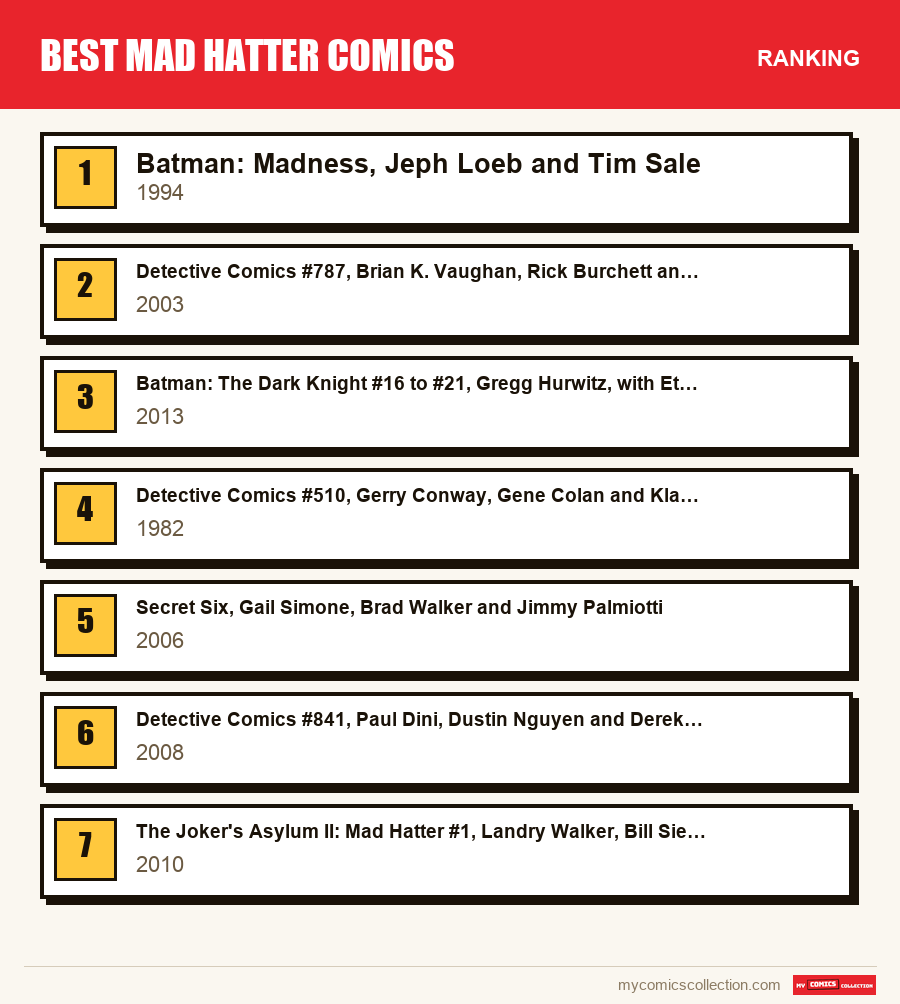
To read the best Mad Hatter comics, open Madness (1994), the Jeph Loeb and Tim Sale story in which Jervis Tetch kidnaps young Barbara Gordon, then follow it with Detective Comics #787 (2003), written by Brian K. Vaughan. Next go back to his first appearance in Batman #49 (1948) and his return in Detective Comics #510 (1982). Finish with Gregg Hurwitz's Mad arc in Batman: The Dark Knight (2013).
Among Batman's adversaries, the Mad Hatter stands out: Jervis Tetch is a small man whose weapons are booby-trapped hats and a fixation on Alice in Wonderland, a long way from the fists of Batman's other enemies. His bibliography is scattered across cameos and supporting roles, which forces some sorting. This guide picks seven reads in which Jervis Tetch truly takes the lead, in the order we recommend them.
As always in this guide, only verified information (creators, issue numbers, dates) is stated as fact; the analysis is our own, with no reproduction of protected panels or dialogue.
His first appearance
Jervis Tetch was born in Batman #49, cover-dated October-November 1948. The story is titled "The Scoop of the Century!" and sits in the middle of the issue, between a prison tale and an Arabian-flavored adventure. Bill Finger wrote it, Lew Sayre Schwartz drew it, Charles Paris inked it, and Bob Kane remains credited as the series' creator. The same issue introduces the reporter Vicki Vale, which makes it a sought-after single issue for two characters at once.
This initial version presents the Hatter as a costumed thief whose taste for headwear serves mostly as a criminal signature. The stories that now make his reputation, with mind control and Lewis Carroll's world, come later. Beware of the namesake: Detective Comics #230 (1956), by Bill Finger and Sheldon Moldoff, features a fake Hatter, and several issues of the following two decades follow this impostor, not Tetch. The catalog separates the two entries, and you need to check which one you are buying.
1: Batman: Madness, Jeph Loeb and Tim Sale (1994)
This story is the second of the three Halloween Specials of Batman: Legends of the Dark Knight that Loeb and Sale published between 1993 and 1995, later collected in the trade paperback Haunted Knight. The Hatter kidnaps Barbara Gordon, the commissioner's daughter, while Batman traces his way back to childhood memories of Bruce Wayne. The inspiration comes directly from Lewis Carroll and John Tenniel's iconography, which Tim Sale translates into angular panels and thick shadows.
What this story gives Tetch: a credible threat, far from a comic accessory. It suits newcomers: one single issue is enough, with no other Batman in your head. To read it without chasing the original, look for Haunted Knight; fans of The Long Halloween will recognize the same duo there, whom we cover in our entry on Two-Face.
2: Detective Comics #787, Brian K. Vaughan, Rick Burchett and John Lowe (2003)
Cover-dated December 2003 and titled "Mimsy Were the Borogoves," this standalone issue confronts Batman with a clue left backward: a Carroll quotation flipped as in a mirror. Kirk Langstrom, the scientist turned Man-Bat, disappears, the Hatter has escaped from Arkham, and the psychiatrist treating him vanishes in turn. Tetch turns Langstrom's research against his doctor to make him feel madness from the inside.
What you gain: a textbook case of how Tetch thinks, with his revenge aimed at a therapist rather than at Batman himself. The single issue is aimed at readers who like complete twenty-page stories, and it reads without any other reading. Rick Burchett on pencils and John Lowe on inks hold together a puzzle story in which every page sets up the next.
3: Batman: The Dark Knight #16 to #21, Gregg Hurwitz, with Ethan Van Sciver and Szymon Kudranski (2013)
From March to August 2013, the series relaunched by DC in 2011 devotes six issues to the Hatter. Gregg Hurwitz writes the arc, titled Mad when collected, Ethan Van Sciver draws the opening with #16, and Szymon Kudranski is among the artists on the rest. Batman follows a trail of bodies with no apparent motive, while Tetch kidnaps Gotham residents for a purpose the investigation gradually reveals. The twins Tweedledum and Tweedledee appear notably in the final chapter.
This is the most modern and darkest read on the list. It reinvents the character's origin without worrying about its earlier versions, which makes it accessible to a reader who arrived with the 2011 relaunch. On the other hand, a reader attached to pre-2011 continuity will find discrepancies. The Mad collection gathers the issues and saves you from chasing monthly single issues that have become hard to put together.
4: Detective Comics #510, Gerry Conway, Gene Colan and Klaus Janson (1982)
This is the issue that puts the real Hatter back on stage after the years of impostors. Cover-dated January 1982, it carries the cover title "Head-Hunt by a Mad Hatter" and announces, according to its blurb, the return of the original, determined to destroy Batman's mind. Gerry Conway writes the main story, Gene Colan pencils it and Klaus Janson inks it. The single issue also contains a backup story, by Cary Burkett and José Delbo.
The interest is historical as much as narrative: we watch the character regain his legitimacy. It is aimed at Bronze Age collectors who like to read an issue in its period context. To place the writer within his overall bibliography, see the page devoted to Gerry Conway.
Do you collect this series?
Track what you own, what you are missing and what your collection is worth. 7-day trial.
Start my trial →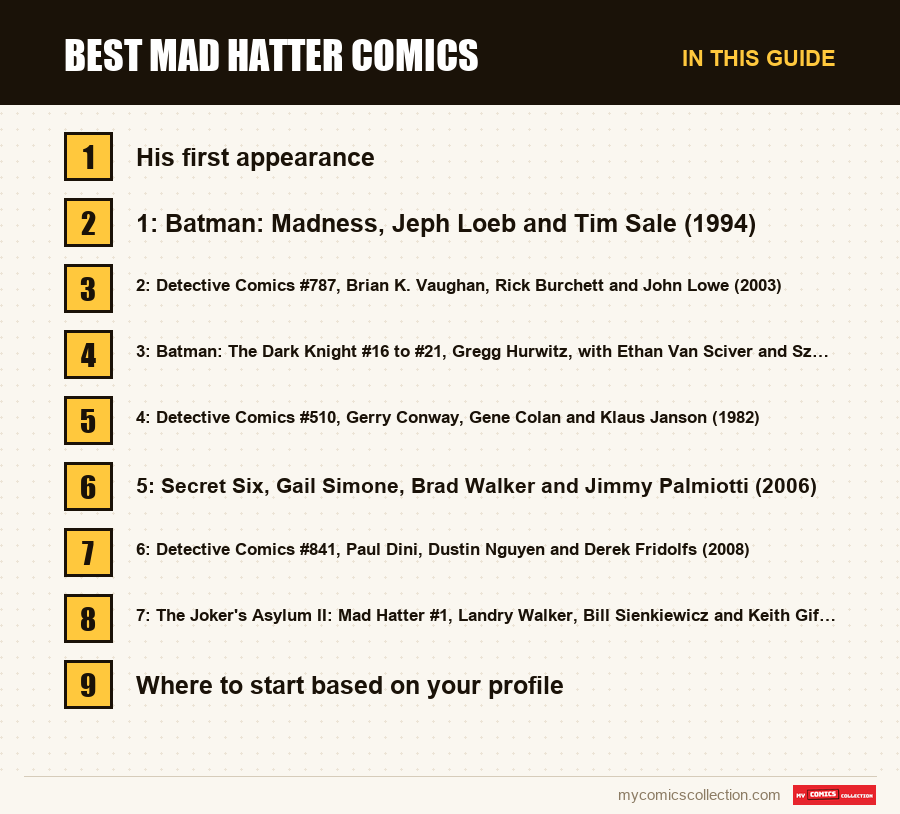
5: Secret Six, Gail Simone, Brad Walker and Jimmy Palmiotti (2006)
The six-issue miniseries, cover-dated July to December 2006, brings together Catman, Deadshot, Scandal Savage, Rag Doll and Knockout, with the Mad Hatter on the team. Gail Simone writes, Brad Walker draws and Jimmy Palmiotti inks. Here, Tetch is no longer Batman's adversary: he becomes a fellow mercenary, with his quirks and grudges. The trade paperback is titled Six Degrees of Devastation.
This series offers a rare angle: the Hatter observed from inside a group, with no hero to contain him. It is aimed at readers who like teams of morally ambiguous characters and does not require knowing Batman. Be warned, however: the main plot is about the team, and Tetch is only one of its members. We rank it because he holds a lasting role there, not because he is its star.
6: Detective Comics #841, Paul Dini, Dustin Nguyen and Derek Fridolfs (2008)
Titled "The Wonderland Gang" and cover-dated April 2008, this issue pits Batman against a team of costumed criminals drawn from Carroll's universe. The twins Tweedledum and Tweedledee exploit the Hatter's technology to build their gang, and the question the story asks is whether Tetch has taken back the reins or been outmaneuvered. Paul Dini writes, Dustin Nguyen pencils and Derek Fridolfs inks.
The issue offers a different view of Tetch: that of an inventor whose tools slip out of his control. It is aimed at readers who have already read Detective Comics #787 and want a light companion piece. Opinions at the time were split, some seeing an entertaining adventure, others a minor Dini story. Save it for the end of your path.
7: The Joker's Asylum II: Mad Hatter #1, Landry Walker, Bill Sienkiewicz and Keith Giffen (2010)
This one-shot cover-dated August 2010 is part of a line in which each single issue gives a voice to an adversary, with the Joker playing host. The story is called "Tea Time" and boils down, according to the official blurb, to a tale told by the Hatter about Alice, himself, hats and tea. Landry Walker writes, Bill Sienkiewicz does the cover and the art with Keith Giffen.
It is the most experimental read on the list, and the one best suited to art lovers more than story lovers. It requires no prerequisites. Do not read it first: its strength comes from your already knowing the character and his visual vocabulary.
Where to start based on your profile
If you want something to read right away, grab Haunted Knight for Madness, then Detective Comics #787. If you prefer recent stories, start with Mad in Batman: The Dark Knight and go back afterward to the Loeb and Sale episodes. If you collect the Golden Age or the Bronze Age, Batman #49 and Detective Comics #510 are your two landmarks.
Readers who like teams of villains will turn to Secret Six. Those looking for a lighter-toned companion will try Detective Comics #841. To put the Hatter in perspective against another adversary who works on his victims' minds, read our entry on Scarecrow. You can also continue with the best Batman runs.
Two appearances deserve a mention without making the ranking. In the "Unresolved" arc of Gotham Central (#19 to #22, 2004), by Ed Brubaker, Michael Lark and Stefano Gaudiano, Tetch is questioned by Gotham police detectives: he is a source in an investigation into a bombing, not the main villain. In the graphic novel Arkham Asylum (1989), which Grant Morrison wrote with Dave McKean on art, he is among the inmates without playing the central role. If Brubaker interests you, see the creator page.
The key issues to know
The hierarchy follows the logic of first appearances and turning points. The major landmark is Batman #49 (October-November 1948), where the character is born, followed by Detective Comics #230 (1956), which launches the impostor and muddies the chronology for two decades. Detective Comics #510 (January 1982) marks the return of the real Tetch; it is the key to look for if you want to document that turning point.
Next come the modern landmarks: the Madness Halloween Special (1994), Detective Comics #787 (December 2003), Secret Six #1 (July 2006) and Batman: The Dark Knight #16 (March 2013). Their value depends on their scarcity and the condition of the single issue. Method: compare several completed sales of the same issue, in the same condition, before trusting a single listing. For a 1948 or 1982 single issue, also note any restoration flagged in the description.
Frequently asked questions
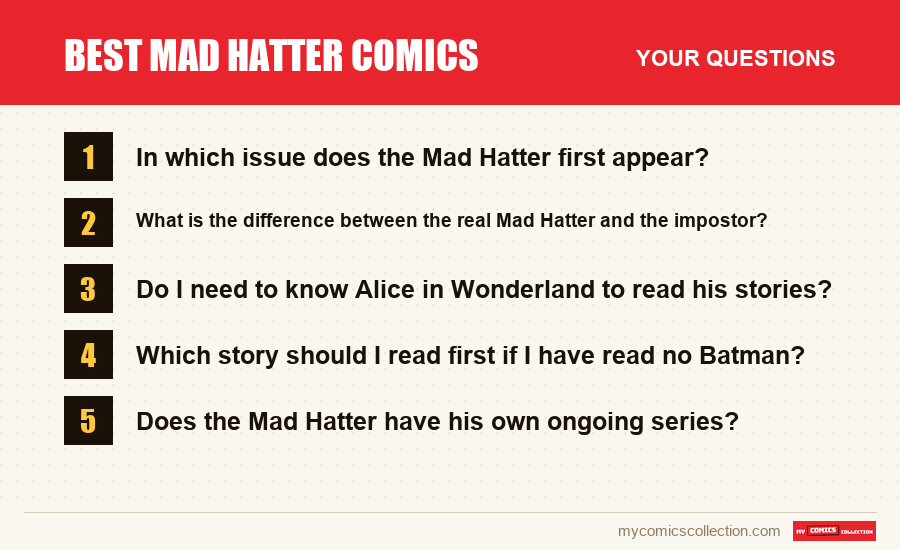
In Batman #49, cover-dated October-November 1948, within the story "The Scoop of the Century!" Bill Finger wrote it, Lew Sayre Schwartz drew it and Charles Paris inked it, with Bob Kane remaining credited as the series' creator. This issue also introduces Vicki Vale.
The real character is Jervis Tetch, introduced in 1948. An impostor takes the name in Detective Comics #230 (1956) and dominates the following years, until the original returns in Detective Comics #510 (January 1982). So check the catalog entry before buying an issue from this period.
No, but it enriches the reading. The stories by Loeb and Sale, Vaughan or Hurwitz borrow Lewis Carroll's vocabulary: tea, mirrors, flipped quotations. They remain understandable without having read it, because each writer explains what the story needs as the pages go by.
Take Batman: Madness, in the Haunted Knight collection. Jeph Loeb and Tim Sale tell the kidnapping of Barbara Gordon in a single issue, with no prerequisites. If you prefer a recent story, choose Gregg Hurwitz's Mad arc, published in Batman: The Dark Knight in 2013.
Our ranking includes no ongoing series in his name at DC. His best stories are standalone issues, a six-issue arc in Batman: The Dark Knight, a team miniseries with Secret Six and a one-shot published in 2010 in the The Joker's Asylum II line.
Do you own a Mad Hatter issue, such as Batman #49 or Detective Comics #510? Have its condition and value appraised.
Appraise my comic