To find the best Killer Frost comics and where to start, open the one-shot Justice League of America: Killer Frost Rebirth #1 (2017), by Steve Orlando, Jody Houser and Mirka Andolfo, then go back to Justice League of America #7.2, "Freezing to Death" (2013). For the origins, read Firestorm #3 (June 1978), by Gerry Conway and Al Milgrom, where Crystal Frost debuts, then The Fury of Firestorm #34 (1985), where Louise Lincoln takes up the name. Three women have carried it, which changes the reading order.
Killer Frost is a name before it is a woman. Crystal Frost invents it in 1978, Louise Lincoln picks it up in 1985, Caitlin Snow takes it over in 2013, and each has her own era, writers and enemies. The trap for a reader searching for "the best Killer Frost" is to mix the three threads, or to rank a story where she is only passing through. This guide only includes stories where she is at the center, or a clear part of the team, and it says each time which of the three is at work.
As always in this guide, only verified facts (creators, issue numbers, dates) are stated as fact; the analysis is our own, with no reproduction of panels or copyrighted dialogue.
Her first appearance
Crystal Frost debuts in Firestorm #3, cover-dated June 1978, in a story titled "Kiss Not the Lips of Killer Frost". The text is by Gerry Conway and the art by Al Milgrom, the two creators who launch the series that same year. The issue tells how a woman locked in a super-refrigeration chamber emerges transformed, with a power over cold that sets her apart at once from the thieves with freeze guns. The title already does most of the work: this enemy seduces, and whatever she touches freezes.
For a collector, this issue belongs to a tight group. The 1978 series stops after five issues, a victim of the editorial crisis DC nicknamed the "implosion". Our page on the best Firestorm comics describes what that launch is worth from the hero's point of view; here, we keep only what the issue fixes for the villain: the name, the ice, and a lasting tie to Firestorm.
Two later landmarks open the other two lives of the name. Louise Lincoln appears in March 1984 in The Fury of Firestorm #21, where she is still only a supporting character. Caitlin Snow arrives in June 2013 in The Fury of Firestorm: The Nuclear Men #19, during the period when Dan Jurgens runs the series.
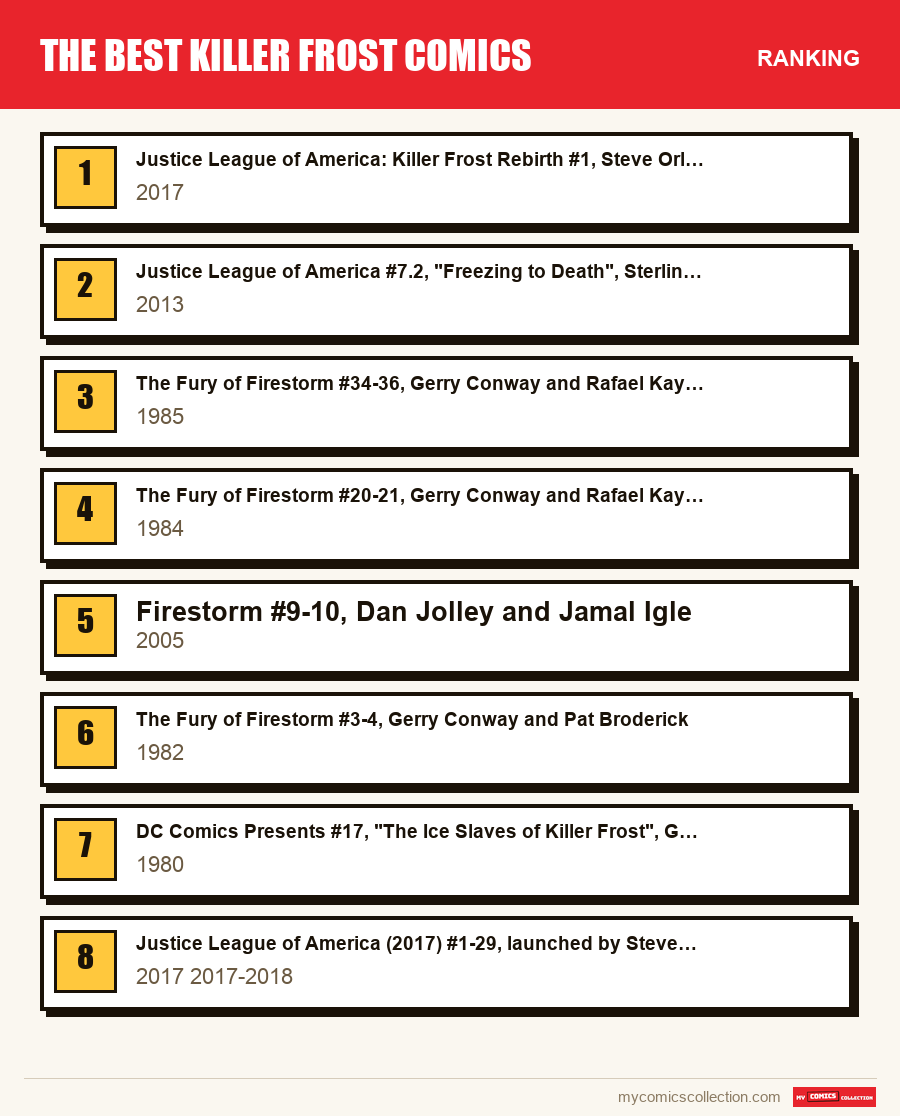
1: Justice League of America: Killer Frost Rebirth #1, Steve Orlando, Jody Houser and Mirka Andolfo (2017)
This is the best entry point for Caitlin Snow. The one-shot, cover-dated March 2017, directly follows the miniseries Justice League vs. Suicide Squad, and it does so without requiring you to have read it: it shows a Belle Reve inmate whose release depends on a deal with Batman, and whose warden, Amanda Waller, intends to spare her nothing. The writers, Steve Orlando and Jody Houser, turn the character's hunger for heat into a concrete situation: in every scene, the question is what she will take from others to hold on.
Mirka Andolfo gives the character a human face rather than a monster's mask, which is the right choice for a story that lives on its silences and glances. The story suits the reader who is discovering Caitlin and wants to understand why a former enemy can join a team of heroes. It suits less anyone looking for action: the conflict is mostly psychological, and it plays out in a prison more than on a Gotham street.
2: Justice League of America #7.2, "Freezing to Death", Sterling Gates and Derlis Santacruz (2013)
This November 2013 issue puts Caitlin Snow at the center under the name Killer Frost; its decimal number, 7.2, places it in a series of issues devoted to villains. Sterling Gates writes it, Derlis Santacruz draws it, and the story fits in twenty pages. Its idea is precise: Caitlin's power comes from Firestorm's energy, Firestorm has vanished, and she must choose between going to look for him and finding another source.
This dependence ties the 2013 Killer Frost to the earlier lineage, still linked to Firestorm, but it makes Caitlin a tragic character more than a malicious one. The read takes twenty minutes, it suits anyone who wants a complete story with no commitment, and it prepares the 2017 one, where the craving becomes leverage for Amanda Waller.
3: The Fury of Firestorm #34-36, Gerry Conway and Rafael Kayanan (1985)
This is where Louise Lincoln becomes Killer Frost. Issue #34, cover-dated April 1985, presents her as the second to bear the name; issues #35 and #36, published right after, make her the villain of the story and extend the threat. Gerry Conway writes all three, with Rafael Kayanan on art.
These issues come out the year of Crisis on Infinite Earths, when the whole DC universe is reorganizing, but they remain a monthly serial centered on Firestorm. For a present-day reader, this is the right read if you want to see how a villain's name passes from one woman to another without the series needing to explain it in three pages.
4: The Fury of Firestorm #20-21, Gerry Conway and Rafael Kayanan (1984)
The two-parter tells the end of the first Killer Frost. In issue #20 (February 1984), Crystal Frost is the enemy of the story; in issue #21, "Cold Snap!" (March 1984), she dies, and Louise Lincoln appears for the first time as a supporting character. Conway writes, Kayanan draws, and the interior inks are by Rodin Rodriguez, as in the surrounding issues.
This stretch is a turning point for the series: it removes a character established since 1978 and sets down the piece that will be used a year later. These issues assume you know Firestorm, but they show why Louise Lincoln is not a copy of Crystal.
5: Firestorm #9-10, Dan Jolley and Jamal Igle (2005)
The 2004 series puts Jason Rusch in the role of Firestorm, and Louise Lincoln returns there as an enemy of the former host. In issue #9, "Very Bad Things" (March 2005), she learns she has cancer, and she manipulates Jason Rusch into curing her with his powers. Issue #10, "Rebirth" (April 2005), makes her the villain of the story. Dan Jolley writes both, Jamal Igle draws them.
Here, Killer Frost is treated as a sick woman as much as a threat, and the idea is a good one: what defines her turns against her. The end of the arc is not summarized here, because the pleasure lies in how Jason tries to fix his mistake; just note that these issues go further than the ice-woman archetype.
These single issues aim at the reader already familiar with the name, curious about a less caricatured Louise Lincoln. They are a poor entry into the series: better to have read the 1984 issue #21 or the recap of the 2004 series on our Firestorm page. The issues from the period are easy to find, and the right method is to buy #9 and #10 together.
Do you collect this series?
Track what you own, what you are missing and what your collection is worth. 7-day trial.
Start my trial →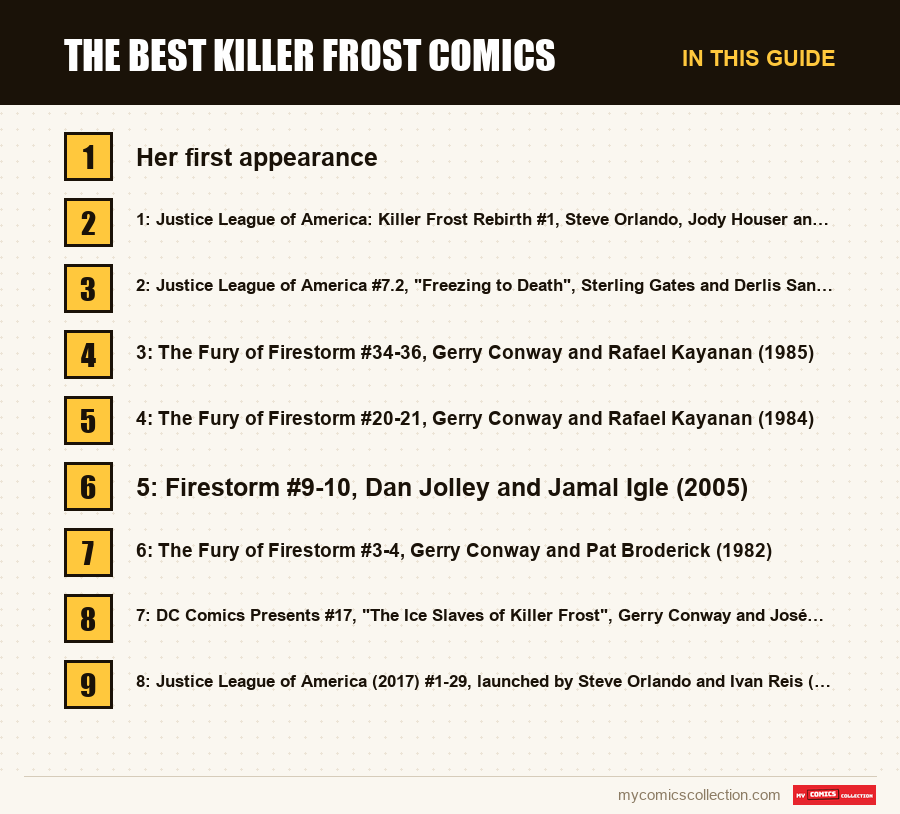
6: The Fury of Firestorm #3-4, Gerry Conway and Pat Broderick (1982)
The new Firestorm series, launched in 1982, brings Crystal Frost back as early as its third issue, then in the fourth, both published in 1982. Gerry Conway writes, Pat Broderick draws. Crystal plays the villain across two consecutive issues.
7: DC Comics Presents #17, "The Ice Slaves of Killer Frost", Gerry Conway and José Luis García-López (1980)
This January 1980 issue is a meeting: Superman and Firestorm face Crystal Frost, and the title already says what she does with her victims. Gerry Conway writes, José Luis García-López draws, and Crystal takes on both Superman and Firestorm.
8: Justice League of America (2017) #1-29, launched by Steve Orlando and Ivan Reis (2017-2018)
The 2017 ongoing series brings together Batman, Black Canary, Lobo, Vixen, the Ray, the Atom (Ryan Choi) and Killer Frost, launched by Steve Orlando on writing and Ivan Reis on art for issue #1, cover-dated April 2017. It runs twenty-nine issues. Killer Frost is a team member there, not the main character, and that distinction explains her place at the bottom of the ranking.
The series is worth reading for what it does with Caitlin Snow after the one-shot: it places her in a group, which extends the question raised above about whether the character can hold on without taking from others. It suits the team-book reader, who accepts following seven characters to find one. Those looking only for Killer Frost will be content with the first two entries.
Where to start based on your profile
If you are new to the character, read entry 1 then entry 2: in two single issues from 2013 and 2017, you get Caitlin Snow, her power source and the frame of her entry into a team. If you collect the Bronze Age, start with Firestorm #3 from 1978, then The Fury of Firestorm #20 and #21 from 1984, then issues #34-36 from 1985: these issues tell the succession from Crystal to Louise.
Readers coming from the Flash universe will find in Captain Cold another figure of cold, but there is no origin link: Killer Frost belongs first to Firestorm. As for the 2017 series, its team context can be found in the Justice League reading guide.
The key issues to know
The following landmarks are read without any price figure: for each, ask yourself whether the name is born, changes hands or disappears, since the issue's interest comes from that gesture.
- Firestorm #3 (June 1978): Crystal Frost, the first Killer Frost, created by Gerry Conway and Al Milgrom.
- The Fury of Firestorm #21 (March 1984): death of Crystal Frost and first appearance of Louise Lincoln.
- The Fury of Firestorm #34 (April 1985): Louise Lincoln becomes the second Killer Frost.
- Firestorm #9 (March 2005): Louise Lincoln's cancer and her manipulation of Jason Rusch.
- The Fury of Firestorm: The Nuclear Men #19 (June 2013): arrival of Caitlin Snow, written by Dan Jurgens.
- Justice League of America #7.2 (November 2013): a story centered on Caitlin Snow as Killer Frost.
- Justice League of America: Killer Frost Rebirth #1 (March 2017): Caitlin facing Amanda Waller, then free.
One last collecting landmark: Crystal Frost returns in 2009 in Blackest Night, written by Geoff Johns, among the dead raised by the black rings. This reappearance is not a story in itself; see our page on the Blackest Night key issues for the details of the event.
Frequently asked questions
Three, in order of publication: Crystal Frost (1978), Louise Lincoln, who takes the name in 1985, and Caitlin Snow (2013). Each has her own stories. Mixing them up distorts the ranking, because Caitlin is not tied to Crystal the way Louise is, but to Firestorm, whose energy fuels her powers.
Crystal Frost, the first, debuts in Firestorm #3, cover-dated June 1978, in the story "Kiss Not the Lips of Killer Frost". The text is by Gerry Conway, the art by Al Milgrom. Louise Lincoln appears in March 1984 in The Fury of Firestorm #21 and becomes Killer Frost in issue #34.
Open the one-shot Justice League of America: Killer Frost Rebirth #1 (2017), written by Steve Orlando and Jody Houser, drawn by Mirka Andolfo: it reads without preparation. Then go back to Justice League of America #7.2 (2013), by Sterling Gates and Derlis Santacruz, and, if the Bronze Age appeals to you, to the Firestorm issues from 1978 and 1985.
Not primarily. In the stories of this guide, she is mostly tied to Firestorm, from 1978 to 2005, then to the Justice League of America in 2017. She shares the cold theme with Captain Cold, but her origins and creators are different: Gerry Conway and Al Milgrom for the first, Dan Jurgens for Caitlin Snow.
In The Fury of Firestorm #34, cover-dated April 1985, written by Gerry Conway and drawn by Rafael Kayanan. Louise Lincoln had appeared a year earlier, in issue #21 from March 1984, where she played a supporting role while Crystal Frost died.
Do you own a Firestorm or Justice League of America issue featuring Killer Frost? A free appraisal helps you place it.
Appraise my comic