
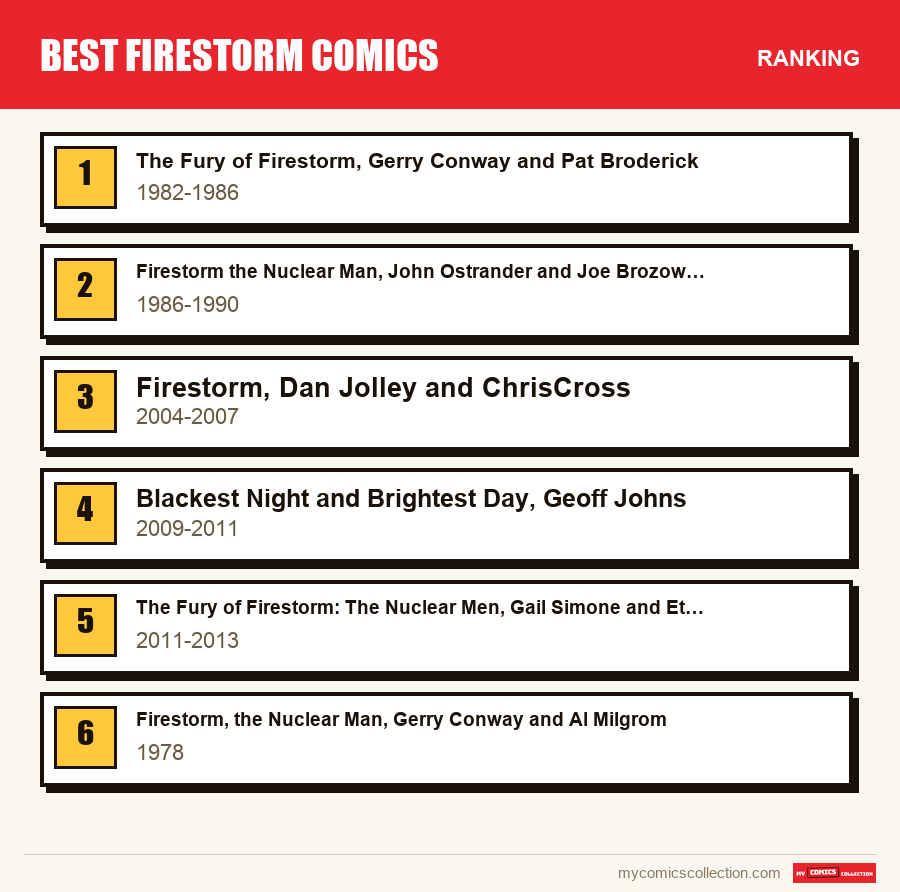
For the best Firestorm comics, start with The Fury of Firestorm (1982), where Gerry Conway and Pat Broderick relaunch the duo of teenager Ronnie Raymond and physicist Martin Stein, then continue with John Ostrander's issues from the late 1980s. Jason Rusch, the second Firestorm, is found in Dan Jolley and ChrisCross's 2004 Firestorm series. The 1978 issues remain the key issues to know.
Firestorm is a two-headed hero: a body of fire born from the fusion of two men, one who pilots and one who advises, and whose identity changes with the era. Ronnie Raymond and Martin Stein in 1978, Jason Rusch in 2004, sometimes both at once: before buying a single issue, you need to know who is holding it. This guide ranks six reads and specifies, for each one, which hosts appear on the page.
As always in this guide, only verified information (creators, issues, dates) is stated as fact; the analysis is our own, with no reproduction of protected art or dialogue.
His first appearance
Ronnie Raymond and Martin Stein merge for the first time in Firestorm, the Nuclear Man #1, cover-dated March 1978. Gerry Conway writes the story and Al Milgrom draws it. The series runs five issues before disappearing in the wave of cancellations DC dubbed the "DC Implosion." A sixth issue, finished but never distributed, was published later in Cancelled Comic Cavalcade.
This first series also introduces a gallery of adversaries who will return often: Danton Black appears in issue 1 before becoming Multiplex in issue 2 (April 1978), Crystal Frost debuts as Killer Frost in issue 3 (June 1978), and Summer Day becomes Hyena in issue 4 (September 1978). These are handy landmarks if you are looking for themed issues rather than a continuous read.
The second Firestorm, Jason Rusch, is born much later, in issue 1 of the 2004 series, cover-dated July: he is created by Dan Jolley and ChrisCross. To place the editorial context of these two dates, our history of DC Comics tells how the publisher went from the 1970s to the era of chain-linked events.
1: The Fury of Firestorm, Gerry Conway and Pat Broderick (1982-1986)
The second series begins in June 1982 with The Fury of Firestorm #1, written by Gerry Conway and drawn by Pat Broderick for that issue. It is then renamed Firestorm the Nuclear Man and runs until 1990. Conway scripts it through 1986, with several artists over the course of the issues.
This read gives the character a longevity the five issues of 1978 could not offer. Ronnie, a teenager, and Stein, a physicist, learn to cohabit in a single body, and the series establishes adversaries who matter: Black Bison appears right in issue 1, and Louise Lincoln becomes Killer Frost in issue 21, in March 1984.
It is for the reader who likes monthly series from the late Bronze Age and accepts a serial rhythm, with its threats of the week. To read it without chasing every single issue, aim first for the opening year, then issue 21 if the arrival of the second Killer Frost interests you. Our page on Gerry Conway comics places this work in the rest of his career.
2: Firestorm the Nuclear Man, John Ostrander and Joe Brozowski (1986-1990)
When Conway leaves the series in 1986, John Ostrander takes over the writing, with Joe Brozowski on art. This is the period when the series changes nature: Mikhail Arkadin appears in issue 62, cover-dated August 1987, under the name Pozhar, and in 1989 Ostrander reveals Firestorm as a fire elemental, formed from Ronnie, Arkadin and an entity named Svarozhich.
By issue 100, a reversal takes place: Martin Stein realizes he was destined to be the true fire elemental, and both Ronnie and Arkadin lose their powers. This is what makes the period a break rather than a simple continuation: the hero's status is no longer that of a fused pair, but of an elemental force.
This read suits whoever appreciates stories that go beyond superhero routine to give their power a mythology. It requires having read a little of the previous period to appreciate the reversals. Advance in stages: Pozhar at issue 62, then the end of the decade for the fire elemental.
3: Firestorm, Dan Jolley and ChrisCross (2004-2007)
For Jason Rusch, it all begins with the Firestorm (vol. 3) series, issue 1 cover-dated July 2004, written by Dan Jolley and drawn by ChrisCross. It revolves around a seventeen-year-old living in Detroit, who finds the Firestorm matrix after Ronnie Raymond's death in Identity Crisis. The series runs until 2007.
What this read brings comes down to the word "legacy": Firestorm is no longer a person, it is a role that another young man takes over, with his own doubts. Jason, here, is the full-fledged protagonist, not a supporting player to Ronnie; that is what sets it apart from the other reads in this guide.
It targets the reader curious to see Firestorm outlive his first pilot, and who prefers Jason to an already familiar face. Read it in order, from issue 1, and do not try to compare it to Conway's series: it follows a different project. To measure what changes next around Ronnie, move on to the next entry.
4: Blackest Night and Brightest Day, Geoff Johns (2009-2011)
Here, Firestorm is no longer the title but a thread in an event story. In Blackest Night, Ronnie Raymond returns as a Black Lantern under the name Deathstorm. In Brightest Day, the Life Entity resurrects Ronnie for good, and he and Jason work together: Firestorm can now switch pilots between the two hosts.
A word on the role, because it is secondary in the event: Blackest Night brings together a very wide gallery of characters and Brightest Day is written by several voices, Geoff Johns and Peter J. Tomasi. Firestorm is not the center there, but Ronnie's resurrection, in Brightest Day, decides the character's future.
This read suits the reader who already knows both hosts and wants to see how an event brings them together. To place these issues, see our guide to Blackest Night key issues, which lists the event's important single issues.
Do you collect this series?
Track what you own, what you are missing and what your collection is worth. 7-day trial.
Start my trial →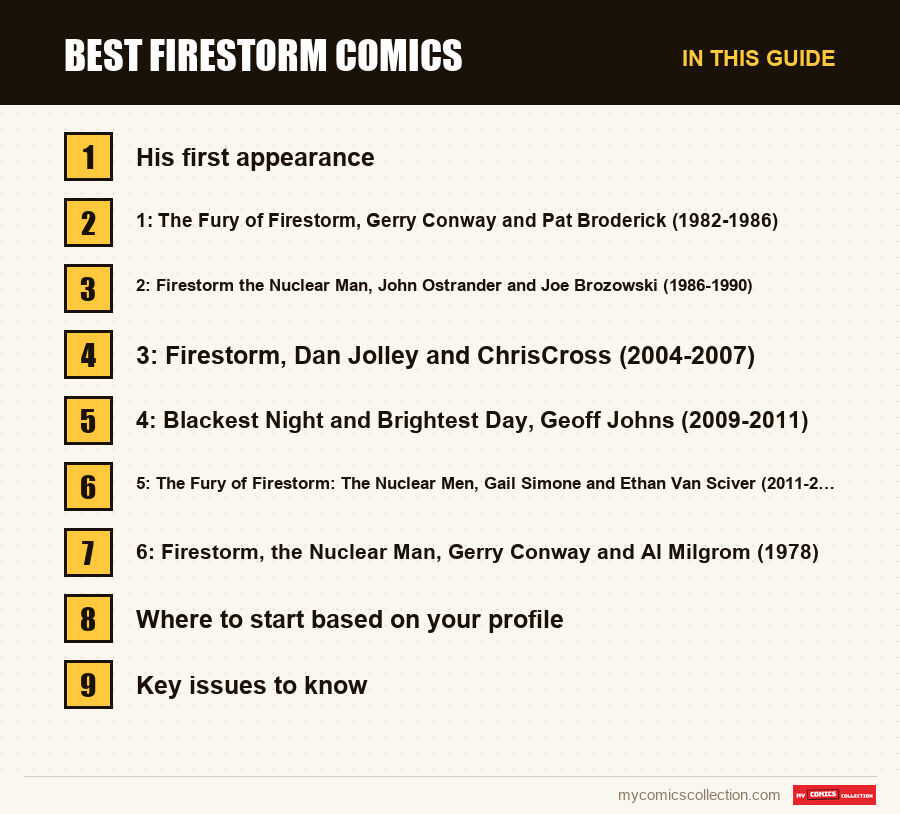
5: The Fury of Firestorm: The Nuclear Men, Gail Simone and Ethan Van Sciver (2011-2013)
This series relaunches the character in the New 52. It begins in September 2011, originally written by Gail Simone and Ethan Van Sciver, with Yıldıray Çınar on art. Joe Harris replaces Simone from issue 7, Van Sciver draws issues 7 and 8 before Çınar returns, and Dan Jurgens takes over with issue 13 through the end of the series, in 2013.
It delivers a version of the character reworked for a new readership, with Ronnie Raymond and Jason Rusch on the page. It is the most changeable of the reads presented here, since three creative teams follow one another in barely two years.
It is for whoever wants to see the character in his contemporary layout, or who collects the New 52 period. The first issues, by Simone and Van Sciver, form a coherent block; beyond that, the writer changes make the series a patchwork that you read out of curiosity rather than rigor.
6: Firestorm, the Nuclear Man, Gerry Conway and Al Milgrom (1978)
The last pick is a collector's read: the five issues of 1978, from March until the halt caused by the "DC Implosion." Gerry Conway and Al Milgrom set up the duo of Ronnie Raymond and Martin Stein there, and the series presents Multiplex, Killer Frost and Hyena, three adversaries who will return.
What you gain is an understanding of the origin: the pilot, the advising mind, and the principle of the fusion. What you lose is the long-haul momentum of the later series, since publication stops before anything has been established.
It is for whoever collects first issues and wants to hold the origin issue. Look for the five single issues together or a reprint that gathers them, and do not settle for issue 1 alone: the three adversaries appear in issues 2 to 4.
Where to start based on your profile
Choose according to the time you have and the Firestorm you want to follow.
- You are discovering the character: take The Fury of Firestorm (1982), the first block of issues by Conway and Broderick.
- You like mythology: move on to the Ostrander and Brozowski issues, from issue 62.
- You prefer a new hero: the 2004 series by Dan Jolley and ChrisCross, for Jason Rusch.
- You follow the big events: Blackest Night and Brightest Day, keeping in mind that Firestorm is not at the center there.
- You collect first issues: the five issues of 1978, then issue 1 of 1982 and that of 2004.
Keep in mind that a single issue can feature Ronnie, Jason or Stein, and that catalogs file everything under one name. Always note the host before comparing two copies.
Key issues to know
Chronological landmarks for Firestorm, from 1978 to 2013. No dollar figure is given: only the method for hunting these single issues matters.
- Firestorm, the Nuclear Man #1 (March 1978): the first appearance of Firestorm, by Gerry Conway and Al Milgrom, and of Danton Black.
- Firestorm #2 (April 1978): Danton Black becomes Multiplex.
- Firestorm #3 (June 1978): Crystal Frost, the first Killer Frost.
- Firestorm #4 (September 1978): Summer Day, Hyena.
- The Fury of Firestorm #1 (June 1982): the second series, by Conway and Pat Broderick, with Black Bison.
- The Fury of Firestorm #21 (March 1984): Louise Lincoln, the second Killer Frost.
- The Fury of Firestorm #62 (August 1987): Mikhail Arkadin, Pozhar.
- Firestorm (vol. 3) #1 (July 2004): the first appearance of Jason Rusch, by Dan Jolley and ChrisCross.
- Brightest Day (2010-2011): the resurrection of Ronnie Raymond by the Life Entity.
- The Fury of Firestorm: The Nuclear Men #1 (September 2011): the start of the New 52.
Before buying, note the year, the volume and the host concerned; then compare three sold listings in the same grade, without counting the extremes. For the 1978 issues, be patient rather than accepting the first copy whose photo is blurry.
Frequently asked questions
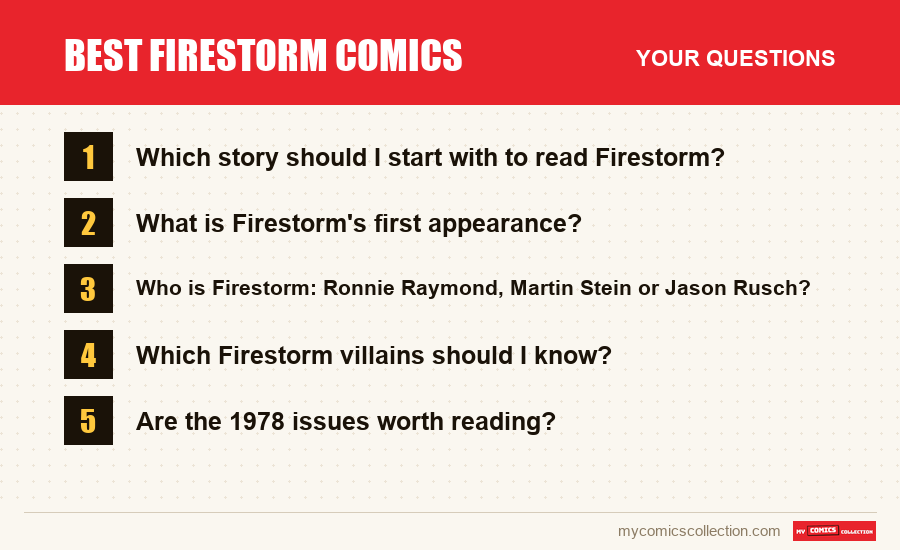
For the Ronnie Raymond and Martin Stein version, open The Fury of Firestorm (1982) by Gerry Conway and Pat Broderick. For Jason Rusch, take the 2004 Firestorm series by Dan Jolley and ChrisCross. Both series read without any prior knowledge and cover the character's two main hosts.
Firestorm, with Ronnie Raymond and Martin Stein, appears in Firestorm, the Nuclear Man #1, cover-dated March 1978, by Gerry Conway and Al Milgrom. Jason Rusch, the second Firestorm, is born in issue 1 of the 2004 series, cover-dated July, by Dan Jolley and ChrisCross.
All three, depending on the era. Ronnie Raymond and Martin Stein form the original duo, since 1978. Jason Rusch takes over the role from 2004. In Brightest Day, Ronnie and Jason cohabit, and Firestorm can then pass from one to the other. So check the host before each purchase.
Multiplex, Killer Frost and Hyena appear right in 1978, in issues 1 to 4. Louise Lincoln becomes the second Killer Frost in issue 21 of the second series, in 1984, and Pozhar, a.k.a. Mikhail Arkadin, debuts in issue 62, in 1987. Black Bison, finally, opens the 1982 series.
Yes, if you collect first issues: they set up the duo, the fusion and three adversaries who will return. They make up only five issues, however, because the series was canceled with the "DC Implosion." For a long-haul read, start with the 1982 series instead.
Do you own a Firestorm from 1978 or 1982 and want to find its place in your collection? Get an estimate in a few moments.
Estimate my comic