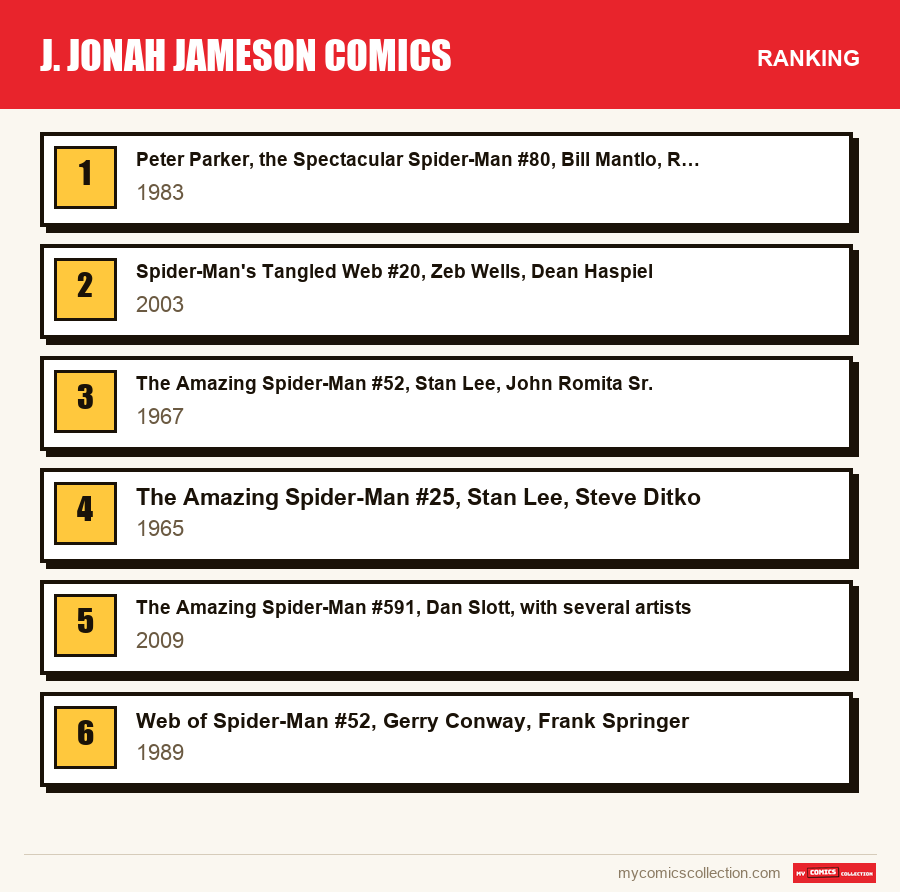
To start with the best J. Jonah Jameson comics, open Peter Parker, the Spectacular Spider-Man #80 (1983), by Bill Mantlo and Ron Frenz, where the Bugle publisher goes out to chase a story himself. Follow it with Spider-Man's Tangled Web #20 (2003), by Zeb Wells and Dean Haspiel, which tells his childhood, then The Amazing Spider-Man #52 (1967) by Stan Lee and John Romita Sr. For his run as mayor, read issue #591 (2009).
Jameson is the newspaper boss who devotes his editorials to smearing Spider-Man, and that is the trap of this ranking: he shows up in a huge number of single issues, almost always as background, behind his desk at the Daily Bugle. The stories that put him at the center can be counted on two hands, and they paint a portrait of a man more complex than his caricature. Six of them are worth your time, presented here with what each one brings and how to read it.
As always on this guide, only verified facts (creators, issue numbers, dates) are stated as fact; the analysis is our own, with no reproduction of protected panels or dialogue.
His first appearance
Jameson appears right in issue #1 of the series, cover-dated March 1963: Stan Lee writes, Steve Ditko draws. The character was born with the series and has been one of its pillars from the start: the second issue, from May 1963, shows Peter Parker selling him his Spider-Man photos for the Daily Bugle, a financial tie between the hero and his detractor that would structure decades of stories.
To place that issue within the run, see the key issue guide to Amazing Spider-Man #1. What is most interesting is what the creators do with the role: Jameson is not a stage villain, he is a convinced publisher, and the gap between his conviction and the truth keeps the series turning.
How the ranking was built
For each of the six readings we chose, Jameson holds the main place in the story, or half the plot, or the stake that drives everything else. We set aside the stories where he passes through a panel or two, as any newspaper editor would, and we cite them further down with the exact role he plays. The ranking runs from the reading most centered on him to the one that works mostly on its premise.
1: Peter Parker, the Spectacular Spider-Man #80, Bill Mantlo, Ron Frenz (1983)
Dated July 1983 and titled "I Cover the Waterfront," this issue, written by Bill Mantlo and drawn by Ron Frenz, has Jameson leave his publisher's chair to report on a dangerous case. Unknown to him, his freelance photographer, Peter Parker, follows to watch over him as Spider-Man, and the story is told in the boss's own voice.
What the reading brings is rare: Jameson is the subject and the narrator here, not the obstacle. We see him do his job as a field journalist, while the hero he vilifies watches over him without his knowledge. Dramatic irony is the engine of the story.
Who should read it? Anyone who wants to understand why Jameson is a character and not a mere foil. How to read it? As a single issue, with no prerequisites: a passing familiarity with the Daily Bugle is enough.
2: Spider-Man's Tangled Web #20, Zeb Wells, Dean Haspiel (2003)
Dated January 2003, "Behind the Mustache" belongs to a series of done-in-one stories whose creative team changes every issue; it ran from June 2001 to March 2003 across twenty-two single issues. Zeb Wells writes this one, Dean Haspiel draws it. It goes back to Jameson's childhood, raised by David and Betty Jameson, an adoptive father, a decorated veteran, who abused his wife and his son.
This reading offers the clearest explanation of his relationship with heroism: the man who refuses to believe in the uprightness of heroes grew up beside an official hero who was no such thing. It does not justify his press campaigns, but it sheds light on them.
Who should read it? The reader looking for the character's psychology. How to read it? After reading 1, so the contrast works. The issue stands on its own; it requires no knowledge of the rest of the Tangled Web series. To follow Zeb Wells at the helm of Spider-Man, see the creator page.
3: The Amazing Spider-Man #52, Stan Lee, John Romita Sr. (1967)
Dated September 1967 and titled "To Die a Hero!," this issue closes the Kingpin sequence that spans issues #50 to #52. In issue #51, we find Frederick Foswell, a former criminal turned Daily Bugle reporter, back at crime in the Kingpin's service. Here, the Kingpin tries to silence Jameson, Spider-Man tries to save him, and Foswell dies taking the bullet meant for his boss.
The sequence delivers a valuable reversal: the man who pursues Spider-Man with hatred finds himself protected by him, and one of his employees sacrifices himself in his place. It is the issue of the Lee and Romita Sr. period where Jameson's life carries the plot from start to finish.
Who should read it? The Silver Age reader, or anyone drawn to a newsroom targeted by a gang boss. How to read it? Together with issues #50 and #51, because the outcome only carries weight if you know the machinery behind it. Issue #50 is also the Kingpin's first appearance, which explains collector interest.
Do you collect this series?
Track what you own, what you are missing and what your collection is worth. 7-day trial.
Start my trial →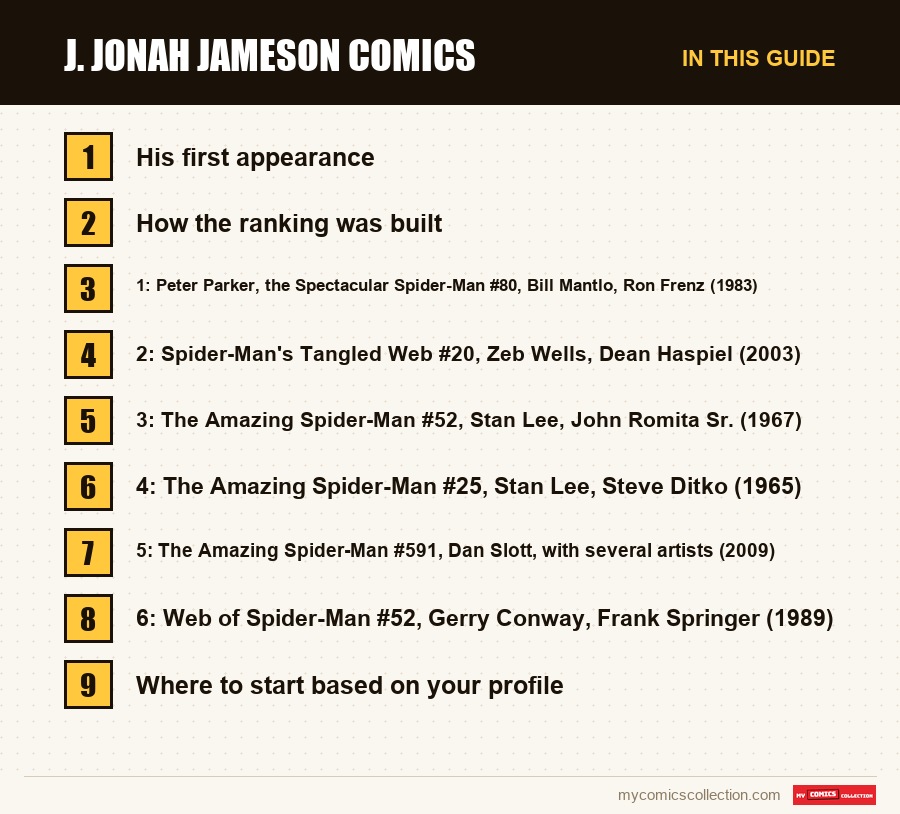
4: The Amazing Spider-Man #25, Stan Lee, Steve Ditko (1965)
Dated June 1965 and titled "Captured by J. Jonah Jameson!," this is the issue where the Spider-Slayer appears. Spencer Smythe builds the robots, and it is Jameson who bankrolls the project, with one fixed idea: capture Spider-Man and unmask him. Stan Lee writes, Steve Ditko draws.
What you find here goes beyond a simple manhunt. Jameson is no longer the editorialist who criticizes from afar: he puts his money and his business at the service of an obsession. You are reading the origin of a thread that runs for decades, from hatred on the front page to ordering hardware.
Who should read it? Ditko fans and anyone who likes 1960s robots. How to read it? As a single issue. For the neighboring issues of the decade, the Silver Age guide to the series works as a map.
5: The Amazing Spider-Man #591, Dan Slott, with several artists (2009)
This June 2009 issue has Dan Slott on script and an art team that includes Jesse Delperdang, Dale Eaglesham and Barry Kitson. Jameson is elected mayor of New York while Spider-Man is in another dimension with the Fantastic Four: a month has passed on Earth during his absence.
The follow-up is in issue #592: Jameson's father demands that he end his vendetta, and the mayor forms an "Anti-Spider Squad," while Spider-Man deliberately doubles down on heroics to provoke him. The conclusion of that term is in the Superior Spider-Man series: in issue #31, Jameson resigns after being confronted by the hero.
The reading brings a Jameson in power, who discovers that hostility is not enough to govern. Who should read it? The reader of the 2000s and 2010s, especially anyone following Dan Slott. How to read it? Start with issue #591, then #592, before moving on to the Superior issues where the end of his term plays out.
6: Web of Spider-Man #52, Gerry Conway, Frank Springer (1989)
Dated July 1989, this issue of the first Web of Spider-Man series is written by Gerry Conway and drawn by Frank Springer. The single issue puts Jameson at the center while Spider-Man appears in only one panel. The series runs one hundred twenty-nine issues, from April 1985 to October 1995, plus ten annuals; Conway wrote issues #50 to #70, among others.
The reading is mostly interesting for its premise: the hero steps aside, and it is the Bugle and its boss who take the stage. It closes the ranking because its interest lies in the bold choice more than in the scale of the story.
Who should read it? The reader following the Conway period. How to read it? On its own, after readings 1 through 5, as a curiosity. For the other issues by this writer on the hero, see the reading guide devoted to Gerry Conway.
Where to start based on your profile
If you are new to Jameson, read 1 and 2: you get the character at work, then the portrait of the man who drives him. If you love the Silver Age, readings 3 and 4 are your entry points, and they tell the two faces of the character, active hatred and the shock of being rescued.
If you have followed Spider-Man since the 2000s, start with reading 5 and continue with Superior Spider-Man. If you collect, look for The Amazing Spider-Man #1 and #25, then round it out with the annual that tells of his wedding.
The key issues to know
For a collector, you track the birth issue first, then the issues that change Jameson's status. No numbers in this list: value is judged by following, season after season, comparable copies by grade and printing.
- The Amazing Spider-Man #1 (March 1963): Jameson's first appearance, with Stan Lee and Steve Ditko at the helm.
- The Amazing Spider-Man #10 (March 1964): after his accusation against Spider-Man, wrongly presented as the Big Man, falls apart, he admits his jealousy of the hero's courage. The plot of the issue is driven by the Enforcers, hence its absence from the ranking.
- The Amazing Spider-Man #25 (June 1965): the Spider-Slayer, financed by Jameson.
- The Amazing Spider-Man #50 (July 1967): the Kingpin appears, by Stan Lee and John Romita Sr.
- The Amazing Spider-Man Annual #18 (1984): Jameson's marriage to Marla Madison, scripted by Stan Lee.
- Marvels #1 (1994): the young reporter who announces he will run the Bugle was meant to be Jameson, per the intent of Kurt Busiek and Alex Ross; his name was removed.
- The Amazing Spider-Man #591 (June 2009): Jameson's election as mayor, by Dan Slott.
When you face a copy for sale, check the cover against the indicia: series and issue number must match. For The Amazing Spider-Man #1, tell the 1963 single issue apart from a reprint by reading the printing indication.
Frequently asked questions
Right in issue #1 of the series, from March 1963, with Stan Lee and Steve Ditko at the helm. Issue #2, from May 1963, establishes his tie to Peter Parker: the young man sells his Spider-Man photos to the Daily Bugle, which Jameson runs.
For the one most centered on him, Peter Parker, the Spectacular Spider-Man #80 (1983): Bill Mantlo writes it, Ron Frenz draws it, and Jameson goes out to report. To understand his wounds, Spider-Man's Tangled Web #20 (2003), by Zeb Wells and Dean Haspiel, is the most illuminating read.
Yes: The Amazing Spider-Man #591, from June 2009, shows him elected mayor during Spider-Man's absence. Dan Slott writes this issue. In Superior Spider-Man #31, he resigns after being confronted by the hero, which closes that chapter.
Not in most of his classic stories. During the Civil War era, when Peter Parker reveals his identity, Jameson faints, files a fraud lawsuit and later fires Robbie Robertson. The episode portrays a man who saw in Peter one last honest man.
A little: his stories are better read with the context of the Daily Bugle and the hatred he bears for Spider-Man. Issues #25 and #52 of Amazing Spider-Man can be read on their own, but each gains depth if you know the character.
Do you own a copy of The Amazing Spider-Man #1, #25 or another Jameson issue? Get a free estimate.
Estimate my comic