
The best Hellcat comics start with Kate Leth and Brittney Williams's Patsy Walker, A.K.A. Hellcat! (2015-2017), the series that finally gives her top billing. Then go back to Kathryn Immonen and David Lafuente's Patsy Walker: Hellcat (2008-2009) and to her costume's debut in The Avengers #144 (1976). For key issues, Patsy Walker herself debuts in Miss America Magazine #2, November 1944.
Hellcat is a rare case: a heroine who already existed thirty years before putting on a costume. Patsy Walker was first the star of a teen humor comic, then of a young-adult romance, before Marvel threw her into the world of superheroes. This double origin explains why her best stories are split between romantic comedy, Bronze Age teams, and the occult side of the Marvel universe.
As always in this guide, we state only verified facts (creators, issue numbers, dates); the analysis is our own, with no reproduction of protected art or dialogue.

Her first appearance
Patsy Walker debuts in Miss America Magazine #2, dated November 1944, at Timely Comics, the publisher Marvel grew out of. The character was created by Stuart Little on script and Ruth Atkinson on art. Al Jaffee, future artist of Mad, wrote and drew most of the early issues of the series that bears her name; Al Hartley succeeded him.
The Hellcat most collectors are after is something else: she debuts in The Avengers #144, cover-dated February 1976. Steve Englehart writes, George Pérez pencils, and Mike Esposito inks. Patsy takes over the costume of Greer Grant Nelson, the former Cat, and adopts the name Hellcat. She had reappeared a few months earlier in The Avengers #141 (November 1975), under her civilian name, before taking on a costume.
So two milestones need to be told apart: Patsy's birth in 1944, and Hellcat's in 1976, separated by more than three decades. The six entries that follow put Patsy or Hellcat in the foreground; when she shares top billing, her exact role is stated.
1: Patsy Walker, A.K.A. Hellcat!, Kate Leth and Brittney Williams (2015-2017)
The series runs seventeen issues, written by Kate Leth and drawn by Brittney Williams. It tries to marry romance and superheroics in a comic tone that Kate Leth compares to a Saturday morning cartoon. Patsy, fired by She-Hulk, tries to start an employment agency for people with powers, and to win back the rights to the old Patsy Walker comics.
That last point deserves attention: the series plays with the character's publishing past, and turns her old romances into narrative material rather than an archival curiosity. Brittney Williams gives the whole a round, bright line that serves the comic vein without erasing what is at stake for the characters.
Who is it for? Readers looking for a light story with no continuity to catch up on. How to read it? In order, from #1 to #17, in three collections: Hooked on a Feline (#1 to #6, 2016), Don't Stop Me-Ow (#7 to #12, 2017), and Careless Whisker(s) (#13 to #17, 2017). For a single-issue collector, the complete series is short, and the few issues that matter are the first ones.
2: Patsy Walker: Hellcat, Kathryn Immonen and David Lafuente (2008-2009)
This five-issue miniseries, from September 2008 to February 2009, is written by Kathryn Immonen and drawn by David Lafuente, with covers by Stuart Immonen. It ties into the Avengers Initiative, the program that places a team in every state: Hellcat is assigned to watch over Alaska. The project grew out of an idea for a "Hellcat Christmas Special."
Alaska offers a disorienting setting for a heroine who keeps her light tone. David Lafuente's expressive, mobile art suits that register. The collection came out in June 2009.
Who is it for? Readers who enjoy short stories with no prerequisites. How to read it? In a single sitting, preferably in the collected edition, and before the 2015 series, whose tone it foreshadows. Together they form a natural pair, ten years apart.
3: The Avengers #144, Steve Englehart, George Pérez, and Mike Esposito (1976)
This February 1976 issue turns Patsy into a costumed heroine. She is a former assistant to Hank McCoy, the Beast, who has helped the Avengers; she is offered a place on the team, but Moondragon persuades her to decline and train on Titan. That training is interrupted when Patsy joins the Defenders to help Doctor Strange.
Here, Hellcat is not alone at the center: she shares top billing with the Avengers, and the issue is a birth milestone far more than a solo story. It is still worth reading, because it shows the character at the exact moment her status changes. Our page on George Pérez places this artist within his career as an illustrator of teams.
Who is it for? Bronze Age collectors first, and readers who want to see how Marvel folds a romance character into the world of heroes. How to read it? As a period single issue, or in a collection of the Avengers series from that era, after #141.
4: The Defenders #92, J.M. DeMatteis and Don Perlin (1981)
Hellcat joins the Defenders in #44, cover-dated February 1977, and it is in #92, dated February 1981, that she meets Daimon Hellstrom, written by J.M. DeMatteis and drawn by Don Perlin. They marry in #125, in November 1983, and become investigators of the occult. Hellstrom's demonic nature eventually reasserts itself.
Patsy's role here is that of one of the two main characters in a long story, within a team. This issue is chosen for the meeting, which opens the relationship at the root of her occult side. Who is it for? Bronze Age readers who enjoy mismatched teams. How to read it? By working through the Defenders series, which the series versus comics comparison puts in perspective.
Do you collect this series?
Track what you own, what you are missing and what your collection is worth. 7-day trial.
Start my trial →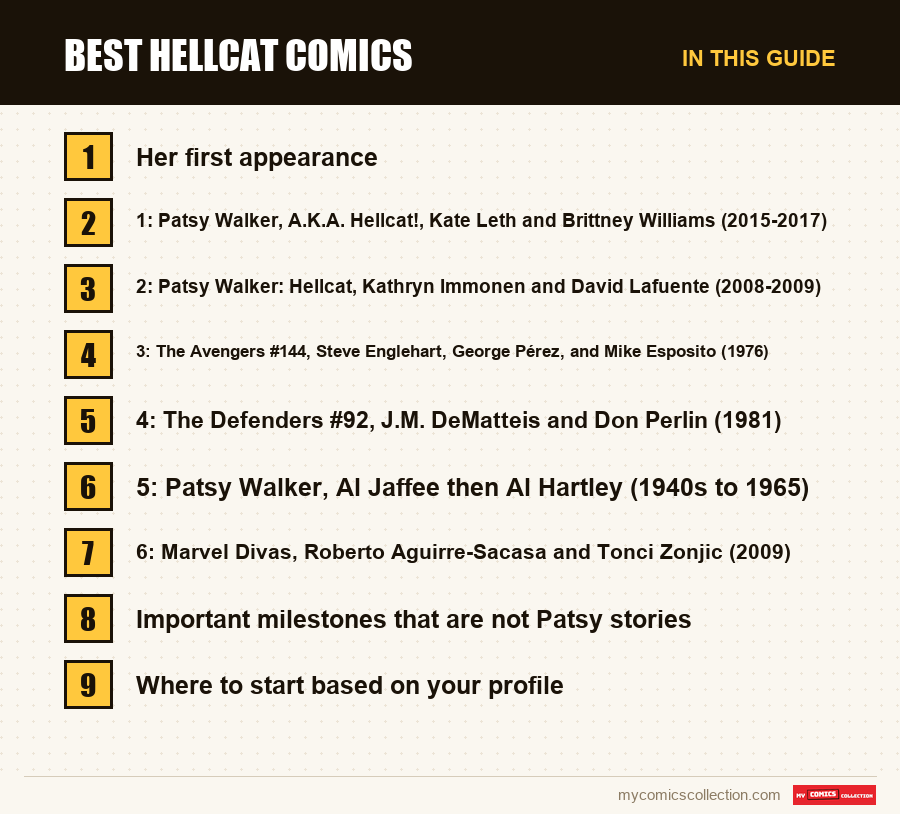
5: Patsy Walker, Al Jaffee then Al Hartley (1940s to 1965)
The series bears its heroine's name and runs through #124, cover-dated December 1965. It starts as a teen humor strip, with Al Jaffee writing and drawing most of the early issues, then Al Hartley. After Patsy's graduation, the title shifts toward career-girl romance.
For today's reader, it is the archive that explains the character: Patsy was not a second-tier heroine but the star of a title that lasted more than twenty years. Reading is easier in reprint than in single issues, and it is mostly relevant to fans of publishing history.
Who is it for? Collectors interested in the Timely and Atlas era series, and anyone who wants to understand why the 2015 series talks about copyright. How to read it? By sampling: a few issues are enough to get the tone, without chasing the completeness of a run of more than a hundred single issues.
6: Marvel Divas, Roberto Aguirre-Sacasa and Tonci Zonjic (2009)
The series runs four issues, from September to December 2009, written by Roberto Aguirre-Sacasa and drawn by Tonci Zonjic. Hellcat is one of the four lead heroines there, alongside Firestar, Black Cat, and Photon. Patsy's role is therefore shared: the story follows a group of friends, not a single heroine.
The series aims at something close to a dramedy, with heroines living their problems outside the costume. It was collected in January 2010. Who is it for? Readers who like stories of friendship between female characters. How to read it? In one sitting, preferably in the collected edition, after the Immonen and Lafuente miniseries, which sets Patsy's tone in 2008.
Important milestones that are not Patsy stories
A few issues matter for the collection without being devoted to Hellcat. Amazing Adventures #13 (July 1972), "Evil Is All in Your Mind!", by Steve Englehart, Tom Sutton, and Frank Giacoia, reintroduces Patsy as a woman who wants to become a superheroine; she is a supporting character in a series devoted to the Beast, which ends three issues later. She-Hulk (volume 3) #2, in 2014, by Charles Soule and Javier Pulido, makes her She-Hulk's private investigator; she plays a second lead there. Our history of She-Hulk in comics and our She-Hulk hub give the context.
A third marker concerns the character's death. Patsy is driven to madness and then to suicide in Hellstorm: Prince of Lies #14, cover-dated May 1994, and her spirit is used in Hell in battles. Hellstrom then tricks Hawkeye into bringing her soul back to Earth, believing he is recovering Mockingbird. She returns endowed with infernal powers and can make her costume appear at will. The return is concluded in Thunderbolts Annual 2000 (May 2000) and Avengers Annual 2000, then in a three-issue Hellcat miniseries, from September to November 2000.
Where to start based on your profile
A curious reader with no knowledge of Marvel should open the 2015 series: seventeen issues, a comic tone, and a heroine who explains her own past. It is the best entry point to the Hellcat catalog.
A reader who wants to understand the character in chronological order will begin with a few issues of Patsy Walker, then move on to The Avengers #141 to #144 and The Defenders from #44. This path requires hunting down period single issues or collections, but it tells the full evolution of a heroine born in romance comics.
An occult fan will focus on the couple formed with Daimon Hellstrom, in J.M. DeMatteis's Defenders, then on the 2000 return. As for the milestone collector, they will find their list just below and should check every credit before buying.
The key issues to know
The markers below are ordered by date. For each line, identify the event the issue carries (birth, new identity, marriage, death, return), then check the printed credits against your inventory sheet.
- Miss America Magazine #2 (November 1944): first appearance of Patsy Walker, by Stuart Little and Ruth Atkinson.
- Patsy Walker #124 (December 1965): last issue of the original series.
- Amazing Adventures #13 (July 1972): Patsy returns as an aspiring heroine, by Steve Englehart, Tom Sutton, and Frank Giacoia.
- The Avengers #141 (November 1975): return to the Avengers universe under her civilian name.
- The Avengers #144 (February 1976): first appearance of Hellcat, by Steve Englehart, George Pérez, and Mike Esposito.
- The Defenders #44 (February 1977): joins the team.
- The Defenders #92 (February 1981): meets Daimon Hellstrom; marriage in #125 (November 1983).
- Hellstorm: Prince of Lies #14 (May 1994): her death.
- Thunderbolts Annual 2000 (May 2000): her return.
- Patsy Walker: Hellcat (2008-2009) and Patsy Walker, A.K.A. Hellcat! (2015-2017): the two series that put her in the lead.

Frequently asked questions
Hellcat is born in The Avengers #144, cover-dated February 1976, written by Steve Englehart and drawn by George Pérez, with Mike Esposito on inks. Patsy Walker herself has existed since Miss America Magazine #2, dated November 1944.
Start with Patsy Walker, A.K.A. Hellcat! by Kate Leth and Brittney Williams, seventeen issues published from 2015 to 2017. The tone is comic, the plot can be followed with no prior knowledge, and the three collections cover the whole series.
Daimon Hellstrom. Patsy meets him in The Defenders #92, cover-dated February 1981, written by J.M. DeMatteis and drawn by Don Perlin. They marry in #125, in November 1983, and carry out occult investigations together.
Yes, but not a superheroine. Patsy Walker is the star of a teen humor comic, then a romance comic, published at Timely and then Atlas through #124, cover-dated December 1965. Hellcat only appears in 1976.
Read Patsy Walker: Hellcat (2008-2009) first, five issues by Kathryn Immonen and David Lafuente, then Patsy Walker, A.K.A. Hellcat! (2015-2017). They do not follow each other directly, but the second picks up the comic tone the first sets.
Do you have a copy of Avengers #144 or Defenders in your boxes? Get a free estimate.
Estimate my comic