
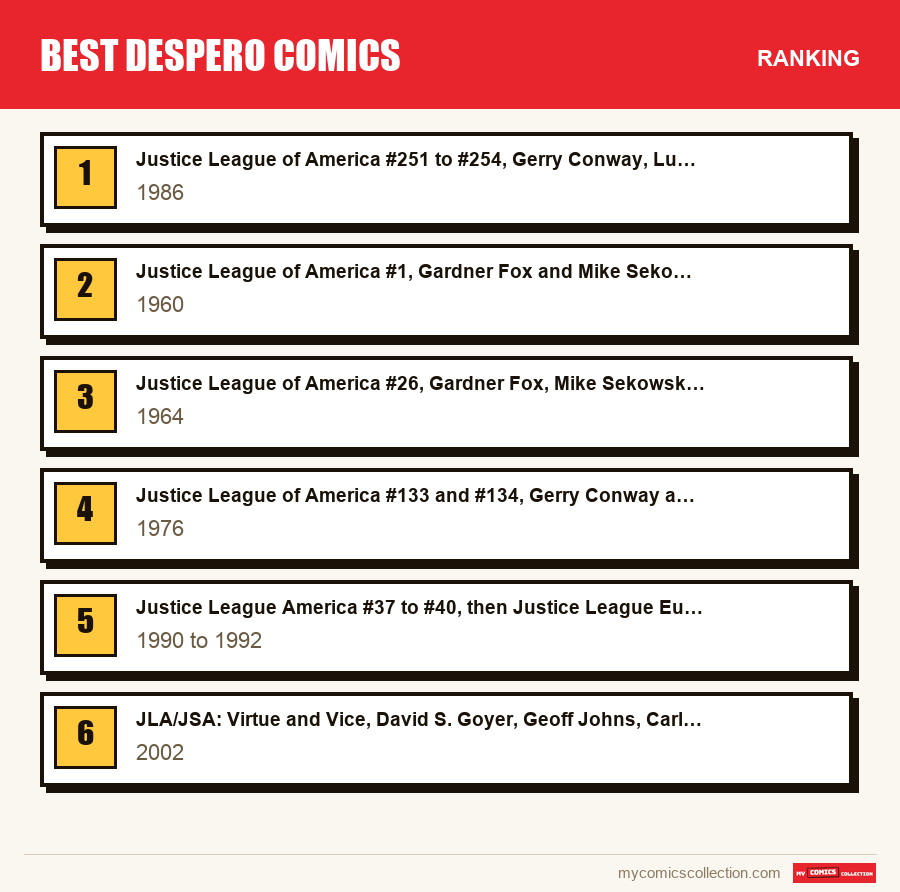
To find the best Despero comics, start with the 1986 storyline in Justice League of America #251 to #254, by Gerry Conway, Luke McDonnell and Bill Wray, where the tyrant of Kalanor turns Gotham into his battlefield. Then go back to his first appearance in Justice League of America #1 (1960, Gardner Fox and Mike Sekowsky) and to #26 (1964), then to #133 and #134 (1976, Gerry Conway and Dick Dillin). Finish with JLA/JSA: Virtue and Vice, by David S. Goyer and Geoff Johns.
Despero doesn't have the name recognition of a Darkseid or a Brainiac, yet he has fought the Justice League for more than half a century, from the Silver Age to the 2010s. A tyrant from the planet Kalanor, he is defined by a third eye that grants him psychic powers, and by a stubborn habit of coming back for the same team. Here are six reads that trace that run, from the 1960 opening issue to a 2002 adventure.
As always in this guide, we only state verified facts (creators, issue numbers, dates); the analysis is our own, with no reproduction of protected art or dialogue.
His first appearance
The tyrant of Kalanor bursts onto the scene in Justice League of America #1, in the fall of 1960, created by writer Gardner Fox and artist Mike Sekowsky. The villain is therefore there from the opening issue of the series, presenting himself as a conqueror who dreams of ruling the universe. For a collector, the point is simple: this foe is no footnote, he is one of the series' through lines for decades.
His trademarks were set very early. Despero rules Kalanor, and his third eye gives him telepathy, mind control, illusions and telekinesis, while a very high intelligence rounds out the package. On top of that comes the Flame of Py'tar, a remnant of the nuclear energy said to have created his race, which gives him enormous strength and the ability to change size. Keep that Flame in mind: several stories use it as a linchpin, and one of the character's best stories, in 1986, turns precisely on it.
1: Justice League of America #251 to #254, Gerry Conway, Luke McDonnell and Bill Wray (1986)
This is the read we would put first for someone new to the character. The lineup of the era brings together Batman, J'onn J'onzz, Zatanna, Vixen, Steel, Vibe and Gypsy. Despero crashes the League's abandoned satellite, learns that the team is now based on Earth, then attacks Gotham: he captures Batman and Vixen, remakes the city, raises a castle ringed with flames and turns the inhabitants into demons with a rebuilt Flame of Py'tar.
Its appeal is readability: one villain, a clear threat, a team that has to learn to cooperate. The resolution pairs Batman's cool head, which distracts Despero, with the power of one of the youngest members, since it is Vibe who puts out the Flame and ends the threat. A reader can dive in without knowing the 1960s; only a few subplots in #251, centered on other members, ask for a little patience.
2: Justice League of America #1, Gardner Fox and Mike Sekowsky (1960)
The source of the character reads for what it is: a Silver Age tale with sharp ideas, in which a team of heroes faces an opponent who outclasses them in intelligence. Fox and Sekowsky set down the traits later writers would reuse: the tyrant of Kalanor, his third eye and his taste for conquest. That third eye becomes his visual signature, the one a reader spots at a glance on a cover.
This issue is for the collector who wants the anchor piece, and for the reader who likes to understand where archetypes come from. Read it in the context of the team's birth, which our history of the Justice League places on the timeline. Don't expect the psychological depth of later stories: its strength lies elsewhere, in the clarity of the founding idea.
3: Justice League of America #26, Gardner Fox, Mike Sekowsky and Bernard Sachs (1964)
Dated March 1964, this issue is Despero's big return in the original series. He escapes from prison, ages half the members of the team and exiles the other half to three other worlds, where he has made reptiles, insects and marine life intelligent. He even disguises himself as an aged Superman to fool Wonder Woman, who unmasks him with her lasso of truth and forces him to undo his misdeeds. Fox shows off his fondness for science fiction worlds here, and Bernard Sachs inks Sekowsky's work.
It is the ideal read for anyone who enjoys the freewheeling imagination of the 1960s. It shows how the villain goes from simple conqueror to manipulator of realities. On the other hand, the tone of the period, with its speak-it-out-loud explanations and slightly mechanical reversals, may surprise you: take it as a historical document as much as entertainment, and follow it with a more modern story.
4: Justice League of America #133 and #134, Gerry Conway and Dick Dillin (1976)
Gerry Conway writes these two issues from August and September 1976, Dick Dillin pencils them and Frank McLaughlin inks. Superman disappears while the League is busy elsewhere, and he ends up on the planet Sirkus, where Despero threatens the population to obtain a cosmic cannon. A missed shot hits Superman, who is defeated and placed in stasis on the tyrant's ship; a local then tries to reach the real League.
It's a recommended read for those who enjoy stories where Despero takes on a top-tier figure: here, it is the Man of Steel who pays the price. Our Superman hub helps place this moment in the hero's journey. The two issues read in one sitting and form one of the rare stretches where the Kalanor tyrant serves to reveal another character, rather than holding the stage alone.
Do you collect this series?
Track what you own, what you are missing and what your collection is worth. 7-day trial.
Start my trial →
5: Justice League America #37 to #40, then Justice League Europe #30 to #34, Keith Giffen, J.M. DeMatteis and Gerard Jones, with several artists (1990 to 1992)
Despero reappears in Justice League America #37 to #40 (April to July 1990), a long arc at the end of which he is handed over to Manga Khan in exchange for the robot L-Ron. He returns in Justice League Europe #30 to #34 (September 1991 to January 1992), issues tied to the Breakdowns crossover: escaped, he fights the League and Lobo in Times Square, before Kilowog and L-Ron swap his mind with the robot's. Keith Giffen handles the plots of this period, with J.M. DeMatteis and then Gerard Jones on dialogue.
This entry is for the reader already sold on the international team of that era: it assumes you know the cast and are willing to follow two titles in parallel. Go by single issues rather than by collected edition, and check the table of contents before any purchase, since the story is split across two separate series. If you want to extend the period, also read our feature on Booster Gold, a member of the same generation of teams.
6: JLA/JSA: Virtue and Vice, David S. Goyer, Geoff Johns, Carlos Pacheco and Jesus Merino (2002)
This complete story, published in December 2002, brings the Justice League and the Justice Society together on the League's lunar station, just as a crisis erupts in Tanzania and Doctor Bedlam goes after Lex Luthor, then president. Behind the commotion, Despero is working with Johnny Sorrow, who has freed the Seven Deadly Enemies of Man: several heroes are possessed, and Shazam, back from the dead, helps turn the tide. Carlos Pacheco and Jesus Merino provide the art.
The read suits anyone who prefers a standalone volume to a series to keep up with. It is dense, with many characters, and Despero's role in it is that of an instigator rather than a physical fighter. We don't rank it higher because it serves the character less than it uses him as a cog in a meeting of teams. Geoff Johns, the co-writer, would later return to Despero in the 2013 Justice League.
Where to start based on your profile
If you want a complete, readable story, take Justice League of America #251 to #254: four issues, a single adversary, a clean conclusion. If you want to understand the origins, read #1, then #26, which show how Gardner Fox went from the idea of conquest to the idea of manipulating worlds. For a Superman reader, the #133 and #134 two-parter offers a direct angle on the hero facing the tyrant of Kalanor.
To build a shelf devoted to Despero alone, #1 and #26 are the two foundations. A reader who wants a readable journey from the League to the modern age will go from #251 to Virtue and Vice, then to the 2013 issues of Justice League. Finally, the reader of second-tier teams will find in the 1990s a mix of comedy and drama, provided they accept reading by single issues. The overall order of the franchise is in our Justice League reading guide, which places each of these titles.
The key issues to know
The first appearance, Justice League of America #1 (1960), remains the benchmark piece, and issue #26 (March 1964) establishes the figure of the world manipulator. In the 1980s, #251 to #254 are the turning point: the villain returns with a rebuilt Flame of Py'tar. The #133 and #134 two-parter (1976) remains the way in for anyone interested in crossovers with Superman.
Other milestones round out the picture. In Justice League International vol. 2 #67 and #68 (August and September 1994), his body hosts L-Ron, and he then appears in many issues of Justice League Task Force between 1994 and 1996. He returns as a disembodied mind in Supergirl vol. 4 #17 and #18 (1998) and in Young Justice #6 (1999), then in person again in JLA/JSA: Virtue and Vice.
Closer to today, note the "Crisis of Conscience" storyline in JLA #115 to #119 (2005), Booster Gold vol. 2 #5 and #7 to #10 (2008), which places him in an alternate universe, and Justice League vol. 2 #19 and #20 (June and July 2013), written by Geoff Johns, in the prologues to Trinity War. He then plays the part of a Secret Society member in Forever Evil #1 (November 2013). For the Booster Gold reader, the 2008 arc offers an unexpected meeting.
To rank these issues, go by function: the foundation first, then the returns that change the nature of the villain, and finally the passing appearances. This hierarchy keeps you from paying for an issue simply because the character's name is on the cover, and helps you spot the ones where he is truly at the center. For the benchmarks specific to Despero as well as those of the team he hunts, also check the Justice League key issues.
Frequently asked questions
Despero first appears in Justice League of America #1, dated fall 1960. The character was created by writer Gardner Fox and artist Mike Sekowsky. He rules the planet Kalanor and has a third eye that gives him psychic powers, which makes him a recurring adversary of the League.
Read Justice League of America #251 to #254 first, published in 1986: Gerry Conway on script, Luke McDonnell on pencils, Bill Wray on inks. The story is self-contained in four issues, with a single adversary and a clear conclusion, and it requires no prior knowledge of the 1960s.
His third eye gives him telepathy, mind control, illusions and telekinesis, and a very high intelligence completes these gifts. The Flame of Py'tar, a remnant of the nuclear energy said to have created his race, grants him great strength and the power to change size. It is this Flame that Vibe puts out in the 1986 arc.
Yes, in Justice League of America #133 and #134 (1976), written by Gerry Conway and drawn by Dick Dillin. Superman, drawn to the planet Sirkus, is beaten by Despero and placed in stasis on his ship. A native of Sirkus then tries to warn the real Justice League.
Yes: he attacks the League in Justice League vol. 2 #19 and #20 (2013), by Geoff Johns, then appears in Forever Evil #1 (November 2013) as a member of the Secret Society. Earlier, he had also shown up in JLA #115 to #119 (2005) and in Booster Gold vol. 2 in 2008.
Do you have a 1960s to 1980s issue of Justice League of America featuring Despero? Have its condition assessed before deciding whether to keep or sell it.
Estimate my comic