
To read the best Dazzler comics (Alison Blaire), open X-Men #130 (February 1980), where she first appears, then move on to her own series Dazzler (1981-1986), launched by Tom DeFalco and John Romita Jr. Round it out with Beauty and the Beast (1984-1985) by Ann Nocenti, the Chris Claremont X-Men years (#214 to #248), then the recent revisits: Dazzler: X-Song (2018) and the Jason Loo miniseries (2024).
A singer before she is a heroine, Alison Blaire converts sound into light, and her bibliography follows the same thread: a title in her name as early as 1981, a long stint with the X-Men in the late 1980s, then occasional returns where the music scene becomes the backdrop again. This guide ranks seven reads where she holds the center, or a prominent place that we describe each time.
As always in this guide, only verified information (creators, issue numbers, dates) is stated as fact; the analysis is our own, with no reproduction of protected art or dialogue.
Her first appearance
Alison Blaire makes her entrance in X-Men #130, cover-dated February 1980. At the helm: Claremont on script, Byrne on pencils, Austin on inks, the trio then running the series. Credit for creating the character goes to Tom DeFalco and John Romita Jr., which explains why Dazzler found her own ground under their pen as early as 1981, outside the pages of the X-Men.
For a collector, this split of roles is useful: you buy X-Men #130 for the opening scene, but you understand the character by reading what DeFalco and Romita Jr. do with her a few months later. Issue #131, which continues the plot, is gathered with #130 in the first volume of the Essential Dazzler collection, along with Amazing Spider-Man #203. If you want everything from the launch period, these three single issues form a coherent set.
To place these single issues in mutant chronology, see our history of the X-Men in comics. The Byrne years also have their own bibliography: see the work of John Byrne to place this issue in his career.
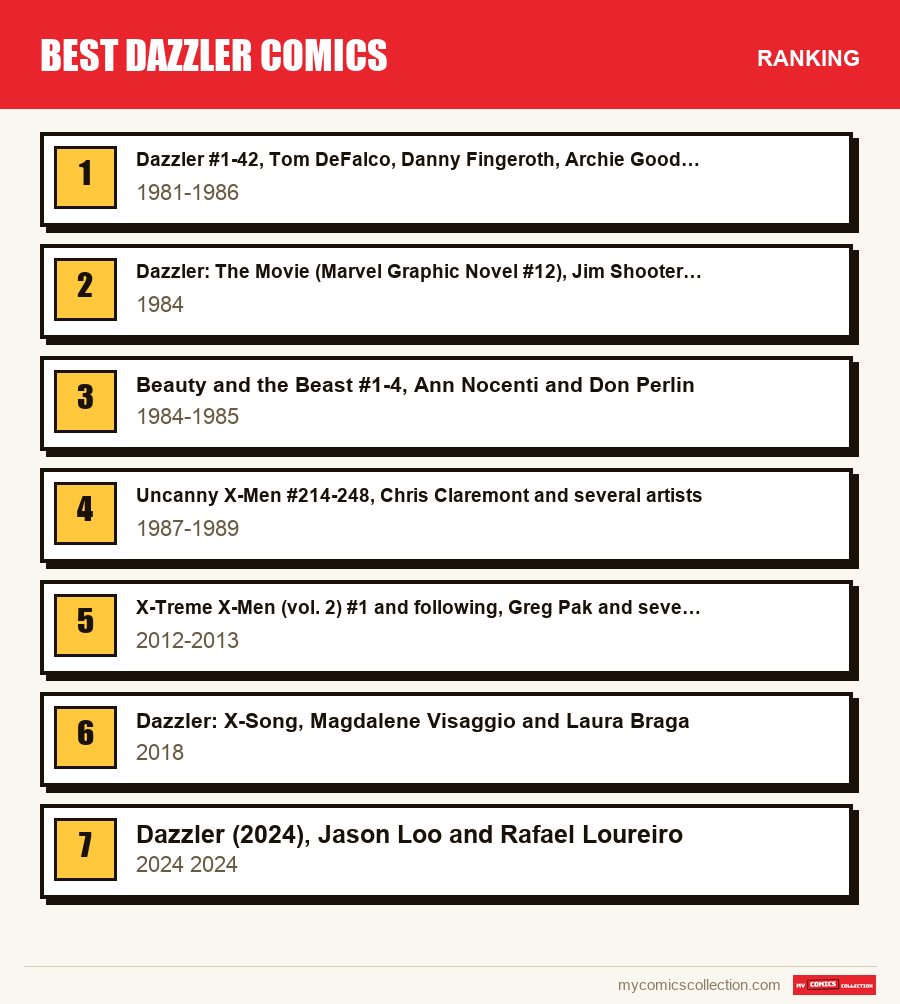
1: Dazzler #1-42, Tom DeFalco, Danny Fingeroth, Archie Goodwin, John Romita Jr., Frank Springer and Paul Chadwick (1981-1986)
This is the foundation read. The regular series starts in 1981 with Tom DeFalco on script and John Romita Jr. on art for the opening; Frank Springer then becomes the regular artist from #3. DeFalco writes the first six issues, then Danny Fingeroth takes over for a long stretch of the run. The title was sold from the outset in specialty shops, a distribution mode that sets it apart from the newsstand series of the same era.
As for the character, the series gives her a world all her own: concerts, contracts, the backstage of an artist's career, and a distinct tone in the early 1980s Marvel catalog. Alison is not just a mutant who fights, she is an artist negotiating with the entertainment industry. The run ends at #42, in 1986, after a visual turn: a new costume appears in #38, with Archie Goodwin on script and Paul Chadwick on art.
Who to recommend it to: readers who like character series carried over the long haul, with slow-burn plots rather than events. How to read it: in order, without skipping the first issues that set the scene, accepting that the 1981 aesthetic is dated. For a condensed read, Essential Dazzler covers #1 to #21 in its first volume and #22 to #42 in the second.
2: Dazzler: The Movie (Marvel Graphic Novel #12), Jim Shooter, Frank Springer and Vince Colletta (1984)
The title says it all: Alison confronts her singing career with the world of film. The album is written by Jim Shooter, then head of Marvel's editorial department, drawn by Frank Springer and inked by Vince Colletta. Springer accompanied the regular series for many years: you therefore find the same hand as in the 1981 run, in a roomier album format.
What this album brings: a breather from the monthly rhythm and a full story, designed for the Marvel Graphic Novel format. Who it is for: readers who got hooked on the 1981 run and want a self-contained tale. How to read it: after the first issues of the regular series and before Beauty and the Beast. It appears in the second volume of Essential Dazzler, which saves you from hunting for the album separately.
For a collector, the numbering of the Marvel Graphic Novel line serves as a landmark: number 12 is Dazzler's, and you can complete a run of albums by following that list alone. Check the condition of the spine and corners before buying: on an album format, those are what betray a handled copy.
3: Beauty and the Beast #1-4, Ann Nocenti and Don Perlin (1984-1985)
Four single issues released between December 1984 and June 1985 pair Dazzler with the Beast. Ann Nocenti writes, Don Perlin draws and Bill Sienkiewicz does the covers. The plot starts from a crisis situation for Alison: her career wobbles and her powers become hard to hold, which leads the Beast to step in.
The appeal of this read lies in the duo and in Nocenti's pen; she would go on to create Longshot with Art Adams, a name the Dazzler reader will meet in the X-Men years. Who it is for: readers who prefer character stories to spectacular fights. How to read it: right after Dazzler: The Movie, before Uncanny X-Men #214. The four issues are gathered in the second volume of Essential Dazzler, with Secret Wars II #4.
Sienkiewicz's covers make this miniseries a thing apart: they stand out from the usual visual line of the time. If you are hunting for the single issues separately, always compare the cover before matching two listings, because cover variants exist for this series.
4: Uncanny X-Men #214-248, Chris Claremont and several artists (1987-1989)
Dazzler joins the team in Uncanny X-Men #214, cover-dated February 1987, written by Chris Claremont with Barry Windsor-Smith on art. Her stay ends at #248 (September 1989), drawn by Jim Lee: Alison passes through the Siege Perilous and loses her memory, which takes her out of the team. The artists change often across these thirty-five issues: do not look for the visual unity of a single-artist run.
Let us be precise about her role: she is a team member among others there, not the protagonist of every episode. This step earns its place in the ranking because it settles Alison in the main team of the parent series for a little over two years, and because she lives out her relationship with Longshot there, also a member of the team. For chronology, keep the X-Men reading guide within reach: it places these issues in the series' sequence.
Target audience: fans of the Claremont era ready to follow a second-tier heroine month after month. Directions: a continuous read, without waiting for an episode where she would carry the whole story. For collectors, our Uncanny X-Men collecting guide helps you decide whether to aim for the whole series or only this window.
Do you collect this series?
Track what you own, what you are missing and what your collection is worth. 7-day trial.
Start my trial →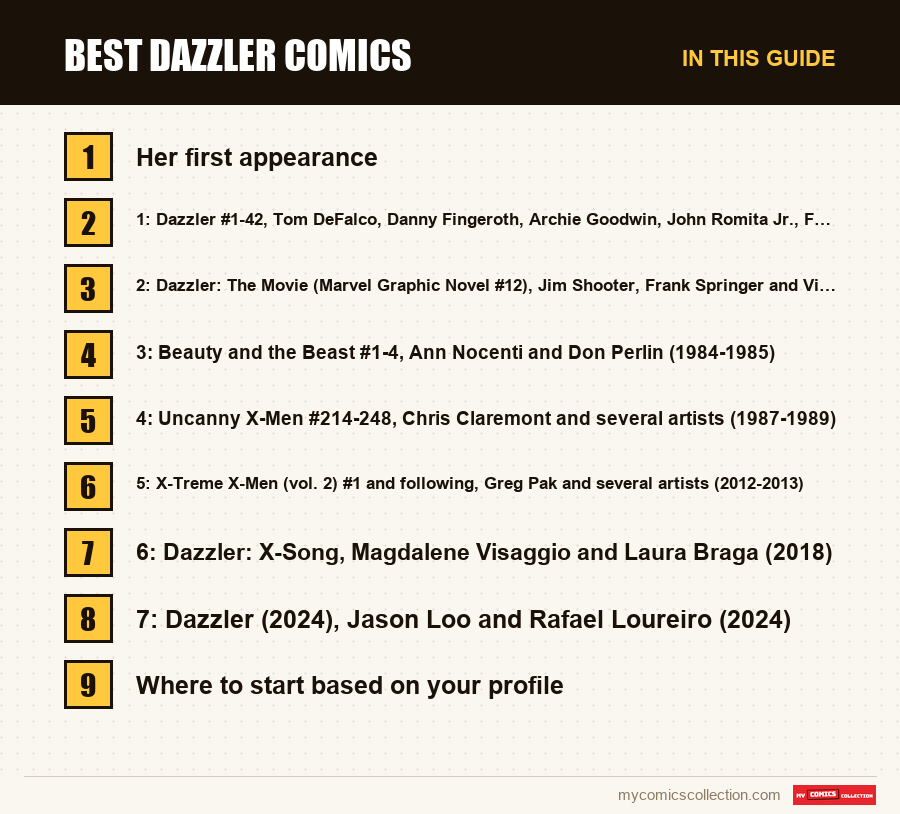
5: X-Treme X-Men (vol. 2) #1 and following, Greg Pak and several artists (2012-2013)
Launched in September 2012, this series puts Dazzler at the head of a team that travels between parallel dimensions. Greg Pak writes; Stephen Segovia draws #1, then other artists follow in turn. Alison takes on leading a group there.
For Alison, it is a team leader role, the opposite of the stage singer, in a science fiction setting where you meet alternate versions of familiar characters. It will please those who like team series with a strong premise and already know the major references. How to read it: continuously, taking the artist changes into account; the collected edition is a simpler entry point than the single issues.
This series belongs to the big wave of X-Men relaunches of the early 2010s. To place it in context, see our page on the X-Men crossovers, which gives the landmarks of that period.
6: Dazzler: X-Song, Magdalene Visaggio and Laura Braga (2018)
This one-shot comes out in June 2018: Magdalene Visaggio writes, Laura Braga draws and Elizabeth Torque does the cover. Alison leads a new band in the Brooklyn punk scene, and her world becomes dangerous to the point that she has to protect her Inhuman fans.
What this read brings: a frank return to music as the character's engine, in a single issue. It suits anyone looking for a short story, knowing nothing of the 1981 series. How to read it: on its own, as a contemporary epilogue to the major reads of the Claremont period. The one-shot format also makes it an easy piece to complete if you follow the character's recent releases.
7: Dazzler (2024), Jason Loo and Rafael Loureiro (2024)
Marvel announced this four-issue miniseries in May 2024, for a September release. Jason Loo writes, Rafael Loureiro draws, with a main cover by Terry and Rachel Dodson. The premise: a world tour for Alison, in the X-Men's From the Ashes era, which examines the celebrity of a mutant after the fall of Krakoa.
What the series brings: a statement on fame and the stage, in a travel adventure. Who it is for: readers coming back to the X-Men after the Krakoa period who want a way into a character. How to read it: directly, with no preparation, even though the 1980s references gain flavor from it. It is the most recent series in this ranking for those who want an issue that is easy to find new.
Where to start based on your profile
You are new to the character. Read Dazzler: X-Song (2018): one issue, no preparation. If the vibe appeals to you, follow with the Jason Loo miniseries (2024), which uses the post-Krakoa moment to reintroduce Alison.
You like Bronze Age series. Dive into Dazzler #1 (1981) and follow the series through #42 (1986). The two volumes of Essential Dazzler are the most economical route in pages, with Dazzler: The Movie and Beauty and the Beast as a bonus in the second.
You are an X-Men reader. Begin with Uncanny X-Men #214 and read through #248: that is where Alison is most tied to the other characters. For this three-year window, the key issues of Uncanny X-Men tell you which single issues to set aside.
You collect first appearances. Aim for X-Men #130 and Dazzler #1 (1981). Then complete with Beauty and the Beast #1 for the work of Nocenti and Sienkiewicz.
You like team series. X-Treme X-Men (2012) is your best door: Alison leads a team there, which is a change from her usual role.
The key issues to know
To collect Dazzler without spreading yourself thin, a few landmarks are enough. You can sort them by role: birth, title in her name, team turning points, recent revisits.
- X-Men #130 (February 1980): the first appearance, by Claremont, Byrne and Austin.
- Dazzler #1 (1981): the start of the series in her name, by DeFalco and Romita Jr.
- Dazzler #38 (1985): the new costume, with Archie Goodwin and Paul Chadwick.
- Marvel Graphic Novel #12 (1984): the Dazzler: The Movie album.
- Beauty and the Beast #1 (December 1984): the start of the Nocenti and Perlin miniseries.
- Uncanny X-Men #214 (February 1987): her entry into the team.
- Uncanny X-Men #248 (September 1989): the last issue of her time as a teammate, with Claremont and Jim Lee.
- X-Treme X-Men (vol. 2) #1 (September 2012): Alison at the head of a team.
- Dazzler: X-Song (June 2018): the Visaggio and Braga one-shot.
- Dazzler #1 (September 2024): the Jason Loo miniseries.
Before buying, identify the exact edition (cover, variant, number) and compare several listings of the same single issue. For a 1980s single issue, look at the corners, the spine and the staples; for a recent one, freshness and the variant come first.
A storage tip: separate your 1981 Dazzler from your Uncanny X-Men, and keep the collected editions next to the original single issues. You will find the issue you want faster, and you will avoid handling the fragile copies at every reread.
Frequently asked questions
In X-Men #130 (February 1980), script by Chris Claremont, pencils by John Byrne, inks by Terry Austin. Credit for creating the character goes to Tom DeFalco and John Romita Jr., who then launch her series in 1981.
Yes. The Dazzler series starts in 1981 with Tom DeFalco and John Romita Jr., then Frank Springer as regular artist, and ends at #42 in 1986. It was followed by several one-shots and miniseries, including Jason Loo's in 2024.
From #214 (February 1987) to #248 (September 1989), written by Chris Claremont. She is a member of the main team there, alongside Longshot. The artists change often: Barry Windsor-Smith at the start, Jim Lee at the end. For the earlier period, read #130.
Yes: Essential Dazzler in two volumes. The first gathers Dazzler #1 to #21, X-Men #130 and #131, and Amazing Spider-Man #203. The second covers Dazzler #22 to #42, Marvel Graphic Novel #12, Beauty and the Beast and Secret Wars II #4.
The Dazzler: X-Song one-shot (June 2018), written by Magdalene Visaggio and drawn by Laura Braga, fits in a single issue. The four-issue miniseries by Jason Loo and Rafael Loureiro (September 2024) asks a bit more commitment and depicts a world tour.
Have an X-Men #130 or a Dazzler #1 in your boxes? An appraisal will tell you where it stands.
Appraise my comic