
To find the best Cyborg comics, start with The New Teen Titans by Marv Wolfman and George Pérez (1980), then read his origin story in Tales of the New Teen Titans #1 (1982). Move on to Justice League #1 to #6 by Geoff Johns and Jim Lee (2011), which rewrites his accident, and save the solo series for later. His first appearance is DC Comics Presents #26 (October 1980), the key issue to know.
Victor Stone is a hero whose body tells the story. An athlete saved by his father's technology, he wears a prosthesis that is also a constant question: what is left of the human when the machine takes up more room? His story runs across four and a half decades, from the Titans to the 2023 miniseries. This guide ranks eight reads, with what each one offers, who it is for, and the order to take them in.
As always in this guide, we only state verified information (creators, issue numbers, dates); the analysis is our own, with no reproduction of protected art or dialogue.
His first appearance
October 1980: DC Comics Presents #26 contains, tucked into the middle of the issue, a preview insert in which Victor Stone appears for the first time, as part of a team still to come. The character was created by Marv Wolfman, writing, and George Pérez, penciling. The New Teen Titans #1, which sets him up in his own series, follows in November 1980.
The detail matters to a collector. The preview insert is a companion piece, filed inside a series whose star is elsewhere, while The New Teen Titans #1 is the issue most readers look for first. Both mark a date, but not for the same purpose: one for the character's chronology, the other for reading.
What comes right after sheds light on the context. The next issue of the series, dated December 1980, brings Deathstroke onto the scene, as our page on that issue explains. Cyborg is already part of the team there, on equal footing with his teammates.
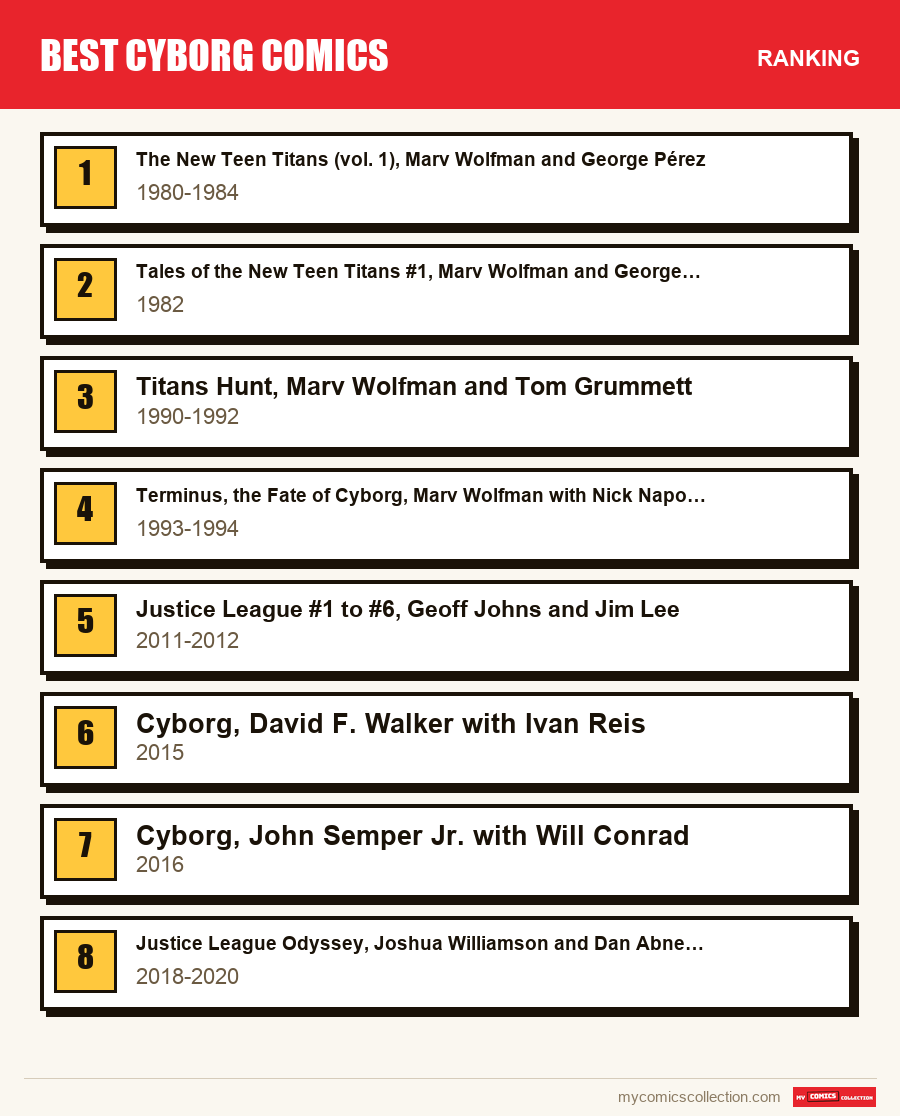
1: The New Teen Titans (vol. 1), Marv Wolfman and George Pérez (1980-1984)
The Wolfman and Pérez series runs forty issues in its first version, from November 1980 to March 1984. It teams Cyborg with Raven and Starfire, and brings back Beast Boy under the name Changeling. For Victor Stone, this is the foundation: his place in the group, his ties to the other Titans, and his relationship with his own body are all laid down here.
What this period gives the character is consistency of tone over time. Wolfman writes a young man at odds with what he has become, and Pérez gives him a readable silhouette, made of exposed metal and a face that stayed human. Later reboots start from this base.
It suits anyone who wants to gauge the character's importance before reading the reinventions. It takes patience: the 1980 pace is that of a monthly serial, with plots that run across several issues. Read it in publication order rather than cherry-picking. Our page on Raven covers the same series from her angle as a teammate, and the one on the best Teen Titans runs places it within the whole franchise.
2: Tales of the New Teen Titans #1, Marv Wolfman and George Pérez (1982)
This issue, dated June 1982, belongs to a four-issue miniseries devoted in turn to Cyborg, Raven, Changeling, and Starfire. The first, titled "Cyborg," tells Victor Stone's origin. Wolfman writes; Pérez draws the cover and the story, with Brett Breeding on inks.
This is where to go to learn who Victor was before the accident and how he became Cyborg. The miniseries only partly concerns you: this issue follows Victor Stone, while the other three focus on other Titans. Read this one, and save the rest for your reading of Raven, Changeling, or Starfire.
It is for the reader who prefers to understand a character through his past: it is the shortest entry point on this list, one issue, one complete story. It also suits anyone who wants to see how Wolfman and Pérez introduce, one by one, the members of a team they had launched two years earlier.
3: Titans Hunt, Marv Wolfman and Tom Grummett (1990-1992)
"Titans Hunt" runs through The New Titans #71 to #84, from the September 1990 issue to the January 1992 one. Wolfman writes, Tom Grummett draws, with Al Vey on inks. The arc deals with the scattering of the Titans: the tower that serves as their base explodes in issue 76, and several heroes end up captured or separated.
Cyborg's role is dramatic. In issues 77 and 78, Victor Stone is wounded, becomes more machine than man, and is then found rebuilt as a robot soldier stripped of free will. For the character, it is a dark turning point: the stakes are no longer coping with a prosthesis but no longer belonging to himself.
This read is for anyone who has already read the original series and wants to see what Wolfman did with it ten years later. The tone is that of the 1990s, edgier. Note that the arc is not centered on Cyborg: the whole team is its subject, and Victor is a major piece among others.
4: Terminus, the Fate of Cyborg, Marv Wolfman with Nick Napolitano then Mark Tenney (1993-1994)
This arc spans The New Titans #104 to #107, between December 1993 and January 1994. The first chapter, "Subroutine," sees Victor Stone's body destroyed after Jericho's betrayal. The following chapters are titled "Killing Machine," "Rebirth," and "Hard Drive." Wolfman writes the script; Nick Napolitano draws the first issues and Mark Tenney takes over for the rest.
What the arc changes is radical: it asks what Victor is without his body, and the character's fate becomes the subject of the entire story. Cyborg is no longer the team's technical support; he is the stakes.
The read is meant for an audience that already knows the character and does not mind a dark tone. It assumes you know the dynamic between the Titans of the era: without that context, some of the stakes feel opaque. Look for the four issues together, because they complement each other.
5: Justice League #1 to #6, Geoff Johns and Jim Lee (2011-2012)
Issue 1 of the relaunched Justice League, dated August 2011, opens the "New 52" line. Geoff Johns writes, Jim Lee draws. Cyborg is a founding member of the team there, and his origin is rewritten: Victor Stone is a star high school football player, on bad terms with his father Silas, a scientist at S.T.A.R. Labs; a Mother Box explodes during an argument at the lab, destroys most of his body, and Silas saves him with experimental nanites, while T. O. Morrow adds robotic parts.
What this version contributes is placing Cyborg at the center of the league, alongside far better-known characters, and tying him to Mother Box technology. It established him well beyond the Titans. Our page on the key issues of the Justice League places these issues within the franchise.
It is the easiest read to open for a reader who knows Cyborg from the screen: a mainstream setting, with no prerequisites. The downside: Cyborg shares the billing with six other members. Treat it as a way in, not an in-depth study of the character. For the creative duo, see also the page on Geoff Johns.
Do you collect this series?
Track what you own, what you are missing and what your collection is worth. 7-day trial.
Start my trial →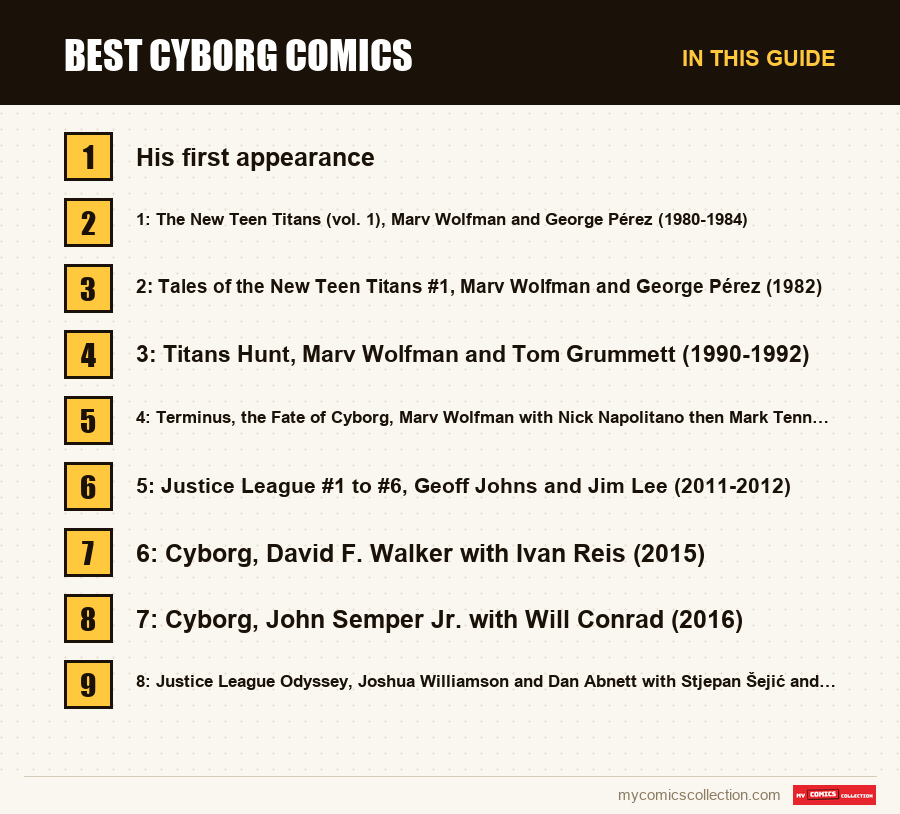
6: Cyborg, David F. Walker with Ivan Reis (2015)
This solo title, on sale starting in July 2015, is written by David F. Walker and launched with Ivan Reis on art, joined by other artists including Joe Prado; color is by Adriano Lucas. The collected edition Unplugged reprints issues 1 to 6. The idea is simple: a series centered on Victor Stone rather than a team, which leaves room for his private life and the question of what technology does to a body.
It is for readers who prefer short series, readable with no preparation, and who want to see the character headlining. The first collected edition is the right pick if you want a self-contained story without knowing the Titans. Take it before deciding whether to keep going.
7: Cyborg, John Semper Jr. with Will Conrad (2016)
The Rebirth-era relaunch begins with Cyborg: Rebirth #1, released on September 7, 2016, written by John Semper Jr. and drawn by Paul Pelletier, with a cover by Will Conrad. The regular series, Cyborg #1, comes out on September 21, 2016; Will Conrad draws the first arc, with other artists such as Timothy Green II stepping in later. The first collected edition gathers issues 1 to 5 and the Rebirth issue; the second is titled Danger in Detroit.
This version is for a reader who enjoys more classic superhero stories. For a collector, it sits next to the Walker series: both carry the same title and each begins with an issue 1, which means checking the cover year and the creative team before any purchase.
8: Justice League Odyssey, Joshua Williamson and Dan Abnett with Stjepan Šejić and others (2018-2020)
This series runs twenty-five issues, published between September 2018 and October 2020. Joshua Williamson and Dan Abnett write it; Stjepan Šejić draws it at the start, with Philippe Briones, Carmine Di Giandomenico, Will Conrad, Daniel Sampere, ChrisCross, and Cliff Richards over the course of the run. Cyborg, Starfire, and Azrael explore the Ghost Sector, a region of space where Darkseid lures them, and Victor unknowingly connects there to the tyrant's Mother Box.
What it offers is cosmic science fiction: the character leaves Earth and faces an adversary who knows the nature of his technology. Four collected editions cover the series, including The Ghost Sector for issues 1 to 5.
It is for space opera readers, less for Titans fans. Since the series changes artists often, take the first collected edition first, which keeps the visual consistency of the start.
Where to start based on your profile
Coming from the screen and looking for a direct way in? Take Justice League #1 to #6, then the Cyborg miniseries by Morgan Hampton and Tom Raney (six issues, starting in May 2023, collected in April 2024 as Homecoming). Both can be read without knowing the Titans' history.
Love the classics and chronology? Go back to the Wolfman and Pérez series, add the 1982 origin issue, then follow Victor Stone through "Titans Hunt" and "Terminus" to see where his creator takes him.
Want a series with his name on it? Start with David F. Walker's Cyborg (2015) for a Victor-centered look, or with John Semper Jr.'s version (2016) for a more classic story. Looking for cosmic science fiction? Justice League Odyssey is made for you.
The key issues to know
Here are the landmarks for Victor Stone, in publication order. No figures here: only the research method matters for these titles.
- DC Comics Presents #26 (October 1980): the preview insert that carries Cyborg's first appearance.
- The New Teen Titans #1 (November 1980): the series' starting issue, where Cyborg is a teammate from the opening.
- The New Teen Titans #2 (December 1980): the issue that introduces Deathstroke; Cyborg is one teammate among others there.
- Tales of the New Teen Titans #1 (June 1982): the character's origin.
- From Wolfman and Pérez in 1984, "The Judas Contract" fills three issues of Tales of the Teen Titans (#42, #43, and #44) and an annual. Terra and Deathstroke are at its center; Cyborg remains a teammate. You hunt for it for the arc, not for the hero.
- The New Titans #77 and #78: Cyborg turned into a robot soldier, at the heart of "Titans Hunt."
- The New Titans #104 (December 1993): the destruction of his body, the start of "Terminus."
- Justice League #1 (August 2011): the character's new origin.
- Cyborg #1 (2015, 2016, and 2023): three distinct issue 1s, not to be confused when cataloging.
Before buying a copy of Victor Stone, compare at least three sold listings of the same grade and the same edition, and discard the extremes. A free valuation page complements this cross-check.
Frequently asked questions
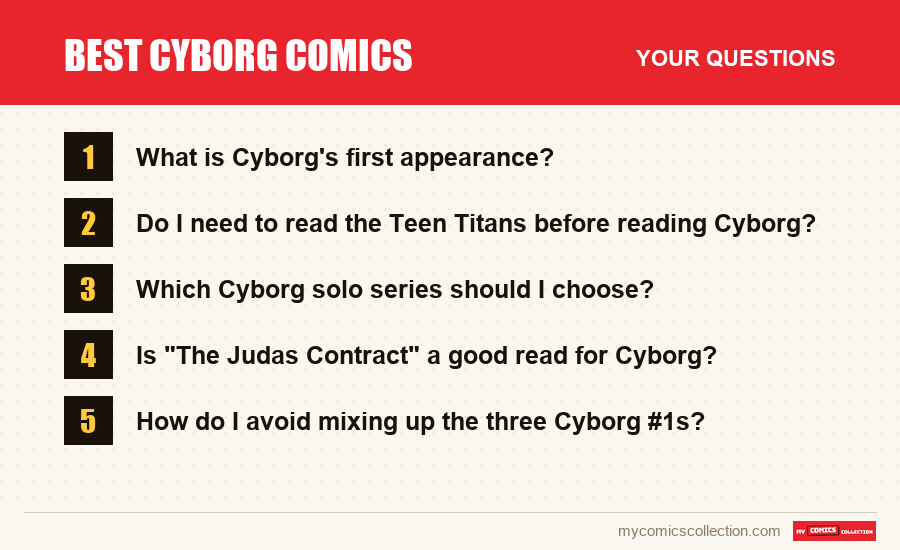
Marv Wolfman and George Pérez created Cyborg; he appears in the tipped-in preview of DC Comics Presents #26, dated October 1980. His starting issue in a series is The New Teen Titans #1, dated November 1980. Depending on whether you collect chronology or reading, you will hunt for one or the other.
Not necessarily. Justice League #1 to #6 (2011) and the 2023 Cyborg miniseries can be read with no preparation. The Wolfman and Pérez classics, on the other hand, are best read in order, because the series builds its plots over time. Start with the version that appeals to you, then work backward.
Three series carry his name: David F. Walker's (2015), John Semper Jr.'s (2016), and the miniseries by Morgan Hampton and Tom Raney (2023). The six-issue miniseries is the quickest to read. If you are unsure, take it, then Walker's series to keep going.
It is a major arc of the series, but Cyborg is a team member there, not the central figure. The story unfolds over three issues and an annual, in 1984. Read it for the Titans as a whole, not to go deeper on Victor Stone.
Note the cover year, the creative team, and the exact title. The 2015 series is by David F. Walker, the 2016 one by John Semper Jr., the 2023 miniseries by Morgan Hampton. The year remains the most reliable criterion for sorting and valuing a copy.
Own an issue of the Wolfman and Pérez Titans or a Cyborg relaunch? Get its condition and value assessed.
Estimate my comic