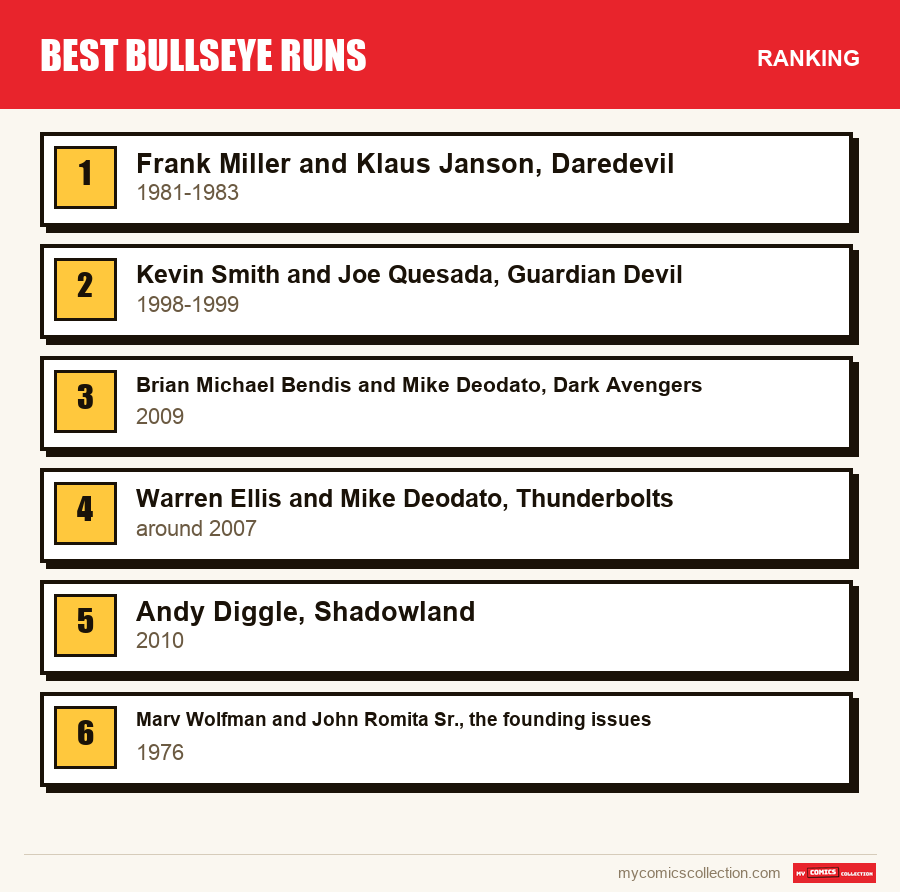
The best Bullseye run is Frank Miller and Klaus Janson's Daredevil (1981-1983), which contains Elektra's death in issue 181. Next come Guardian Devil by Smith and Quesada, then Dark Avengers, Ellis's Thunderbolts, Shadowland and, last, Wolfman's first issues. Six picks, with the format to aim for.
Bullseye has never carried a long series of his own: a powerless hitman, he lives in other characters' pages. Ranking runs devoted to him therefore means looking for the periods when the character takes control of a story, whether against Matt Murdock, in a borrowed costume or in the middle of a team of criminals. The six picks below are all complete reads.
As always in this guide, only verified facts (creators, issues, dates) are stated as fact; the analysis is our own, with no reproduction of protected art or dialogue.
How we ranked these runs
For an antagonist like Bullseye, the deciding criterion is the villain's place in the story: does he drive it, endure it, or is he just a passing threat? We kept the picks where he sits at the center, then separated them by how well they stand alone and how easy they are to assemble. A brilliant saga in which he appears only once is excluded.
The ranking judges reading quality, not the price of the issues: the most sought-after issue, Daredevil #131 from March 1976, ranks dead last, because a first appearance is not a character's best story.
Top 1: Frank Miller and Klaus Janson, Daredevil (1981-1983)
Frank Miller writes Daredevil starting with issue 168, dated January 1981, with Klaus Janson on inks. The Matt Murdock, Elektra and Bullseye triangle takes its definitive shape here. The hitman stops being a grumpy adversary and becomes an absolute danger, and the whole thing peaks in issue 181 from April 1982, where Elektra dies. We won't spoil more than that.
This run matters because it fixes the perception of Bullseye for forty years: a man whose precision is his only talent and whose cruelty is his only conviction. No prior reading is required: the triangle makes sense as you go, and it is the best entry point into Hell's Kitchen. Our page on Frank Miller places this work within his whole career.
For collecting, issues 168 and 181 are two separate landmarks: the first for Elektra's first appearance, the second for her death. We devote two articles to them, on issue 168 and on issue 181. For reading, a collected edition of the Miller run is more than enough.
One collecting landmark: the Miller run breaks into three reading blocks, before Elektra's death, issue 181 itself and its immediate aftermath up to issue 191, where Frank Miller leaves the series for a time. Reading in that order avoids starting at the summit without understanding its price.
Top 2: Kevin Smith and Joe Quesada, Guardian Devil (1998-1999)
In 1998, Marvel relaunches Daredevil with Kevin Smith writing and Joe Quesada drawing, across the first eight issues of the new series. Matt Murdock goes through a crisis that touches his faith as much as his private life, and Bullseye steps in with a brutality that strikes the hero's circle. Issue 5 of this volume 2 sees Karen Page die at the hitman's hands, an episode that remains one of the most discussed of the title's modern era.
This arc matters because it puts Bullseye back at the center of the game with a dramatic purpose, rather than a simple show of force. It is for the reader who knows Daredevil from his adaptations and wants a short story in the same vein as Miller.
For collecting, the eight issues are easy to find and a single collected edition gathers the arc. These are modern print runs whose market price is not settled; the first issue of the series is the natural landmark.
Top 3: Brian Michael Bendis and Mike Deodato, Dark Avengers (2009)
Dark Avengers #1, dated 2009, sets up a team in which every member wears someone else's costume. Norman Osborn leads the team, and Bullseye is given Hawkeye's identity, with the costume that goes with it. Brian Michael Bendis writes, Mike Deodato draws. The hook is cruel and simple: a ruthless killer finds himself in the skin of a hero the public adores.
This run matters because it pulls Bullseye out of his setting, the Hell's Kitchen of Daredevil, and throws him into a team story on the scale of all of Marvel. It is for the reader of the "Dark Reign" line, who enjoys the irony of stolen identities, and less for the pure Daredevil reader. Our page on Brian Michael Bendis places this period within his work.
On the shelf, Dark Avengers exists in recent single issues as well as volume-by-volume collected editions; issue 1 serves as the landmark, and the image of the killer under Hawkeye's mask appeals mostly to fans of striking covers.
A useful detail for the reader: Dark Avengers extends a broader event, Dark Reign, but its first issues can be read without having followed it. If you want the context, the event's collected edition provides it, not the single issues.
Top 4: Warren Ellis and Mike Deodato, Thunderbolts (around 2007)
In Thunderbolts, a team of criminals sent on missions for the government, Warren Ellis writes and Mike Deodato draws from issue 110. Bullseye is part of the group, alongside other sinister figures, and his role as a conscience-free sharpshooter fits the team's logic: he was recruited to kill, not to be liked.
This stretch is for the reader who prefers the ensemble to the solo act. Bullseye is not the center here, but he is one of the engines, and the contrast with his Daredevil role makes for a complementary read. It is less recommendable as a first contact with the character, because it assumes you will accept the whole cast of the team.
For collecting, these are issues from the late 2000s, easy to complete. Arc-by-arc collected editions let you read without hunting down every issue, and that is the most reasonable choice.
Do you collect this series?
Track what you own, what you're missing and what your collection is worth. 7-day trial.
Start my trial →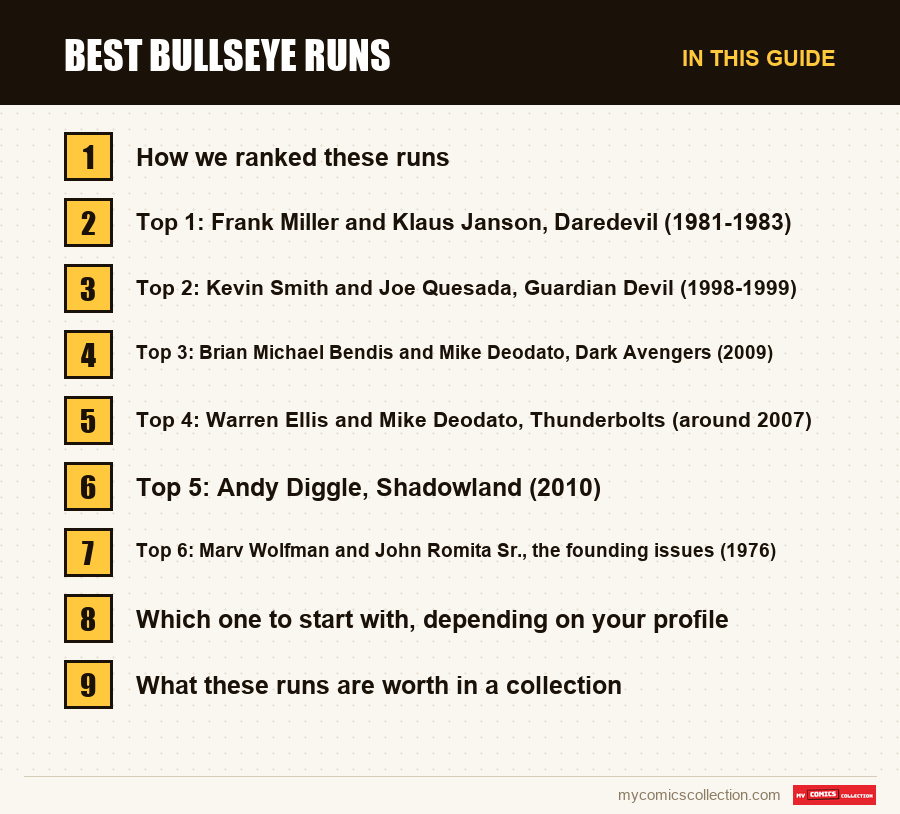
Top 5: Andy Diggle, Shadowland (2010)
Shadowland is the 2010 event in which Matt Murdock, now leader of the Hand, turns Hell's Kitchen into a fortress. Andy Diggle writes its backbone, and Bullseye ends up in the path of a hero who is tipping over. The story serves as the conclusion to Marvel's work on Daredevil in this period, and it replays the old opposition of the killer and the lawyer in a darker register.
The event matters for Bullseye because it tests his relationship with Matt Murdock in an unprecedented setting. It is for the reader who already knows Miller and Bendis and wants to see what the publisher did with the consequences.
For collecting, a collected edition of the complete event beats hunting down isolated issues: the chapters are spread across several titles, and the contents of the various editions do not always overlap.
A tip on method: since Shadowland spreads across several titles, list the issues before you buy and check off each chapter as you go. You will avoid duplicates of near-identical covers and the gaps you only discover too late.
Top 6: Marv Wolfman and John Romita Sr., the founding issues (1976)
Bullseye is born in Daredevil #131, dated March 1976, by Marv Wolfman, Bob Brown and John Romita Sr. The issue sets up the character: a hitman in a two-tone costume, with a target on his forehead, able to turn an ordinary object into a weapon. The story doesn't match the heights of Miller, but it carries everything later creators developed.
This debut ranks sixth because it is foundational rather than the most accomplished. It is for the completist and the reader who wants to understand the raw material before Frank Miller. Our article on the first appearance details the issue and its variants.
For collecting, the original issue is what counts: condition makes up most of the price, and issue 131 is the most coveted of the whole file. For reading only, a collected edition of the Wolfman period is more than enough.
The ranking is not a decision tree: a reader who loves Miller's atmosphere can easily follow up with Shadowland to see what forty years of continuity did to the killer. The buying order, for its part, rarely follows the reading order, and that is normal.
One landmark helps place the episodes relative to each other. After his fall in Daredevil #181, the killer leaves the hospital with an adamantium-reinforced skeleton, an operation attributed to Lord Dark Wind and told around issue 197, in 1983: stories where he takes hits without breaking therefore come after this step, which lets you slot an isolated issue into the timeline without knowing its plot.
Which one to start with, depending on your profile
If Bullseye is just a name to you, start with Frank Miller and Klaus Janson: issue 168 is the way in, 181 the high point. For a brief, more recent story, Guardian Devil, eight issues by Kevin Smith and Joe Quesada, reads in one evening. If you like teams and dark humor, jump straight to Dark Avengers.
For a reader who has already been through Daredevil, Shadowland and Ellis's Thunderbolts round out the portrait. Our Bullseye reading guide offers the chronological order, and the character's history gives the biographical thread.
What these runs are worth in a collection
Three tiers emerge. The issues from 1976 and the early 1980s carry the premium, with a marked gap between a reading copy and a well-graded one; Daredevil issue 181 and issue 131 are the two landmarks the market adjusts fastest. Issue 168, Elektra's first appearance, plays the same tune.
The 1998 to 2010 issues are modern print runs, more plentiful, whose market price is not settled. What will move it is a possible return of the character in an adaptation, the length of any comeback in a series and the availability of the first issues in good condition.
A Daredevil #181 is not judged like a Dark Avengers #1: for the first, cross-check the grade and completed sales; for the second, look mostly at lots. Each case is covered in the article Bullseye comics value.
Frequently asked questions
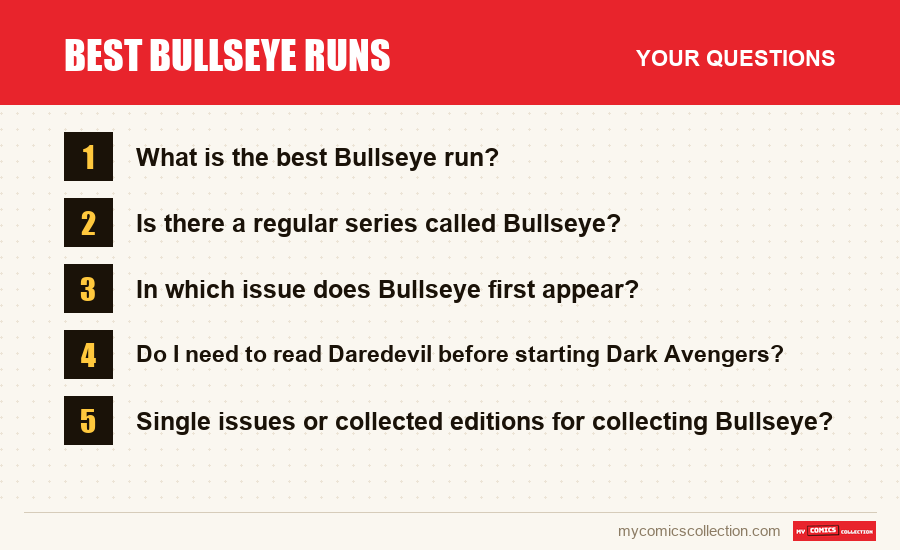
Frank Miller and Klaus Janson's run on Daredevil, between 1981 and 1983, remains the benchmark. Issue 181 from April 1982 is its high point, and the whole thing establishes the killer as Matt Murdock's nemesis.
He has had miniseries, but no long-running regular series. That is why the best stories about him are found in Daredevil, in Dark Avengers or in Thunderbolts rather than in a title bearing his name.
In Daredevil #131, dated March 1976. The character was created by Marv Wolfman, Bob Brown and John Romita Sr.; the cover is by Gil Kane. It is the founding issue of any collection devoted to the killer.
Not necessarily. Dark Avengers, published in 2009, can be read for its concept of a team with stolen identities. Knowing Bullseye from Miller gives his turn in Hawkeye's costume more weight, but the story stands on its own.
Original issues for 1976 and the Miller years, if your budget allows, since they carry the premium. For Guardian Devil, Dark Avengers, Thunderbolts and Shadowland, a collected edition is enough and saves you from hunting scattered issues.
Do you have a Daredevil #131, #168 or #181? Get your copy estimated based on its real condition.
Estimate my comic