Bullseye , created by Marv Wolfman, John Romita Sr., and Bob Brown, makes his first appearance in Daredevil #131 (March 1976). His most sought-after key issues cluster around the Frank Miller run (1979-1983), with Daredevil #181 (the death of Elektra) as the centerpiece, rounded out by Dark Avengers #1 (2009) and the Shadowland arc (2010). This guide breaks down the 10 key issues to target for building a coherent Bullseye collection.
Bullseye never had a long-running solo series, which paradoxically makes collecting him easier to read: the character's market value rests on a handful of clearly identified single issues, almost all concentrated in the Daredevil title. From Wolfman's first issue in 1976 to Soule's return in 2017, by way of Frank Miller's iconic pages and his promotion to Dark Avenger under Norman Osborn, the hitman's editorial trajectory lends itself to a tight wishlist. This guide details the 10 Bullseye key issues to prioritize, their narrative significance, indicative price ranges by CGC grade, and the major arcs that anchor the collection. Whether you're starting your Marvel collection or looking to round out a Daredevil wishlist, these are the issues to lock down first.
Bullseye in comic book history
Bullseye holds an unusual place in the Marvel Comics roster: he's not a supervillain with cosmic powers, but a hitman whose flawless precision is enough to make him Daredevil's personal nemesis. That distinction explains why his key issues are all tied to the Daredevil series rather than to solo titles: Marvel tried more than once to launch him in a miniseries, but never managed to make it stick over the long haul. The Bronze Age and the Modern Age therefore hold most of the value.
Three iconic runs shape the character's collector value. Frank Miller (Daredevil #168 to #191, 1981-1983) establishes the definitive version of the character and delivers the murder of Elektra in #181, one of the most sought-after single issues of the Marvel Bronze Age. Brian Michael Bendis (Daredevil vol. 2, 2001-2006) modernizes the characterization and has Bullseye kill Karen Page in #5 . Ed Brubaker carries that noir tone into the second half of the 2000s.
The marketing turning point arrives with the Dark Reign era (2009-2010), when Norman Osborn casts Bullseye under the public identity of Hawkeye in the Dark Avengers. That detour significantly broadens collector interest beyond the Daredevil framework. The live-action adaptations (Colin Farrell in 2003, Wilson Bethel in Netflix's season 3 in 2018, and the confirmed return for Daredevil: Born Again on Disney+) have kept demand steady on the early appearances. For a serious collector, targeting the right single issues rather than a hard-to-find solo series remains the winning strategy.
Top 10 Bullseye key issues
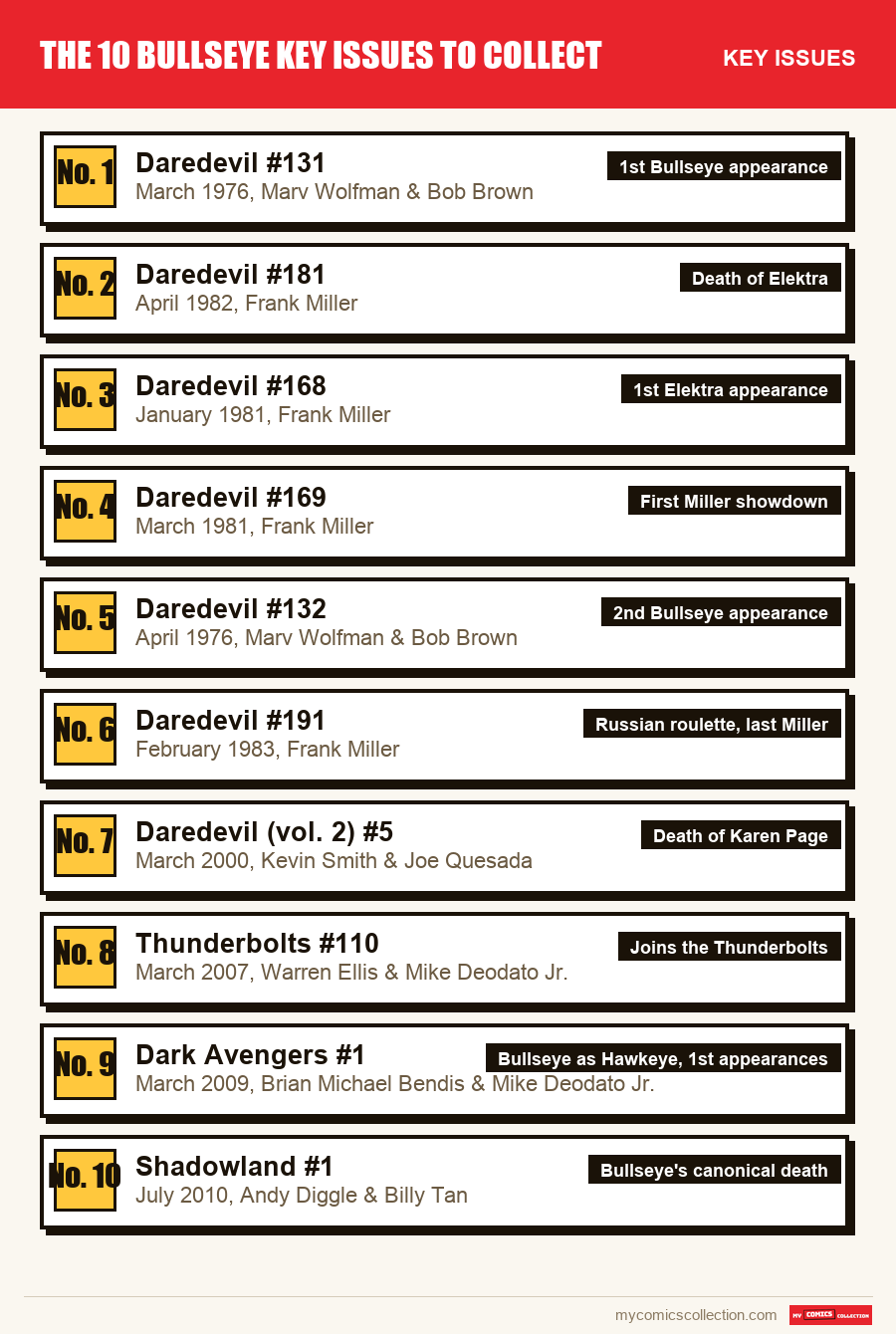
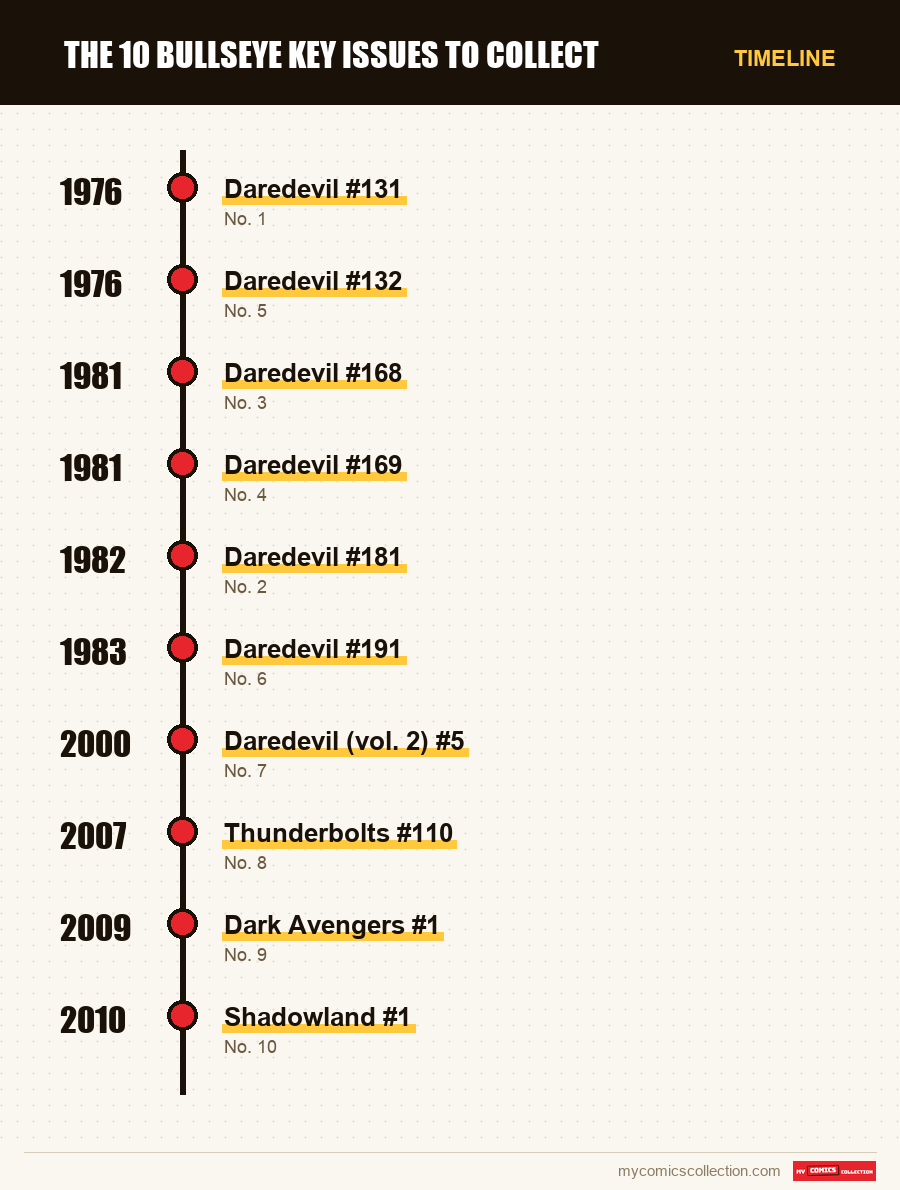
These ten issues form the backbone of a well-structured Bullseye collection. The ranking blends historical significance, scarcity in high grades, and current demand on the CGC market.
Daredevil #131
The full first appearance and the debut of the signature two-tone costume designed by John Romita Sr. Cover by Gil Kane. This is the absolute cornerstone issue of any Bullseye collection: a double key issue for Daredevil completists and for hunters of Marvel Bronze Age first appearances alike. Its value in high CGC grades has climbed noticeably since the Daredevil: Born Again announcements.
Daredevil #181
Written and drawn by Frank Miller. Bullseye kills Elektra with her own sai in a sequence that became a defining moment of the medium. The issue pushes the Miller run into an unprecedented tragic register and cements Bullseye in the pantheon of Marvel villains for good. One of the most in-demand Marvel Bronze Age single issues, especially in CGC 9.6 and 9.8.
Daredevil #168
Frank Miller's first issue as writer-artist on the series, and the first appearance of Elektra Natchios. A major narrative pivot that sets up the Murdock/Elektra/Bullseye triangle the franchise would keep mining for forty years. The CGC market is tight, with value driven by its dual importance (first Elektra + the Miller turning point). Essential to the Bullseye triptych.
Daredevil #169
The first Daredevil/Bullseye showdown under Frank Miller's pen. The issue is regularly bundled with #168 and #181 in CGC sales, sought after by run fans for its tonal shift and the arrival of the definitive Bullseye. More affordable than #168 and #181 in equivalent grades, which makes it a sensible entry point into the Miller run.
Daredevil #132
The second appearance, immediately following #131, in which Bullseye cements his gimmick of weaponizing any object at hand. Its value tracks that of #131 and it's often bought together as a long-term hold. A sensible compromise for a beginning collector who wants an early Bullseye without immediately chasing the #131 grail in high grade.
Daredevil #191
Frank Miller's final issue on the original run and one of his most-discussed one-shots. Murdock interrogates a paralyzed Bullseye in a game of Russian roulette layered with dense psychological subtext. The closing issue of the character's most important run, sought after by Miller completists and fans of late Bronze Age art-book one-shots.
Daredevil (vol. 2) #5
In the Guardian Devil arc that launches volume 2, Bullseye causes the death of Karen Page with a single sai. A defining Modern Age Daredevil issue and a natural entry point for readers coming from the Netflix series and the MCU. The Smith/Quesada pairing gives it cult status that sustains demand in CGC 9.8 on an often-volatile Modern Age market.
Thunderbolts #110
Warren Ellis's first issue on Thunderbolts, where Bullseye joins the team under government supervision in the post-Civil War landscape. Mike Deodato Jr.'s art gives the character a new visual identity and sets the stage for the Dark Reign phase. A crucial transitional issue for collectors of Marvel events, with a value that remains undervalued relative to its actual narrative importance.
Dark Avengers #1
Norman Osborn assembles the Dark Avengers and casts Bullseye under the public identity of Hawkeye. Iconic cover by Mike Deodato Jr. and the first appearances of several Dark Avengers members. A major entry issue for the Dark Reign event, also worth tracking through its many variant covers, which have a market of their own.
Shadowland #1
In the Shadowland crossover, a Daredevil corrupted by the Hand kills Bullseye with a sai through the chest: a direct mirror of Daredevil #181. A canonical death at the time, later reversed by Charles Soule. An event entry issue with moderate value but steady demand among Daredevil fans who want to close the loop Miller opened. Still an accessible market for a patient collector.
Collecting this series?
Track what you own, what you are missing and what your collection is worth. 7 day trial.
Start my trial →The essential Bullseye story arcs
Four major arcs shape the character's collector mythology. Pulling them together is the logical complement to the key single issues and offers a coherent read across forty years of editorial writing.
The Elektra Saga
The foundational arc by Frank Miller (Daredevil #168 to #181, 1981-1982). Miller establishes the Murdock/Elektra/Bullseye triangle, builds the tension across thirteen issues, and closes it with Elektra's murder. An absolute Marvel Bronze Age benchmark, essential to any serious collection.
Underboss / Guardian Devil
The gateway into volume 2 by Kevin Smith , Joe Quesada , and then Brian Michael Bendis (Daredevil vol. 2 #1 to #15, 1999-2002). Bullseye causes the death of Karen Page here, then Bendis reinstalls him as the Kingpin's tool in a crime noir register that would define the 2000s.
Dark Reign
The line-wide Marvel event (2008-2010) that takes Bullseye out of the Daredevil framework. Under Norman Osborn, he becomes a public Avenger under the Hawkeye identity, which dramatically widens the character's narrative and marketing potential. Read it in Dark Avengers #1-16.
Shadowland
The crossover by Andy Diggle and Billy Tan (2010) that symbolically closes the cycle. A corrupted Daredevil kills Bullseye with a sai: an exact mirror of Elektra's death. A short read (5 issues + tie-ins) but essential for wrapping up the arc opened in 1982.
The Charles Soule arc from 2017 (Daredevil vol. 5) provides the contemporary epilogue with the character's canonical return. To follow these arcs as they span multiple series and events, My Comics Collection's Collection Tracking tool lets you map your progress and pinpoint the missing issues arc by arc.
How My Comics Collection manages your Bullseye collection
Collecting Bullseye means navigating several series (Daredevil vol. 1 through 5, Thunderbolts , Dark Avengers , Shadowland) and tracking key appearances without a reference solo series. My Comics Collection catalogs Bullseye appearances in a few clicks, identifies missing issues, tracks CGC and eBay values, updated daily, and lets you group arcs (Elektra Saga , Dark Reign , Shadowland) into custom lists.