
The best Beast comics (Hank McCoy) are easiest to approach through Whedon and Cassaday's Astonishing X-Men, published from 2004 to 2008 and readable with no prerequisites; then go back to Amazing Adventures #11 (1972), where Gerry Conway and Tom Sutton give him his fur. Hank's first appearance is X-Men #1 (September 1963), by Stan Lee and Jack Kirby. X-Factor #1, New X-Men, and All-New X-Men round out a journey of more than sixty years.
Beast is an unusual character among the mutants: a brilliant scientist, happily theatrical, whose body has never stopped changing shape at the whim of his writers. This article tells you which reads show each version of Hank McCoy, in what order to approach them, and which issues deserve a place in a collection.
As always in this guide, only verified information (creators, issue numbers, dates) is stated as fact; the analysis is our own, with no reproduction of protected artwork or dialogue.
His first appearance
Hank McCoy bursts onto the scene in X-Men #1 (cover-dated September 1963): Stan Lee writes, Jack Kirby draws and contributes to the plot. At that date, he has none of the fur we know today: he is a student at Charles Xavier's school, with remarkable strength and oversized hands and feet, but a human face and body. The five founding students are brought together there; this issue already has its own detailed page, which we do not copy here.
For a present-day reader, this starting point raises a question of method. The Beast of 1963 and the one of today are two visually different characters, and the transformation that turns the first into the second only happens nine years later, in another series. That is what opens our ranking.
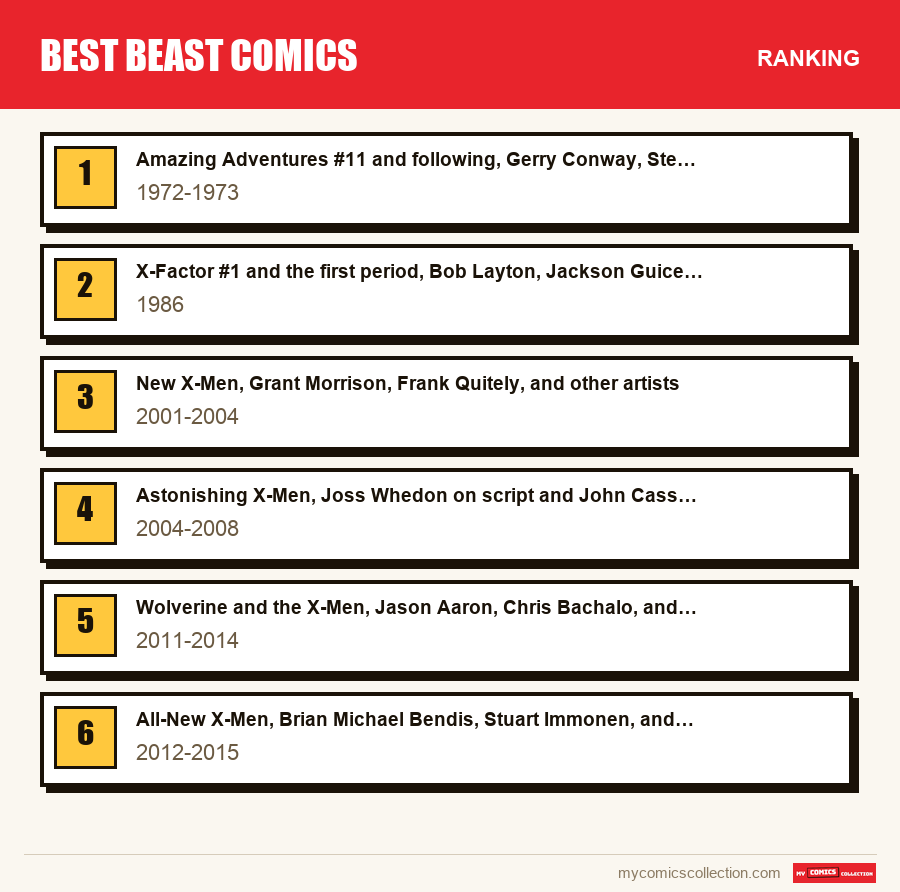
1: Amazing Adventures #11 and following, Gerry Conway, Steve Englehart, and Tom Sutton (1972-1973)
After leaving Xavier's team, Hank McCoy gets his own spotlight in Amazing Adventures (second series), starting with issue #11 in 1972. Gerry Conway writes this issue and Tom Sutton draws it; the idea of the change comes from Roy Thomas. Hank experiments on himself, ends up covered in hair, and thereby sets the principle that defines the character to this day: a man of science whose monstrous appearance contradicts his eloquence.
The fur in #11 is gray, and the blue settles in later, with #15. Steve Englehart takes over the writing, and several artists take turns over the few issues of Hank's run as a headliner. The tone is that of a 1970s monster story: laboratory, rival company, betrayal by a colleague.
Who is this read for? Bronze Age fans who want to see the birth of Beast's look, and those who collect character origins. It reads without knowing the X-Men, since Hank is on his own there, and it provides the key to everything that follows: without it, the transformation of 2001 or the blue fur of All-New X-Men would have no anchor point.
2: X-Factor #1 and the first period, Bob Layton, Jackson Guice, then Louise Simonson (1986)
In February 1986, X-Factor #1 brings the 1963 quintet back together: Cyclops, Jean Grey, Angel, Iceman, and Hank. Bob Layton and Jackson Guice launch the series, which Louise Simonson then writes, notably #6, which introduces Apocalypse. The premise is unexpected: the five pass themselves off as mutant hunters for hire, based in New York, while secretly training those they claim to capture.
For Beast, the period is a return to the roots. After years with the Avengers and the Defenders, Hank reunites with the friends of his youth, and the series leans on that mix of nostalgia and unease. His role is that of the team's scientist, the one who talks about biology and risks while the others talk about the mission.
This read is for readers who like group dynamics more than stories centered on a single hero. Hank is not the sole protagonist here: it is an ensemble series, and you will read it as such. Our guide to ranking the X-Factor runs puts this period in the context of the others.
3: New X-Men, Grant Morrison, Frank Quitely, and other artists (2001-2004)
When Grant Morrison takes over the X-Men in 2001, he redoes the whole setting: a crowded school, mutants who own what they are, a resolutely adult tone. Within this frame, Hank McCoy takes on a feline appearance, drawn by Frank Quitely, which will be kept long after Morrison's departure and which durably changes the way the character is depicted. Hank remains a teacher and voice of reason there, but his cat-like face gives a more animal dimension to his role.
Morrison writes the whole series, while several artists share the issues, including Quitely, Phil Jimenez, Igor Kordey, and Chris Bachalo. Beast is not the center of the run: Cyclops, Jean Grey, Emma Frost, and Wolverine take up more pages. We include it because this period fixes Hank's look for the 2000s, and readers discovering the character will almost always run into it.
Who should we recommend it to? To those who want a modern, demanding X-Men run, and who accept that the character serves an overall vision here. To appreciate Hank himself, it is better to go through the next pick, which is more tightly focused on him. On the writer, our page on Grant Morrison offers other ways into his work.
4: Astonishing X-Men, Joss Whedon on script and John Cassaday on art (2004-2008)
The series runs twenty-four issues, plus a giant-size issue, from 2004 to 2008. In "Gifted," which fills #1 to #6, a cure for mutation is presented to the world by the scientist Kavita Rao. Hank, in his feline form, goes to see her, tempted by the idea of a humanity given back to him, and discovers that the product rests on illegal experiments. The dilemma is personal before it is political, and that is what makes the arc exemplary for understanding the character.
Whedon and Cassaday then follow with "Dangerous" (#7-12), "Torn" (#13-18), and "Unstoppable" (#19-24 and the giant-size issue), in which Hank is one of the pillars of the team. Cassaday's art stays clear, which helps readers who have never opened an X-Men single issue.
It is the best entry point on the list: the story reads with no prerequisites, in publication order, in trade paperbacks. If you can only keep one read, take this one, then go back to the 1970s.
Do you collect this series?
Track what you own, what you are missing and what your collection is worth. 7-day trial.
Start my trial →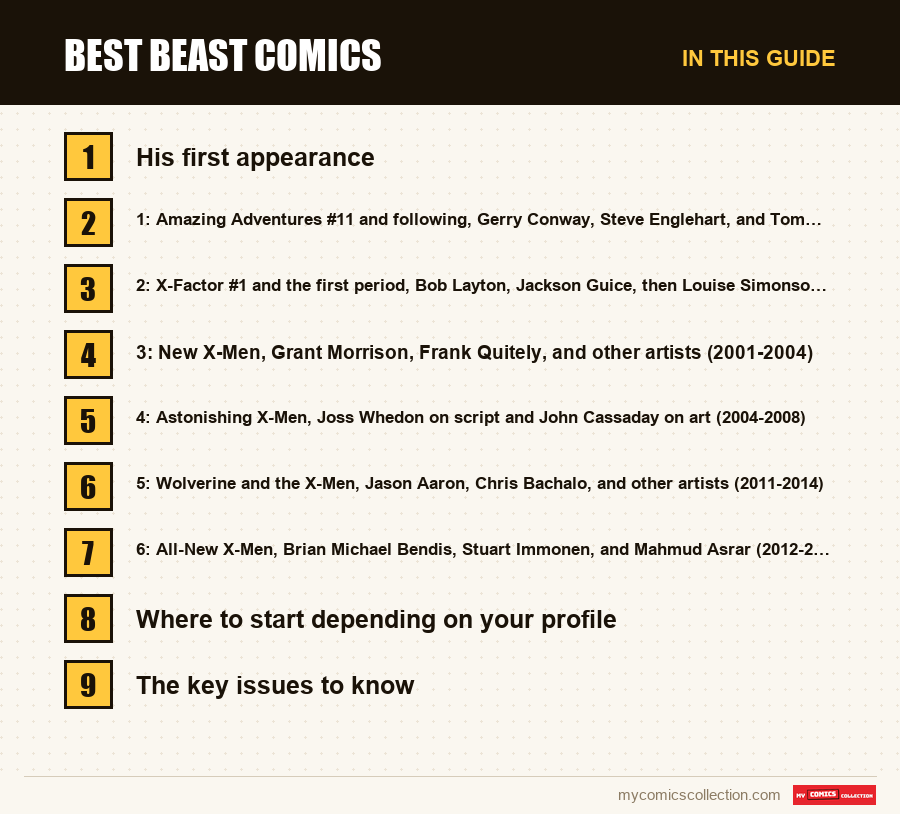
5: Wolverine and the X-Men, Jason Aaron, Chris Bachalo, and other artists (2011-2014)
Forty-two issues, from December 2011 to February 2014. After the X-Men split, Wolverine and Kitty Pryde run the Jean Grey school, and Hank is its deputy headmaster. Aaron and Bachalo create the series; Nick Bradshaw, Ramon Perez, and Pepe Larraz are among the artists who follow one another on it. Hank finds a natural playground here: that of the teacher and educator.
This run stands out from the others through its humor and comedic pacing: the school is a permanent construction site and Hank plays the reasonable adult among unruly students. The series suits readers who like lighter ensemble stories, and it has the merit of showing Beast far from the big dramas. We covered it from Kitty Pryde's side in our pick devoted to Kitty Pryde; you find the same school there, seen from another angle. For the writer, the Jason Aaron page extends the reading.
6: All-New X-Men, Brian Michael Bendis, Stuart Immonen, and Mahmud Asrar (2012-2015)
Forty-one issues under Bendis's pen, with Immonen and then Asrar on art. The starting point is a reversal: Hank, who is trying to do something good with the time he has left, travels back into the past to fetch the five original X-Men and bring them to the present. Beast is therefore the trigger of the series, with a double presence, since the young Hank and the adult one find themselves face to face.
The first arc, "Yesterday's X-Men," fills #1 to #5. The series then counts the arcs "Here to Stay" (#6-10), "Out of Their Depth" (#11-15), and several crossovers. For Beast, the interest lies in the confrontation between the twenty-year-old scientist, full of hope, and the worn-out man who recruited him.
Read this series if you enjoyed the generational dynamic of X-Factor, or if you want to understand how Xavier's team could be replayed fifty years later. For Bendis, his writer page is here.
Where to start depending on your profile
If you are discovering the X-Men, open Astonishing X-Men: Whedon and Cassaday assume no prior knowledge, and Hank has a front-line role in the opening arc. If you prefer ensemble stories and humor, move on to Jason Aaron's Wolverine and the X-Men, where Beast is a teacher among unruly students.
Bronze Age fans will start with Amazing Adventures #11, then read #15 for the blue fur. Readers who like reassembled teams will find their place in X-Factor #1 (1986). As for those looking for the character's feline look, Grant Morrison's New X-Men is the obligatory stop, even though Beast is a supporting role there.
A collector profile can limit itself to three landmarks, X-Men #1, Amazing Adventures #11, and X-Factor #1, which on their own cover the three big stages of the character: the student, the monster, the return of the founder. For an overview of the parent series, the X-Men reading guide gives the landmarks.
The key issues to know
The first landmark is X-Men #1 (September 1963), his first appearance. Next come Amazing Adventures #11 (1972), where the fur makes its entrance, and #15, where it turns blue. Avengers #137 (July 1975) marks his arrival with the Avengers, with Steve Englehart writing. X-Factor #1 (February 1986) is the point of return to the founders.
For the recent periods, the first issue of New X-Men (2001), that of Astonishing X-Men (2004), and that of All-New X-Men (2012) are the entry points of each modern version. Before buying an issue of Hank's, ask yourself whether it marks his birth, a visible mutation, or just a good read: these three categories do not weigh the same in a collection.
A change of appearance is judged over time: an issue where Hank changes form only carries weight if that form stays in use, as with the blue fur. For recent stories, a trade paperback is enough; for the issues of the 1960s and 1970s, condition and the original printing make the difference.
Frequently asked questions
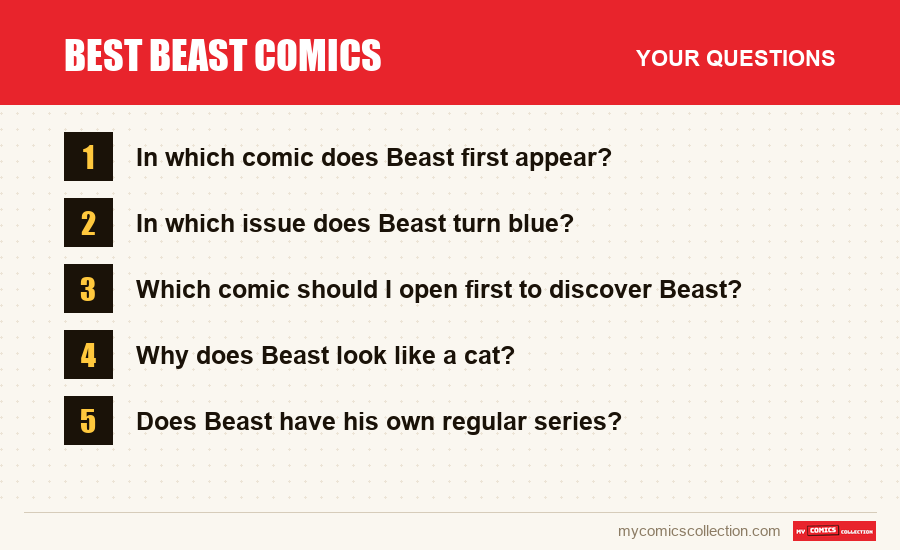
In X-Men #1 (September 1963), where Stan Lee writes and Jack Kirby draws. Hank McCoy is one of the five students of Charles Xavier's first class. He still has a human look, with oversized hands and feet, and the fur only arrives in 1972.
He becomes covered in hair in Amazing Adventures #11 (1972), an issue with Gerry Conway on script and Tom Sutton on pencils. The fur is gray at first, then the blue settles in with #15. Since then, that shade has remained one of his trademarks.
Go for Whedon and Cassaday's run: in Astonishing X-Men (2004-2008), the "Gifted" arc (#1-6) puts Hank front and center. The series reads with no prerequisites and in trade paperbacks. Fans of 1970s monster stories will prefer Amazing Adventures #11.
That look appears under Grant Morrison and Frank Quitely in New X-Men, starting in 2001, through a new mutation. It serves as the visual basis for Whedon and Cassaday's Astonishing X-Men, before artists bring it closer to a more human look.
His clearest spotlight remains the 1972 Amazing Adventures series, in which he headlines for several issues. Since then, Hank lives mostly in team series: X-Factor, Astonishing X-Men, Wolverine and the X-Men, or All-New X-Men, where he often plays a pivotal role.
Do you own an issue featuring Hank McCoy, from X-Men #1 to Amazing Adventures #11? Estimate it before getting it graded or selling it.
Estimate my comic