
In short
Hank McCoy, the Beast, is a bright student with outsized hands and feet when Stan Lee and Jack Kirby introduce him in X-Men #1 (September 1963). He took his furred form in Amazing Adventures #11 (1972), by Gerry Conway and Tom Sutton, joined the Avengers and Defenders, and came home with X-Factor in 1986. The turns that matter most are the feline mutation of 2001, Joss Whedon's Astonishing X-Men with its mutant cure, and the Krakoa-era reinvention that made him a villain.
Hank McCoy is the X-Man who has changed the most while insisting that he has not. Across more than six decades he has been a football star, a furred monster story, an Avenger, a Defender, the head of a mutant nation's intelligence agency and, at the end of that road, an antagonist the X-Men had to hunt. Following him means following several different Marvel books in several different decades.
We checked the credits and cover years for Hank's 1963 debut, his 1972 mutation, the 1986 relaunch and the 2013 run, and we leave the Krakoa-era creators unnamed. Our reading of why each stretch matters is opinion, and no value figures appear on this page.
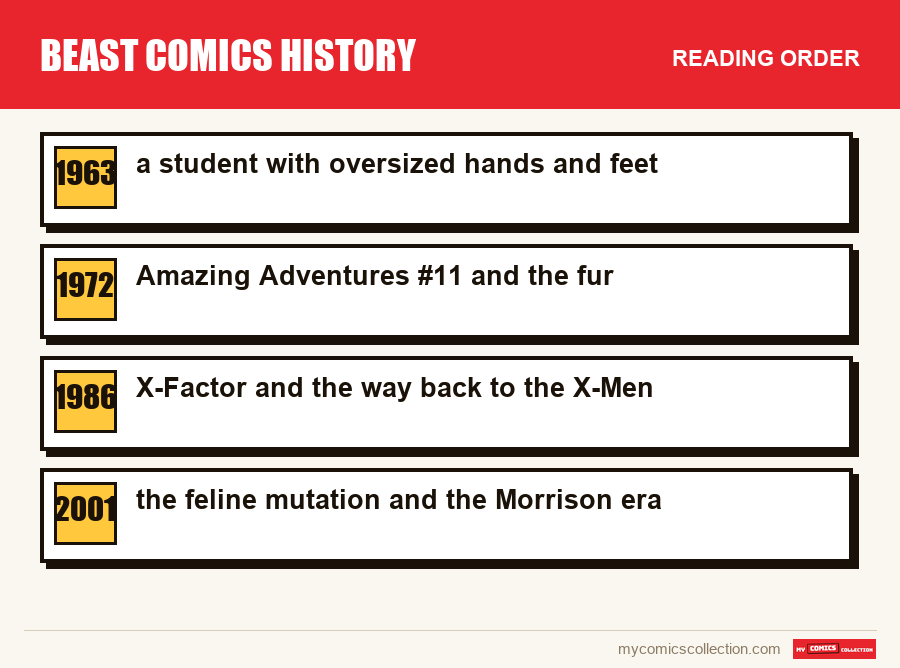
1963: a student with oversized hands and feet
Hank McCoy walks into X-Men #1 with a September 1963 cover date, by Stan Lee and Jack Kirby. In that issue he has no fur and no blue skin. He is a young mutant with oversized hands and feet and a human face, and the contrast between that body and his intellect is the character's whole engine, and every later version of Hank is a variation on it.
The first years give him a conventional supporting role. He is a founding student next to Cyclops, Marvel Girl, Iceman and Angel, and the early story has him as a football star whose parents are abducted by the villain Conquistador. The creative team changes quickly: by X-Men #18, Werner Roth, credited as Jay Gavin, has taken over the drawing from Kirby. In X-Men #39 Hank receives an individualized, colorful new costume. Hank is still a student at Xavier's school, not a headliner.
The original series ends its new-story run with the Hulk battle in X-Men #66 (March 1970). From #67 (December 1970) to #93 (April 1975) the title recycles old stories, so Hank disappears from new X-Men comics for years. That gap is why his next step happens in a different title entirely.
1972: Amazing Adventures #11 and the fur
The change that defines the look of Beast comes in Amazing Adventures (second series) #11, cover-dated March 1972. Gerry Conway writes it, Tom Sutton draws it, and Roy Thomas proposed the concept. Hank, working as a researcher at the Brand Corporation, drinks a compound he had isolated to disguise himself when communist spies inside the company threaten to expose him as a mutant, and the result is a furred form, grey at first. He misses the window for an antidote and hides behind a mask and gloves for a time before abandoning the disguise.
Steve Englehart takes over the writing for the rest of Beast's short spotlight, which runs through the early issues after #11. The material reads as a Bronze Age monster story, with a laboratory, a duplicitous employer and a hero who is horrified by his own face, and it adds elements that outlast the series: a healing factor, short-term amnesia and a second mutation within the same run that turns the fur from grey to black. For a collector, this is the origin of the look as much as the character. The 1963 issue explains who Hank is; the 1972 issue explains why he looks the way he does.
The Avengers and the Defenders
Hank joins the Avengers in the 1970s. Avengers #137 (July 1975) debuts his catchphrase, and Avengers #164 (October 1977) is the first issue to depict him as a sex symbol, a take that writer Jim Shooter said brought very positive mail from female readers. In the same stretch Hank worries that Hank Pym overshadows his scientific work, and he forms a lasting friendship with Wonder Man. Avengers #211 (September 1981) is a later checkpoint for his gift for languages, Latverian included.
After leaving the Avengers when the roster is overhauled, McCoy turns up with the Defenders. He joins the Defenders to seek Doctor Strange's help, finds the team's looser structure liberating, and ends up as its leader. In the same period he becomes a public lecturer and founds a mutant rights coalition called MONSTER and is paired with Dazzler to rescue her from a cult-like mutant group. These years are the least collected part of his history, yet they establish him as an institution-builder, a trait that returns in the Krakoa era.
1986: X-Factor and the way back to the X-Men
In February 1986, X-Factor #1 brings Hank back together with Cyclops, Jean Grey, Iceman and Angel, the five students of 1963. Bob Layton and Jackson Guice are the creators of the 1980s team, and the premise has the five posing as mutant hunters for hire from a base in TriBeCa while secretly training the young mutants they supposedly capture. Louise Simonson introduces Apocalypse in issue #6, and he becomes the book's nemesis.
Hank's own thread in the book is a loss of his fur: former Brand scientist Carl Maddicks abducts him and returns him to a human appearance, and a mutant named Infectia later restores the fur. The reversal is worth knowing about because it explains why collectors find a human-looking Beast in some 1980s issues. The original five stay with X-Factor until the Shadow King storyline, after which they rejoin the X-Men proper, in X-Factor #70 and X-Men #1 (1991). That ends the long separation that began in the reprint years.
2001: the feline mutation and the Morrison era
The next structural change belongs to the start of the 2000s. After he is critically wounded in X-Treme X-Men #2 to #4, a secondary mutation in X-Treme X-Men #3 (2001), written by Chris Claremont, reshapes Hank into a feline form. The form is first shown in the introduction to Grant Morrison and Frank Quitely's New X-Men (June 2001), which writes him as a brilliant, witty scientist.
Here the character turns inward. This is also the Hank who secludes himself in his lab until he finds a cure for the Legacy Virus, and the story reads less as a monster tale than as a portrait of an intellectual who has been physically remade a second time. For readers following the character through his most recognizable runs, the shift matters because the Beast of the 1970s and the Beast of Morrison's series do not look alike, and shelf order can hide that fact.
Astonishing X-Men and the mutant cure
After Morrison, the best-known Beast story belongs to Joss Whedon's Astonishing X-Men, which opens with the arc "Gifted." Its subject is a "mutant cure," and Hank is the team member who has the most personal reason to look at it closely.
In "Gifted," the cure is designed by Benetech scientist Dr. Kavita Rao, and for a man remade twice by his own mutation it is a temptation as much as a threat. That is the Beast most readers imagine when they picture a modern X-Man, which is why this run is the most common entry point. It needs no prior reading, and it reduces the sixty-year character to one clear question: what does a man with his intelligence want from his body?
Do you collect this series?
Track what you own, what you are missing and what your collection is worth. 7-day trial.
Start my trial →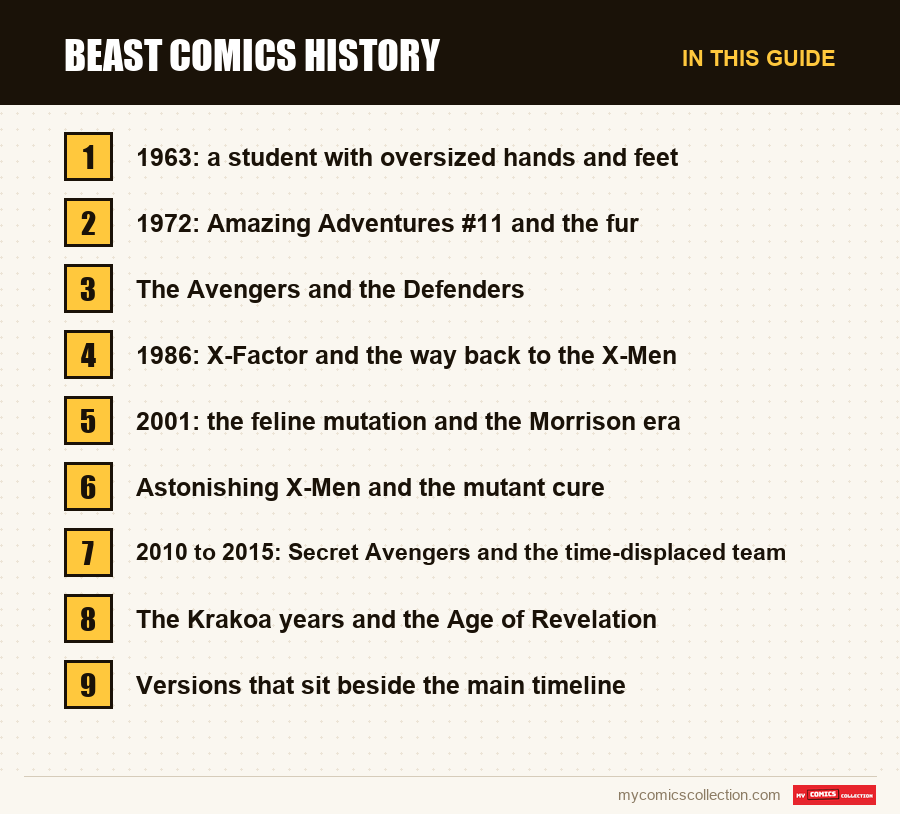
2010 to 2015: Secret Avengers and the time-displaced team
Secret Avengers runs from issue #1 (July 2010) to #37 (March 2013), and Beast is a regular character throughout it. In the same years he takes Professor X's seat in the Illuminati, inheriting his Infinity Gem, and dates S.W.O.R.D. director Abigail Brand. The Hank of these years is a scientist among power brokers.
The larger idea belongs to All-New X-Men, written by Brian Michael Bendis and created with artist Stuart Immonen. In that series Beast travels back in time to recruit the five original X-Men, telling them that Cyclops must come to the future to stop himself from committing mutant genocide. Volume 1 has a January 2013 cover date on its first issue and runs 41 issues; Immonen and Mahmud Asrar pencil it. In the possible future seen in "Battle of the Atom," a further-mutated Beast has defected to the Brotherhood, while the present-day Hank later decides to return to the X-Men. The second volume, by Dennis Hopeless and Mark Bagley, ran 19 issues from January 2016 to May 2017.
The Krakoa years and the Age of Revelation
In the Krakoan era, Hank becomes the leader of X-Force, repurposed as the island's intelligence-gathering agency. After the Reavers assassinate Xavier, McCoy leads the team that traces the killers to an XENO cell led by a clone of Dr. Moreau. His methods then turn brutal: he enslaves his old ally Wolverine, beheads him and disrupts his resurrection. Wolverine hunts him down and kills him. Reborn in a clone body, Hank flees Krakoa and builds an army of clones until Wolverine and his ally Maverick track him down and defeat him.
The story continues under the title "Age of Revelation," in which the original Beast survives by transferring his consciousness into an artificial white-furred body and becomes chairman of 3K, an organization that intends to create new mutants by force. His clone joins Cyclops's X-Men in Alaska. Nothing in the 1963 debut predicts this outcome, yet it follows from traits that were always there: certainty in his own intellect and a willingness to decide for others. For collectors, the Krakoa-era books are recent enough that the creative credits are best checked issue by issue on the cover or in the indicia.
Versions that sit beside the main timeline
Two alternate Beasts shape how people talk about the character. Dark Beast, an evil version from the Age of Apocalypse reality, is a recurring character in 2000s and 2010s comics, a mirror image of the benevolent scientist. The Ultimate Beast is a different founding member again: in Ultimate X-Men #37 a Weapon X operation gives him blue fur and heightened senses, he is later killed by Sentinels and resurrected, and in Ultimatum #1 he drowns when Magneto floods New York.
These versions matter in a collection mostly for sorting. Dark Beast and Ultimate Beast are separate continuities, and an issue with "Beast" on the cover may belong to any of them. When you list a copy, note the universe or the series, so that a 1990s Age of Apocalypse appearance is not confused with the mainline Hank McCoy.
The key issues across his history
- X-Men #1 (1963): Hank McCoy debuts in the founding issue, by Stan Lee and Jack Kirby.
- Amazing Adventures #11 (1972): the transformation into a furred Beast, by Gerry Conway and Tom Sutton.
- Avengers #137 (1975): Hank is an Avenger, and the issue debuts his catchphrase.
- X-Factor #1 (1986): the five original X-Men return together, with Bob Layton and Jackson Guice.
- X-Treme X-Men #3 (2001): the feline mutation, with Chris Claremont writing.
- Astonishing X-Men #1: Joss Whedon's run opens with "Gifted" and its mutant cure.
- All-New X-Men #1 (2013): Beast brings the original five to the present, with Bendis and Immonen.
- Ultimate X-Men #37: the Ultimate Beast receives his blue fur.
Following Beast through a collection
Start with Whedon's Astonishing X-Men, because it reads without prior knowledge, then work backward to Amazing Adventures #11 and forward to All-New X-Men. Numbering is the main trap. The original X-Men volume runs to #93 with reprints from #67, so a copy numbered from #67 through #93 contains no new Beast story at all. Amazing Adventures is a second series for this purpose, All-New X-Men has two volumes (41 issues, then 19), and the Ultimate and Age of Apocalypse versions sit on separate shelves.
A practical method is to build three shelves: the 1963 and 1972 origins, the team books where he is a lead (X-Factor, Astonishing X-Men, All-New X-Men), and the Krakoa-era material. For the surrounding story of the franchise, the X-Men history guide and the Beast reading guide cover the groups he moves through.
Frequently asked questions
The answer is the founding issue of the team's title, with Stan Lee and Jack Kirby on the credits. The Hank of that issue is a student with oversized hands and feet, not the furred figure of later decades, because the fur arrives nearly nine years afterward in another series.
In Amazing Adventures (second series) #11, cover-dated March 1972. Gerry Conway wrote the issue, Tom Sutton drew it, and Roy Thomas proposed the concept. Hank drinks a compound he had isolated to disguise himself and becomes covered in fur, and Steve Englehart wrote the rest of his short solo run in that title.
A secondary mutation reshaped him into a feline form in 2001, after he was critically wounded in X-Treme X-Men #2 to #4. The change is attached to X-Treme X-Men #3 by Chris Claremont, and the form is first shown in the introduction to Grant Morrison and Frank Quitely's New X-Men, so both series show it.
Astonishing X-Men, the run written by Joss Whedon, requires no earlier reading, and its opening "Gifted" arc turns on the mutant cure that tempts Beast. After it, Amazing Adventures #11 shows his origin look, and All-New X-Men shows the time-travel story built around him.
In the Krakoan era he leads X-Force, grows increasingly brutal and is eventually killed by Wolverine. Reborn as a clone, Hank then builds an army of clones. In "Age of Revelation," Beast survives in an artificial body and chairs 3K, which aims to create mutants by force, so the antagonist role is his current state.
Found an Amazing Adventures #11 or an early X-Men issue in a long box? Get an estimate before you decide how to shelve it.
Estimate my comic