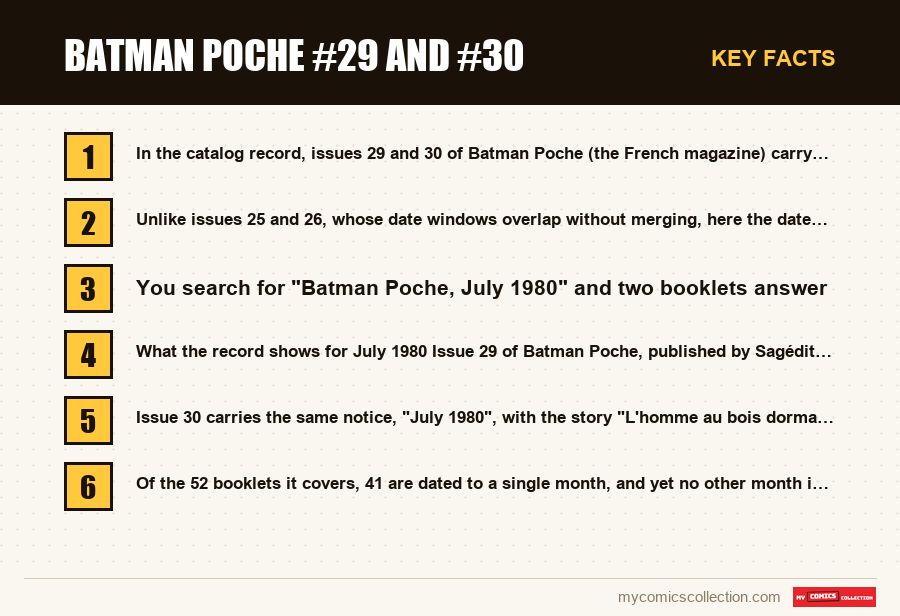
In the catalog record, issues 29 and 30 of Batman Poche (the French magazine) carry exactly the same cover date: July 1980. It is the only exact month shared by two booklets in the series. Unlike issues 25 and 26, whose date windows overlap without merging, here the date settles nothing: only the printed issue number, then the story title, tell you which one you are holding.
You search for "Batman Poche, July 1980" and two booklets answer. This is not a data-entry error to correct: it is what the catalog records, and that is precisely what makes these two issues interesting for a collector who keeps a list of missing copies or who sorts booklets by date.
As always on this guide, only verified information (creators, numbers, dates) is stated as fact; the analysis is ours, with no reproduction of any panel or protected dialogue.
What the record shows for July 1980
Issue 29 of Batman Poche, published by Sagédition, is recorded with the date "July 1980" and the story "Les seigneurs de la nuit". Issue 30 carries the same notice, "July 1980", with the story "L'homme au bois dormant". Both dates are written in the same form, a month and a year, with no window and no quarter.
This coincidence is rare in the record. Of the 52 booklets it covers, 41 are dated to a single month, and yet no other month is shared by two issues. The only other date duplicate is of a different kind: issues 2 and 3 are both dated "3rd quarter 1976", a three-month period, which is an imprecision more than a coincidence. For July 1980, the precision is the same on both sides, and it is real.
What the data does not tell us is the actual order of release. A cover date is a printed notice, not a cash-register record. That two booklets carry the same month establishes neither that they were distributed on the same day, nor that they were distributed in issue-number order. It only establishes that the publisher gave them the same label.
What changes when dating a single copy
The series has already run into the problem of ambiguous dates, a little earlier, in another form. Issues 25 to 28 are dated by windows of two or three months: "February-March-April 1980", "February-March 1980", "April-May-June 1980", "May-June 1980". There, a date read on a copy leaves several candidates, but the windows do not all have the same width or the same boundaries, so the exact form of the notice narrows the list.
Here the mechanism is reversed. The date is clean, a single month, and it is the date that falls short: it designates two issues with the same precision. To date a single copy, two consequences follow. First, the cover date tells you that the object is neither 28 nor 31, its immediate neighbors, and that is already a lot. Second, it tells you nothing more: the choice between 29 and 30 has to come from the series number printed on the booklet or, failing that, from the title of the main story.
In other words, the date gives you the pair, not the item. A listing that only says "Batman Poche July 1980" does not describe an object, it describes two possibilities.
The neighbors: a zone where dating tightens
Looking around this pair shows why it stands out. Issue 28 is dated "May-June 1980", so from a window that stops just before July. Issue 31 is dated "September 1980": no booklet in the record carries "August 1980". Between May-June and September, there are therefore two issues for a single month of July, and an empty slot in August.
After September, the series slips back into imprecision. Issue 32 is dated "November December 1980", written without a hyphen, and its story is titled "Les nouvelles collections aventures Sagédition", which looks more like a publisher's announcement than a story. Issue 33 is dated "4th quarter 1980", then issue 34 returns to a clean month, "January 1981".
What can be drawn from this without extrapolating: of the nine issues in the record dated 1980, from 25 to 33, only three carry an isolated month (29, 30 and 31), and those three follow one another. The July 1980 page is therefore a small island of precision between two zones where the publisher gave ranges. For a collector reconstructing a publication calendar, this is the only stretch of 1980 where the date truly carries weight, and it is exactly there that it no longer discriminates.
Do you collect this series?
Track what you own, what you are missing and what your collection is worth. 7-day trial.
Start my trial →
What the credits separate, and what they leave open
The credits are recorded at the level of the booklet, not the episode: we know which names appear somewhere in the issue, not who signed which story. For 29, the catalog lists three writers, Len Wein, Denny O'Neil and Jack C. Harris, and three artists, José Luis García-López, Irv Novick and Don Newton. For 30, the writers are Denny O'Neil, Len Wein and Bob Rozakis, and the artists Bernie Wrightson, Irv Novick and Walter Simonson.
The two lists therefore share Len Wein, Denny O'Neil and Irv Novick, which does not settle the question. But the differences are useful. Bernie Wrightson appears, throughout the record, only in issue 30: if his name is among the credits of a booklet in your hands, you are holding that issue. Bob Rozakis also separates the two, since he is credited on 30 and not on 29, but he appears elsewhere in the record: he does not single out 30 on his own. Conversely, José Luis García-López and Don Newton are on 29 and not on 30.
A trap hides in these cross-checks: issue 31 repeats exactly the same three writers as 29, Len Wein, Denny O'Neil and Jack C. Harris, and shares with it Irv Novick and Don Newton on art. A copy of which you read only the writers therefore cannot be tied to 29 rather than 31. The title of the main story and the date, together, close the question: "Les seigneurs de la nuit" and July 1980 for 29, "Quand les insurgés prennent le pouvoir" and September 1980 for 31.
Recognizing the copy in your hands
The check runs in this order, from most decisive to most indirect. First criterion: the printed series number. If it reads 29 or 30, the question is settled and the date only confirms. Second criterion: the title of the main story, which in the record corresponds to a single title per issue, "Les seigneurs de la nuit" for 29 and "L'homme au bois dormant" for 30. Third criterion, weaker: the names in the credits, to be handled with the reservations above.
What this page cannot tell you is the rest of the table of contents. The record gives only one title per booklet. If the question is what one of the two issues actually contains, it is the copy that answers, not the catalog. Likewise, no correspondence with an American booklet is established here, and no first French appearance is claimed.
As for condition, both booklets are judged like any other in the series: spine, corners, cover edges and paper discoloration. Nothing in the data allows us to say that one of the two is more fragile or rarer than the other.
Two lines in a list of missing issues, not one
In a list of missing issues, the natural mistake is to write "July 1980" and consider the slot filled as soon as one booklet matches. There are two slots. The correct entry is "No. 29, July 1980" and "No. 30, July 1980", two separate lines, each ticked on its own.
The symmetrical error exists for duplicates: two copies labeled "Batman Poche July 1980" are not necessarily a duplicate to resell. They may be 29 and 30, that is a complete pair. Before setting one of them aside, turn them over and read the numbers.
The same vigilance applies to sorting. A table sorted by date places the two ties, and the order in which they display is arbitrary until the number serves as a second criterion. Sort by number, or by date and then by number, and you recover the order of the series.
Frequently asked questions
The catalog does not say so. It records a cover date, "July 1980", identical for both issues. It is a notice printed on the booklet, which proves neither simultaneous distribution nor a precise order of release. It only proves that the publisher gave both the same month label.
Read the printed series number first: 29 or 30. Failing that, compare the title of the main story: "Les seigneurs de la nuit" designates 29, "L'homme au bois dormant" designates 30. The date alone is never enough, since it is identical for both issues.
Not in the record: July 1980 is the only exact month carried by two issues. Issues 2 and 3 do share a date, "3rd quarter 1976", but that is a three-month period and not a month, so it is an imprecision of another kind. Issues 25 to 28, for their part, fall under overlapping windows.
Partly. Len Wein, Denny O'Neil and Irv Novick appear on both. Bernie Wrightson, Walter Simonson and Bob Rozakis are on 30 and not on 29, while José Luis García-López and Don Newton are on 29. Since the credits are recorded per booklet, they serve as a cross-checking clue, not as proof episode by episode.
Nothing in the data requires a joint purchase: no content link between the two is established, only a shared date. The argument is practical. Having them together prevents confusing the two in a list of missing issues and turns a complete pair into a false duplicate.