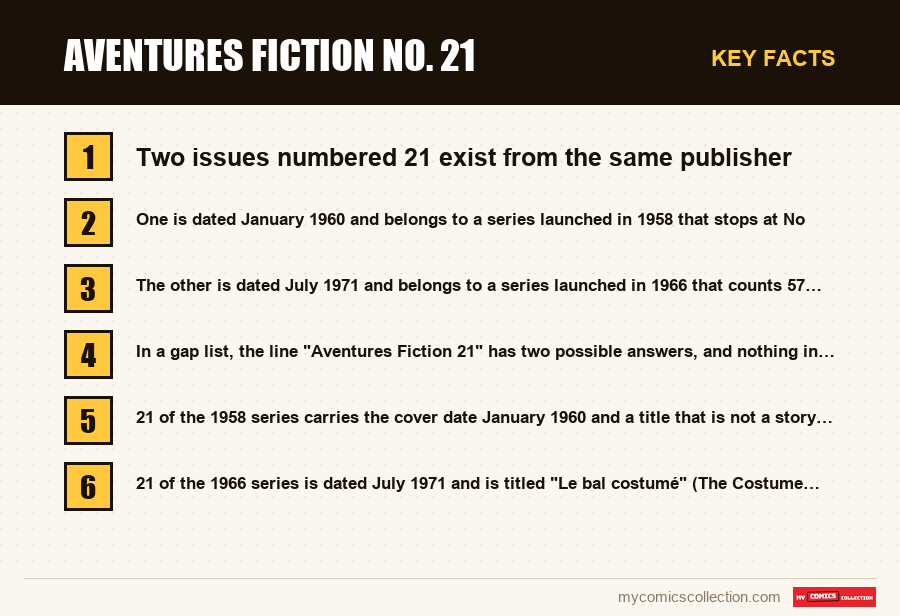
Two issues numbered 21 exist from the same publisher. One is dated January 1960 and belongs to a series launched in 1958 that stops at No. 29. The other is dated July 1971 and belongs to a series launched in 1966 that counts 57 numbers in the listing. The gap is eleven years and six months. So note the series year together with the number.
In a gap list, the line "Aventures Fiction 21" has two possible answers, and nothing in those three words tells you which one you are looking for. This sheet sets the two issues side by side, measures what separates them, and fixes what the listing lets us assert about each.
As always on this guide, only verified information (creators, issue numbers, dates) is stated as fact; the analysis is our own, with no reproduction of panels or protected dialogue.
Two No. 21s, two dates, two titles
In the listing, No. 21 of the 1958 series carries the cover date January 1960 and a title that is not a story's: "Tarif des abonnements annuels (12 numéros)" (annual subscription rates, 12 issues). No. 21 of the 1966 series is dated July 1971 and is titled "Le bal costumé" (The Costume Ball). Both series are attached to the same publisher, Arédit-Artima, and share the name Aventures Fiction. On a shelf, what separates them is therefore read on the cover date and on what the issue contains, not on the number.
The credits differ too. For the 1958 series, the listing gives Gardner Fox on script, and Gil Kane, Mike Sekowsky and Sid Greene on art. For the other, it gives Gardner Fox, Stan Lee and Larry Lieber on script, and Gil Kane, Jack Kirby and Murphy Anderson on art. Two names appear in both issues, those of Gardner Fox and Gil Kane, and the temptation is to conclude that the contents are related. Credits are given at the level of the issue, not the story, and the listing does not say which name corresponds to which story: this resemblance proves nothing.
The exact gap between the two issues
From January 1960 to July 1971, eleven years and six months elapse, or 138 months. The cover years differ by eleven. The gap with the 1958 No. 21 exceeds twelve years only from No. 24 of the 1966 series, dated February 1972, which is no longer the same rank.
To date a copy, calculate from the cover date of the issue in hand, not from the year of the series. Remember that this date is the one the issue carries, not necessarily the date it went on sale.
Two series at different stages
The same rank does not mean the same moment in a series' life. The 1958 series counts 29 issues: after the 21st, eight remain, from February to September 1960. The January 1960 issue therefore sits near the end, eight steps from the last. The 1966 series counts 57 in the listing: the 21st is still far from the end, and 36 follow, up to the first quarter of 1978.
The pace differs too. The 1958 series reaches its 21st in 22 months; the 1966 series takes 60 months, five years for the same rank. Between the two series, the catalogue shows nothing: the first stops in September 1960, the second starts nearly six years later. When the 1971 No. 21 appears, the last issue of the previous series is therefore ten years and ten months old.
The precision of the date also changes with the stage. In the 1966 series, the date to the month stops with No. 39; from No. 40 on, only the quarter is known. No. 21 therefore falls within the month-precise range, which is no longer possible toward the end of the series.
What titles and credits reveal
In the 1958 series, the title of No. 21 is shared: "Tarif des abonnements annuels (12 numéros)" also appears on Nos. 19, 20 and 22, so four consecutive issues that the title alone cannot tell apart. In that series' listing, 12 of 29 numbers carry a title that reads as an advertisement or a call to readers rather than a story. For a collector, the practical consequence is that on these issues, the number and the date do the work the title cannot do.
The mention "12 numéros" fits a monthly publication, and the dates confirm it over a stretch: the 24 issues from No. 6 (October 1958) to No. 29 (September 1960) are dated across 24 consecutive months. Early on the pace had been slower: No. 6 arrives seven months after No. 1.
On the 1966 side, No. 21 is a turning point for credits. Stan Lee appears on script in five issues of the listing, from 21 to 25, and nowhere else. Larry Lieber is credited only once, on this line. Jack Kirby is credited on art at 21, then disappears from the listing from 22 to 37 before returning from 38. None of these appearances says what the issue contains, but they show that "Le bal costumé" does not resemble, in its credits, the numbers that precede it in the same series.
Do you collect this series?
Track what you own, what you are missing and what your collection is worth. 7-day trial.
Start my trial →
Neighboring issues
In the 1958 series, the October 1959 issue is titled "L'invincible étranger" (The invincible stranger); then come four issues of rates, then the March 1960 issue, "Le reportage dans l'espace en 2159" (A report from space in 2159), and the April 1960 issue, "Prix de pêche sur Venus !" (Fishing prices on Venus!). Gil Kane reappears on art with the January 1960 issue and remains credited on the three that follow, after an absence since the August 1959 issue. No. 21 therefore opens a run of credits, in the middle of a run of identical titles.
For 1966, the neighbors tell of a changing rhythm. From 1 to 19, the listing runs through three-month intervals, then No. 20 arrives in May 1971, four months after No. 19. Three two-month intervals follow, before the return to three months. No. 21 is thus at the heart of a short, tight period. No. 22 is titled "Robots à vendre" (Robots for sale), No. 23 "Guerre intersidérale" (Intersidereal war), No. 24 "4ème de couverture" (back cover). The title of No. 20 names a character, which opens the way to the Green Lantern hub for anyone following this hero rather than the magazine.
Recognizing the copy and logging the gap
Start with the cover date: January 1960 or July 1971 settles the question without any other clue, since neither has a neighboring date in the other series. Then look at the contents and the ad pages. A 1958 issue whose subscription rates page is visible fits the catalogue's title; that is not proof in itself, since the same title runs across four numbers.
In your list, write "Aventures Fiction, 1958 series, No. 21 (January 1960)" or "1966 series, No. 21 (July 1971)". If you sort both listings together by number, ranks 1 to 29 appear twice, and a copy you already own can hide a gap in the other series. Keep two separate lists, or a year column that serves as the key.
What the listing leaves open
The listing gives a title, a date and credits per issue: it gives neither the full contents, nor the page count, nor the format, nor a match with an American issue. We therefore cannot assert that the two No. 21s overlap, nor that they differ entirely, beyond what the titles show. A listing is not the series either: the 1958 series counts 29 numbers with no gap between 1 and 29, and the 1966 one counts 57 in the same way, but nothing says that a special issue does not exist outside the catalogue.
The condition of a 1960 issue and a 1971 issue cannot be compared: eleven and a half years of paper, storage and handling separate their histories. The listing says nothing about it, and the copy in hand is what counts. For the wider context, the blog brings together the guides to these series.
Frequently asked questions
The first is dated January 1960, the second July 1971: that makes eleven years and six months, or 138 months. Twelve years are passed from No. 24 of the 1966 series, dated February 1972.
The listing titles differ, "Tarif des abonnements annuels (12 numéros)" and "Le bal costumé". Two names, Gardner Fox and Gil Kane, appear in both issues, but at the issue level only: the listing does not allow deducing a shared content.
The catalogue keeps only one title per issue, and for this number it reads as an advertisement. Numbers 19, 20 and 22 carry the same one. The rest of the contents is not detailed: it has to be checked on the copy itself.
Write the name, the series year and the cover date: "1958 series, No. 21, January 1960" or "1966 series, No. 21, July 1971". The number alone is ambiguous, and the series year is enough to remove the doubt.
In the listing, the 1958 series counts 29 numbers and the 1966 series 57. The catalogue says nothing about the rarity of individual issues: the size of a series tells you how many gaps are possible, not how hard each one is to find.