
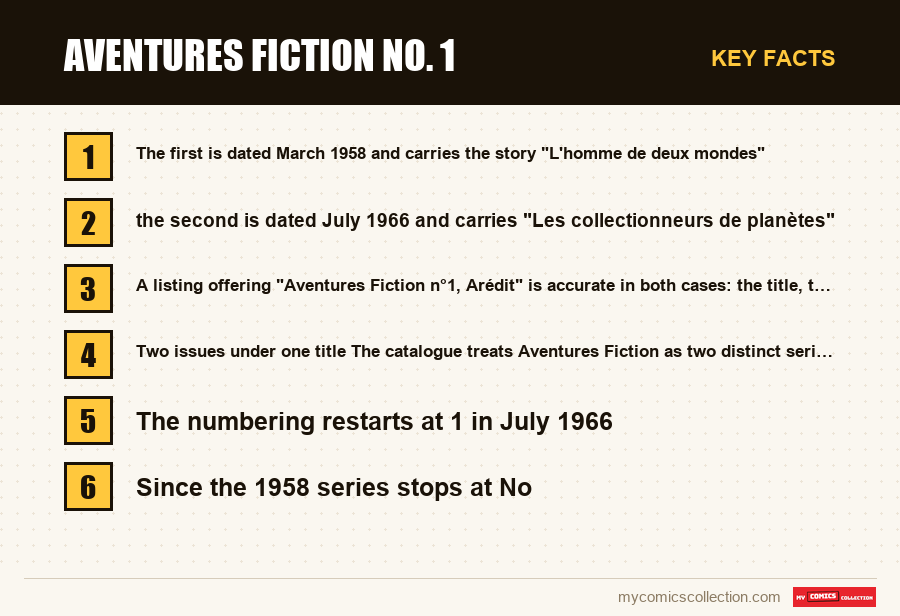
The catalogue lists two Aventures Fiction No. 1 issues from Arédit-Artima. The first is dated March 1958 and carries the story "L'homme de deux mondes"; the second is dated July 1966 and carries "Les collectionneurs de planètes". Eight years and four months separate them, and their credits share no name. Faced with a listing, the cover date decides; failing that, the story title, then the names.
A listing offering "Aventures Fiction n°1, Arédit" is accurate in both cases: the title, the publisher and the number each exist twice in the catalogue, and nothing in those three words points to one rather than the other. This page is there so that you do not pay for the wrong issue, or wrongly dismiss a copy as a duplicate when it is a different object.
As always on this guide, only verified information (creators, issue numbers, dates) is stated as fact; the analysis is our own, with no reproduction of panels or protected dialogue.
Two issues under one title
The catalogue treats Aventures Fiction as two distinct series, both attached to Arédit-Artima: a 1958 series, which counts 29 numbers in the listing, and a 1966 series, which counts 57. The numbering restarts at 1 in July 1966. The listing does not say why, and we will not guess: it records two series, and says nothing about the editorial decision that separates them.
What matters to you is the overlap. Since the 1958 series stops at No. 29 in the listing, ranks 1 to 29 exist in two copies, one per series. Beyond that, from No. 30 to No. 57, a rank designates only one issue.
In other words, 29 of the 57 issues of the 1966 series, a little more than half, carry a rank that a 1958 issue also carries. No. 1 is the most exposed case, since it is the one you search for first.
The cover date decides first
The 1958 issue is dated March 1958, the 1966 issue July 1966. That makes 100 months, or eight years and four months.
The 1958 series stops in the listing at September 1960; until July 1966, the catalogue contains no issue of the title for 70 months, almost six years.
The rhythm also helps, from No. 2 onward. In 1958, the first four issues follow one another month by month, from March to June.
In 1966, the first three are spaced three months apart: July 1966, October 1966, January 1967.
From No. 2 to No. 19 of the 1966 listing, the gap stays at three months between consecutive issues. A seller who cites "No. 2, April" or "No. 2, October" therefore points you, without knowing it, to one series or the other.
One caveat: this is the cover date as the catalogue records it. Ask the seller what is printed on the copy, not a year reconstructed from memory.
The credits: useful, but not decisive
Credits are given at the level of the issue, not the story. For the 1958 opening issue, the catalogue lists two writers, Otto Binder and Ed Herron, and three artists, Jack Kirby, Sid Greene and Nick Cardy.
For the 1966 one, it lists three writers, Dave Wood, George Kashdan and Don Freeman, and three artists, Gil Kane, Bill Ely and John Allard. That makes five names on one side and six on the other, and none is common to both lists.
Do not conclude too quickly from this absence. Names circulate from one series to the other: four of the five 1958 names turn up somewhere in the 1966 listing, and three of the six 1966 names appear somewhere in the 1958 listing. Jack Kirby, for example, is credited only once in the 1958 series, at its opening, and reappears in the 1966 series only from rank 21. Gil Kane, absent from the 1958 opening, is credited there from rank 4, and also opens the 1966 series.
A single name proves nothing, but some names act as markers in the listing. Sid Greene appears in no 1966 issue in the listing; George Kashdan, Don Freeman and John Allard appear in no 1958 issue in the listing. If a listing copies one of them, the series is practically identified. Bill Ely, on the other hand, is a trap: he is credited on the third issue of the 1958 series and on the first three of the 1966 one, so he does not tell the two No. 3s apart.
The story title, and its limits
The catalogue gives only one story title per issue: "L'homme de deux mondes" for 1958, "Les collectionneurs de planètes" for 1966. These are two unrelated titles, and it is the sharpest clue you have when the date is missing. But this title is not the contents: the listing does not give the content of the issue.
Keep this method for No. 1, not for the rest. In the 1958 series, the title field sometimes holds promotional text or a price: No. 15 is titled "Tarif des abonnements annuels (12 numéros)" (annual subscription rates, 12 issues), No. 29 "Amis lecteurs" (Dear readers). In the 1966 series, Nos. 12 and 13 carry the mention "4ème de couverture" (back cover). For these numbers, the catalogue title describes a page of the issue, not a story, and it will not help you identify a copy.
Do you collect this series?
Track what you own, what you are missing and what your collection is worth. 7-day trial.
Start my trial →
Before an ad: the order of checks
Proceed in order. First the cover date: March 1958 or July 1966, and nothing else needs discussing if it is legible. Then the story title, if it appears in the photo or the description. Then the names, looking for markers rather than shared names. Finally, if the seller also offers the next issue, its date (April 1958 or October 1966) confirms the series.
What the catalogue cannot settle: the format, the page count, the paper, or the condition. It gives no price either, and we do not write one. If the description contains neither a date nor a story title, ask for a photo of the cover and of the page that carries them, rather than relying on "No. 1" and the publisher's name.
Neighboring numbers
For the 1958 series, No. 2 is titled "Fusée d'amateur" (April 1958) and No. 3 "Le jouet qui sauva le monde" (May 1958).
Otto Binder and Ed Herron are credited on Nos. 1 and 2; No. 3 renews the credits, with Martin Naydel, Gardner Fox and Julius Schwartz on the script.
For the 1966 series, No. 2 is titled "La planète maudite" (October 1966) and No. 3 "L'oeil qui tue" (January 1967). George Kashdan is credited on the first three issues, Don Freeman and John Allard on the first two. In the listing, the first three 1966 issues therefore share a more stable team than those of 1958, which remains an observation about credits, not about the quality of the stories.
Logging the right number in a gap list
If you are completing a collection, note the series year in the line's label: "Aventures Fiction (1958) No. 1" and "Aventures Fiction (1966) No. 1" are two gaps, not one. A sort by title and then by number would put them side by side, and a copy of one would tick the line of the other. Make the year the first reflex, before the number.
For preservation, nothing in the listing distinguishes one from the other; condition is judged on the copy itself.
Frequently asked questions
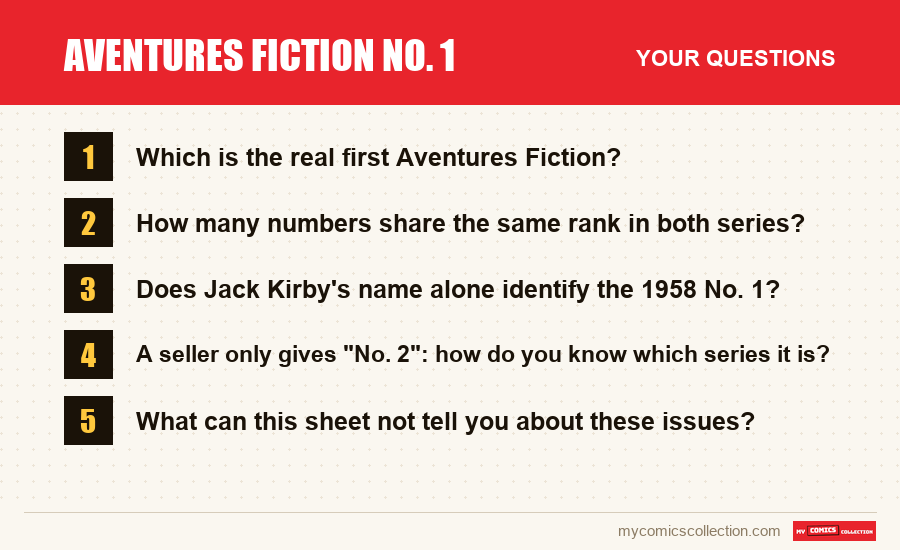
The March 1958 issue is the oldest in the catalogue. The July 1966 one is No. 1 of a different series with the same title, featuring another lead story. The catalogue does not say whether the second repeats the first; the two story titles differ, so they are two distinct objects.
Twenty-nine: every rank of the 1958 series, which stops there in the listing. The 1966 series then continues up to rank 57; beyond rank 29, a rank designates only 1966 issues, so the collision concerns the first half of the second series.
Not on its own. He is credited at the opening of the 1958 series, but also in the 1966 series from rank 21, and in several later issues. For the No. 1 itself, he distinguishes the 1958 issue from the 1966 one, whose credits do not mention him.
By the date: April 1958 for the 1958 series, October 1966 for the 1966 one. The story titles also differ: "Fusée d'amateur" on one side, "La planète maudite" on the other. Without a date or a title, ask for a photo of the cover before buying.
It gives neither the full contents, nor a match with an American issue, nor the first French appearance of a character, nor a price. The catalogue records a date, a story title and the issue's credits. The rest can be read on the copy you have in hand.