
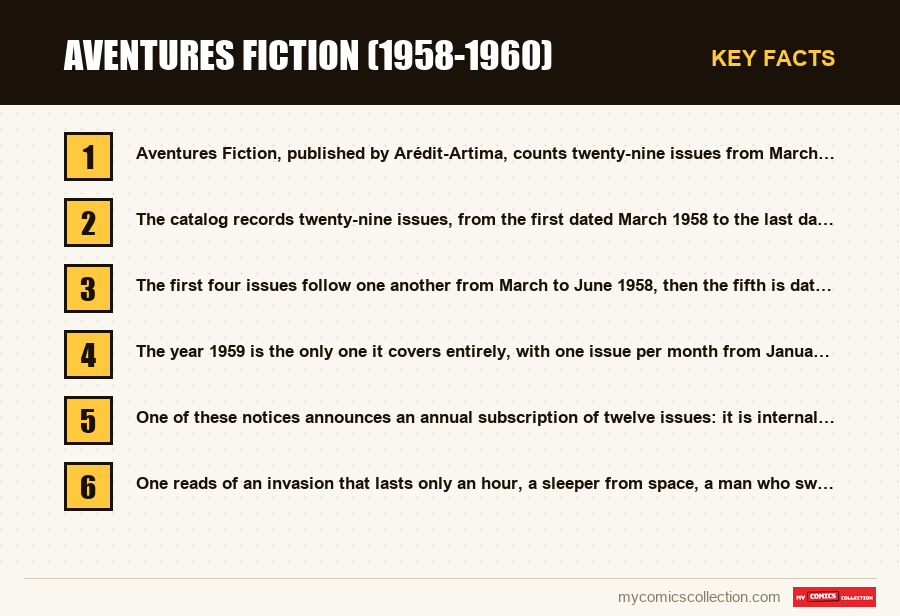
Aventures Fiction, published by Arédit-Artima, counts twenty-nine issues from March 1958 to September 1960. The catalog gives its complete numbering, with no gaps, and American science-fiction credits dominated by Gardner Fox, Otto Binder and Gil Kane. However, the detailed contents are missing: nearly half the issues have only a subscription notice or an in-house announcement recorded as their title. It is a short, bounded series, documented on purpose only in part.
Twenty-nine booklets, thirty-one months on newsstands, and documentation that stops halfway: if you have inherited a stack of these Aventures Fiction, your difficulty will not be knowing how many are missing, but knowing what each of the ones you hold contains. This guide separates what is established from what still has to be opened on the copy.
As always on this guide, only verified information (creators, numbers, dates) is stated as fact; the analysis is our own, with no reproduction of panels or protected dialogue.
A short series, closed and entirely bounded
The first thing to understand is that this collection has a known end. The catalog records twenty-nine issues, from the first dated March 1958 to the last dated September 1960, and the numbering skips no rank between the two. You are therefore not looking for an open set whose late issues might turn up; you are looking for a closed list, and every empty slot in your binder corresponds to a precise booklet that someone, somewhere, owns.
This closure changes how you collect. On a magazine that lasted twenty years, you build by stretches and accept remaining incomplete for a long time. Here, the reasonable goal is the complete run, and the reasoning becomes arithmetic: what is missing can be identified to the exact number, which makes exchanges between collectors much easier to negotiate than with a long-running series.
Two months missing, then unbroken regularity
The cover dates tell a hesitant start. The first four issues follow one another from March to June 1958, then the fifth is dated August and the sixth October: July and September 1958 had no issue. For a collector, this matters twice over. First, because a seller who announces a gap in his run between the fourth and the sixth may not be mistaken; second, because an irregular dating makes any month-based sorting unusable for that first year.
From the sixth issue onward, by contrast, the magazine misses not a single month until it stops. The year 1959 is the only one it covers entirely, with one issue per month from January to December, and the final issue falls in September 1960 with no announcement of a sequel in the data. The series thus stops in full regularity, not in editorial exhaustion: the sign of a decision, not of a loss of steam.
This detail has a practical consequence. When a magazine stops while still appearing on schedule, the last issue has no reason to be rarer than the others: it was printed like its neighbors. Be wary, therefore, of a listing that presents the twenty-ninth as a difficult piece on the grounds that it closes the collection.
Story titles that are not story titles
This is the most telling anomaly in this dossier, and it should be named rather than hidden. Of the twenty-nine issues, twelve have as their recorded title only a text from the publisher: a subscription rate, an announcement inviting readers to the catalog's fiction, a farewell to readers on the last booklet. These are not stories; they are service pages that ended up indexed in place of the contents.
This poverty is itself information. It indicates that the oldest booklets of this family were logged by different hands, and that nobody had a complete run in front of them to copy the contents from. The concentration of these empty entries is also telling: they cluster in the second half of the series, whereas the first twelve issues almost all carry a real French title. The record began with care, then tailed off.
There is an unexpected benefit as well. One of these notices announces an annual subscription of twelve issues: it is internal proof that the magazine was meant to be monthly, and it matches exactly what the dates show for 1959. When the data is missing, what remains still allows a hypothesis to be checked.
The stories whose French titles are known
The recorded titles clearly draw a line of science-fiction anticipation. One reads of an invasion that lasts only an hour, a sleeper from space, a man who swindles time, an anti-invasion machine, a space report set in 2159, a Martian witness. No costumed superheroes in these titles, no terrestrial adventure: the magazine sold brief stories built on a mechanism, around an idea turned on its head in a few pages.
The first issue opens with a story titled "L'homme de deux mondes", and it is also the only booklet in the whole series where the catalog lists Jack Kirby among the artists. Whether that credit applies to the title story or to another episode of the contents, the data does not say. But the coincidence between a first issue and a signature of that weight is enough to explain why this rank is the most sought after in the collection.
Keep in mind the limit: the catalog gives only one title per booklet, whereas a small format of that era bundled several. What a sales listing calls "the contents" is therefore very probably just one entry among three or four. The only way to know what a number contains is to open it and record the episodes one by one.
Recurring signatures and their limits
On the writing side, one signature dominates: Gardner Fox is credited on twenty of the twenty-nine issues, and his presence runs from the third issue to the last. Otto Binder follows closely, from the first to the twenty-second, after which his name disappears from the record. Between these two pillars, John Broome returns intermittently, across eleven issues spread from the fourth to the twenty-eighth, and Ed Herron stops at the tenth issue, which makes him a useful marker for placing an issue whose cover is illegible.
On the art side, the leading trio is clear: Gil Kane appears on seventeen issues, Sid Greene on fourteen, and Greene is the only one to appear on both the first and the last booklet. Carmine Infantino accompanies the series up to the twenty-third, then ceases to be credited. Two names, conversely, arrive late: Manny Stallman from the fifteenth, Mike Sekowsky from the eighteenth, both present through the final ranks.
This shift toward the middle of the series is the most useful observation in the file. It signals that the pool of reprinted material changed midway, and that the second-half issues no longer draw on the same stock as the early ones. If you collect for an artist rather than for a title, this boundary, not the date, should guide your purchases.
Do you collect this series?
Track what you own, what you are missing and what your collection is worth. 7-day trial.
Start my trial →
What the credits do not allow you to do
Each issue carries exactly three artist names in the catalog, without exception. This regularity is no coincidence: it reflects the structure of the booklet, which bundled several episodes, rather than the attribution of a specific story. In other words, the credits are those of the whole issue, not of the title displayed beside them.
The same reasoning applies to the writers, whose number varies from one issue to the next, with one booklet from mid-1960 for which no writer is recorded at all. And across four consecutive issues at the end of 1958, the catalog simply records a mention of various authors, an explicit admission that the record could go no further.
The operational conclusion is strict: never buy a copy of this series on the sole promise that it contains a story by a given artist. Ask for photographs of the interior pages, in particular the first panels of each episode, where the signature most often appears.
Recognizing the edition and not getting the year wrong
The identification trap for this title has a name: the same publisher launched in 1966 another magazine called Aventures Fiction, which is not a continuation of this one and has its own numbering. Before any purchase, cross-check the announced issue number with the cover date, and make sure that date falls between March 1958 and September 1960.
In practice, dating is your best authentication tool, because it is constrained. An issue presented as the twelfth of this series must be dated April 1959, and no other month is possible. This rigid match between rank and date applies to the last twenty-four issues, since the rhythm there is strictly monthly: a gap signals either a recording error or an issue from the other magazine.
Assessing a copy of this particular series
Two checks are specific to this title. The first concerns the subscription pages. Five issues from late 1959 and early 1960 carry an annual rate in their recorded pages; if such a page included a detachable order form, its absence is not an accidental tear but a period practice, and it should not be judged as ordinary paper loss.
The second concerns binding. An issue that gathers several short episodes opens more often in the middle than a single-story booklet does, and that is where the staples give way first. So check the central signature before the cover: on this series, a copy with a fresh cover but a loose central signature is common, and it is the defect that weighs most heavily, since it jeopardizes the completeness of the contents.
For everything else, reason by internal comparison rather than by scale. Line up three copies of the same rank and rank them: your relative scale will be more reliable than any grade assigned blind, and it will serve as your benchmark for the other twenty-eight issues.
Completing the twenty-nine issues
The right strategy here is the reverse of a long series. Start by acquiring a lot from the monthly stretch, meaning the bulk running from the sixth issue to the end: these booklets circulate together, sell together, and will give you most of the complete run in one go. Then bring the problem back to the first ranks, which are dealt with one at a time.
Keep a written trace of missing ranks and their corresponding months, because that pairing is what makes a search on this title efficient. A seller who does not know the series will often give the month without the number, or the reverse; knowing that the fifteenth is from July 1959 lets you recognize your missing copy in a badly described listing. An inventory kept up to date, rank by rank and month by month, does that matching for you.
Price, and what tracking this collection is worth
No standard price guide applies usefully to a title whose contents are not published. Value is built here through ratios: the first issue trades at a multiple of the monthly-run issues, and the gap between a complete copy of its central signature and an incomplete one generally exceeds the gap between two cover conditions. These proportions, not absolute figures, let you judge a listing.
That said, the real added value you can bring to this title is documentary. Each time you open one of your booklets and record the episodes it contains, you produce information that exists nowhere in structured form. Kept issue by issue, that list ends up being worth more than the sum of the copies, because it finally makes it possible to say what this magazine contained.
For what comes next, two habits are enough. The other collecting guides treat French magazines using the same method.
Frequently asked questions
Twenty-nine, from the first dated March 1958 to the last dated September 1960. The numbering is continuous and shows no missing rank in the catalog. It is a closed series, which makes the complete run an attainable goal and lets you identify exactly what your run is missing, issue by issue.
The cover dates skip July and September 1958: the fifth issue is dated August, the sixth October. So this is not a gap in your collection but a gap in the publication run. From the sixth issue on, the magazine is strictly monthly and misses not a single month until it stops.
Because the record is incomplete. Twelve issues carry as their recorded title only a service page, a subscription rate or a publisher's notice, and these entries are concentrated in the second half of the series. The real contents of these issues remain to be established by opening the copies.
Gardner Fox is credited on twenty of the twenty-nine issues, from the third to the last, which makes him the structuring signature of the series. Gil Kane leads on art. Be careful, though: the credits apply to the whole booklet, which often contained several episodes, and not to the title printed beside them.
By the date. An issue of this series necessarily carries a date between March 1958 and September 1960, and from the sixth issue on, each rank corresponds to a single month. Always require the month in addition to the number: it is the only check that settles the question without ambiguity.