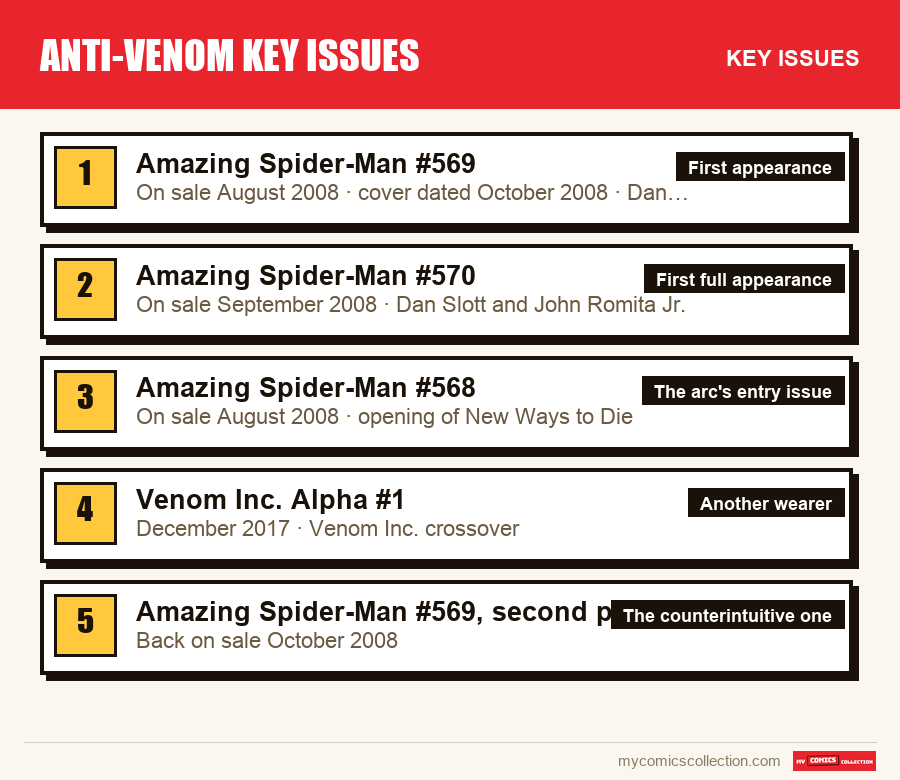
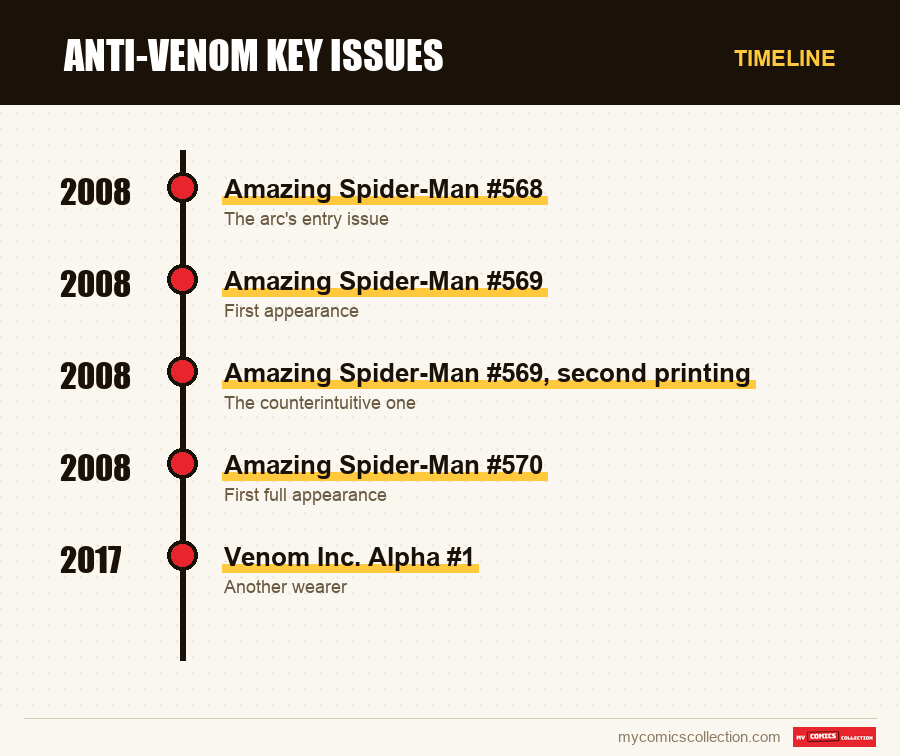
Anti-Venom first appears in Amazing Spider-Man #569, on sale in August 2008 (cover dated October 2008), written by Dan Slott and drawn by John Romita Jr., during the New Ways to Die arc that runs through issues 568 to 573. His first full appearance is in the next issue, #570. The character is born from an accident: Eddie Brock, cured of his cancer by the Lightforce powers of Martin Li, a.k.a. Mister Negative, sees his antibodies fuse with residual traces of the Venom symbiote. The result is a white symbiote, with no consciousness of its own, able to heal and to repel other symbiotes. From a collecting standpoint, it is a textbook case: a perfectly identified first appearance, but printed at such a level that its value hardly rests on raw scarcity.
There are two families of key issues, and they do not obey the same laws. In the first, that of the 1960s and 1970s, an issue is scarce because almost nobody kept it: copies were read, lent, thrown away, and chance did the sorting. In the second, that of the post-2000 era, an issue is scarce only if it is in flawless condition or carries a cover produced at a low ratio. The number of copies that came off the presses is no longer a limiting factor.
Anti-Venom belongs entirely to the second family, and that is precisely what makes him a good subject of study. The character is popular, his white design is instantly recognizable, his appearance is dated to the issue, and yet nobody will ever hunt for years for a copy of Amazing Spider-Man #569. They turn up. Plenty of them. So the question is not "where do I find it" but "which one do I buy, and in what condition".
This article does two things. First, it establishes what is verifiable about the character and his issues, without extrapolating. Then it explains the value mechanism specific to modern key issues, the one that applies to Anti-Venom just as much as to any other post-2000 first appearance.
What actually happens in Amazing Spider-Man #569
New Ways to Die is a six-part arc published in Amazing Spider-Man #568 to #573, written by Dan Slott and drawn by John Romita Jr. Its main plot has nothing to do with symbiotes, by the way: Norman Osborn arrives in New York with the Thunderbolts to hunt down Spider-Man, wrongly accused of murder.
Anti-Venom is a side effect of this story, and that matters for understanding the issue's status. Eddie Brock, eaten away by cancer, has separated from the symbiote and works at the F.E.A.S.T. aid center, run by a philanthropist named Martin Li. What Brock does not know is that Li is also Mister Negative, and that, on top of his corrupting Darkforce powers, he has healing Lightforce abilities. Li cures Brock's cancer. That treatment fuses Brock's white blood cells with the traces of Venom symbiote still present in his body.
The transformation is triggered when the Venom symbiote, then worn by Mac Gargan, tries to forcibly reunite with its former host. Brock's body reacts: it covers itself in a white symbiote, which he names Anti-Venom. This scene takes place at the end of #569, making it the character's first appearance. #570, published the following month, contains the first full appearance, with the character in action for most of the issue.
This distinction between appearance and full appearance is not a scholar's quibble. On the secondary market, both issues are sold claiming Anti-Venom, often with the same wording. Knowing which is which keeps you from paying a first-appearance price for an issue that is not one, and conversely from passing on #570 because you think it does not count.
Why Anti-Venom is unlike any other symbiote
The symbiote family has many variations, and most of them merely change the color and the mood. Anti-Venom does something else, on two specific points.
He has no consciousness. The original Anti-Venom symbiote has no mind of its own. It is a complete inversion of the principle that has defined Venom since 1988: the relationship of negotiation, dependence and manipulation between a host and a creature that wants something. Here, Brock keeps total control of his actions. Narratively, that changes everything, since the usual dramatic engine of the lineage disappears.
He heals. That is his memorable trait. The symbiote produces antibodies able to detect and neutralize in a human body whatever should not be there: diseases, parasites, toxins, substances, radioactive contamination. A second, mechanical property follows from it: it repels other symbiotes, whose presence is treated as an impurity to eliminate. A character whose power is to cancel symbiotes, in a franchise entirely built on symbiotes, is an extremely convenient plot tool, which explains why he is regularly brought back out.
That healing ability is also what ended the Brock version of the character. During the Spider-Island arc, in 2011, Brock sacrifices the Anti-Venom symbiote so that it can be converted into a cure for the spider virus contaminating New York. The original symbiote is destroyed on that occasion. A healing power has this particular quality: it can be spent once and for all.
The issues to target, in order of importance
The hierarchy below does not reflect price guides, which move, but each issue's place in the character's history. It is the only ranking that remains valid in ten years.
Amazing Spider-Man #569
The reference issue, and the only one the market will always identify. Anti-Venom appears at the end of the story, in Brock's transformation sequence. It is the third part of New Ways to Die. Two covers exist for this issue: the main cover by John Romita Jr. and an alternate cover by Adi Granov, noticeably less common.
Amazing Spider-Man #570
The issue where the character truly exists, over time, with his white design spread across entire pages. Collectors who favor the full appearance over the minimal one prefer it to #569, and that is not a marginal position: it is a permanent debate in the hobby.
Amazing Spider-Man #568
Anti-Venom is not in it, but it is the first chapter, the one that sets up the whole scheme. It was ordered noticeably more than #569, because it opened a highly anticipated arc and was a higher-priced format issue. For anyone who wants the complete story rather than an isolated piece, the whole arc is six issues, all easy to gather.
Venom Inc. Alpha #1
Anti-Venom did not remain Eddie Brock's property. During the Venom Inc. crossover, in late 2017, Flash Thompson ends up transformed into Anti-Venom, under the name Agent Anti-Venom, after facing Brock for control of the Venom symbiote. This issue is the first appearance of this second version of the character.
Amazing Spider-Man #569, second printing
Marvel reprinted #569 two months after its release, a sign that the first printing had been absorbed. Orders for this second printing number in the thousands of copies, against tens of thousands for the first. It is not the reference piece and never will be, but in terms of copy count it is the least common edition of Anti-Venom's first appearance.
The number that explains everything: how many copies are out there
Here is the data point most discussions about Anti-Venom ignore, and without which nothing makes sense. North American direct market order estimates, published month by month and available for the period, put the first printing of Amazing Spider-Man #569 at nearly 78,000 copies ordered in August 2008. #568 of the same month exceeds 93,000. #570, in September, approaches 82,500.
Let us put these numbers in perspective. These are orders placed by specialty retailers in a single market, excluding newsstands, export and subscriptions. The actual number of copies printed is therefore higher. And above all, these copies were not bought by children in 1965 who cut them up: they were bought in 2008, by an adult and mostly collector readership, in a channel where people bag their comics the very day they buy them.
Direct conclusion: there will never be a shortage of Amazing Spider-Man #569. Tens of thousands of copies exist, a very high proportion of them in near-mint condition. Anyone who presents this issue to you as rare is either mistaken or misleading you.
The second printing sheds light on the same phenomenon from the other end. It was ordered at an order of magnitude lower, a few thousand copies where the first counted tens of thousands. On a 1970 comic, such a gap would create a sought-after piece. On a 2008 comic, it creates a variant that few people chase, because demand concentrates on the edition identified as the true first.
The general rule for post-2000 key issues
What we observe with Anti-Venom is nothing specific to the character. It is the common law of all modern key issues, and it fits in one sentence: when supply is abundant, value no longer comes from the object's existence but from its quality and its identification.
This law breaks down into four practical consequences.
High grade sets the price. On a Silver Age issue, an average copy retains real value, because there are few of them, in all conditions. On a 2008 issue, the average copy is the norm, and it carries no premium. The price gap between a decent raw copy and a copy graded at the highest level reaches, on these issues, proportions the Silver Age does not know, because all the demand shifts to the minority of flawless copies. For a collector, that means choosing the condition is not fine-tuning: it is the main decision.
Variants replace natural scarcity. From the 2000s on, the publisher manufactures scarcity itself by producing alternate covers in reduced quantities. It has become the only real lever of scarcity on a contemporary issue. You still have to know what you are buying: an alternate cover is only valuable if its production volume is actually low, and that volume is never written on the object. Without that information, buying a variant amounts to a blind bet.
Later printings are a category of their own. Second printing, third printing, corrected editions: each is a distinct object, rarely more expensive, but not interchangeable with the first. Confusing them in your own inventory is the most widespread mistake on modern series, and also the easiest to avoid since the information is generally in the legal notice on the title page.
Value follows the character, not the issue. In the modern era, what moves a key issue is the character's news: his return in an ongoing series, his appearance in another medium, his promotion to protagonist. None of that is predictable, and none of those movements changes the number of copies in circulation. What rises on an announcement falls back when attention moves on, because supply has not budged by a single copy.
Applied to our subject, this grid gives a clear verdict. Amazing Spider-Man #569 is an issue to own if Anti-Venom interests you, to buy in the best condition your budget allows, and never to treat as an investment. It is exactly the same reasoning that applies to Amazing Spider-Man #300 from 1988, with one difference: #300 benefits from background demand twenty years older and a cover that has become a visual icon, two things #569 does not have.
Buying a modern key issue without getting it wrong
First decide which first appearance you want
Strict first appearance is #569. Full first appearance is #570. Both positions are defensible, but you need to pick one before looking at listings, otherwise the decision is made on what is available rather than on what you want.
Check the printing before the cover
On a reprinted issue like #569, the first thing to establish is not condition but edition. The title page carries the printing notice. A listing that says nothing and does not show this page is a listing to discard, no discussion.
Put your budget into condition, not quantity
This is the reversal specific to the modern era. On an abundant issue, three average copies are no more interesting than one, whereas a copy clearly superior in condition changes the nature of the piece. A single good copy is better than a collection of decent copies.
Examine the spine and the corners, not the cover
The defects that cost dearly on a 2008 comic are the ones that knock it out of the very high grades: a corner crease, a binding shift, the beginnings of whitening on the spine edge. On a recent comic, the buyer is not looking for a decent copy, but for a copy with no flaws, and those three zones decide.
Only get a copy graded if it is already excellent
Grading has a fixed cost, whatever the result. On a modern comic, a middling certified grade brings nothing, since middling copies abound in raw condition. The operation only makes sense if the copy has a real chance of reaching the top of the scale, which means inspecting it seriously beforehand.
Record the edition in your inventory, not just the issue number
"Amazing Spider-Man #569" is not enough information. "#569, first printing, main cover" is. It is the only way to know, five years from now, what you actually own, and to avoid buying the same thing twice.
Where Anti-Venom stands in fall 2026
The character's current status deserves to be laid out clearly, because it has become confusing for anyone who dropped off along the way.
The original Anti-Venom symbiote, the one from #569, no longer exists: it was consumed as a cure during Spider-Island in 2011. The version worn by Flash Thompson, born in Venom Inc. in late 2017, is on the other hand still active. During the Queen in Black crossover, published in July 2026, Flash Thompson appears under the identity of Agent Anti-Venom within a task force sent to fight Knull's armies beyond the solar system. So it is he, and not Eddie Brock, who wears the costume today.
Eddie Brock, for his part, has followed an independent trajectory. He was bonded with Carnage in a series devoted to him, then went through the Death Spiral crossover between February and May 2026, at the end of which he turns himself in to the police. During Queen in Black, held at the Raft, he is freed by the Sleeper symbiote and reunites with the Venom symbiote. In October 2026, a new Venom series picks up precisely from that reunion.
What this changes for a collector is simple and unintuitive: the Anti-Venom character is not a closed file. A design that periodically reappears in ongoing series keeps a background demand, far more than a character who appeared once and was forgotten. But that demand creates no scarcity. It only means that #569 will remain an issue people look for, in a stock that does not shrink.
Tracking the lineage in a collection
Anti-Venom poses a filing problem that characters with their own series do not. His key issues are scattered: two issues of Amazing Spider-Man in 2008, a crossover in late 2017 spread over several titles, event appearances in 2026. None of these issues has "Anti-Venom" on its cover.
In the app, three habits make this scatter manageable. Record the exact edition, not just the issue number, for every copy affected by a second printing. Enter the condition at the time of purchase, while you have the object in hand, because it is the information that determines value across the whole modern era and the one that is hardest to reconstruct from memory. Finally, use the missing list to close the full arc if you started with the two key issues: New Ways to Die is six issues, all common, and reading it whole costs little.
To go further into the lineage, two reads complement this one without repeating it: the overview of modern Venom key issues, which covers the 2018 run and the arrival of Knull, and the Venom reading guide, which places New Ways to Die in the general order of the stories. On the question of editions and alternate covers, the Venom variants file details what sets one printing apart from another.
Should you buy Amazing Spider-Man #569?
Yes, if Anti-Venom interests you as a character or if you are building the symbiote lineage methodically. It is an identified, findable first appearance, whose narrative importance will not be contested. Nothing justifies doing without it.
No, if you buy it hoping for a gain. The number of copies in circulation structurally rules out that scenario, except for copies at the top of the condition scale, which are precisely the ones you do not find by chance and do not pay an ordinary copy's price for.
The right way to approach a modern key issue is therefore closer to buying a book than to making an investment. You choose the object for what it tells, you take it in the best condition within reach, you check that it is indeed the edition you think it is, and you record it properly. The rest is not up to us.