
In short
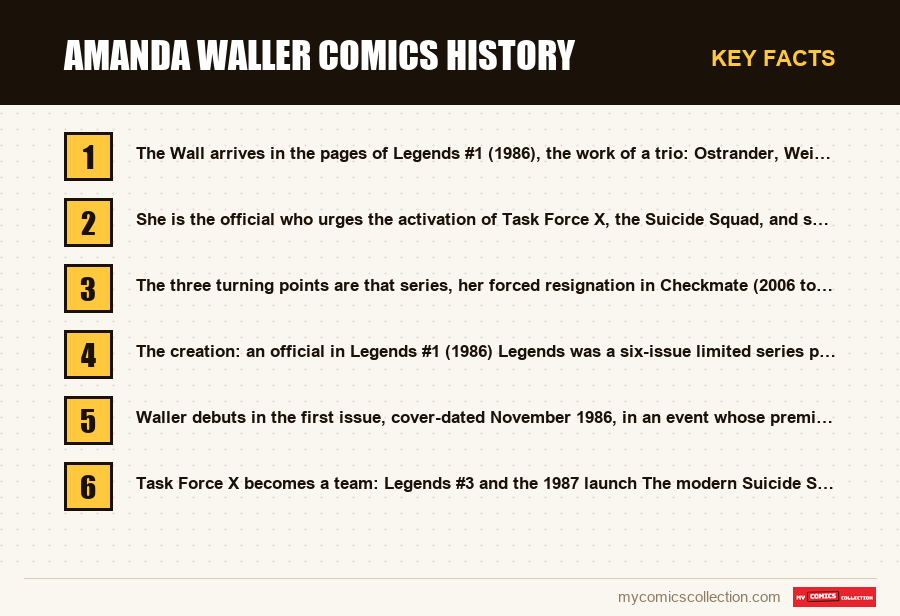
The Wall arrives in the pages of Legends #1 (1986), the work of a trio: Ostrander, Wein and Byrne. She is the official who urges the activation of Task Force X, the Suicide Squad, and she runs it from Suicide Squad (1987 to 1992), written by Ostrander with Kim Yale. The three turning points are that series, her forced resignation in Checkmate (2006 to 2008), and her turn into the main antagonist of Absolute Power (2024).
Amanda Waller has no powers and no costume, yet she holds a place among DC's most durable characters, because every era that has used her has found a different kind of authority to give her.
Credits, issue numbers, run lengths and years in this chronology were verified one by one, with months given only when confirmed; the commentary on how each stage reshapes Waller, and the buying method at the close, are our own reading.
The creation: an official in Legends #1 (1986)
Legends was a six-issue limited series published from November 1986 to May 1987, with twenty-two tie-in chapters in other titles. John Ostrander plotted it, Len Wein scripted it, John Byrne penciled it and Karl Kesel inked it. Waller debuts in the first issue, cover-dated November 1986, in an event whose premise is that Darkseid wants to turn humanity against its heroes.
The detail that matters is the job she is given. In the story, officials activate Task Force X at her urging, and the Suicide Squad destroys Brimstone, the fire elemental Darkseid had sent against the Detroit-based Justice League. She is therefore introduced as a person who solves problems that the heroes cannot, which is a very different pitch from a hero or a villain. Her given name, Amanda Belle Waller, and her maiden name, Blake, belong to a character sheet that grows later; at birth she is a role more than a biography.
Task Force X becomes a team: Legends #3 and the 1987 launch
The modern Suicide Squad itself takes the stage in Legends #3 (1987), the chapter titled "Send For... the Suicide Squad!". That issue is useful to collectors who want the origin of the team and of the Waller era in one place, because it shows the program at the moment it stops being a rumor and becomes an operation. The six-issue event also acts as a launch pad: its listed spin-offs include a Justice League title by Keith Giffen and J. M. DeMatteis, Shazam!: The New Beginning, the Flash ongoing series and the new Suicide Squad series.
Waller's role in Legends is mostly administrative, and that is part of the design. The character that readers know needed a book of her own, and DC gave it to her the next year. Waller's Squad is described as the third incarnation of Task Force X, which she developed after learning of the earlier versions, so her creation is also a reinvention of an older idea.
The Ostrander and Yale years: Suicide Squad (1987 to 1992)
The first Suicide Squad series ran monthly from 1987 to 1992, with 66 issues plus an Annual and the Doom Patrol and Suicide Squad Special #1. Ostrander wrote it, with Kim Yale co-writing many issues, and Luke McDonnell penciled much of the early run. Karl Kesel is the inker credited on the run.
This is where the character gets her shape. Waller directs the Squad from Belle Reve, the prison that doubles as the team's base, and the stories use that setting to keep her under pressure from convicts, from superiors and from other agencies. She is the person who needs the team to succeed and cannot trust it, a position that produces drama in almost every issue. The nickname "the Wall" belongs to this period of her career and says something about her function: she absorbs attacks from every direction and does not move.
If you want a single block to understand why the character lasted, this run is the answer, and it is the part of her history that later writers return to when they want to reset her. Our Suicide Squad reading guide orders the relaunches that followed.
Checkmate and the Janus Directive (from 1988)
Waller's story also runs outside the Squad's own pages. The Agency she set up as a branch of Task Force X under Valentina Vostok is the precursor of Checkmate, and Checkmate itself debuts in Action Comics #598 (1988), created by Paul Kupperberg and Steve Erwin. Their Checkmate! series ran 33 issues from April 1988 to January 1991.
The crossover that connects the two organizations is the Janus Directive. It pits Checkmate, the Suicide Squad and Project Atom against each other while Kobra manipulates them. Checkmate loses at least 38 Knight agents and its headquarters in Shelby, Virginia, and Sarge Steel replaces Waller as head of the organization. Read as a career event, it is the first major reversal of her story: the woman who runs the program loses the command that she had built. Her character grows through setbacks like this rather than through victories.
Later volumes and the fall of the Wall (2001 to 2008)
The Suicide Squad name returns in new volumes. Volume 2 (2001 to 2002) was written by Keith Giffen with art by Paco Medina and ran 12 issues. Volume 3 (2007 to 2008) was written by Ostrander again and ran 8 issues with art by Javier Pina. These are the stretches where the title keeps the premise, and the reuse of Ostrander for the third volume shows how closely the concept is tied to its original writer.
The decisive Waller story of the period is in Checkmate volume 2, which ran 31 issues from June 2006 to December 2008. Waller serves as the UN-assigned White Queen in #6 and is implicated in several schemes across #5, #7 and #18, and the "Fall of the Wall" arc in #18 to #20 ends with Waller forced to resign once the other Royals gather evidence against her. The writers credited on the collected stories include Greg Rucka, Nunzio DeFilippis and Christina Weir. It is her second major loss of command, and it clarifies the pattern: Waller is powerful because she builds institutions, and she is vulnerable because institutions turn on their builders.
Do you collect this series?
Track what you own, what you are missing and what your collection is worth. 7-day trial.
Start my trial →
The New 52: A.R.G.U.S., a new Justice League and Black Manta (2011 to 2014)
With the 2011 reboot, volume 4 of Suicide Squad ran 32 issues under Adam Glass, with art by Federico Dallocchio and Ransom Getty. In this continuity Waller commands the Squad and is shown as director of A.R.G.U.S. The bigger story is her expansion into other parts of the line: Justice League of America volume 3 #1 shows her forming a separate Justice League of America, and Justice League of America #7.1 shows her contacting Deadshot.
In Forever Evil #1, Waller tries to recruit Black Manta at Belle Reve. That detail places her prison in a crossover event rather than a single series, which is a good example of how the character changes status in the New 52: she is no longer only the director of one book but a presence that surfaces in the line's major stories. A second title in the same window, New Suicide Squad (2014 to 2016), written by Sean Ryan, ran 22 issues.
Rebirth: the shot, the fake and Rob Williams (2016 to 2019)
Suicide Squad: Rebirth (August 2016) shows Waller recruiting Rick Flag, and the new volume 5 by Rob Williams runs 50 issues from 2016 to 2019. Its central twist is the character's apparent death: Suicide Squad #11 shows her shot and killed, #12 confirms the death, and #15 reveals she faked it with Deadshot and Enchantress.
The faked death is a useful marker of how the writers see her. A character who is hard to remove from the board becomes more dangerous when the other characters think she is gone, and the reveal confirms that she is the planner the readers assumed. Tom Taylor's Suicide Squad volume 6 followed, with art by Bruno Redondo, and ran 11 issues from 2019 to 2020. Our history guide for the team's runs compares these volumes.
The antagonist: Absolute Power (2024)
Absolute Power, the event that concluded the Dawn of DC initiative, has Mark Waid writing and Dan Mora drawing, with Alejandro Sánchez on colors. The four-issue main series ran from July 3 to October 2, 2024, and is joined by Task Force VII (seven issues), Origins (three issues), preludes and tie-ins. Her road to the event passes through Titans: Beast World #6, and Absolute Power #4 closes it.
Waller is the main antagonist. Seizing the Hall of Justice, she sets up a Bureau of Sovereignty whose purpose is to discredit the Titans and the League, while her Task Force VII, an army of Amazo robots, strips most heroes on the planet of their powers and locks them up. The Brainiac Queen, whom she recruits, creates fake videos that frame heroes as violent, and Superman is shot down in the first issue. Her plan collapses when Green Arrow, secretly working against her, shoots a device that shuts down Task Force VII and restores the heroes' powers. She ends up imprisoned, with Dreamer erasing her memory of the heroes' identities, and she is held in Belle Reve, the prison she once ran. It is the most complete reversal of her history, from the official who commands the villains to the villain whom the heroes defeat.
The key issues across her history
- Legends #1 (1986): her debut, plotted by Ostrander, scripted by Wein and penciled by Byrne.
- Legends #3 (1987): "Send For... the Suicide Squad!", where the modern Squad takes the stage in the same series that introduced her.
- Suicide Squad #1 (1987): the ongoing series that makes her the director of the team, with Ostrander and Luke McDonnell.
- The Janus Directive crossover: Checkmate, the Squad and Project Atom clash under Kobra's manipulation, and Sarge Steel replaces her.
- Checkmate volume 2 #18 to #20 (2006 to 2008 series): the "Fall of the Wall" arc ends with her forced resignation.
- Suicide Squad volume 5 #11, #12 and #15 (2016 series): her apparent death and the reveal that she faked it.
- Absolute Power #1 to #4 (2024): Mark Waid and Dan Mora make her the main antagonist.
How to collect Amanda Waller
Waller has no series of her own, so a collection is built around the Suicide Squad, with side entries for the Checkmate and event stories. A practical order starts with the 1987 series, the 66-issue core, which is easier to assemble by collected volumes than by single issues, then adds Legends for the origin, the Janus Directive for the crossover and Checkmate volume 2 for the resignation arc.
Watch two numbering traps. The Suicide Squad has been relaunched with a new first issue at least six times since 1987, so always check the volume and the year before buying, and match the issue to the era. The second trap is that Legends is a limited series of six issues with tie-ins in other titles, so a Waller reader should buy the main six and treat the tie-ins as optional. For a ranked route, the Waller starter guide sorts her stories by ease of entry, and the blog collects related timelines.
Frequently asked questions
Her debut is Legends #1, dated November 1986, a six-issue DC event from Ostrander, Wein and Byrne. In that story, officials activate Task Force X at her urging, and the Suicide Squad destroys Brimstone. Her real development begins with the Suicide Squad series launched in 1987.
John Ostrander, Len Wein and John Byrne are the creators credited for her debut in Legends. Ostrander plotted the series, Wein scripted it and Byrne penciled it. Ostrander then wrote her in the ongoing Suicide Squad series, with Kim Yale co-writing many issues of its 66-issue run.
Task Force X is the official name of the Suicide Squad program. Waller's version is described as the third incarnation of the idea, which she developed after learning of the earlier teams. In the 1987 series she directs it from Belle Reve, the prison that serves as the team's base.
She is written as both. In the 1987 series she is a director who manipulates her team but protects her program. In Absolute Power (2024) by Mark Waid and Dan Mora she is the main antagonist, depowering and capturing most of the world's heroes before Green Arrow and Dreamer help bring her down.
Begin with the first volume of Suicide Squad (1987 to 1992) by John Ostrander and Kim Yale, since it defines her. Then read the Janus Directive for her fall from command, Checkmate volume 2 for her resignation, and Absolute Power (2024) for her turn as the heroes' adversary.
Found a Legends #1 or an early Suicide Squad issue in your boxes? Get a market-based estimate in seconds.
Estimate my comic