The X-Tinction Agenda reading order runs nine parts, from November 1990 to January 1991: Uncanny X-Men #270 to 272, New Mutants #95 to 97 and X-Factor #60 to 62, in that rotation each month. Chris Claremont and Louise Simonson wrote it; Jim Lee, Rob Liefeld, Jon Bogdanove and Guang Yap drew it. Read Uncanny X-Men first, then New Mutants, then X-Factor, month after month.
Three mutant teams, an island where slaves are manufactured from children carrying the X-gene, and nine single issues you must not shuffle: X-Tinction Agenda is a crossover from the era when Marvel was multiplying its mutant titles, and it remains a handy entry point to Genosha. Its mechanism is simple, but the rotation among three titles takes a little method so you don't read a chapter before the one that explains it.
As always in this guide, only verified facts (creators, issue numbers, dates) are stated as fact; the analysis is ours, with no reproduction of protected art or dialogue.
What to read first
The story can be followed without heavy preparation, but three reference points change the reading. They are ranked from most useful to most optional.
- Uncanny X-Men #246 to 251: the sequence after which the X-Men find themselves scattered to the four corners of the globe. It is the logical starting point for understanding why the team is spread out when the crossover begins.
- Uncanny X-Men #235 to 238: Genosha appears in issue 235 (October 1988), created by Chris Claremont and Rick Leonardi. The 2011 oversized hardcover and the 2016 trade paperback add these four issues ahead of the saga.
- X-Factor #1 (February 1986): Cameron Hodge appears there, created by Bob Layton and Jackson Guice. He plays a supporting role: the team's public relations agent, Angel's former roommate, who turns out to be working against it. This issue isn't essential, but it shows where the character comes from.
To place these reference points in the overall X-Men thread, see our X-Men reading guide: it shows which titles to follow around 1990. If you are short on time, open Uncanny X-Men #270 directly.
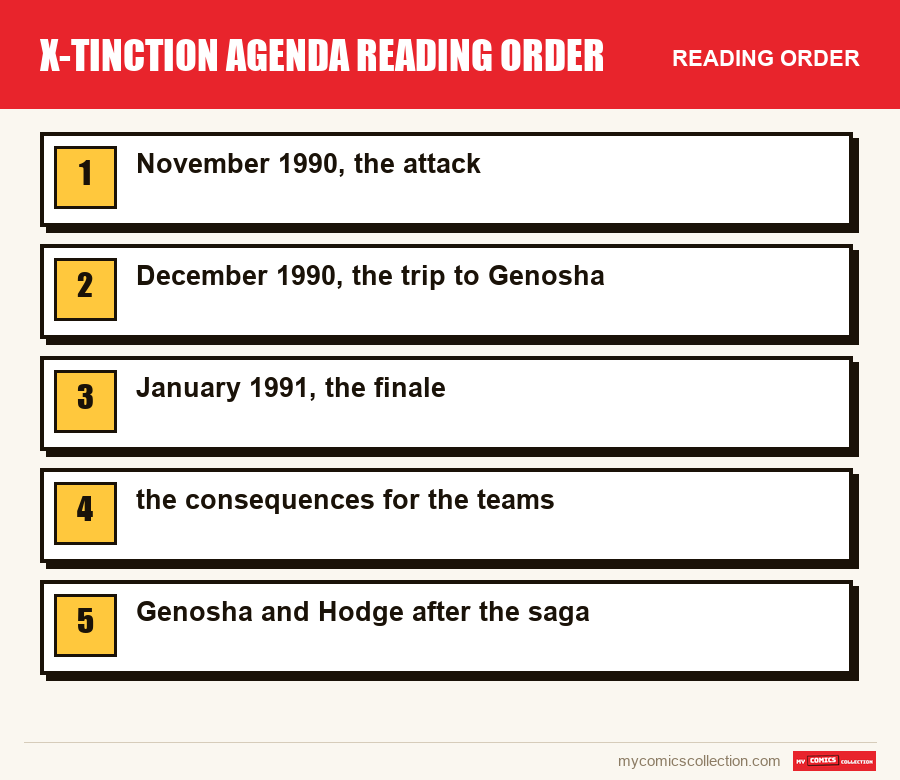
Phase 1: November 1990, the attack
The crossover opens with three single issues, dated November 1990: Uncanny X-Men #270, New Mutants #95 and X-Factor #60. The cover of Uncanny X-Men #270 is by Jim Lee.
The starting situation is as follows. Genoshan magistrates, backed by the cyborg Cameron Hodge, attack the X-Men's mansion and kidnap Storm, Warlock, Boom Boom, Rictor and Wolfsbane. All three teams are hit by the same offensive, which explains why three titles share the story. Read the month's three single issues before moving on to the next.
Genosha is depicted in this story as a country whose prosperity rests on mutant slaves, the "mutates," who form the backbone of its economy. Keep this in mind: it explains why the island becomes a recurring setting in the mutant titles.
Phase 2: December 1990, the trip to Genosha
The second month repeats the same rotation: Uncanny X-Men #271, New Mutants #96 and X-Factor #61, all dated December 1990.
The X-Men, X-Factor and the New Mutants travel to Genosha. There they fight the magistrates, among them Havok, who has amnesia. Havok's amnesia comes from an earlier sequence, the Siege Perilous, which wiped his memory. The heroes are beaten there: it is the darkest stage of the crossover, the one where you gauge the unfavorable balance of power.
From the reader's point of view, the difficulty is the scattering: you have to keep track of who is captured, who is resisting, who joins whom. A small hand-drawn chart helps: one column per team, one row per single issue. Note, for example, that Cyclops is captured and then handed over to Hodge, that Psylocke, Wolverine and Jubilee set out to free Rictor and Boom Boom, and that Jean, Cable, Gambit, Sunspot and Forge bomb the Citadel before being captured in turn. The Genoshan engineer David Moreau, for his part, stands against Hodge. These crisscrossing movements are spread over the three titles, and a chart keeps you from mixing them up. Our page on X-Men crossovers shows how this rotation mechanic returns in other events.
Phase 3: January 1991, the finale
The last month closes the story with Uncanny X-Men #272, New Mutants #97 and X-Factor #62, dated January 1991.
Spoiler alert: Warlock dies during a power transfer to Hodge, and Wolfsbane, conditioned by the mutate process, is enslaved. Hodge then perishes in the Citadel, which Rictor brings down on top of him; his severed head survives, however, thanks to the immortality promised him by N'astirh, the Limbo demon from the Inferno crossover. Havok and Wolfsbane stay on Genosha. The heroes hold a funeral for Warlock and scatter his ashes on Cypher's grave.
This last month is where the three titles converge on a single outcome: read it in one go, in the order Uncanny X-Men, New Mutants, X-Factor, so that X-Factor's concluding chapter arrives after the ones that set it up.
One last reading precaution: the ending mixes very different fates, from Warlock's funeral to Havok and Wolfsbane's decision to stay put. Take a break after X-Factor #62 before opening another mutant title, so you can measure what has changed for each team. That comparison, more than the action, is what gives the saga its meaning and sets up the next phase.
Phase 4: the consequences for the teams
The crossover leaves several lasting effects. The loss of Wolfsbane, Rictor and Warlock kicks off the New Mutants' transition into X-Force. The X-Men featured form the official lineup that followed the breakup of the Australia-based team. Finally, the mutate process psychically links Wolfsbane to Havok, a thread that is picked up after their arrival in X-Factor.
To follow the transition into X-Force, our page on the X-Force #1 (1991) cards gives the collecting follow-up.
Do you collect this series?
Track what you own, what you are missing and what your collection is worth. 7-day trial.
Start my trial →
Phase 5: Genosha and Hodge after the saga
Genosha then goes through several events. X-Men volume 2 #87 (April 1999) sees the UN hand sovereignty of the island over to Magneto. New X-Men #115 (2001) shows Cassandra Nova's Sentinels ravaging the island and killing most of its inhabitants. Excalibur volume 3 #6 (December 2004) follows the reconstruction led by Magneto and Xavier. In 2009, the Necrosha event resurrects the island's millions of dead through the Technarch virus.
Cameron Hodge, for his part, reappears in a storyline where he turns out to have merged with the Phalanx; Purifiers later find his remains in the Himalayas. These sequels are optional: they serve readers who want to follow the island or the character over the long haul.
Finally, in 2015, a new mini-event called X-Tinction Agenda was part of Secret Wars, on the Battleworld domain called X-Topia.
Beyond the saga, the New Mutants and X-Factor teams resume their course in their respective titles. If you follow one of them onward, simply continue the numbering after the January 1991 chapter: no other reading is needed to move on.
The tie-ins you can skip
Here again, the notion of a tie-in is thin: all nine parts carry their own series numbering and take part in the story. None can be dropped without losing a link. What is optional is what surrounds the story.
- Uncanny X-Men #235 to 238: useful for placing Genosha, unnecessary for following the saga itself.
- X-Factor #1: it introduces Cameron Hodge, but the saga reads fine without it.
- The late Genosha sequels (from X-Men #87 to Necrosha): they extend the setting and don't explain the 1990 saga.
- The Secret Wars mini-event (2015): a nod carried by a different editorial context.
If you are after a short path, read Uncanny X-Men #270 to 272, then fill in with the other two titles; but you will lose important threads, notably those of Warlock and Wolfsbane, which run through New Mutants.
Single issues or trade paperbacks: how to read it
For an event split across three titles, a collected edition is especially handy, since the rotation among three series is a pain to reconstruct by hand. Several editions exist.
- X-Men: X-Tinction Agenda in trade paperback (224 pages, 2001) collects Uncanny X-Men #270 to 272, New Mutants #95 to 97 and X-Factor #60 to 62.
- The 2011 oversized hardcover (304 pages) and the 2016 trade paperback (328 pages) add Uncanny X-Men #235 to 238 ahead of the saga.
- The New Mutants Epic Collection volume 8 (504 pages, 2022) includes the saga in the middle of other issues.
For single issues, work in three steps: first gather the nine issues, file them by month, then within each month in the order Uncanny X-Men, New Mutants, X-Factor. Then read each month in one sitting. This method is safer than sorting by title, which would have you read all three Uncanny X-Men back to back before learning what happens to Warlock in New Mutants.
A storage tip: keep the nine single issues together in one box, separate from your regular runs, with a sheet listing the order of the nine parts. That way you can find the missing chapter in seconds, and you will avoid rebuying an issue you already own when you complete a run of Uncanny X-Men, New Mutants or X-Factor.
The key issues to know
Between November 1990 and January 1991, the nine Genosha chapters came out at the height of the speculator fever, and surviving copies remain plentiful. Without putting forward a figure, here is how to approach the key issues.
- Uncanny X-Men #270 (November 1990): the crossover's opener, with a Jim Lee cover.
- New Mutants #95 (November 1990): the opening chapter on the New Mutants side, a natural landmark for collectors of that series.
- X-Factor #62 (January 1991): the crossover's closing chapter.
- New Mutants #97 (January 1991): the last chapter on the New Mutants side, before the team's transition into X-Force.
- Uncanny X-Men #235 (October 1988): the first appearance of Genosha, useful to collectors who follow the location.
To place a November 1990 or January 1991 copy, match it against a single issue with the same cover and the same condition, looking at the spine and the corners, then check several completed sales.
Recap: the complete order
- Optional prep: Uncanny X-Men #235 to 238 and #246 to 251
- Uncanny X-Men #270 (November 1990)
- New Mutants #95 (November 1990)
- X-Factor #60 (November 1990)
- Uncanny X-Men #271 (December 1990)
- New Mutants #96 (December 1990)
- X-Factor #61 (December 1990)
- Uncanny X-Men #272 (January 1991)
- New Mutants #97 (January 1991)
- X-Factor #62 (January 1991)
- Optional sequels: Genosha in X-Men #87 (1999), New X-Men #115 (2001), Excalibur #6 (2004), Necrosha (2009)
Frequently asked questions
Read the nine parts month by month: Uncanny X-Men #270, New Mutants #95 and X-Factor #60 in November 1990, then #271, #96 and #61 in December, then #272, #97 and #62 in January 1991. Each month follows the same rotation among the three titles.
The crossover was written by Louise Simonson and Chris Claremont. Jim Lee, Rob Liefeld, Jon Bogdanove and Guang Yap drew it. Jim Lee in particular did the cover of Uncanny X-Men #270.
Nothing is required. The most useful reference point is Uncanny X-Men #246 to 251, after which the X-Men are scattered. To discover Genosha, Uncanny X-Men #235 to 238 are reprinted in the 2011 and 2016 collected editions as an introduction to the saga.
Yes, several. A 2001 trade paperback collects the nine parts. The 2011 oversized hardcover and the 2016 trade paperback add Uncanny X-Men #235 to 238. The New Mutants Epic Collection volume 8 (2022) also includes the saga within a broader period.
The loss of Wolfsbane, Rictor and Warlock kicks off the New Mutants' transition into X-Force, and a psychic link ties Wolfsbane to Havok. Genosha then remains a recurring location, until its devastation in New X-Men #115 in 2001.
Do you own single issues from the 1990 saga? Get them appraised before completing your mutant runs.
Appraise my comic