X-23 existed under her own name and under that of Wolverine, which she took over. Its booklets are therefore divided between several series titles, and a search carried out on “X-23” alone only brings back part of it. The statement from August 30, 2026 shows it in black and white: five advertisements taken in a row carried four different series titles for one and the same character. Look for both names, and write down the exact title of the series on each line of your inventory: the character's name isn't enough to stash a copy.
There is a category of characters that inventories list poorly, and it is not a question of the collector's rigor. It's a question of identity. When a character takes on the name of another (takes his mask, his title, his function) the publisher names his series after the predecessor, because it's that name that sells. The character continues to exist under his own name in other publications. Result: its determining fascicles are found under at least two names, sometimes more, and no single search brings them together.
X-23 is the textbook case. She has had series to her name. She also bore the name Wolverine, and the series which tells about this period is called All-New Wolverine. A collector who types “X-23” in a search bar thinks he is searching his collection; he is actually questioning a fraction of his collection. A collector who types “Wolverine” brings up thousands of booklets, the vast majority of which do not concern her. Between the two, there is no magic query: there is a classification method to ask once and for all.
What a reading taken on a single day shows
On August 30, 2026, a « X-23 All New Wolverine 1 » query on a general auction site in the American market returned 154 unverified advertisements. The minimum requested was $1.00, the median was $20.49, and the maximum was $143.83. The copies verified by an organization, counted separately because they do not belong to the same market, formed a set of 27 advertisements: minimum $50.00, median $199.99, maximum $415.00.
Two precautions before going any further. These amounts are what sellers claim at the time of the statement, not what buyers have agreed to pay. A displayed price is an offer; as long as no transaction has validated it, it says nothing about the real level of exchanges. And because this reading was taken on a single date, it does not describe any movement: it is impossible to read an increase, a decrease or a trend. A photo is not a film. The maximum at $143.83 is the hope of an isolated seller, not an observed price; the maximum at $415.00 among verified copies has exactly the same status.
The interesting figure is not any of these amounts. This is the fact that 154 ads respond to a query that mixes two character names. A set of this size for a single issue should be consistent. It is not, and the details of the announcements noted explain why.
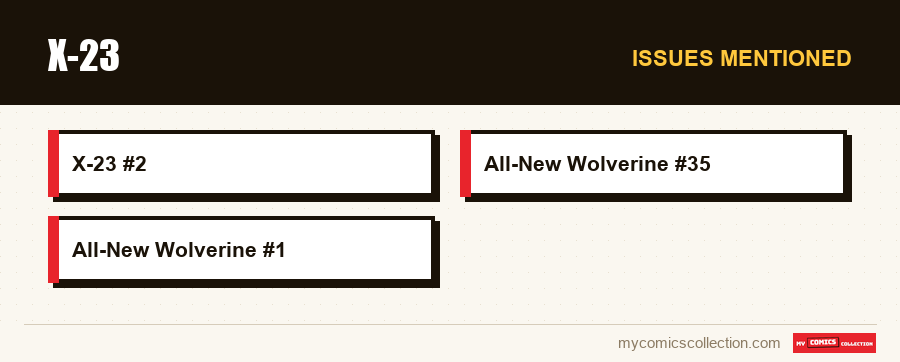
Five announcements, four series titles, one character
A series with the character's own name
“X-23 #2 BY MARVEL COMICS 2018 $1 COMIC SALE + BONUS”, listed at $1.00. The series title here is the name of the character itself. This is the only one of five listings that a search for "X-23" alone would reliably return.
The name used as the series title
« ALL-NEW WOLVERINE (2017 Marvel) #18 VF/NM X-23 X-Men », at $2.24, and « All-New Wolverine #35 [...] 2018 [...] X-23 [...] Last Issue Finale », at $2.54. The title is named after the predecessor; « X-23 » only appears in keywords added by the seller.
The booklet which brings together the two bearers
« Generations Wolverine and All-New Wolverine #1 X-23 [...] 2017 », at $2.54. Its title names both bearers of the name at once. It does not fully belong to either of the two series: it is a category in its own right.
A fourth title, even different
« WEAPON X (2017 Marvel) #14 [...] Wolverine Old Man Logan X-23 », at $2.77. Neither the character's own name, nor the name taken: a third title, where the character appears without the series being dedicated to him.
Five announcements taken in a row, four distinct series titles, a single character. This is not a statistical curiosity, it is the very structure of the bibliography of this type of character. None of these four entries can be correctly classified from the name "X-23": three of them do not have it in their series title, and the fourth does not have "Wolverine". An inventory indexed on the character produces four lines which are similar and which nevertheless do not designate the same editorial object.
The regular median of $20.49 is for a set that mixes at least four different sets. A central value calculated on heterogeneous objects does not describe any of them: it describes the mixture, which is the price of nothing.
On this type of character, you have to measure series by series, or give up measuring. A reassuring median calculated on a poorly divided set is more misleading than the absence of a figure, because it has the appearance of a result.
Why is a character's name not a ranking criterion?
The confusion comes from a shortcut that seems obvious: we collect a character, so we arrange by character. But the unit you buy, resell, and protect is not a character: it's an issue, and an issue belongs to a numbered series. The character crosses the series; the series limits the booklet. A number 18 only exists in relation to a title: the 18 of All-New Wolverine and the 18 of any other title have only the number in common.
When one character takes the name of another, this distinction ceases to be theoretical. The name of the character becomes a moving attribute, it changes over the course of editorial relaunches, while the title of the series remains fixed once printed. Arranging by the moving and hoping to find the fixed, is to guarantee yourself holes. The good reflex is the opposite: the series is the key, the character is an additional filter.
This logic applies to the entire mechanics of the names used. We find it as soon as a coat changes shoulders, and it explains a good part of the misunderstandings around Wolverine key numbers: depending on the bearer of the name we are thinking of, we are not talking about the same issues, nor the same series, nor the same market. The word "Wolverine" in a title doesn't say who's inside.
There is an immediate practical consequence. If you put together a search list, it should contain both names, not as two variations of the same term: as two separate entries, each with its expected series titles. A query on the proper name misses the period when the character published under the name taken up: that is to say, in this case, alongside an entire series, from its first issue to its last.
The six pitfalls that cause booklets to be missed
Searching on a single name
Querying “X-23” only brings up series that have that name in title. The entire period published under the named name escapes the request. Systematically search for the two names, separately, and compare the two lists obtained.
The year confused with the series
The advertisements noted mention 2017 and 2018 for different titles. The year is used to remove ambiguity between homonymous relaunches, it does not replace the title. Two issues from the same year may belong to two unrelated series.
Keywords taken for the title
In “ALL-NEW WOLVERINE (2017 Marvel) #18 VF/NM X-23 X-Men”, three names jostle: only one is the title of the series. The others are words added by the seller to be found. Isolate the title before entering the line.
The batch that hides its contents
A $1.00 listing advertised with a “bonus” does not accurately describe what is being delivered. Until the exact contents are known, the inventory line remains incomplete: write down what you received, not what the title promised.
The number without its title
Writing “#18” in an inventory without the series title is the number one cause of invisible duplicates. The same figure exists in each of the four series noted. The number only has meaning when attached to the exact title.
The crossover put away by force
A booklet which brings together the two bearers of the name finds itself arbitrarily classified under one or the other, depending on the mood of the moment. He then changes place each time the list is revised, and ends up bought back by mistake.
The booklet which brings together the two bearers of the name
“Generations Wolverine and All-New Wolverine #1” deserves attention, because it represents an entire category that inventories poorly manage. This is not a series number in the character's own name. It is also not an issue of the series with the same name. It is an autonomous title, with its own numbering, whose raison d'être is precisely to bring face to face the one who bore the name and the one who took it up.
Classifying it under one of two names is like choosing a side arbitrarily. Six months later, we no longer remember the choice made, we search under the other name, we find nothing, and we buy again. The only treatment that holds is to recognize it as its own series title, as it is printed, and to add a note indicating that it concerns the two characters. It will then appear in both searches, without falsely belonging to either series.
This category is not anecdotal. Each time a name passes from one bearer to another, the publisher sooner or later produces the booklet that brings them together, because this is the scene that the readership expects. Anyone who follows a character through a name change will eventually come across one. You might as well have planned a place for it in advance, rather than improvising it at the time of entry.
Note in passing that at $2.54 displayed, this issue is among the least expensive ads in the survey: at the same level as the last issue of the series. No conclusion to draw on its value: two isolated announcements, a single day, amounts claimed. What we can say is simply that nothing in these displayed prices indicates to the collector the editorial particularity of the issue. The ranking is not deduced from the price.
Collecting this series?
Track what you own, what you are missing and what your collection is worth. 7 day trial.
Start my trial →The last number in a series is a mark, and it is indicated
The ad "All-New Wolverine #35 [...] Last Issue Finale" contains classification information, slipped by the seller in the middle of its keywords: this issue is the last in its series. It's the kind of detail that you read without noting it, even though it's worth more than the price displayed next to it.
A final issue closes the collection. He transforms an open quest, “I collect this series”, into a finite objective: from such and such an issue, so many issues, that's what remains to be found. Without this terminal, you never know if you have finished, and you continue to monitor announcements for numbers that do not exist. With it, you immediately calculate what remains to be done, and you know when to stop looking.
The first number plays the same role at the other end. Together they define the interval. It is this interval, and not the name of the character, which allows us to say that a series is complete. On a person who has published under two names, this means two distinct intervals to complete, plus isolated issues which belong to neither.
The benchmark also applies to the purchasing strategy. When you know how many numbers are missing, you can decide to buy them in groups or one by one, and choose between patience and shipping costs. Collectors looking to buy Wolverine without leaving your budget behind above all benefit from knowing exactly which titles and which numbers they are pursuing: the precision of the need costs less than permanent vigilance on searches that are too broad.
What to note on each inventory line
The exact title of the series, as printed. Not "X-23" as a convenient shortcut, but the full title of the title to which the booklet belongs: the one which distinguishes a series with the character's own name from a series with the name repeated, and these two from an autonomous title like the one which brings together the two bearers. It is the only data that makes a number unambiguous. Without it, a “#18” designates nothing: the August 30 statement shows four titles capable of carrying the same number.
The name under which the character appears in this issue. Proper name or name taken, the information is distinct from the series title and is not always deduced from it. It allows you to find the entire period concerned at once, whatever the title under which it was published, and to understand at a glance why an issue that you were looking for under one name was dormant under the other. This is the field that fixes the character search.
The position of the number in its series. First, last, or current. The seller of #35 explicitly indicated that this was the last number: this is boundary information, to be recorded immediately or risk losing it. A series of which you know the first and last number becomes a quantified objective; a series without limits remains an endless surveillance, and you will never know if it is complete.
The presence of other characters, when it motivates the purchase. The booklet which brings together the two bearers of the name, or that of a third party title where the character is only one speaker among others, was not purchased for the same reason as a current issue of its own series. Note this reason at the time of purchase, while it is clear: in a year, the inventory line will no longer say why this issue is in a collection dedicated to this character.
The price paid, shipping included. The total amount actually released, not the price displayed in the ad. This is the only value of which you are certain, unlike all the amounts claimed that you will come across afterwards. Accumulated line by line, it gives you the only reliable price history you will have on your own collection, and it saves you from comparing your actual spending to requests from sellers who have never found a buyer.
Measure series by series, or not measure
Let’s look back at the median of $20.49. It is calculated on 154 advertisements which cover at least four series titles, very different rank numbers, and booklets, some of which are not dedicated to the character. The dispersion confirms this: from $1.00 to $143.83, the difference is such that no central value can represent the whole. This is not a defect in the measurement, it is a defect in the measured perimeter.
The resulting rule is simple. Before calculating anything, break it down by series title. If the division leaves less than ten ads in a category, give up trying to derive a price level: such a small number does not mean anything stable, and the slightest eccentric ad shifts the central value. It is better to note “too few announcements to conclude” than to enter a figure to which you will then give a confidence that it does not deserve.
The same reasoning requires keeping verified copies away. The 27 verified ads in the survey, with their median at $199.99, are not comparable to the 154 ordinary ads: going through a verification organization changes the nature of the item offered, and the two sets do not have the same buyers. Mixing them together would produce an average that would not correspond to any real market.
Finally, remember what a single statement cannot do. It shows no evolution. He does not say whether the amounts claimed are rising, falling or stagnating, because he only has one point of comparison: himself. To speak of movement, several measurements would be required on different dates, carried out on identical perimeters, and on a character divided between four series, the identity of the perimeters is precisely the most difficult to guarantee.
A method transposable to all the names included
What applies here does not only apply to X-23. The mechanism repeats itself each time a character takes on the identity of another: the series takes the name of the predecessor, the character keeps his elsewhere, and the bibliography splits. Superhero universes multiply these successions; large teams produce them mechanically, since a vacant position is always taken up. Who follows the history of the X-Men in comics crosses this pattern repeatedly, over several generations of characters.
The parade is always the same, and it takes three gestures. One: search under both names, separately, never expecting a single query to cover both. Two: index on the printed series title, keeping the character's name as a secondary filter. Three: reserve an explicit place for fascicles which do not properly belong to either series, rather than forcing them into one of them.
These three actions cost seconds when typing and save you hours of searching later. Above all, they avoid repurchase, which is the stupidest expense of a collection: paying twice for an issue that you already owned, simply because it was dormant under a name that you had not thought to question.
If you are new to the character and want to know in what order his series come before putting together your research list, a guide de lecture d'X-23 will give you the editorial chronology; this is the best starting point for drawing up the two intervals to be completed and identifying the special issues in advance.
Because the character took the name of his predecessor, and the publisher named the series after the name, not after the character's civil identity. It is this name that identifies the role in the eyes of the readership. The consequence for the collector is direct: the period concerned does not go back in a search on “X-23”, even though it is indeed the same character.
At least two, the proper name and the name taken, but the statement of August 30, 2026 revealed four out of five announcements taken in succession, including an independent title bringing together the two bearers of the name and a third title where the character appears without the series being dedicated to him. There is no fixed number: the only reliable method is to note each new title you encounter and attach it to the character in your inventory.
No. It was calculated on a set mixing at least four different series and very varied rank numbers, in a range going from $1.00 to $143.83. A central value on a heterogeneous perimeter does not describe any of the objects that compose it. In addition, these are amounts claimed by sellers on August 30, 2026, not completed transactions.
Under its own series title, as printed on the cover, with a note indicating that it concerns both characters. Forcing him into one of the two series guarantees that he will change places with each revision of your list and that he will end up repurchased. Recognizing an independent title makes it findable from both searches without distorting either interval.
Count them separately, always. In the survey, they formed a set of 27 ads with a median of $199.99, incommensurate with the 154 ordinary ads. Going through a verification body changes the nature of what is sold and the audience it is aimed at. Merging them would produce a figure that would not correspond to either market.
An inventory that sorts by series, not by name
My Comics Collection records the exact title of the series on each copy, with its position in the numbering and the price paid including shipping. Your booklets of the same character remain findable even when they are published under four different titles, and you know, series by series, what you still have to find.