On a current listing survey taken on August 30, 2026 for query « X-23 Innocence Lost 1 2005 », the cheapest offer of the whole set: $5.25: is marked « Limited Edition Sketch Variant » and describes an NM+ state. An ordinary copy of number 2, announced in 9.2, fetches $9.70: almost double. Only twenty-six advertisements make up the statement, none concerns a verified copy. The lesson can be summed up in one sentence: a rarity decided upon in print only becomes a price if someone, in front, demands it.
The word “limited” makes an implicit promise. It suggests that an object exists in small numbers, therefore that it will compete, therefore that it will cost more than its neighbor on the radius. This chain of reasoning seems so natural that we go through it without stopping at the central link. But it is this link that most often breaks: between rarity and price, there must be demand, and demand cannot be decreed on a cover.
The statement of August 30, 2026 gives a clear illustration of this. On the current advertisements of a general auction site, American market, the search “X-23 Innocence Lost 1 2005” returns twenty-six unverified offers. The minimum claimed is $5.25, the median is $9.93, and the maximum is $50.00. These amounts are those that sellers display, not those that a buyer paid; the nuance controls the entire reading that follows. And the lowest ad of the set is not a tired copy or a discounted lot: it is a variant presented as limited, in NM+.
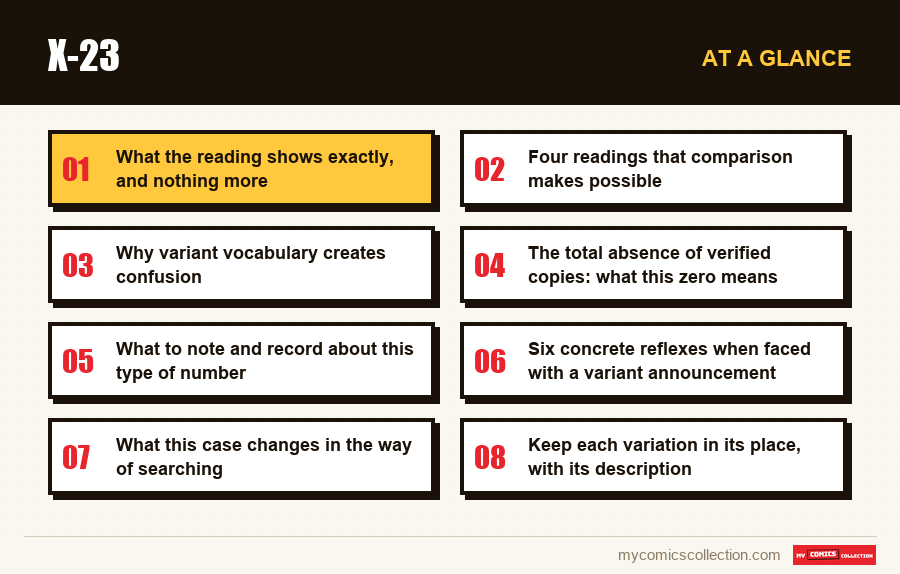
What the reading shows exactly, and nothing more
Let's take the numbers as they are. Twenty-six active listings, zero verified copies, low $5.25, median $9.93, high $50.00. Several offers cluster around the median: a number 6 described as belonging to the first series of 2005 and announced NM at $6.76, a number 3 corresponding to the third part of Innocence Lost at $8.00, a copy of 1A described in VG/FN 5.0 at $9.00, a number 2 announced in 9.2 at $9.70. The distribution is therefore short and compact, with a single high value which clearly stands out.
This maximum at $50.00 should be put aside without hesitation. A single ad at the top of a distribution does not measure a price: it measures what a particular seller hopes to get, one day, from someone. As long as no one pays, this figure remains an intention. It colors the impression that the list leaves, it says nothing about the real level at which these fascicles change hands.
We must also remember what a dated statement cannot contain. All these values were observed on the same day, in a single pass. A photograph taken at a single moment shows no movement: it says neither that these amounts rise, nor that they descend, nor that they stagnate. To write “the limited variant has lost value” would be a pure invention, since there is no previous point of comparison here. What the statement allows is a comparison between simultaneous announcements, and that is already a lot.
Well, twenty-six offers is not enough. Enough to place an order of magnitude, frankly too little to settle on a price. A handful of sellers revising their labels would be enough to move the median by several dollars. Any conclusions drawn from such numbers must be cautious, and saying so is part of honest work.
Four readings that comparison makes possible
The announced rarity does not determine the asking price
The variant described as limited, in sketch, and presented NM+, costs $5.25. The ordinary number 2 announced in 9.2 is claimed at $9.70. Two sellers, two opposing assessments of what a limited edition statement is worth. The mention therefore imposes nothing: it enters into the negotiation as one argument among others, and sometimes it does not enter into it at all.
No verified copy, on the entire request
Not a single announcement of a copy passed by a verification body. The fact is consistent with the price level: having a booklet authenticated and encapsulated costs more than the median of the statement suggests. The mention of limited edition does not change anything in this calculation: it does not make the approach profitable.
Advertised condition and asking price do not align
A described copy VG/FN 5.0 is asking $9.00; another advertised NM+ is asking $5.25. In this segment, the state declared by the seller does not automatically control the amount displayed. The price depends at least as much on who is selling, their haste to sell, and their idea of the value of the lot.
The distribution is short, the gap is real
Between $5.25 and $9.93, the percentage difference seems spectacular; in absolute value, it represents less than five dollars. This is the trap of small amounts: reports panic when the amounts are small. A doubling of price on a five-dollar issue does not tell the same story as a doubling of a five-hundred-dollar coin.
These four readings overlap on one point: the vocabulary of the variant and the behavior of the market are two distinct things. We can precisely describe the first: it’s fabrication, it’s verifiable. We can only observe the second, occasionally, with imperfect instruments. Confusing the two is like reading a printer's label like a rating slip.
A limited variant claimed under the price of the current edition of the same number is not a market anomaly: it is the normal functioning of an object whose rarity has not met with an enthusiast. Rarity is a condition, never a cause.
Practical corollary: when an ad highlights a print run rather than a condition, an identified cover or completeness, the seller relies on the argument he has at hand. This doesn't disqualify it: it just indicates where to direct your own attention.
Why variant vocabulary creates confusion
“Limited”, “exclusive”, “sketch”, “alternative”: all these words describe decisions taken upstream, at the workshop. They say how many copies were made, what the cover looks like, what distribution channel it was reserved for. This is factual and useful information: it helps identify an item unambiguously, which is precisely what a collector needs.
Shifting occurs when these words leave the descriptive register to enter the promotional register. “Limited” then ceases to mean “produced in limited numbers” and begins to mean “desirable”. Nothing in the word itself authorizes this second meaning. A cover may be genuinely rare and interest no one; conversely, an issue with a circulation of hundreds of thousands of copies can be hotly contested if it concentrates a strong narrative interest.
We must be clear on this point: variants are not less legitimate objects than others. Many are beautiful, many are sought after, many support active markets. The report does not judge the category, it notes a case. This case only reminds us that no printed notice exempts us from looking at what is happening in the face, on the side of those who buy.
This caution also applies in both directions. Refusing in principle to pay more for a variant would be as mechanical as the opposite. The right posture consists of treating the mention as an element of identification, essential to know what we are talking about, and to look elsewhere for clues about the price level: number of comparable announcements, narrowing or dispersion of the amounts requested, presence or absence of verified copies.
On a series like the one that concerns us, this gymnastics is all the more necessary as the character belongs to a larger whole. Price movements, when they occur, rarely propagate evenly from one security to another. To place a publication in its context, the detour through Wolverine's editorial history and by that of the X-Men helps to understand which numbers traditionally focus attention, and which ones live on the fringes of this attention.
The total absence of verified copies: what this zero means
A zero is rarely talkative, but this one is. In the entire query, not a single advert offers a copy that has gone through an independent verification procedure. This is not a statistical coincidence linked to the low workforce: it is the direct consequence of the price level observed.
The logic is simple. Having a booklet verified incurs fixed costs (shipping, service, return) which do not depend on the value of the object. Below a certain threshold, the process costs more than it brings in, and no one undertakes it. When an entire query does not return any verified copies, it therefore signals that all of the advertisements are below this threshold, in the minds of both sellers and buyers.
This observation also applies to the limited variant. Its mention of the print was not enough to push it into the category of objects that need to be documented. In other words, the market, as we can see it that day, treats it like an ordinary booklet, whatever its cover says. Here is an independent confirmation of the first observation, obtained by a completely different route.
However, we must be careful not to reverse the reasoning. The absence of verified copies does not prove that none exist: it proves that none was offered for sale that day, on this site, for this request. A survey describes what it sees; it does not map the entire world. This is a limitation of the process, and recognizing it avoids making the data say more than it contains.
What to note and record about this type of number
The exact description of the cover, word for word.“Limited Edition Sketch Variant” is not a category, it is a specific wording attached to a specific object. Copy it as it appears on the ad or on the booklet, without summarizing it as a “variant”. The day you compare two offers, this wording will be the only thing that will tell you if you are looking at the same item.
A separate line for the variant, never a box checked on the current number. The survey shows why: the variant and the regular edition of number 2 are not demanded at the same price, and not in the same direction as intuition suggests. Arranged together, they merge, and you lose the only information that distinguished your two copies. Stored separately, each keeps its own history.
The fact that no verified copy was offered, with the date. This absence is a given, not a void. Write it down as such: "August 30, 2026, no verified copies among 26 listings." If, in six months, a verified copy appears, you will know that something has changed, and you will know where to start.
The number of the statement next to each amount kept. A median of $9.93 calculated on twenty-six ads and an identical median calculated on three hundred ads do not have the same solidity. If you just keep the number, you lose that difference, and your next year self will treat the two as equivalent. The number of observations belongs to the measurement.
The exact nature of the amounts: claimed, not collected. Everything on this statement is a seller inquiry on a current listing. No transaction is attested. Enter this qualification in your form, otherwise these values will imperceptibly transform, upon rereading, into observed prices, and you will build your following decisions on a basis that never existed.
Collecting this series?
Track what you own, what you are missing and what your collection is worth. 7 day trial.
Start my trial →Six concrete reflexes when faced with a variant announcement
Find the current edition of the same issue
This is exactly what made this statement speak for itself. Comparing the variant to its ordinary edition, on the same advertisements at the same time, immediately reveals whether the mention of the print run carries any weight. Here, the current number 2 in 9.2 was asked for $9.70 compared to $5.25 for the announced NM+ variant.
Dater chaque observation
An amount without a date is worthless. It cannot be compared to anything and does not prove any evolution. The values cited here are only useful because they bear a unique and explicit date: August 30, 2026.
Distinguish the announced state from the requested price
The two appear side by side in the ad, which suggests that they order each other. The reading shows the opposite: a VG/FN 5.0 at $9.00 neighbors an NM+ at $5.25. Treat them as two independent fields in your notes.
Count the ads before concluding
Twenty-six offers are enough to place an order of magnitude around ten dollars, not to establish a price. Get into the habit of noting the number at the same time as the median; it is he who will tell you later how much confidence to place in the figure.
Discard the isolated high value
The maximum at $50.00 stands out clearly from the rest. A value that is not based on any other comparable listing expresses a seller's expectation. Using it as a reference would distort all your subsequent comparisons.
Check the series and year first
Several ads specify “2005, first series”. Without this mention, the same number may designate different publications. Identification comes before price comparison: two amounts on two distinct objects cannot be compared.
What this case changes in the way of searching
It shifts the focus from the label to the context. When faced with an ad, the first useful question is not “is this cover rare?” » but “how many comparable announcements exist today, and at what amounts? ". The first question has an answer printed on the object; the second requests a statement, and it is the second which informs a decision.
This approach is particularly useful when you are looking to equip yourself without spending a lot. A set of advertisements narrowed around a low median, without a verified copy, precisely describes the terrain where a collection is built at measured cost. The principles detailed in our guide for buy Wolverine without breaking the bank apply as is here: identify before comparing, compare before paying.
At the other end of the spectrum, certain numbers concentrate real and lasting demand, and there the mechanisms change completely. Knowing which ones allows you to calibrate your expectations: our summary of numéros clés de Wolverine shows what a segment where demand actually exists looks like, in contrast to the segment seen here.
There remains a point of method, valid well beyond this case. A single statement does not establish a conviction; it establishes a hypothesis and a starting point. Repeating the measurement in a few months, with the same protocol and on the same request, would produce a second observation, and two dated observations begin to authorize reasoning on the movement. One never allows it, no matter how good the numbers are.
The basic question: what is such a thin measure for?
It serves to rule out misconceptions, which is already considerable. Twenty-six advertisements do not set any price, but they are more than enough to establish that a limited advertised variant can be claimed less expensively than the current edition of the same issue. This observation does not require a large sample: it requires a counter-example, and just one is enough to undo a supposedly general rule.
This is the particular value of small readings. They are bad at affirming and excellent at denying. “Limited variants are worth more” is a general statement; All it takes is a limited variant asking for $5.25 next to a current copy asking for $9.70 for it to cease to hold as a rule. However, we will not know how much this variant is worth, and we must resist the temptation to fill in this blank.
This asymmetry deserves to be integrated into practice. When presented with a short list, look for what it refutes rather than what it establishes. Faced with a long and stable list, you can start talking about level. Confusing the two uses leads either to fabricated certainties based on three announcements, or to a skepticism that refuses any reading.
Applied to a collection, this reflex saves a lot of false maneuvers. He avoids overpaying for a cover mention on the grounds that it sounds rare, just as he avoids selling off a piece on the grounds that a handful of listings rank it low. In both cases, protection comes from the same gesture: recording what we actually saw, with its date and its number, and refraining from deducing the rest.
No, and the statement of August 30, 2026 provides a direct counterexample. The variant described as limited and announced NM+ was asked for $5.25, while a current copy of number 2 announced in 9.2 was asked for $9.70. A limited edition statement describes a manufacturing decision; it does not guarantee any price level, otherwise there would have to be demand.
No. All the values cited come from a single passage carried out on August 30, 2026. A measurement taken on a single date does not contain any information on a movement: at least two comparable readings, separated in time and carried out according to the same protocol, are required to speak of an increase or decrease. Here there is only one photograph.
Because the process would cost more than the apparent value of the copies concerned. The costs of an independent verification are largely fixed and do not adjust to the price of the item. On a set whose claimed median is $9.93, no one has an interest in incurring this expense: including the mention of limited edition.
It expresses what a seller hopes to get, nothing else. No transactions match it, and no other announcements in the statement come close. An isolated high value does not establish a market level; retaining it as a reference would distort any subsequent comparison. Better to look at where the ads are focused.
By giving it its own line, distinct from that of the current issue, and by copying the exact description of the cover as it appears on the item or on the ad. Stored under the single number, it will sooner or later be confused with the ordinary edition: in one direction or the other, which distorts both an estimate and an exchange.
Keep each variation in its place, with its description
One line per copy, the cover described word for word, the date of each observation and its number: this is exactly what a properly maintained collection preserves, and what an improvised spreadsheet always ends up losing.