On the French market, a survey carried out on August 30, 2026 on the query “X-23 Panini Marvel” revealed only five advertisements, displayed between €4.50 and €6.90, without a single verified copy. These amounts are sums claimed by sellers that day, never completed transactions, and five proposals are not enough to describe a price level: we refuse to draw a reference value from them. The highlight of the statement is not monetary but editorial. Two of the five ads have huge numbers in relation to the character, one volume 15 and one volume 118, because those numbers belong to newsstand collections, not the series they cover. On these objects, the printed number indicates the place of the book in a French editorial suite, and absolutely nothing about the story it contains.
The collector accustomed to American issues reasons with a simple reflex: a title, a numbering, a reading order. The number on the cover reads like a position in a continuing story, and two distant issues imply dozens of months of publication between them. This reflex works as long as we stay in the original circuit. It goes haywire as soon as we move to the French market, because the newsstand edition has built its own counting system, independent of that of the series it translates. A French collection numbers its own volumes. It advances by one with each release, regardless of the content it includes that month, and the character who occupies the cover has no influence on the counter.
The statement of August 30, 2026 gives a clear illustration of this, and it must be clarified from the outset that it does not resemble the American measures usually published here: the announcements observed come from the French market and the amounts are expressed in euros, not in dollars. Of only five announcements, two display two- and three-digit numbers, a 15 and a 118, while no series devoted to the character needs to go that far to be complete. These numbers do not count episodes. They have books in two separate French catalogs, each of which crossed paths with the character at some point in their own journey. Understanding this gap changes the way we search, catalog and value what we own.
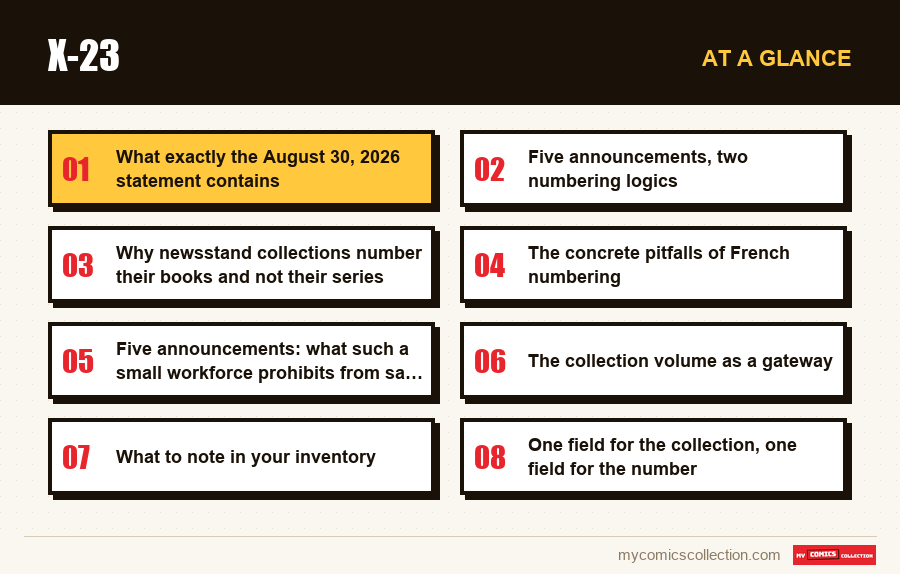
What exactly the August 30, 2026 statement contains
The query "X-23 Panini Marvel" returned five active listings, not one more. The lowest amount claimed was €4.50, the highest €6.90, with a median value of €4.90. None of these announcements concerned a copy that had gone through an external verification procedure: the count of verified copies is zero. It is important to emphasize what these figures are not. These are requests posted on a given day, not closed sales; no one paid these sums, and nothing in the statement says whether they found a buyer. A single reading, taken on a single date, cannot by construction show any movement: it establishes neither rise, nor fall, nor stability, since there is no previous point of comparison. And with five lines, the calculated median has no descriptive significance: it simply designates the third ad in the list, which does not constitute a market price.
Five announcements, two numbering logics
Volume 118 of a bound collection
The most expensive ad in the survey, at €6.90, describes a volume bearing the number 118 in a French “best of superheroes” type collection. This 118 counts the books already published in this collection since its launch. There are no episodes dedicated to the character, who has never had so many under his name.
Volume 15 of another collection
At €5.00, a second advertisement designates number 15 of a distinct French collection, of the “best seller” type, containing the story entitled Cible X. Here again, 15 is the rank of the book in this precise editorial suite. Nothing connects this 15 to 118 of the other collection, except the presence of the same character.
Short numbered booklets
The three other announcements follow a different logic: periodical issues whose number remains low, a 15 dated November 2014, a 3 from August 2016, a 6 from November 2016. Here the number belongs to a followed title, and the French publication date accompanies the number in the seller's title.
A number followed by a letter
The cheapest ad in the survey, at €4.50, has a number with a letter suffix. The number alone is therefore not enough to designate the object: two publications can share the same number and be distinguished only by the letter that follows it, or by the precision of the cover that accompanies it.
Put together, these five lines show two counting systems that coexist on the same shelf and under the same query. On one side, fascicles whose number indicates the position in a title; on the other, volumes whose number indicates their position in a catalog. A buyer who does not know the difference will read the 118 as a sign of rarity, or on the contrary as proof of a long series to be completed. Both readings are false. The 118 means that the French collection was in its one hundred and eighteenth book, which says nothing about the volume of material published on the character.
A practical consequence immediately arises: in an inventory, writing “number 118” without the name of the collection makes the copy impossible to find. The number, by itself, does not refer to anything identifiable: there is a 118 in every collection long enough to reach it, and these 118 have no relation to each other.
On these objects, the sheet must be read in the reverse order of usual: first the name of the collection, then the volume number, finally the title of the story contained. The name carries the identification, the number only clarifies it.
Why newsstand collections number their books and not their series
A newsstand collection is an independent editorial object. It is designed to occupy a shelf space for years, with regular publication and a constant graphic identity, and its unit of account is the book it publishes that month. The content of each volume is chosen separately: a complete story, a period, a character. The counter never stops and does not reset when the subject changes. It is exactly this mechanism which produces a volume 118 devoted to a character whose original series, in the American circuit, did not reach such numbers.
This autonomy also explains the gap between the two linked announcements in the statement. The collections observed are two different suites, launched at different times, with different rhythms. One meets the character in his fifteenth volume, the other in his one hundred and eighteenth. No progression, no chronology, no reading order connects these two numbers. They belong to two meters which run in parallel and which do not speak to each other. Wanting to place them one after the other in the same sequence is a category error.
The same reasoning applies to neighboring characters. A collector's volume which highlights Wolverine, another which highlights the X-Men, a third which highlights To place each story in its real chronology rather than in that of the French catalog, we must go through the thread of the character himself: this is the role of the Wolverine editorial history and that of X-Men, which give the order that the cover does not give.
There remains one nuance not to lose sight of: the three other announcements in the statement, those which bear low numbers accompanied by their month of publication, follow the opposite logic. There, the number belongs to the title and progresses with it. The same seller can therefore offer, in the same list of results, an object whose number reads like a serial rank and another whose number reads like a catalog rank. Nothing in the presentation warns the buyer; only knowledge of the name allows us to decide.
The concrete pitfalls of French numbering
Search by number alone
Typing a number into a classifieds search engine without the collection name brings up unrelated items. The number only has meaning when attached to the editorial suite that issued it, and there are as many “15s” as there are collections that have exceeded this rank.
Confusing French date and original date
The titles of the statement mention the months of French publication, November 2014, August 2016, November 2016. These dates place the release in France, not the original publication. Saving one for the other misaligns the entire timeline of an inventory.
Ignore letter suffix
One of the five advertisements has a number followed by a letter. An inventory that only records the number merges two distinct objects into a single line, and the error is only seen when the two copies are held side by side.
Compare prices without comparing formats
A bound collection volume and a periodical issue do not contain the same quantity of material. Putting their claimed amounts on the same line produces an average that describes neither object.
Taking a big number for a signal
A 118 impresses, and that is precisely what should not be allowed to happen. This number measures the age of the collection at the time of publication, not the depth of material available on the character or the difficulty of finding it.
Believing that you have to complete the sequel
A collection volume can be read alone. Wanting to bring together the 117 preceding volumes to “understand” the 118 makes no sense: the neighboring books focus on other characters and other stories, with no narrative continuity between them.
Collecting this series?
Track what you own, what you are missing and what your collection is worth. 7 day trial.
Start my trial →Five announcements: what such a small workforce prohibits from saying
We must be direct on this point, because it conditions any use of the statement. Five ads is not a deal, it's an anecdotal sample. At this level, the disappearance of a single ad shifts the median, and the arrival of an optimistic seller shifts the maximum. None of the three indicators (minimum, median, maximum) deserves to be cited as a character value on the French market. We will therefore not do so, and we invite you to treat with suspicion any page which presents these amounts as a rating.
The maximum of €6.90 deserves special mention. A single high point in such a short list reflects what a seller hopes to get, not what a buyer has agreed to pay. It constitutes information on the seller's intention, and nothing else. Using it as a valuation benchmark is confusing an inquiry with a transaction, which is the quickest way to overvalue an entire collection.
The total absence of verified copies is the second structural lesson. None of the five listings go through an external verification process, meaning the condition of each item is based entirely on the seller's description and photographs provided. This configuration is not abnormal on objects displayed for less than seven euros: the cost of verification would greatly exceed the amount requested. But it requires us to consider that the announced state is a declaration, not an opposable observation.
Finally, the sheer number of ads tells something. Five proposals on an entire national market, this means that the French offer on this character is almost non-existent at this date. This scarcity of announcements does not automatically translate into a high value: the amounts claimed all remain under seven euros. Scarcity of supply and price level are two distinct things, and the survey shows precisely a case where the first does not influence the second. For those looking to equip themselves without spending, the same principles as those set out in the guide for buy Wolverine at a low price apply here without reservation.
The collection volume as a gateway
There is a positive use to be made of this editorial structure, and it is worth stating. A collection volume contains a complete story in a single object. Where the original series requires bringing together several issues, sometimes dispersed over several months and several sellers, the bound volume settles the question in one purchase. For a reader who wants to discover a character before deciding whether to collect it, this is a format to consider first, before going hunting for booklets.
The statement also shows that the two routes coexist at very similar amounts claimed, between €4.50 and €6.90. The price difference between an isolated issue and a complete volume is negligible here, which makes arbitrage simpler than it usually is. Be careful, however, not to turn this observation into a general rule: it describes five announcements, on a given day, on a single character.
For the collector already established, the reasoning is reversed. The periodical issue retains its own interest (its date, its cover, its possible letter suffix, its belonging to a followed title) which the bound volume erases. Knowing which of these issues really count requires knowing the references of the title concerned, which is detailed in the census of Wolverine key numbers.
What to note in your inventory
The name of the collection, written before the number. On kiosk volumes, it is the name that identifies and the number that specifies. An inventory line that begins with "118" will never return this item during a search; a line that begins with the name of the collection will find it instantly. Adopt this order for all related objects, and keep the usual order for fascicles, where the followed title plays this role.
The title of the story contained in the volume. The two linked announcements of the survey show the difference: one specifies the embedded story: Target X for volume 15 - the other sticks to the name of the collection and the number. Without the title of the story, it is impossible to know if two volumes from different collections contain the same material, and therefore impossible to spot a duplicate of content under two separate covers.
The possible suffix that accompanies the number. One of the five ads has a letter after its number. This letter must appear in the form in the same way as the number, in a dedicated field rather than buried in a comment. Unrecorded lettered numbering produces silent collisions between exemplars, and these collisions are only discovered by physically manipulating the two objects.
The French publication date of the volume. The titles noted bear specific months, November 2014, August 2016, November 2016, which locate the release on newsstands in France. This date is the right key to ordering a French collection and to distinguishing two editions of the same content. Write it down as such, explicitly, so as not to confuse it later with the story's original publication date.
The price paid, shipping included. On items priced between €4.50 and €6.90, shipping costs often cost as much as the item itself, and sometimes more. An inventory that only records the listing price systematically underestimates what the collection cost. Note the total actually debited, and specify the currency: on the French market, these amounts are in euros, which is not obvious when you also keep American statements.
Because this 118 does not count the episodes of the character but the books already published in the French collection which publishes it. The counter belongs to the collection and advances with each publication, whatever the subject of the volume. The character is only the content of the one hundred and eighteenth book in this sequel.
No. They come from two distinct French collections, each with its own counter. No link of numbering, chronology or continuity connects them. The only common point observable in the survey is the presence of the same character.
No, and this is a point on which we must be firm. Five advertisements constitute too small a number to describe a price level: the median of €4.90 simply designates the third line of the list. These amounts are also claimed by sellers on August 30, 2026, without any concluded sale being recorded.
No. This statement relates to the French market and all amounts cited are in euros. This is an exception compared to the American measurements usually published here, and precision matters: mentally converting these figures as if they were dollars would distort any comparison.
That none of the five announcements go through an external verification procedure. The condition of the objects is therefore based on the seller's description and photographs. This is consistent with amounts below seven euros, where the cost of a verification would exceed that of the item, but it means that the stated condition remains a declaration.
One field for the collection, one field for the number
My Comics Collection separates the publication name, issue, suffix, and release date into separate fields. Your newsstand volumes become findable again by name, your issues remain sorted by their rank, and the total actually spent adds up by itself.