The notion of printing does not only concern issues: a bound collection that sells well is reprinted, and the reprinted volume is no longer quite the same object as the volume released first. A statement carried out on August 30, 2026 on the market French, in euros: and not in the American places usually cited on this site: brought only twelve advertisements for a collection of Marvel Deluxe hardcovers published by Panini. Twelve is too little to establish a price level, and I refuse to do so. What these twelve announcements clearly show, however, is that the distinction exists and that it circulates: the same volume 3 is claimed for €18.00 without special mention and €19.90 with the mention “first edition” written in full in the title. None of the twelve ads was for a copy verified by a third party.
When a reader begins to be interested in prints, he almost always thinks of booklets: first printing, reprint, newsstand reissue, variant cover. The vocabulary is well established, sellers use it, buyers recognize it. The bound collection is spontaneously treated as a unique and interchangeable object: a volume bears a number, this number designates content, and the matter seems closed. This is false, and the statement of August 30, 2026 clearly states this. An album that finds its audience is reprinted, sometimes several times, sometimes years later. The copies from these successive printings then end up all together on the second-hand market, mixed together, with the same title, the same volume number, the same cover. Nothing separates them at first glance.
For a collector who follows a character like Only the seller who takes the trouble to specify the print run makes the difference visible. The others don't lie, they are silent, and this silence is also information, provided you know that it should be noticed. Before going into the detail of the survey, it is worth placing the character in his editorial trajectory, which is what the overall journey devoted to his story in comics.
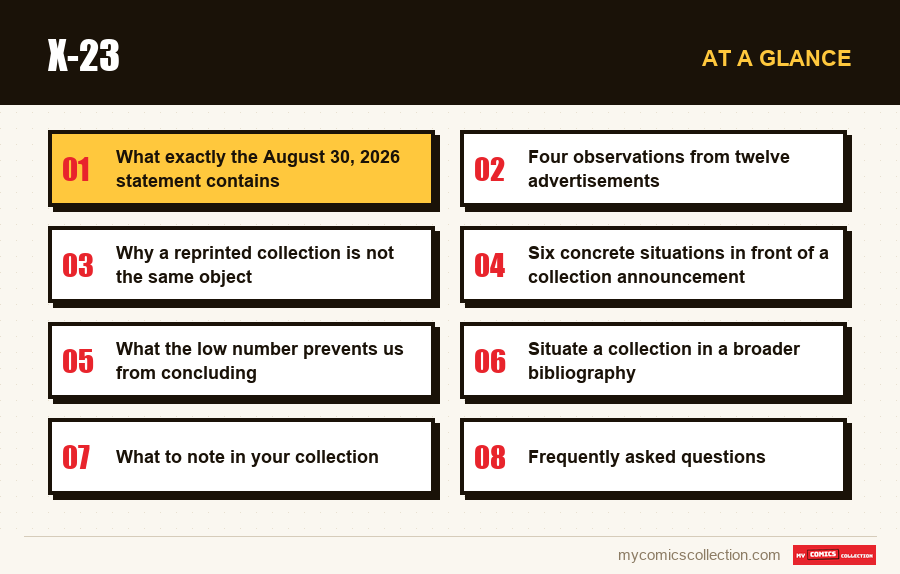
What exactly the August 30, 2026 statement contains
The measurement was made in one go, on the French market, with amounts expressed in euros. This is a precision which is not decorative: most of the figures that we come across on comics circulate in dollars and come from American places, where the bound collections bear neither the same titles nor the same numberings. Here, everything is French: the collection, the publisher, the language of the announcements, the motto. The amounts noted are those that the sellers were demanding that day. These are not completed transactions: no one confirms to me that a buyer has paid these sums, and a displayed price remains a proposition until it has found a buyer.
The query “Marvel Deluxe Ultimate volume Panini” brought back twelve ads. The lowest amount was €11.99, the median value was €28.75, the highest amount was €79.00. I'm not going to turn these three numbers into a reference range, and here's why: twelve ads is a tiny number. A single additional upload, in one direction or the other, would move the median by several euros. As for the maximum, it says nothing other than what a seller hopes to obtain on a given day; it does not prove that such an amount was ever reached. On such a thin sample, the extremes are noise, not a signal.
One last piece of data deserves to be isolated: out of these twelve announcements, none did not relate to a copy verified by a third party. This is not unusual for recent bound collections: the external verification market was built around old issues, not around albums. But the consequence is real: neither the condition nor the mintage are attested by anyone other than the seller. It all depends on the description he writes and the photos he publishes.
Four observations from twelve advertisements
The same volume 3, twice, two prices
Volume 3 appears twice in the survey. A first ad offered it at €18.00 without qualifying its print run. A second offers it at €19.90 by writing “first edition” in the title. The difference is less than two euros: it demonstrates nothing about the value of a first print. What matters is that the distinction is formulated at all.
The same volume 1, twice, without explanation
Volume 1 also appears twice: at €11.99 in one ad, at €15.99 in another. Four euros separate the two, and nothing in the titles justifies the difference. No edition, no condition, no additional content announced. This is the most common scenario, and the most uncomfortable for the buyer.
Each volume has its own title.
The volumes reviewed are not satisfied with a number: volume 1 is announced as “The Man of Tomorrow”, volume 2 “World Tour”, volume 3 “The Return of the King”. This title is the most stable identifying element of the ad, the one that survives numbering errors and reprints.
Twelve announcements, zero external certification
None of the twelve batches came with third-party verification. Neither the announced print run nor the condition described are confirmed elsewhere than in the seller's text. On an album, this is the norm; you simply have to draw conclusions when comparing two ads.
These four observations fit into a very narrow space, twelve lines of results, and yet they are enough to install the mechanism. The first and the second answer each other: in one case the price difference is accompanied by an explanation, in the other it is not. The third provides the identification tool that allows you to find your way around. The fourth reminds that no one, apart from the seller, guarantees what is written.
A measurement taken on a single date shows no movement. The amounts cited here were recorded on August 30, 2026 and nothing else: they do not say whether these volumes were worth less a year ago, nor whether they will be worth more in six months. Any reading in terms of an increase or a decrease would be a pure and simple invention.
Likewise, the €79.00 at the top of the sample does not constitute a market ceiling. This is the amount that a seller demanded that day, on a lot of which I know neither the exact composition nor the destiny. It serves as a measurement limit, not as a value marker.
Why a reprinted collection is not the same object
A bound collection is born from an editorial decision: to bring together several episodes published separately, to put them in volume, to sell them to a public who did not follow the original publication or who wanted a more durable object. This first printing corresponds to a sales estimate made before the release. If it sells out, the publisher puts the title back on the presses. Nothing obliges him to indicate that this new copy is a reprint, and nothing obliges him to make it visible on the cover.
Between the two printings, details can change without the reader noticing them: the paper, the color of the ink, the legal notice on the back of the title page, sometimes the printed price. None of these elements can be read in a cover photograph taken from a meter away. This is why two ads can show the exact same image while describing two items that do not have the same manufacturing history.
This mechanism is exactly the one that collectors of booklets know by heart and have always applied to their issues. It circulates abundantly as soon as we approach the Wolverine key numbers, where the question of the original print comes up in almost every description. What the August 30 statement shows is that the vocabulary has crossed the format boundary: “first edition” is now also written on a bound album, in French, in the title of an advertisement.
However, we must keep measure. A mention in an advertisement is not proof. The seller who writes “first edition” says what he thinks he knows, and he can honestly be wrong, especially on collections where the reprints are not explicitly numbered. The mention opens a conversation; it does not close the check. It's even one of the rare points where the buyer has real leverage: ask what the seller is relying on, and look at the answer.
Six concrete situations in front of a collection announcement
The mention of draw is absent
This is the most common case. The ad gives a title, a volume number, a price, and nothing about the printing. There is nothing suspicious about the absence: most sellers simply do not know what print run they have. It only means that the information is not available since the announcement.
Two prices for the same volume
Volume 1 raised to €11.99 then to €15.99 is an exact illustration of this. Neither title explains the difference. A price difference does not always have a clear cause: the condition, the age of the online posting, the patience of the seller or the shipping costs all come into play without ever being written down.
The words “first edition” appear in the title.
Volume 3 at €19.90 bears this mention, when another copy of the same volume is offered for €18.00 without it. Two ads demonstrate no additional value. On the other hand, they prove that a seller considers the distinction important enough to write it in his title.
No verified items in sample
Of the twelve announcements, not a single one relies on external control. Neither the condition nor the edition are attested by a third party. This does not devalue anything: it simply shifts the entire burden of proof onto the description and photos provided.
The volume number alone is not enough
A volume number only has meaning within a given collection. The same number designates completely different contents from one collection to another, and a reissue under another packaging can start from one. The number is a local landmark, never an identifier.
The proper title of the volume is the key
“The Man of Tomorrow”, “World Tour”, “The Return of the King”: these titles identify the content much better than the number. They survive reprints, layout changes and data entry errors. This is the information to note as a priority.
Collecting this series?
Track what you own, what you are missing and what your collection is worth. 7 day trial.
Start my trial →What the low number prevents us from concluding
Twelve announcements are very few. This must be said clearly, because there is a great temptation to calculate an average and present it as a market price. On a sample of this size, no statistic is robust: the median of €28.75 is based on a handful of lines, several of which concern lots or sets whose composition I do not know. Removing an ad or adding one would cause it to move noticeably.
There is a second, less obvious reason. These twelve advertisements do not describe twelve comparable objects: at least two volumes appear in duplicate, and the others correspond to different volumes from the same collection. Mixing volume 1 and volume 3 in the same calculation amounts to adding objects that have neither the same content nor the same availability. The resulting figure would be arithmetically correct and editorially empty.
What the sample allows, on the other hand, is a solid qualitative observation: the distinction of circulation exists on the bound collections, it is formulated in French, it appears in the title of an advertisement and not only in the body of the text. This conclusion does not depend on the number of announcements. A single one would have been enough to establish it; twelve confirm it.
It is also an invitation to be careful when looking to buy at the best price. The strategies described in the guide dedicated to the idea of buy Wolverine without breaking the bank are valid for booklets as for albums, with one nuance: on a collection, the variable “circulation” is added discreetly to the equation, and it only appears if someone mentions it.
Situate a collection in a broader bibliography
One final point is worth asking, because it conditions everything else: a bound collection never exists alone. He cuts out a portion of a series, puts it into volume, and this cutting is an editorial decision which can vary from one edition to another. Two albums with different titles can partially cover the same episodes; two successive editions of the same title may not contain exactly the same additional material.
For a character whose appearances are divided between several regular series, mini-series and participation in collective stories, this question becomes central. Knowing what a volume really contains requires knowing the original series and the period concerned, which is enabled by an overall tour like the one devoted to the history of the X-Men in comics or, for a character adjacent to the same universe, to the Wolverine story.
Without this mapping, the buyer finds himself comparing coverages. With it, he compares contents, and the question of circulation finds its rightful place: a characteristic of the copy, not a characteristic of the story. A first printing and a reprint of the same album tell exactly the same story. What separates them is a matter of the object, not of the reading, and this is precisely why it must be recorded somewhere, otherwise the information disappears the day the ad is withdrawn.
What to note in your collection
The edition of the collection, when indicated. If the seller writes "first edition" or any equivalent wording, copy it as is, in quotation marks, specifying that this is a declaration by the seller and not a verification. If nothing is indicated, explicitly note "unspecified edition" rather than leaving the field empty: the absence of information is itself information, and an empty field becomes illegible six months later.
The proper title of the volume.“The Man of Tomorrow”, “World Tour”, “The Return of the King”: this label identifies the content much more reliably than the number alone. It resists reprints, seller entry errors and design changes between editions. This is the first element to record, even before the price.
The volume number and the name of the collection. The two go together and are worthless separately. “Volume 3” does not designate anything outside its collection, and the name of the collection without a number does not allow us to find the volume. Note the complete pair, in the exact terms used by the publisher, including the mention of range when it exists.
The publisher and year of printing. On a collection, the year shown on the title page or in the legal notices is often the only material clue allowing one impression to be distinguished from another. It almost never appears in advertisements: it is information to be noted on the copy itself, once received, and to be added to the file.
The price paid, shipping included. On albums sold for around fifteen or twenty euros, shipping costs represent a significant part of the actual amount, and they never appear in the displayed price. Record the total actually debited, with the date of purchase. This is the only figure you are certain of, unlike all the claimed amounts that you will come across elsewhere.
Frequently asked questions
Yes. An album that sells is reprinted, exactly like a booklet, and the copies from successive printings then coexist on the second-hand market. The statement of August 30, 2026 contains a French advertisement which includes "first edition" in its title for a bound collector's volume: the distinction is therefore well used by sellers in this format.
The survey does not allow this to be confirmed. Volume 3 appears there at €18.00 without mention and at €19.90 with: less than two euros difference, on two advertisements only. This is too little to demonstrate anything about extra value. What these two lines establish is that the distinction is being pointed out, not what it's worth.
The ad doesn't say this, and that's precisely the point. Neither mentions an edition, a particular condition or additional content. A price difference may be due to the actual condition, shipping costs, the age of the online posting or simply the seller's discretion. Since the announcement alone, the cause remains inaccessible.
No. These are amounts claimed by sellers on August 30, 2026, on the French market and in euros. None correspond to a transaction for which I have confirmation. And as the measurement was taken only once, it says nothing about a possible evolution: it photographs a state of demands at a given moment, nothing more.
Since the announcement, this has generally been impossible: the cover is identical and the photos do not show the legal notice pages. The copy received often bears the year of printing or a form of completion of printing. Of the twelve advertisements noted, none was based on external verification: everything was based on the seller's description.
Keep track of the print run, not just the title
A volume of which you only note the number becomes indistinguishable from its reprint as soon as the announcement disappears. My Comics Collection allows you to record the proper title of the volume, the collection, the year of printing and the price actually paid, including shipping, and find everything at a glance when you buy the next volume.