He was an editorial manager before and during his career as a screenwriter, and this dual position explains many of his writing choices. An author who has supervised the work of others knows what a schedule achieves, what a designer can deliver, and what a continuity decision will cost his colleagues. He writes knowing the device: which makes his series more tenable and his decisions more prudent than those of an author who would never have managed a publication.
This dimension is almost absent from the comments, even though it conditions what he could undertake.
Here is what the position actually entails, what this experience produced in his writing, what it cost him, and why these trajectories are poorly documented.
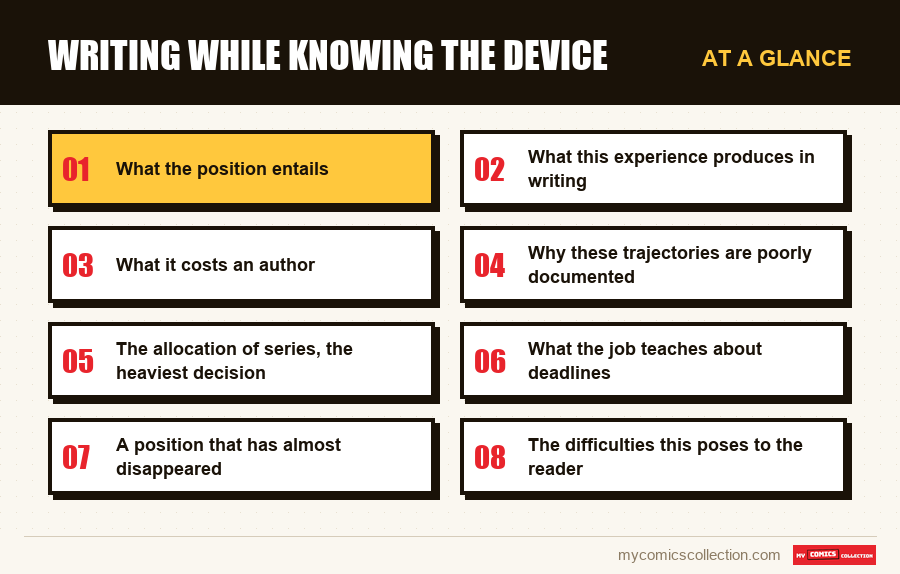
What the position entails
Four functions, none of which are visible to the reader and all of which determine what the reader will read.
Arbitrer les calendriers. Deciding who delivers what and when, with teams whose rhythms differ, and without the possibility of pushing back a publication date.
Attribuer les séries. Choosing which screenwriter works with which designer: a decision that largely determines the outcome, as we observe in successful and failed collaborations.
Coordonner les continuités. Ensuring that two series do not contradict each other, which requires knowing what is being prepared everywhere and imposing arbitrations on authors who do not want them.
Absorber les incidents. A delay, an abandonment, a lost board: a solution must be found in a few days, and this solution almost always leaves a trace in the finished product.
These four functions form a complete profession. There is nothing creative about them and they entirely condition what can be created., which is poorly understood by those who have not been confronted with it.
What this experience produces in writing
Des scénarios livrables
He writes what can be drawn in the time given by the person concerned, rather than what he would like to see.
This is the skill most directly derived from the position.
Des continuités praticables
It poses lasting consequences without blocking other series: a balance that an author ignorant of the device cannot maintain.
Anticipation of incidents
His narrative structures support an issue being shifted or a designer changing, because he knows it will happen.
A caution about the irreversible
Having seen what a final decision costs colleagues, he takes fewer of them and negotiates them more.
What it costs an author
The dual position has a price, and it is worth naming it precisely.
Le temps. Managing an editorial line takes up entire days, and that time is not spent on writing. An author who assumes both mechanically produces less.
La prudence. Knowing the consequences of every decision makes it harder to make them. An author who ignores the device sometimes writes things that a manager would never have validated, and some of them are excellent.
The conflict of interest. Arbitrating between series, one of which you wrote yourself, is an uncomfortable position, regardless of the honesty of the arbitration.
Invisibility. The editorial work leaves no signed trace. An author recognized as a screenwriter will be judged on his pages, never on the series he made possible.
These four costs are real and they explain why few authors hold the double position for long. It requires giving up part of one's own work for the benefit of that of others, without corresponding recognition.
A necessary reservation on this analysis. I am describing here what a position entails in general, and I notice traits in a writing. I cannot demonstrate that the latter follow from the former.
An author can very well write deliverable scenarios without having ever managed a schedule, through simple field experience. The correlation is plausible and the explanation coherent; it is not proof, and the documents which would make it possible to decide do not exist.
Why these trajectories are poorly documented
Three reasons combine, and they apply to the entire profession.
The post does not sign anything. A mention in the masthead, sometimes absent, and that's it. No catalog indexes editorial responsibilities, unlike scripts and drawings.
Decisions are private. What was refused, redirected or narrowly saved leaves no public trace: only the result appears, and it says nothing about the process.
The testimonies are late and partial. They arrive decades later, often in contexts of settling scores, and regularly contradict each other.
The result is a history of the medium written almost solely from the perspective of visible creators. Entire sections of what made the works possible remain outside the story, not out of malice but due to lack of sources.
The allocation of series, the heaviest decision
Of the four functions described above, one weighs more than the others and deserves development.
Deciding who works with who determines the outcome more surely than any note of intent. An atmospheric screenwriter combined with an action artist produces a series that doesn't work for anyone; the same associated with a compatible partner sometimes produces lasting success.
It is a decision taken before writing and which entirely constrains it, which probably makes it the most creative act in a supposedly administrative position.
It is also the most difficult to succeed, because it requires knowing each person's real strengths: information that does not appear on any curriculum and is acquired by watching people work for years.
A reader can observe the effects without effort: in any long series, certain associations last for dozens of issues and others break off after three. It's almost never a problem of individual talent, it's a matching problem.
What the job teaches about deadlines
One specific skill is worth isolating because it explains a recurring feature of the writing examined here.
Managing a monthly publication teaches you something that no one anticipates: everything arrives late, systematically, and a plan that does not provide margin does not survive the first incident.
An author who has occupied this position therefore writes structures which absorb accidents: arcs whose order can vary slightly, numbers which can slip between two, threads which can be lengthened or shortened without anything breaking.
This flexibility has a perceptible cost: it produces these connecting episodes that we criticize long series, and which are in reality the price of their regularity.
A reader who identifies them as filler is right about the form and wrong about the cause. They are shock absorbers, not weaknesses, and a series which had none would appear irregularly.
Collecting this series?
Track what you own, what you are missing and what your collection is worth. 7 day trial.
Start my trial →A position that has almost disappeared
A final observation on the evolution of this profession, because it sheds light on why these trajectories have become rare.
The combination of functions-writing and supervising-presupposed structures where the same people stayed for a long time, knew each other, and could assume several roles without formalized conflict.
Current organizations clearly separate these positions, for understandable reasons of management and responsibility. A screenwriter who supervises his competitors' series would today pose a problem that no one wants to deal with.
The consequence is that knowledge is transmitted less well. An author who has never managed a calendar learns through failure what a stint in this position taught in a few months.
This is not a nostalgic complaint: the separation of roles has obvious merits. It's simply a loss to put against the gains, and it can be read in the series which are struggling to maintain a consistency that teams of the past obtained without thinking about it.
The difficulties this poses to the reader
A name with multiple functions
The same name on the cover indicates a scenario, supervision or a simple mention, without distinction.
Incomplete bears
On older publications, editorial responsibilities are not always credited.
No index available
Reconstructing what a person supervised involves going through the numbers one by one.
Contested attributions
What is an editorial decision or an author's choice is the subject of divergent accounts.
What this changes when judging a work
Three consequences for anyone who wants to honestly evaluate this type of work.
Don't lend everything to the signing author. A consistent series over years assumes team stability, refereeing held, and incidents absorbed: none of which is visible.
Don't blame the author for everything either. A stretching arc, a weak number, a sudden change of designer are often part of the constraints he was under.
Seek stability rather than name. The best periods of long series almost always coincide with a team that does not change: more than with the presence of a particular individual.
This third criterion is the most useful in practice and the least used. A series is often worth the duration of its team, information that a bear provides in seconds and that no one consults.
What to record
In a catalog where the same names occupy different functions, the sheet must note what the cover does not say.
The entire team noted in the bear, including the editorial manager. It is the only item never indexed anywhere, and noting it allows us to identify periods of stability: which correspond, out of all the series examined here, to the best.
This survey is tedious and it produces information that nothing else provides: the map of the teams behind a catalog, which explains the variations in quality much better than the names on the cover.
The numbers where the team changes, marked as such: these are the breaking points, and they predict changes in pace and tone better than any critical assessment.
These two mentions give access to a reading of the production, and no longer just the story: a rare use of an inventory, and the only one which makes visible what the editorial work has done.
Frequently asked questions
He arbitrates the calendars, assigns the series by choosing who works with whom, coordinates the continuities between titles, and absorbs incidents: delay, abandonment, lost board. Four functions without anything creative, and which entirely condition what can be created.
We write what can be delivered rather than what we would like to see, we pose lasting consequences without blocking neighboring series, we build structures that support a change of designer, and we make fewer irreversible decisions because we know the cost for others.
No, and I say it. I describe what a position entails and I notice traits in a writing, without being able to establish that the latter arise from the former. An author can acquire these reflexes through simple field experience: the correlation is plausible, it is not proof.
Because he does not sign anything, his decisions are private, what was refused or saved leaves no public trace, and the testimonies arrive decades later, often in conflictual contexts. The history of the medium is therefore written almost exclusively from the point of view of visible creators.
By the stability of the team rather than by the name of the screenwriter. In all the series examined here, the best periods coincide with a team that does not change. It's a criterion that a bear provides in seconds and that almost no one consults.
Who was the team, and when did it change?
Breakpoints predict changes in tone better than any criticism.