The signature of this screenwriter comes down to a practice: what happens, stays there. Injuries do not disappear, betrayals are not forgotten, the dead do not return, and a character remembers what another did to him fifty issues earlier. This was rare in the serial format of those decades, where each episode put almost everything back in place. This outfit requires precise methods, and she explains why her work stands up to rereading better than that of her contemporaries.
Understanding how he goes about it also sheds light on why this practice remains in the minority despite its results.
This article describes the methods used, what they cost, what they make possible, and why the industry discourages them.
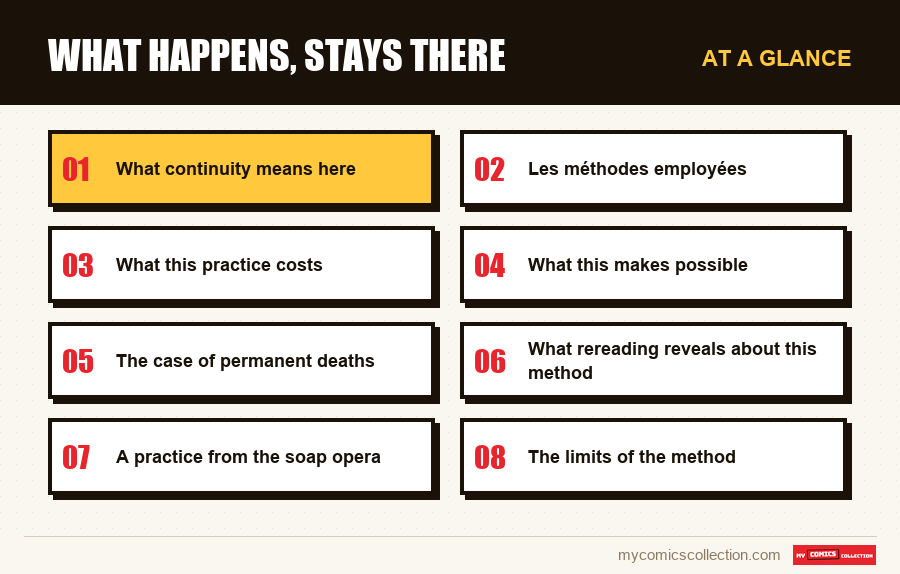
What continuity means here
The word covers two very different things that are constantly confused, and the distinction is the heart of the matter.
Factual continuity consists of not contradicting yourself: not making a dead character reappear, not forgetting that a city has been destroyed. This is a requirement for consistency, and it mainly concerns documentation.
The consequent continuity consists of making the past weigh on the present: a character acts differently because he has experienced something, and the story returns to it. This is a writing requirement, and it is much more expensive.
The first is minimal hygiene that many series respect. The second is rare because it limits what we can write next: each consequence posed closes doors.
It is the second that we are talking about here, and this is what distinguishes this work from series that are nevertheless deemed coherent.
Les méthodes employées
Long-lasting physical consequences
A serious injury leaves a limitation that persists for dozens of issues and changes the way the character acts.
This is the simplest and most effective process.
Grudges that last
A betrayed character does not forget, and the story makes this distrust last long after the reader would have let it go.
Permanent deaths
On his best series, the death of a character is not canceled. This is a costly decision that makes all subsequent threats credible.
Des retours différés
An element posed returns a long time later, without explicit reminder: which requires trusting the reader's memory.
What this practice costs
You have to be precise about the price, because it explains the rarity of the method.
Elle réduit l'espace narratif. Every consequence maintained prohibits stories. A character who is definitely dead can no longer be used; a broken relationship can no longer produce the scenes it used to.
It complicates the arrival of new readers. A reader who picks up the current series does not understand why two characters are suspicious of each other, and nothing explains it to him.
It exposes to subsequent corrections. A subsequent screenwriter can undo what has been established, and the work of continuity then turns into visible inconsistency.
It requires production memory. You need to know what was published, including what you wrote three years earlier, without a tool to find it.
These four costs are real and immediate, when the benefit only appears in the long term. This is exactly the profile of a practice that incentives discourage, and its persistence presupposes personal conviction rather than calculation.
A necessary reservation on this type of analysis. Attributing careful continuity to a single screenwriter is simplistic: an editorial manager, a designer who remembers, or a stable team contribute just as much.
What we can observe from the outside is the result, a series where the past weighs, without being able to distribute the merit between those who produced it. Stories that blame everything on the screenwriter rarely know more than we do.
What this makes possible
Three effects that a series without consequences never obtains, and which justify the cost.
Une menace crédible. If characters are truly dead, the reader believes that others may die. This is the only way to produce anxiety in a genre where the protagonists are a priori protected.
An attachment that grows. We become attached to characters whose trials we have followed, not to characters who start again every month. Duration becomes an investment on the part of the reader.
Scenes that don't need to be written. When two characters meet after an old conflict, the tension is already there. The screenwriter has nothing to set up: the past works for him.
This third effect is the most economical and the least noticed. Maintained continuity is narrative capital: she makes scenes free that would cost pages elsewhere, which partially compensates for the doors she closed.
The case of permanent deaths
This is the most visible and most discussed process, and it deserves a separate examination because it concentrates all the difficulty.
Killing an established character is a business decision as much as a narrative one. We remove an exploitable asset, we deprive colleagues of material, and we expose ourselves to the anger of an attached readership.
This is also the only way to make subsequent threats credible. In a genre where death is usually temporary, one held death alone is worth years of gratuitous tension: each subsequent danger is taken seriously because a precedent exists.
The difficulty is that this capital is spent. Once a successor undoes the death, the effect retroactively disappears for the entire series, including previously published issues.
This is what makes this practice fragile: it depends on decisions that will be taken after the departure of the person who established it, and no author controls what happens to their work in a shared universe.
What rereading reveals about this method
One effect is worth noting, because it only appears on the second reading and it is demonstrative.
By rereading a series where the consequences are held, we spot scenes which prepare much later developments: not by announcement, but by the installation of a state which will be useful.
We then see that the story almost never had to create conflict: the tensions he uses already existed, produced by previous episodes. This is a considerable saving, invisible at first reading.
Conversely, a series without consistent continuity must create a conflict in each episode, which produces these artificial misunderstandings and these reversals that the genre is criticized for.
The difference in perceived quality between two series is often due to this, and not to the talent of their authors. One spends capital, the other improvises each time: and the reader feels the gap without being able to name it.
A practice from the soap opera
It is worth situating this method, because it was not born in the genre in which we observe it here.
The serial novel of the nineteenth century already practiced the consequence held: a mistake committed in the first chapters weighed a hundred chapters later, and the authors counted on the memory of a readership which followed for years.
What serial comics had lost was not the technique but the conditions: a changing readership, changing teams, and a requirement for permanent accessibility which pushes us to rethink everything.
Finding this practice in a monthly series for the general public is therefore less an invention than a reestablishment, and this requires resisting constant structural pressures.
This is also why the series that achieve this are similar beyond their subjects. They share the same conviction: that the reader remembers, and can be trusted.
Collecting this series?
Track what you own, what you are missing and what your collection is worth. 7 day trial.
Start my trial →The limits of the method
A barrier to entry
The further the series progresses, the more difficult it becomes to watch it in progress. The readership is gradually closing.
Subsequent cancellations
A successor can undo what has been laid down, retrospectively transforming rigor into contradiction.
A progressive confinement
By dint of maintaining consequences, the options are reduced and certain series end up blocked by their own story.
Orderly reading required
These series are difficult to read out of order, which limits the opportunistic purchase of isolated issues.
Redesigning the universe, reverse exercise
It is instructive that the same author was tasked with an exercise that contradicts his own practice.
A continuity overhaul involves erasing, simplifying, and rewriting decades of accumulation-that is, doing exactly what consequential continuity refuses. The past ceases to weigh, it is canceled.
Entrusting this task to someone whose signature is the outfit of the past is not absurd: you have to know the value of what you erase in order to choose what you keep. An author indifferent to continuity would have erased without measure.
That says something about redesigns in general. They are made necessary by decades of poorly maintained continuity, not by continuity itself:we do not put into order what has never been disordered.
The contradiction is therefore apparent. The exercise repairs a defect in application, not the principle, and it is consistent that its conduct was entrusted to someone who held to the principle.
What this changes for a reader today
Three practical consequences, applicable when buying.
Read these series in order. This is one of the rare cases in this campaign where the order is not a preference but a condition. A disordered reading removes most of what makes the work valuable.
Buy in consecutive blocks rather than key numbers. Isolated references show nothing of this quality, which only manifests itself over time.
Accept that you won't understand everything at first. Taking such a series at a given point implies missing references, and waiting for someone to explain leads to giving up.
These three recommendations go against common purchasing reflexes, which favor identified numbers and entry through a remarkable point. On this type of work, it is the ordinary block which has value, and it costs a fraction of the rest.
Ce qu'il faut enregistrer
On series where the past weighs heavily, the sheet must retain what the memory loses between two reading sessions.
The ongoing consequences at the end of each block read: who is hurt, who is angry with whom, what was destroyed. These states persist over dozens of issues without ever being recalled, and a resumption after several months without this trace makes one read tense scenes without perceiving the cause.
This is exactly what the screenwriter expects from the reader, and what the original serial format, one delivery per month, made natural. Modern reading, in spaced blocks, needs support that period reading did not require.
Items placed without explanation, noted separately: these are those who will come back, often very far away, and identifying them is what distinguishes attentive reading from passive reading.
These two mentions transform a long series into a followable object. Without them, the main quality of this work, the holding of the past, remains invisible to the reader who nevertheless has it before his eyes.
Questions fréquentes
Two things that we confuse. Factual continuity consists of not contradicting oneself: a hygiene that many series respect. Consequential continuity places the past on the present: a character acts differently because he has experienced something. It's the second that we're talking about, and it's rare because it limits what we can write next.
Because its costs are immediate and its benefit deferred: it reduces the narrative space, complicates the arrival of new readers, exposes it to cancellations by a successor, and requires a production memory without tools to support it. This is the profile of a practice that incentives discourage.
No, and that’s a reservation to keep. An editorial manager, a designer who remembers or a stable team contribute just as much. We observe the result, a series where the past weighs, without being able to distribute the merit, and the stories which attribute everything to the screenwriter rarely know more than us.
In order and in consecutive blocks, not by key numbers. This is one of the rare cases where order is a condition and not a preference: isolated references show nothing of a quality that only manifests itself over time. And you have to accept not understanding everything when you enter.
This is not contradictory: you have to know the value of what you erase in order to choose what you keep, and an author indifferent to continuity would have erased without measure. Recasts also repair a defect in application, not the principle: we do not put back into order what has never been disordered.
Who is mad at who, and since when?
These states persist for dozens of numbers without ever being called back, and a cold recovery erases them.