This screenwriter doesn't write the same way depending on who draws, and the difference is measurable page by page. With an atmospheric designer, his stories slow down, the panels become rarer and the text withdraws; with a designer generous in detail, he increases the number of characters present and the density of the scenes. This is not polite adaptation but a production calculation: he writes what his partner can actually deliver in the allotted time.
Identifying these adjustments changes the way we judge our work, often evaluated without taking into account who accompanied it.
This article describes the observable adjustments, explains what requires them, examines what they reveal about the business, and explains how to take them into account when purchasing.
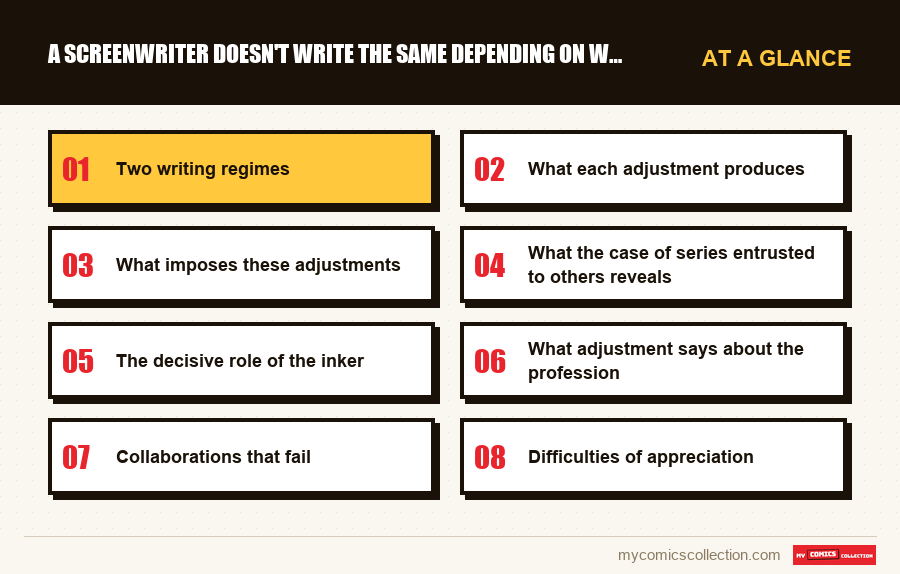
Two writing regimes
The comparison between his two major series is telling because the two designers work in complete contrast to each other.
With an atmospheric designer: masses of shadow, partial lighting, photographic rendering: the writing slows down. The scenes stretch out, the silences multiply, and a page can only contain three or four panels.
With a density designer: lots of panels, complete settings, actually drawn crowds: the writing fills up. The number of characters present increases, the dialogues intersect, and a page contains eight.
These two regimes produce unrelated reading rhythms, from the same author and a few years apart. It is not an evolution of style but an adaptation to what each partner does well.
This can be verified directly: open two pages, count the boxes and the characters present. The difference is immediate and requires no expertise.
What each adjustment produces
Fewer boxes, more tension
A page with four boxes gives each person time to weigh in. This is what a story of atmosphere requires, and it supposes that the drawing alone carries the disquiet.
The text is rare, sometimes absent.
More boxes, more characters
A dense page allows an entire group to exist in the same scene, each with their own reaction. This is the condition of a choral narrative.
Decors that become places
When a designer actually constructs his backgrounds, the writer can place scenes in identifiable locations and return to them.
Useable silences
An expressive sketcher allows you to delete text. The screenwriter then writes silent sequences that he could not entrust to everyone.
What imposes these adjustments
The main reason is economic, and it is rarely said.
A designer has maximum rhythm. A page with eight detailed panels takes more time than a page with four atmospheric panels. For a monthly publication, this ceiling is an absolute constraint.
A screenwriter who wrote crowds for a slow penciler would get delays or sloppy pages. Writing beyond your partner's capabilities does not produce a better series, it produces a series that is behind., then a series entrusted to someone else.
Added to this is a reason of taste: a designer gives his best on what he likes to draw, and entrusting him with something else wastes his skill.
These two reasons explain why the adjustment is systematic and not occasional. It is a basic professional skill, invisible when it's done well and immediately noticeable when it's missing.
An important reservation about this analysis. Distinguishing what comes from the screenwriter from what comes from the designer is largely impossible from the outside, and late testimonies are rarely reliable.
What I observe is a result, two series with opposite rhythms, without being able to say who decided what. A designer may have imposed his rhythm as much as a screenwriter may have anticipated it, and the division of tasks varies according to the periods and working methods.
What the case of series entrusted to others reveals
An interesting test arises when a series changes artists midway through.
In the long series examined, these changes occur and the writing adjusts: the number of characters present varies, silent sequences appear or disappear, the length of scenes changes.
It is these transitions that prove the adjustment, much better than a comparison between two different series: because everything else is constant: same author, same characters, same continuity, same month.
A reader who wants to verify this analysis therefore has a simple protocol: spot a change of designer in a series, read the three issues which precede and the three which follow, and count.
It's more convincing than any argument, and it only requires six issues: available for a few dollars on the series concerned.
The decisive role of the inker
A position is almost always missing from these analyzes and its omission distorts the conclusions.
Between the sketch and the printed page, an inker retraces, thickens, adds blacks and decides what remains. Two inkers on the same sketch produce pages that an uninformed reader will attribute to two different artists.
On a series of atmosphere, this position is more decisive than anywhere else: it is the inking which places the masses of shadow and therefore the essential part of the effect. An inker who hardened these sketches would destroy the series without the artist having anything to do with it.
The collaborations that last therefore owe as much to the stability of this position as to that of the two names displayed. A team that changes inkers changes renderings, and the reader attributes it to the artist.
For an honest analysis, we must therefore talk about trios rather than couples, and accept that one of the three is systematically invisible in discussions.
What adjustment says about the profession
A broader observation is worth making, because it touches on the way we talk about comic book authors.
Critics readily treat the screenwriter as the author and the designer as the performer. This distribution is convenient and it poorly describes what is happening: a screenwriter who writes according to his partner is not in a position of command but of negotiation.
He writes what can be drawn, by this person, within this time frame: three constraints which determine the form of the story before any narrative consideration.
This does not diminish his contribution, it describes him. A comic book writer does not write a text that is then illustrated; he writes an order addressed to someone whose strengths and limitations he knows.
This is why the best collaborations last. It takes time to know what a partner does well, and a team that changes every six numbers never learns it.
Collecting this series?
Track what you own, what you are missing and what your collection is worth. 7 day trial.
Start my trial →Collaborations that fail
It is worth examining the cases where adjustment does not take place, as they are instructive and observable.
This happens when a screenwriter delivers a cut without knowing his designer: a common situation with last-minute replacements or series with a rotating crew.
The result is identifiable to the eye. Overcrowded pages where the designer is visibly struggling, or on the contrary empty pages where he had nothing to do. In both cases, an imbalance between what is demanded and what is delivered.
These numbers exist in any long series and they distort judgments: a reader who came across them first would conclude that there was a general weakness.
This is an additional argument, and undoubtedly the strongest, for reading in consecutive blocks rather than in isolated numbers. A block contains its accidents and allows them to be located in relation to the rest; a number taken alone could very well be an accident, without us having any means of noticing it.
Difficulties of appreciation
A part impossible to disentangle
There is no evidence of who decided on a pace, and retrospective accounts are unreliable.
Variable working methods
Depending on the era, the screenwriter provides a complete breakdown or a synopsis that the designer cuts out himself.
The forgotten inker
Inking considerably changes the rendering of a sketch, and it is almost never taken into account.
Incomplete credits
On old series, not all the speakers are always mentioned in the title.
What this changes when judging a screenwriter
Three consequences for anyone who wants to evaluate this work honestly.
Don’t judge on just one collaboration. A screenwriter read only with an atmosphere partner will seem slow; read only with a dense partner, it will seem loaded. Neither judgment concerns him alone.
Look for constants. What comes back from one collaboration to another (the maintenance of continuity, the faulty characters, the differentiated distributions) is probably up to him. What varies is up to the couple.
Be wary of poorly matched series. There are collaborations where the adjustment did not take place, and the result harms both parties. These are poor samples to judge one or the other.
This method requires reading several series, which is possible here: this entire catalog can be browsed for a modest budget, and this is precisely what a flat market allows.
What to record
On a screenwriter who adjusts to his partners, the file must keep the couple and not just the name.
The designer and inker of each issue, rated at the same rank as the writer. This is the only way to form comparable sets (all the numbers from the same collaboration on one side, those from another on the other) and therefore to judge on homogeneous samples rather than on a mixture.
Without this distinction, an assessment of “this author” actually relates to the partner we have read the most, something we ourselves do not know.
Transition numbers, when a designer changes, noted as such: these are the places where the adjustment is visible, and spotting them afterwards in a long series is almost impossible without a note taken while reading.
These two mentions transform a collection into material for analysis. On an author whose signature is precisely adaptation, this is the only way to see what he does.
Frequently asked questions
By counting. Open a page from each of its two major series and count the boxes and characters present: the difference is immediate and requires no expertise. Three or four boxes on one side, eight on the other, a few years apart and by the same author.
For an economic reason: a designer has a maximum pace, and writing beyond his abilities does not produce a better series but a late series, then a series entrusted to someone else. Added to this is the fact that a designer gives his best on what he likes to draw.
No, and it must be said. I observe a result, two series with opposite rhythms, without being able to attribute the decisions. A designer may have imposed his rhythm as much as a screenwriter may have anticipated it, and the division of tasks varies according to the periods and working methods.
By spotting a change of artist within the same series, then reading the three issues which precede and the three which follow. Everything else is constant (same author, same characters, same continuity) so the observed difference can only come from there. Six issues for a few dollars are enough.
By reading about several collaborations and looking for the constants: what goes from one partner to the other probably belongs to them, what varies is up to the couple. A screenwriter read with only one artist is judged on an association, not on himself.
Who drew, who inked?
An assessment based on “this author” actually relates to the partner we have read the most.