
Writing a group is not writing several characters: it is managing a budget of pages where everyone claims a share. With six protagonists, a twenty-two page issue gives on average less than four pages to each one, and the plot still needs to be accommodated. The solution used here is alternation rather than sharing: each issue serves two or three characters in depth and leaves the others in the background, with a rotation held over years.
This calculation explains most of the successes and failures of the group narrative, including those of other authors.
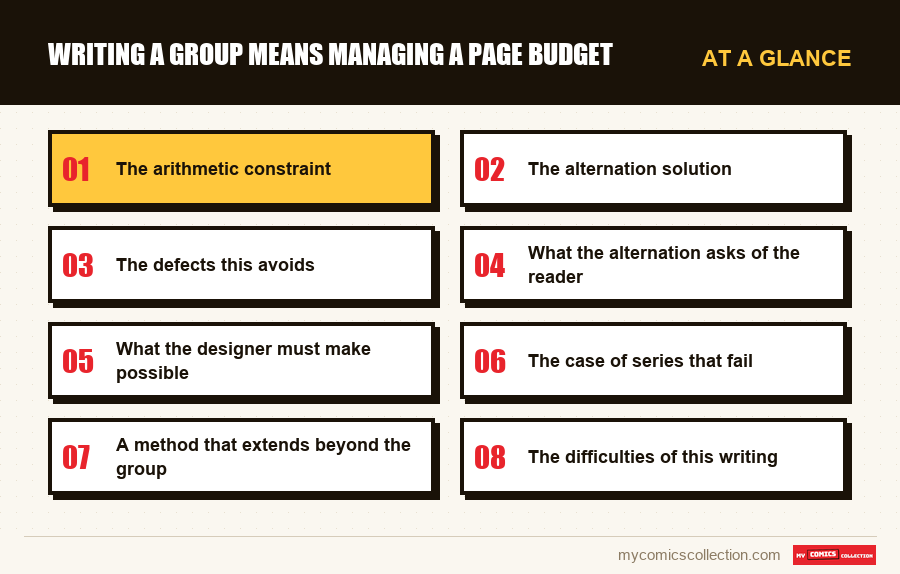
Here is the arithmetic constraint, the solution adopted, the defects it avoids, and what it asks of the reader.
The arithmetic constraint
It is rarely asked and it determines everything else.
A monthly issue offers around twenty pages. This number does not vary, regardless of the size of the distribution.
A plot consumes half of it. You have to pose a situation, develop it, conclude it or relaunch it: this cannot be done in three boxes.
What remains is divided. With six characters, each has a page and a half to exist as a person rather than a function.
A page and a half is not enough. This is the wall against which every group story comes up., and most get around it by reducing characters to a single, repeated trait.
The alternation solution
Two or three served per number
Each episode devotes real development to only a few characters, and leaves the others present but functional.
This yields four to six pages useful to those being served.
A sustained rotation
Over ten numbers, everyone had their turn. The reader does not perceive the mechanism, only a living distribution.
Persistent subplots
A character not served this month sees his situation advance a space or two, which maintains his presence at minimal cost.
Periodic convergences
Every few issues, the threads come together in an episode that makes them all count: which in retrospect justifies the wait.
The defects this avoids
Three classic traps of group storytelling, all avoided by the same decision.
The character-function. When everyone only has one page, they can only be one power and one character trait. The alternation gives each person, in turn, enough space to be something else.
The obligatory turn to speak. Some series give each member one line per scene to justify their presence. This produces mechanical dialogues where no one says anything useful.
The silent disappearance. Other series simply forget about characters for months. The persistent subplots avoid this for almost nothing.
These three defects are immediately perceptible when reading and are encountered everywhere. Avoiding them does not require any particular talent but a discipline of distribution, held issue after issue over the years.
The cost of this method is real and it relates to the rhythm. A reader attached to a specific character will sometimes wait several issues before we take care of him.
With a monthly release, that meant months of waiting, and that’s what built loyalty. In modern reading by volumes, the wait disappears and the alternation becomes invisible: we no longer perceive the frustration that it organized, and therefore no longer the satisfaction that it provided.
What the alternation asks of the reader
Two requirements, one of which has disappeared with current reading modes.
Remember pending threads. A character left in a difficult situation stays there for several issues. The reader must remember this situation for its repetition to have an effect.
Agree to wait. It was the main requirement for monthly publication and it organized the pleasure: waiting was the condition of satisfaction.
Reading in volumes removed the second. We continue, and a thread left hanging is picked up three pages later: which makes the device imperceptible.
A method designed for the monthly is therefore partly read empty in volume, which explains why these series are sometimes considered repetitive by readers who discover them today.
What the designer must make possible
The alternation does not only rely on writing, and the graphic side conditions what it can do.
Maintaining characters “present but functional” requires being able to show them without dedicating boxes to them. They must appear in the background of a scene, recognizable at first glance, without the story stopping on them.
This requires a designer capable of populating his boxes: crowds actually drawn, distinct silhouettes in small format, settings that hold. An economical drawing would require removing the unused characters from the field, and they would actually disappear.
This explains why the best group series are almost always drawn by prolix artists. This is not an aesthetic preference but a necessity of the device.
A reader can verify this: in a successful group scene, count the characters present and those who have a line. The gap between the two numbers is the exact measure of what the drawing allows for writing.
The case of series that fail
It is instructive to examine what happens when the method is not applied, because the symptoms are recognizable.
First symptom: presence replicas. Each character places one sentence per scene, without this sentence contributing anything. The dialogue becomes a roll call.
Second symptom: unexplained absences. A member disappears for three issues without anyone noticing, then returns as if nothing had happened.
Third symptom: interchangeable personalities. We could assign the lines differently and nothing would change: a sign that no character was given enough space to stand out.
These three symptoms are constantly encountered, even in otherwise correct series. They do not report a bad screenwriter but a screenwriter who has not made the initial calculation: and which tries to serve everyone with a budget that does not allow it.
A method that extends beyond the group
The principle is generalized and it sheds light on other narrative forms.
Any work with a large cast faces the same arithmetic: a finite story time, a number of characters who demand attention, and an impossibility of serving everything simultaneously.
The solutions are always the same. Reduce the cast, reduce each character to one function, or organize a rotation. There is no fourth way, and works that seem to have found one are in reality one of the three without saying so.
Recognizing which one is used changes the reading of any long series. We stop attributing to clumsiness what is an arbitration, and we can judge the arbitration itself rather than its consequences.
This is probably the most transferable analysis tool in this entire file. It does not require any prior knowledge and it is applied from the first issue of a series that we do not know.
Collecting this series?
Track what you own, what you are missing and what your collection is worth. 7 day trial.
Start my trial →The difficulties of this writing
Invisible accounting
You have to know who was served and when, across dozens of numbers, without a tool to track it.
Unequal characters
Some are more interesting to the author or the audience, and the strict rotation then becomes artificial.
Adding new members
Each arrival reduces the share of all the others. A growing distribution ends up being unable to give anything to anyone.
A distorting reading in volumes
The device assumes a wait that continuous reading eliminates, which neutralizes part of its effect.
The growing distribution problem
This is the disease of all group stories and it deserves to be detailed.
A successful series attracts: new characters arrive, guests settle in, secondary figures gain importance. Each addition seems small and the total becomes unmanageable.
The page budget does not grow with distribution. Going from six to ten members halves what each can receive, and the rotation lengthens until it becomes imperceptible.
Two outcomes present themselves, both bad. Serve everyone a little, which brings us back to the character-function. Or discreetly abandon it, which betrays the readers who cared about it.
The only proper solution is to make characters exit: departure, death, explicit withdrawal. It's painful and it's the only way to preserve what's left, which explains why the best group series regularly clean up.
How to spot this method
Three simple checks, applicable to any group series.
Count the pages per character on one number. An equal distribution signals a mandatory turn to speak; a very uneven distribution signals an alternation.
Follow a character over ten issues. If it receives substantial development once or twice and remains functional the rest of the time, rotation is at work.
Identify episodes of convergence. The numbers where all the threads come together are evenly spaced, and their periodicity reveals the plan.
These three checks only require a few numbers and they change the reading. What appeared to be a disorder appears as a distribution, and the numbers we thought were low turn out to be episodes of service for someone else.
What to record
On a rotating series, the sheet must follow what the story never summarizes.
The threads left hanging at the end of each issue, character by character. This is exactly what the monthly publication required me to remember and which reading in volumes eliminates the need to memorize: at the cost of the desired effect. Noting these expectations restores part of what the system produced.
A reader who keeps this list finds the original tension: he knows that a character has been in difficulty for three issues and waits for us to return to it, which is precisely the experience that the series organized.
The number where each character was last served: this accounting, invisible to the reader, was kept by the author. Reconstructing it allows us to perceive the rotation, and to verify that it exists instead of assuming it.
These two statements transform passive reading into observation of a method, and they require one line per number, no more.
Frequently asked questions
Because a page and a half isn't enough. With six characters and a plot that consumes half the issue, the equal distribution reduces each to a power and a character trait: it is the character-function, the most common fault of the group story.
Each issue really develops two or three characters and leaves the others present but functional, with subplots that move forward a panel or two. Over ten issues everyone has had their turn, and the reader only perceives a lively cast.
Because the device assumes a wait that reading in volumes eliminates. In monthly, a thread left hanging waited for weeks and this wait organized the pleasure; in volume, it repeats itself three pages later and the alternation becomes invisible. The method can be read partly empty.
The page budget does not grow with it. Going from six to ten members halves what each member receives and lengthens the rotation until it is imperceptible. The only clean solution is to bring out characters: which explains why the best group shows regularly clean up.
Count the pages per character on a number: a very unequal distribution signals alternation, an equal distribution an obligatory speaking turn. Then follow a character over ten issues and spot the episodes where all the threads converge: their periodicity reveals the plan.
Who is waiting for their turn, and since when?
This accounting was kept by the author and reading in volumes dispenses with keeping it: at the cost of the effect.