
The August 30, 2026 report on the query "Winter Soldier Winter Soldier 1 2012" has 118 unverified listings, from $2.15 to $999.00, with a median of $9.99. But the five cheapest offers all show exactly $2.15 and exactly the same wording, with the same mention of combined shipping: these are obviously five lines of the same stock, not five independent offers. The bottom of the statement therefore only measures a single, repeated business decision. The seven verified listings, counted separately, range from $56.00 to $899.00 with a central value of $110.00: far too thin a range to draw a level from. All these amounts are claimed by sellers on current advertisements, never completed transactions, and a photograph taken on a single date says nothing of progress.
An ad report is like a metric. It has the form: a workforce, a floor, a center, a peak. This appearance is misleading, because a statistical measurement assumes that each observation provides new information independent of the others. If thirty lines of the table come from the same box, the same inventory and the same price list, the number swells but the information content does not move an inch. We think we are observing a market; we observe the policy of a single actor, duplicated as many times as there are issues to sell.
The case noted on August 30, 2026 around the Winter Soldier illustrates this confusion with rare clarity, because the trace is visible to the naked eye: the five proposals at the bottom of the scale carry the same amount to the nearest cent, the same wording suffix and the same promise of grouped shipping. There is nothing to calculate to see this. Just read the first five lines side by side, which takes half a minute, and see that they are too similar to be the result of five separate decisions.
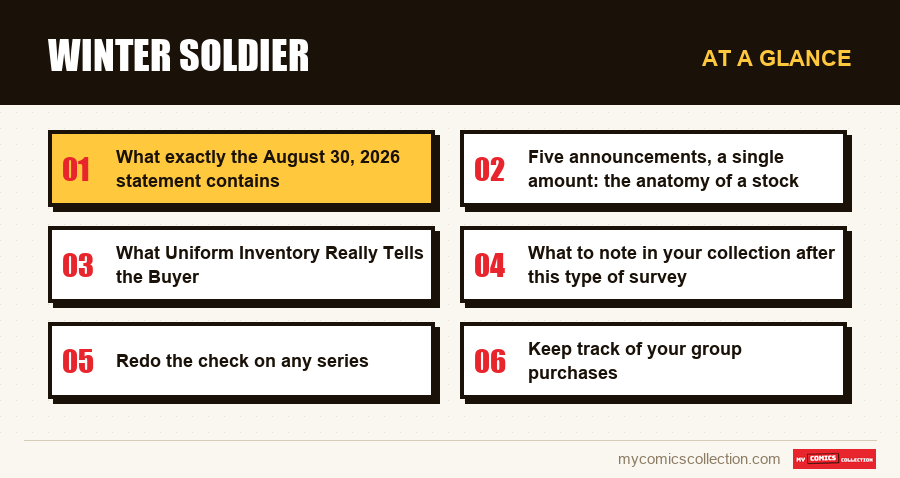
What exactly the August 30, 2026 statement contains
Let's start by stating the figures as they are, with their limits. The query “Winter Soldier Winter Soldier 1 2012” returns 118 unverified listings on a general auction site in the US market. The lowest amount charged is $2.15, the middle amount is $9.99, the highest is $999.00. Separately, just seven listings are for copies that have passed a review agency: they range from $56.00 to $899.00, with $110.00 in the middle. None of these amounts correspond to a completed transaction. These are sums claimed by sellers on advertisements that are still open, that is to say sales intentions and not agreements between two parties.
This distinction is not a scruple of language. An asking price binds only one person, the one who publishes it. A price paid commits two people, and it is this meeting which gives a figure its intelligence value. As long as the ad remains online, it only proves that a seller is hoping to get that amount. The high at $999.00 is entirely about this hope: it establishes nothing, it leads to nothing, it should not be used for any reasoning. The same goes for the high at $899.00 on the verified side.
Another limitation, just as important: this reading was taken on a single date. It therefore does not contain, by construction, any information on a movement. Comparing two columns of the same snapshot does not produce a trend; it would take at least two photographs separated in time, taken with the same request and the same counting rules, to start talking about direction. Any sentence like “it goes up” or “it goes down” based on these numbers alone would be a pure invention.
Finally, the seven verified ads do not form a usable sample. Seven is a workforce where a single eccentric announcement moves the center by several dozen dollars. I therefore conclude nothing about the price level of the verified copies: I note that they exist, that they are rare in this survey, and that their dispersion is too wide for such a small number. Refusing to conclude is part of the job; producing a seven-line average would be dressing up, not reading.
Five announcements, a single amount: the anatomy of a stock
The highlight of the survey is at the very bottom of the scale. The five cheapest listings all ask for exactly $2.15. They concern three different numbers (the second, third and fifth) and two of these numbers each occur twice. Each label ends with the same mention of combined shipping, and the announced status barely varies from one line to the next. Such an alignment does not happen by chance between five people who do not know each other.
The amount identical to the cent
$2.15 is not a round number. Two independent sellers who aim at the low end choose different psychological thresholds, and rarely the same improbable decimal place. Five lines at the same exact amount designate an inventory rate applied in bulk to an entire batch of issues.
The repeated label suffix
All five titles end with the same mention of grouped shipping, written in the same way. A label is composed by hand or generated from a template; word for word repetition betrays the template, therefore a single operator behind the five lines.
Same issue published twice
The second and fifth numbers each appear on two separate ads, at the same price. No one puts the same copy on sale twice: they are two copies of the same issue, therefore one stock, each published on its own line.
Three neighboring numbers treated the same
The second, third and fifth issues receive the same price even though nothing makes them equivalent for a reader. A uniform price across different numbers indicates lot weight pricing, not number by number pricing.
Taken separately, these four observations could pass for coincidences. Gathered on the same five lines, they leave little room for doubt. The practical consequence is direct: the bottom of the statement is not populated by five competing offers which would have come together through comparison, but by a single offer declined five times. A buyer who saw in this alignment proof of a “market price of $2.15” would be committing an elementary reading error, that of confusing the number of lines with the number of reviews.
Counting ads is not counting sellers. A uniform stock published announcement by announcement mechanically increases the number of a statement without adding the slightest independent information, and nothing in the raw figures indicates the operation.
The distinctive sign is the exact repetition: same amount, same wording, same shipping note. This check requires thirty seconds of reading and is better than any calculation applied to data already distorted upstream.
Why is the center of the reading moved?
The central value of a series of numbers has a property that is often presented as a guarantee: it resists extremes. An isolated high at $999.00 doesn't move it. This is true, and this is precisely what makes the stock trap so effective, because this trap does not attack by extremes but by numbers. Adding five lines at the bottom of the scale does not create any outliers to discard: it simply moves the middle row. The usual filter sees nothing pass.
Now let's imagine that the same actor did not publish five lines but thirty, which is commonplace for someone who liquidates a full fund. The reading would then display a reassuring number, an apparently stable median and a narrower dispersion at the bottom. However, he would only observe a single commercial decision, taken once, duplicated thirty times. The median would become the price of a store and not the level of a market, without any indicator in the table indicating this.
This is why I place the duplicate check before the calculation, and not after. Once the median has been calculated, it can no longer be corrected without returning to the list of labels; and if we come back to the list, we might as well have read it first. The correct sequence is therefore: read the first five to ten lines, spot the repetitions, group the lines which obviously come from the same source, then only look at the remaining number. Often, there are far fewer sightings than reported, and this reduction is the most useful information in the survey.
This reasoning applies symmetrically at the top of the scale, even if the mechanism is less frequent there. A seller who published ten copies of the same issue at a very high price would produce a high pile, just as uninformative. In the August 30 reading, the unverified high is isolated and not repeating, making it an individual hope rather than a stock policy. Isolated or repeated, it notices nothing.
What Uniform Inventory Really Tells the Buyer
Once the statistical illusion is ruled out, the discovery remains useful: it simply does not provide information on what we believed. Recognizing a stock says nothing about the price level of the stock, but it does say a lot about immediate buying conditions, including the pace at which it is reasonable to move forward.
Read the labels before the columns
The table of figures does not display the origin of the lines; the text of the advertisements, yes. A few seconds of reading the headings reveals what no column of amounts will ever indicate.
One date, no trajectory
The August 30, 2026 statement is a snapshot. It allows us to describe a situation, never to announce an increase or a decrease, for lack of a second point of comparison taken under the same conditions.
Requested is not paid
Each statement amount is claimed by a seller on a current listing. None proves that a buyer accepted this level, or even that a buyer came forward.
Combined shipping betrays the cart
The mention of grouped shipping, repeated on the five lower lines, indicates a seller who constructs baskets of several issues rather than single sales. Its price list follows this logic.
Same number twice
The second and fifth numbers appear twice at the same amount. This is the signature of availability in several copies, therefore of an offer which will not run out within an hour.
Seven lines checked, zero conclusions
The copies passed by a verification body are only seven in this statement, for a range of $56.00 to $899.00. The workforce is too small to support any assertion about their level.
The most concrete point is that of availability. When the same number is offered twice by the same source at the same amount, the immediate scarcity disappears: there is still stock, and there will probably be some left tomorrow. The urgency argument, the one that pushes you to buy right away before the opportunity evaporates, simply does not apply here. You can take the time to check the actual condition, ask the seller a question, and compare with other sources. This time is free and the offer is waiting for him.
The mention of grouped shipping confirms this reading in another way. A seller who displays it systematically seeks to increase the basket rather than optimize each unit sale, which explains a very low unit price. It does not set the price of a booklet; it sets the price of entry into a lot. The difference is decisive when transferring this amount somewhere.
Collecting this series?
Track what you own, what you are missing and what your collection is worth. 7 day trial.
Start my trial →What to note in your collection after this type of survey
Note the grouped provenance, not just the amount. If you purchase three issues of The Winter Soldier from the same source, with combined shipping and an identical unit price applied as a block, this unit amount does not have the same nature as a price paid for a copy chosen alone. Write in the form for each number that it comes from a group purchase, and attach the three lines to the same purchase event. Without this mention, you will later reread three prices which will appear comparable to unit purchases when they are not.
Record the allocated shipping cost, not just the listed price. The interest of a lot lies in the shared shipping: this is precisely what makes the unit price so low. If you only record the amount of the ad line, you systematically underestimate what each issue really cost you. Note the total port and the distribution key that you have chosen, even approximate, so that the figure remains interpretable in two years.
Mark the exact number, never the title alone. The report mixes advertisements for three different numbers under the same query, and two of them appear in duplicate. A sheet that only retains the name of the series reproduces this confusion in your own collection. Each copy deserves its number in the field provided for this purpose, otherwise you will no longer know which of your copies corresponds to which purchase line.
Record the statement date next to any reference amounts. A figure recorded on August 30, 2026 is only valid for that day. If you note an indicative value in a file without its date, it will age silently and you will continue to reason about it without knowing that it is out of date. The date transforms fragile data into honest data: it warns your future reader, who will be yourself.
Separate what you paid for from what others are asking for. Your collection must distinguish two distinct fields: the price actually paid, which is a fact about you, and the amount observed in an ad, which is an intention about someone else. Mixing the two in the same column makes the whole thing unreadable, and transforms the $2.15 in liquidation stock into the pseudo-value of your copies.
Redo the check on any series
The method depends neither on the character nor the era. It consists of three steps that apply to any ad statement, regardless of the publisher or the decade concerned. First step: display the results from least expensive to most expensive and read the labels of the first ten lines, without looking at the amounts. Second gesture: surround the repetitions: same wording, same logistical mention, same number that comes back. Third action: recount the number, considering each group spotted as a unique observation.
The result of this recount is often brutal. A statement advertised with more than a hundred lines may contain only a handful of truly independent ones once the stocks are grouped together. This reduction is not bad news: it is the first reliable information in the statement, and it prevents you from building your reasoning on nothing. It is better to know that you have ten real observations than to believe you have a hundred and ten.
The same reflex applies to neighboring titles from the same editorial family. The Winter Soldier issues cross over with those of Captain America, and a seller who liquidates a crate happily mixes the two together in the same publication wave. If you follow several related titles, you will sometimes see the same wording template appear from one title to another: the signature of a single actor who simultaneously weighs on two statements that you thought were independent. To situate these titles in relation to each other, the identification of key issues of Captain America and the reminder of editorial history of Captain America avoid confusing two series in the same count.
There remains a question of framing that this survey does not and cannot resolve: the gap between what an adaptation says and what a booklet contains. The expectations of a buyer who comes via the screen do not relate to the same numbers as those of a reader who comes via the printed series, and this difference can sometimes be seen in the wording of the advertisements. The comparison between the 2014 film and the booklets it was inspired by helps you know what you're looking for before opening a statement, and therefore not buying a number for a scene it doesn't contain.
Finally, if your goal is to put together a complete series on a low budget rather than aiming for a specific example, a uniform stock may be just the opportunity you need: as long as you know it's one. The mechanism described here does not condemn this type of offer: it only prohibits it from being read as a market measure. The benchmarks collected in the guide for buy these booklets without breaking the bank combine well with this duplicate check, because they also reason in batches rather than in isolated pieces.
Three indices are combined and read without tools: a strictly identical amount down to the decimal place, a wording repeated word for word, and a common logistical mention such as grouped shipping. In the August 30, 2026 statement, the five cheapest ads combine all three at $2.15 each. When the same issue costs the same amount twice, the demonstration is complete: no one sells the same item twice.
It correctly describes the list as published, but that list does not represent one hundred and eighteen separate decisions. As part of the lower lines comes from a single source, the middle row is moved without any aberrant point appearing. It is better to consider it as the center of an announcement table, not as the level of a market, and to group the lines from the same stock before any calculation.
They range from $56.00 to $899.00 with $110.00 in the center, which represents a considerable range for seven observations. Such a thin number does not support any conclusion on a price level: it would be enough for a single announcement to disappear for the central value to move clearly. I note their existence and their rarity in this statement, nothing more.
No. This amount is claimed by a seller on a current ad, without any buyer having accepted it. An isolated summit reflects the hope of the person who publishes it, never an established price. It should not enter into any reasoning about value, and especially not serve as a reference for valuing a copy that you already own.
In this specific case, no: the same number offered twice at the same amount by the same source indicates stock, therefore availability that will last. The supposed emergency does not exist. Take the time to check the advertised status, to verify that it is the number you are looking for, and to see if the shipping grouping makes it interesting.
Keep track of your group purchases
A unit price from a batch cannot be compared to a price paid per unit. My Comics Collection allows you to record each copy with its exact number, the date of purchase, the amount actually paid and the nature of the transaction, so that your history remains readable long after the ads have disappeared.