A volume number does not designate a book: it designates a place in a given collection, and two French collections number each from 1. A survey of 273 advertisements taken on August 30, 2026 reveals two linked collections of Marvel stories: one with 81 distinct issues, the other with 43. Thirty-four issues exist in both at once. The same story dedicated to the Winter Soldier is numbered 41 in one collection and number 59 in the other. Without the name of the collection, the volume number does not identify anything.
The booklet has accustomed collectors to a convenient reasoning: a series, a number, an object. The bound book breaks this reasoning, and the break often goes unnoticed because the form of the data has not changed. There is always a title and always a number. But the number no longer counts the publications of a series: it counts the volumes of an editorial collection, which brings together unrelated stories, borrowed from different series.
The consequence is immediate. Two competing collections can publish the same story, each in its place in its own order. The object is comparable, the content is comparable, and yet the two numbers have no relation to each other. This is not an anomaly: it is the normal functioning of a collection numbering, and it is enough to ignore it for a moment to create a false record.
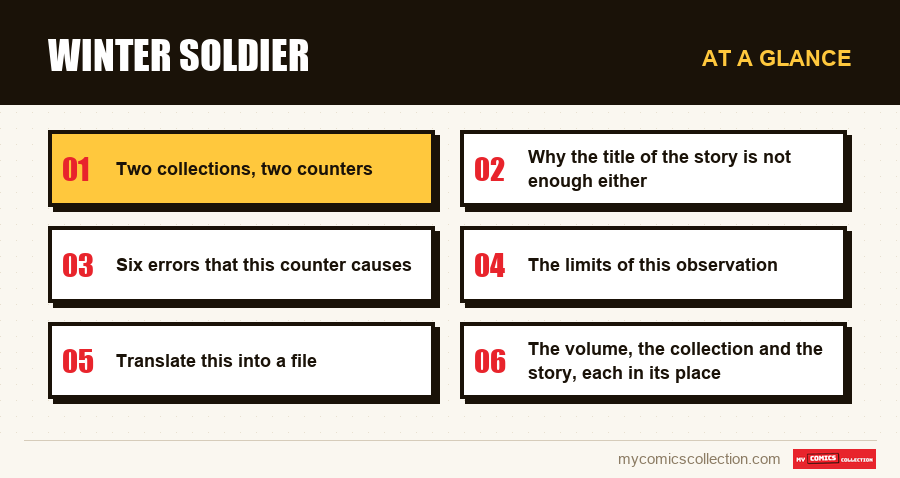
Two collections, two counters
I surveyed the French market on August 30, 2026 on three requests for bound editions, then duplicated: 273 separate announcements. The amounts quoted are are requested that day, no sales were ever concluded; a statement taken on a single date describes an offer and does not measure any evolution.
Two collections dominate this set of results. The first appears in 191 advertisements and covers 81 distinct issues, ranging from 1 to 118. The second appears in 81 advertisements and covers 43 distinct issues, ranging from 3 to 277. These are two separate editorial enterprises, each with its own order, rhythm and scope.
The decisive figure is that of recovery: 34 issues exist in both collections at once. The numbers 3, 5, 6, 9, 10, 11, 14 and around thirty others designate a volume in one and a different volume in the other. For these thirty-four values, a sheet which only retains the number describes two books simultaneously, which amounts to describing none of them.
Same story, two rows
The story dedicated to the character is numbered 59 in one collection and number 41 in the other. Two ads explicitly cite 59, three others 41, for content presented in the same way.
Trente-quatre collisions
Of the 81 and 43 numbers noted, 34 values are common to both collections. A volume bearing one of these numbers is ambiguous until the collection is named.
Very different areas
From 1 to 118 for one, from 3 to 277 for the other. A high number only belongs to the second: this is the only case where the number alone removes the ambiguity, by elimination.
Distinct price levels
Median of €9.00 out of 191 ads for one, €19.90 out of 81 ads for the other. Confusing the two collections distorts any estimate.
A word about these medians, because they must be read with caution. They concern announcements which mix single volumes and lots, very diverse states and different sellers; they locate two levels of asking prices, they do not compare two identical objects. The maximums recorded (several hundred euros, and up to a four-figure amount) are the hopes of isolated sellers, not benchmarks. This is precisely why the median, with its number of observations, says more than any extreme.
What makes this trap effective is that the volume number looks like a serial number. Same position in the title, same form, often the same word in front: “n°”, “volume”, “volume”. Nothing tells the reader that they are changing numbering systems.
However, the two systems do not answer the same question. The serial number says “what publication”. The volume number says “which place in which catalog”. The second question necessarily calls for two pieces of information, and a sheet which only provides one will always lose one.
Why the title of the story is not enough either
One might think that noting the name of the story settles the question: since both collections publish the same story, it would be enough to designate it by its title. This solution fails for two distinct reasons, and it's worth separating them.
The first is that the title of the story does not identify the subject. Two volumes from different collections, containing the same story, remain two different books: format, pagination, editorial apparatus, selling price. A collector who owns one does not own the other, and a file that only records the story no longer allows you to tell which one he has on his shelf.
The second is that the announcements do not quote the title of the story in a stable way. The statement shows the same story announced sometimes under its title alone, sometimes preceded by the name of the main character of the original series, sometimes reduced to a mention in a list. This is not a fault of the sellers: it is that a story included in a collection does not have a unique designation, and that everyone names it as they understand it.
You therefore need three pieces of information, not one: the name of the collection, the number in this collection, and the title of the story. None replaces the other two. The first two identify the object, the third allows you to find it when you search by content.
Six errors that this counter causes
Two books on a line
A “volume 17” without collection can designate two distinct volumes. The sheet appears complete and yet does not allow you to know which one is in the box.
A duplicate purchased twice
The same story, published in numbers 41 and 59 of two collections, is purchased twice without any warning. The inventory does not indicate any redundancy since the numbers differ.
A series never complete
Mixing volumes from the two collections in the same suite creates permanent gaps: we look for numbers that belong to the other catalog.
Une estimation faussée
Two very different asking price levels, €9.00 and €19.90 median. Assigning the reference of the other collection to a volume shifts the estimate in one direction or the other.
An unstable story title
The same story is announced in several formulations. Searching by title returns only some of the offers, without indicating what is missing.
Un contenu mal attribué
A collection volume brings together episodes from an original series. Confusing the rank of the volume with those of the episodes it contains blurs the two accounts.
Collecting this series?
Track what you own, what you are missing and what your collection is worth. 7 day trial.
Start my trial →The limits of this observation
The statement describes what sellers were offering on a given day, not the actual catalog of the two collections. The 81 and 43 numbers observed are those which were on sale at that moment; both catalogs certainly include other volumes that were not advertised that day. The number of actual collisions is therefore probably greater than thirty-four, but I cannot put a number on it and I refrain from estimating it.
I can't say anything about the dates of publication, nor the order in which these collections followed one another or coexisted. The advertisements cite years too irregularly for a chronology to be drawn from them, and a sales notice does not have the value of a publisher's document. What the survey establishes is due to the structure: two independent counters, a large overlap, a story identified with two different ranks.
Finally, the gap between the two medians does not prove that a collection is “worth” more than the other. It may relate to the format, the average condition of the copies offered, the presence of lots, or simply the composition of the offer that day. What it establishes is more modest: the two ad populations are not at the same asking price level, which is enough to make the confusion costly.
Translate this into a file
La règle : for a collection volume, the collection is part of the identity, exactly like the series for an issue. The inventory line is not written “volume 41” but “name of the collection, volume 41”. It is this couple, and it alone, which designates an object.
Add the story title in a separate field rather than in the collection name. It is used to find the volume when you search by content, and above all it allows you to detect redundancy: if two lines in your inventory bear the same story title under two different collections, you have the same story twice. Without this field, this information does not exist anywhere.
Finally, get into the habit of noting, when the announcement or the volume specifies, which episodes of the original series are repeated. This is the most tedious information to enter and the most useful in the long term: it alone allows you to know if a booklet that you are about to buy is already with you in another form. The report also shows advertisements which give this precision themselves, in the form of a range of original numbers; when it is provided, it is worth keeping as is.
None of this is comfortable when typing. Three fields instead of one, for an object that we thought was simple. But the alternative is not to save time: it is to build up an inventory where at least thirty-four numbers refer to two different books, without anything notifying you the day you need it.
Because the number counts the volumes of a collection, not the publications of a series. Two French collections publishing the same story each give it its rightful place in their own order: 41 for one, 59 for the other in the statement of August 30, 2026. The two numbers are exact, they simply do not speak of the same catalog.
By the name printed on the volume, and by it alone. The number does not help: 34 values are common to both collections in the statement. An exception: a very high number only belongs to the collection whose extent goes beyond, which removes the ambiguity by elimination, but this is fragile reasoning, not to be generalized.
No, for two reasons. Two volumes of different collections containing the same story remain two books distinct in their format and their editorial apparatus. And the announcements do not name the story in a stable way: the statement shows it announced in several formulations. The title is used to find, it does not identify.
The two ad populations are not at the same level: €9.00 median on 191 ads on one side, €19.90 on 81 on the other. This difference may be due to the format, the condition of the copies or the presence of lots: it does not prove that a collection would be worth more. On the other hand, it is enough to make the confusion costly.
By entering the title of the story in a separate field in the collection. Two lines with the same title under two different collections immediately indicate redundancy. Also note, when the information is given, the original episodes included in the volume: this is the only way to know if a coveted booklet is already with you.
The volume, the collection and the story, each in its place
My Comics Collection keeps the three separately, so that two different books stop occupying the same row.