Winter Soldier: the first chapter of a story is worthless, it's the revelation that pays for itself
On August 30, 2026, on a general American auction site, number 8 of the series Captain America from 2005, the one that opens “The Winter Soldier” arc, was offered between $1.99 and $3.78 in its lowest listings, with one copy declared very damaged at $0.99. The same day, number 14 of this same series, the one where the origin of the character is told, was priced between $14.99 and $18.87. These are amounts requested by sellers, not completed transactions. In other words: the market does not pay for the space in the story, it pays for the information contained in the booklet.
In almost all collections there is a silent distortion that no one corrects, because it is only visible if two neighboring numbers are noted on the same day. A story to follow is built over several parts: an opening chapter which establishes the situation, a progression, then an episode where something changes and becomes public. The reader needs the whole thing. The buyer does not behave at all like the reader: he concentrates his request on the episode where the information is delivered, and abandons the rest of the arc at prices that border on the shipping cost. The first chapter, although strictly essential, can be picked up for two dollars.
This is not a local oddity or an accident of timing. It is a structural mechanism: the market value of a booklet is indexed on what it contains that is nameable (a first appearance, a revelation, a change of status) and not on its narrative usefulness. An opening chapter contains, by definition, nothing nameable: it sets up. It is therefore invisible to speculative demand, and this is exactly what makes it the best reading/price ratio available in an entire collection. The survey carried out on August 30, 2026 allows us to put an order of magnitude on this gap rather than describing it freehand.
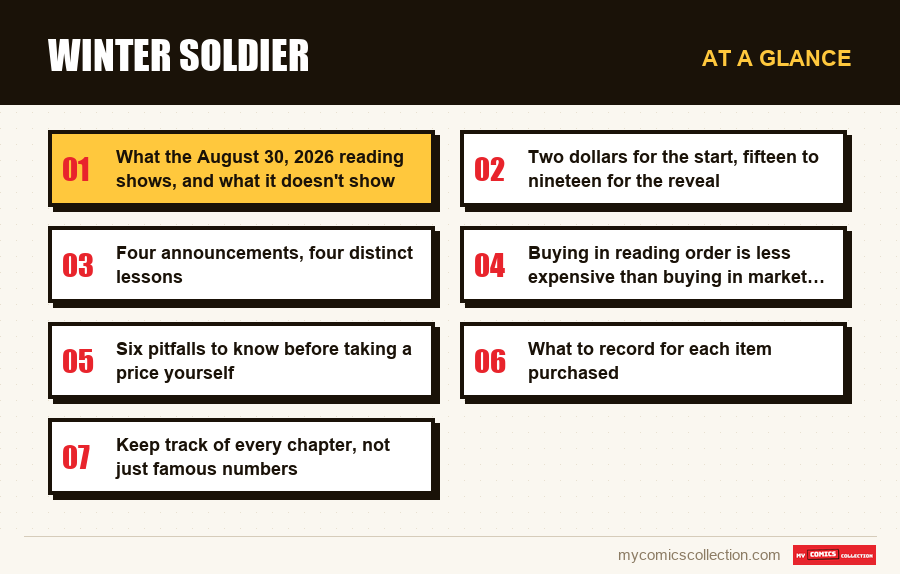
What the August 30, 2026 reading shows, and what it doesn't show
The starting point is a simple query, “Winter Soldier Captain America 8 2005”, queried on a general auction site oriented to the American market. It shows 43 listings without certification, with a lower limit at $0.99, a median value at $9.99 and an upper limit at $450.00. Next to it, counted separately because they do not describe the same product, 9 copies passed by a verification organization: minimum $31.99, central value $65.00, maximum $529.90.
These numbers call for a precaution that I prefer to pose before any reading: none of the above is a sale price. These are amounts displayed by sellers who hope to obtain them. A $450.00 ad can stay online for months without ever meeting a buyer; it measures an ambition, not a market level. The maximum of a statement is therefore the least useful information in the whole table, and I only use it here to show the amplitude of the space where the requests are dispersed.
Second precaution, just as important: this reading was taken on a single date. A photograph does not show movement. Nothing here authorizes us to say that this number is going up, down, or stabilizing: it would take at least two readings spaced over time, built on the same query and the same sorting rules, to pronounce the word evolution. All I can say is what was called for on August 30, 2026, in this specific research configuration.
Third precaution, on the verified copies: 9 announcements, that's a derisory number. Out of such a small number, a single atypical offer moves the central value by several tens of dollars, and two sellers who withdraw their ad the next day are enough to change the picture completely. I therefore refuse to draw a conclusion on the price level of this segment. The only solid statement is a statement of structure: copies passed by a verification body start significantly higher than the bottom of the uncertified market, which is true of any booklet and does not teach anything specific about it.
Two dollars for the start, fifteen to nineteen for the reveal
It is the comparison which gives this statement its full significance. The same day, with the same method, a second survey focused on number 14 of the same series: the one where the origin of the character is told. It shows 53 listings without certification and a median of $35.00, with items fetched between $14.99 and $18.87 in the low end. Faced with this, the opening chapter showed $1.99, $2.69, $3.78.
The ratio is therefore of the order of one to seven or one to nine between two issues published in the same series, a few months apart, written in continuity with one another. No difference in objective rarity explains this: nothing in the data says that one was printed less than the other, and I am careful not to assume so. What separates them is what is expressible in them. The number 14 carries information that can be summarized in one sentence in an ad title. Number 8 carries a mise en place, that is to say something which cannot be summed up and therefore cannot be sold.
We also see this mechanism at work in the way sellers themselves write. An ad for issue #8 is titled "Captain America #8 - "The Winter Soldier," Part I" and is asking for $1.99: the seller knows exactly what he's selling, he names it correctly, he even indicates the position in the arc, and he sells it for two dollars. It's not ignorance, it's lucid arbitrage: he knows that this issue has no speculative demand and he prices it at its reading value.
This discrepancy deserves a broader reading than just the present case. In any series to follow, the same asymmetry is reproduced: the establishment episodes and the transition episodes constitute the mass of the issues, they are abundant, they are in little demand, and they are exchanged at the bottom of the market. Identifying where the boundary between "number that contains nameable information" and "number that does not" is the most profitable skill a collector can develop, well ahead of any consideration of status or certification. The ranking of key issues of Captain America does not ultimately say anything else: it lists the fascicles that can be stated, and leaves everything else in the shadows.
Four announcements, four distinct lessons
The $0.99 copy declared very damaged
“Captain America #8 (Marvel Comics September 2005) Comic Book Poor,” less than a dollar. The declared state is the lowest on the scale, but a booklet in this state can be read in its entirety: the pages are there, the ink is there, the story is complete. On a title published in 2005, wear only has consequences if the object itself is the objective. To read the opening of the arc, this is the best price on the reading.
The announcement that names the position in the arc
“Captain America #8: “The Winter Soldier,” Part I” for $1.99. This is the most informative title of the report: it gives the title of the arc and the exact place of the fascicle within it. A buyer looking for where to start reading gets their answer in the title of the ad, without having to open the file. Wording of this quality is better than a three-line argument.
The wording that ends with an internal code
“Captain America #8 Winter Soldier Part 1 (2005) UCB5” at $2.69. The end of the title is not a variant, an edition or a grade: it is a storage reference specific to the seller. Confusing this type of suffix with a characteristic of the fascicle leads to believing in a distinction that does not exist, then to paying for it. A stock code cannot be searched or compared.
The generic mention without complement
« (2005) Captain America #8: KEY ISSUE! [...] (7.0/7.5)” at $3.78. The catchword is set without ever saying what the number would be the key to. A mention of this type does not provide any verifiable information: it occupies the place where the reason should have appeared. Compare with the previous ad, which for a lower price indicates precisely what the reader is buying.
These four labels, placed side by side, draw an unexpected hierarchy: the most expensive ad in the lot is also the least informed, and the two-dollar ad is the one that best describes its merchandise. The displayed price is correlated neither to the quality of the description, nor to the usefulness of the object for those who want to read. It reflects the seller's confidence in a catchword. This is reason enough to never sort a statement by ascending price assuming that the order reflects anything other than independent individual decisions.
An ad without certification and a verified ad do not describe the same product and should never be mixed in the same calculation. The second includes an expert service and a sealed case; the first includes a booklet and the seller's word on its condition. Adding the two populations produces an average that does not correspond to any actual transaction.
Here, the verified population has 9 listings. This is too little to say anything reliable about it, and I prefer to explicitly rule it out rather than present it as a range. All conclusions in this article relate exclusively to the 43 unverified advertisements, and only to what was claimed there on August 30, 2026.
Collecting this series?
Track what you own, what you are missing and what your collection is worth. 7 day trial.
Start my trial →Buying in reading order is less expensive than buying in market order
This is the practical consequence, and it is almost counterintuitive. For a reader, the hierarchy of the market is exactly reversed compared to the hierarchy of use. The opening chapter is essential: without it, the situation is not established and the rest floats. The revelation episode cannot be understood without the chapters which prepared it: it draws all its strength from what was established previously. The most expensive booklet is therefore the one which depends the most on the others, and the least expensive is the one on which all the others depend.
This results in a simple purchasing strategy: start at the beginning, and leave the reveal number for later. Not out of moral discipline, but because it is arithmetically cheaper. A reader who buys the opening and progression chapters of an arc spends, at the levels recorded on August 30, 2026, a few dollars per issue. The same budget, spent on the enunciable episode alone, buys a booklet that it will not be able to locate.
This logic applies beyond a single arc. She explains why it is possible to build up a considerable reading library for a paltry budget, provided you accept not having the three or four booklets per series that everyone is chasing. This is the reasoning developed in the dedicated guide for buy Captain America at a low price: aim for continuity rather than summits, and let speculation concentrate where it wants to concentrate.
It remains to be seen in what order to read, and here again the market is a poor guide: it ranks by desirability, not by chronology. An arc is read in the order of publication; a character's career is read in an order which is not always that. This is precisely what is used to establish a reading path constructed separately, independently of prices.
Six pitfalls to know before taking a price yourself
The lower limit is not the desired object
The bottom of a statement attracts ads that don't match the query. Here, another stock sharing the number and year goes back to $3.20. Check the exact name of the series on each line selected, never just the number.
A date is not enough to identify
2005 is a very busy publishing year. The same number and the same year can designate several publications without any connection. The date restricts the field, it does not individualize it.
An unmotivated teaser mention
A word praising the importance of the booklet, without saying what, is worthless. Conversely, a label that names the arc and the part provides verifiable information. Only pay for the second.
Seller's storage codes
Alphanumeric suffixes at the end of the title are used to find the issue in stock. They do not designate either a variant or an edition. Ignore them completely when comparing ads.
Mix verified and unverified
Two populations, two products, two price levels. Counting them together creates an intermediate value that describes neither. Note them separately and comment on them separately.
Take as much as possible for a reference
An ad far above the rest expresses the hope of an isolated seller. She did not meet any buyers at the time of the survey. It is used to measure dispersion, never to set an expectation.
What to record for each item purchased
The exact position of the fascicle in the arc. Note “part I on…” rather than just the number, because it is this information that makes the sheet useful years later. An isolated number requires you to mentally reconstruct the order of the story each time you consult the collection; a noted position immediately tells whether the set is complete and, if not, what is missing. It is also what allows, at a glance, to identify that we have the episode of revelation without having the chapter which sets it up.
The exact title of the series, written in full. Since another title here shares the same number and the same year, a simple “#8 (2005)” in a file is a time bomb: when it comes time to complete the series, the line will not allow you to distinguish what is possessed from what is not. Write the full title, as it appears on the cover, and the year the specific issue was published: not the year the series was launched.
The condition noted by you, upon receipt. The condition stated in a listing is the seller's opinion; on a model advertised at the lowest of the scale, the gap between the announcement and reality can work in both directions. Open the booklet, look at the spine, the corners, the interior pages, and record what you see. This note is valid for resale, but especially to know if the copy supports repeated readings.
The reason you keep it: read or keep. This is the most neglected and decisive field. A copy purchased to read has no condition requirements, can be handled freely, and can be replaced for a few dollars. A copy purchased as an object obeys opposite rules: protection, non-manipulation, attention to conservation. The same number can occupy both roles in a collection; not noting which leads to treating a reading copy as a fragile piece, or the opposite.
The price paid, including shipping, and the date of purchase. On a booklet advertised for two dollars, shipping often represents most of the actual expense: a price noted without postage gives a false idea of the cost of the collection. The date is what will one day make a comparison possible: since a single statement says nothing about an evolution, only a history of your own dated purchases will allow you to see something later.
Because it doesn't contain any information that a seller can say in three words in a listing title. The speculative request concerns what is called: a revelation, a first appearance, a change of state. An opening chapter sets up a situation, which is essential for reading but impossible to summarize commercially. On August 30, 2026, this translated into requests around two to four dollars for issue 8, compared to fifteen to nineteen dollars for issue 14 of the same series.
Yes. A condition declared at the lowest describes degradation of the object (dulled corners, marked spine, worn cover) not a loss of contents. The story is fully present. On a booklet published in 2005, that is to say on recent paper, the question of condition only becomes decisive if one collects the object rather than the history. To read, the $0.99 statement ad does the same job as any other.
They do not allow us to conclude. Nine ads is a workforce where a single unusual offer moves the central value by several dozen dollars. We can only observe one thing, banal and true of all the fascicles: the verified population starts clearly above the bottom of the non-certified market, because it integrates an expertise service in addition to the fascicle. No price level specific to this number can be deduced from this.
No, and this is important: all the values cited come from a single reading, taken on August 30, 2026. A measurement taken on a single date cannot by construction show any movement. It would take at least two spaced statements, built on the same query and the same rules, to speak of evolution. These are also amounts claimed by sellers, not sales concluded.
By checking the full name of the series on each selected ad, line by line, before comparing prices. The August 30, 2026 statement contains another security with the same number and the same year at $3.20: nothing in the price indicates the error, only the wording does. The general rule is that a number and a year are never enough to identify an issue, even on a recent and well-documented story.
Keep track of every chapter, not just famous numbers
A reading collection is judged by its continuity: an arc whose opening is missing cannot be read, even if the most expensive number is there. My Comics Collection records for each copy its position in the story, the exact title of the series, the condition noted and the price paid including shipping, and shows you the missing chapters at a glance.