
Nobody knows the print runs of French comic magazines from the 1960s to the 1990s, because those figures were internal publisher management data and were never published issue by issue. The catalogue documents issue numbers, cover dates, story titles and creators, not printed quantities. A collector is not left empty-handed for all that: publishing span, pace, date precision and what passes through the sales channels are measurable clues, provided you know what each one measures.
The question comes up in every discussion among French-language magazine collectors, and it is legitimate: knowing how many copies of an issue came off the presses would help judge whether the one you have been hunting for three years is genuinely rare. The problem is that no serious answer exists, and that absence is itself useful information. It is better to understand why the data is missing, then work with the data that does exist, than to repeat a figure heard at a flea market.
As always on this guide, only verified information (creators, issue numbers, dates) is stated as fact; the analysis is our own, with no reproduction of artwork or protected dialogue.
What the catalogue documents, and what it does not
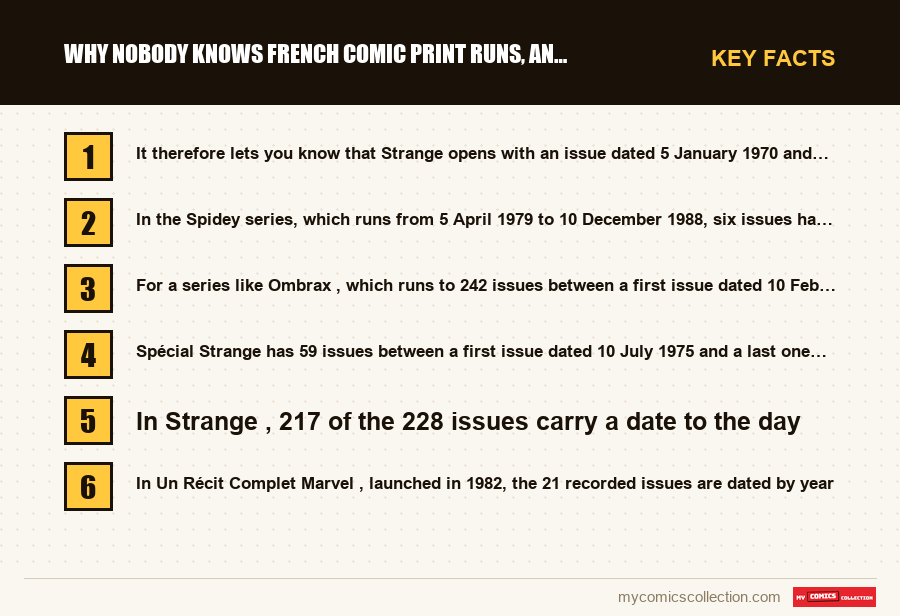
Let us set the limits right away. For each issue listed, the catalogue records the number, the date printed on the cover, a story title, and the writer or writers and the artist or artists. It therefore lets you know that Strange opens with an issue dated 5 January 1970 and closes, under its first publisher, with issue 228 dated 5 December 1988. That is publishing information, not industrial information.
Nowhere in this structure is there a field for the printed quantity, for copies put on sale, or for unsold copies returned by the distributor. These figures were not left out through carelessness: they did not belong to the same world as the contents pages. A contents page is read on the object; a print run is read in an accounts ledger.
We must go further in honesty still. The catalogue is not complete even on what it claims to document. In the Spidey series, which runs from 5 April 1979 to 10 December 1988, six issues have neither a story title nor a writer recorded, and one has no date. If a database built on decades of cataloguing leaves gaps in fields that can be read with the naked eye, the idea that it could yield production figures is wishful thinking.
Why these figures never circulated
These magazines were press publications. They arrived at the newsagent in a bundle, stayed on the shelf for the length of a cycle, and then unsold copies went back. The print run was therefore a decision revised continuously, title by title, according to what the distributor reported the previous month. That kind of decision is not published: it is recorded internally, and the internal records disappeared with the companies, the moves and the estates.
There is also a vocabulary problem. The print run, the paid circulation, the distribution quantity and the actual sales are four distinct quantities, and one and the same figure heard at a fair may refer to any of them. When someone from the house recalls from memory what a title "did", they are talking about an average sale over a successful period, not about the printed quantity of the issue you are holding.
Finally, the sources disagree, and that is normal. Publisher testimonies, interviews given long after the events, and studies of the children's press agree neither on orders of magnitude nor on periods. We will not settle the question, and we will not repeat any of these figures: quoting them would give a memory the appearance of a measurement.
The figures in circulation, and why they are fragile
A print figure presented as established almost always suffers from the same flaw: it holds for one specific moment, and it gets applied to everything. Either it describes the launch, when the publisher prints wide to establish itself, or it describes the peak of the title, and it is extended to years that have nothing to do with it. Sometimes it mixes several publications from the same house, or it has been rounded and then hardened into certainty by sheer repetition.
The test is simple: ask which year the figure refers to, and which specific issue. For a series like Ombrax, which runs to 242 issues between a first issue dated 10 February 1966 and a last one dated 10 March 1986, a single figure cannot hold for twenty years of publication, of readership changes and of format changes. If the answer remains vague, the figure is worth nothing for your buying decision.
First substitute: the publishing span
Span is the most solid substitute, because it is directly readable from the cover dates. It measures one precise thing: the title's perceived profitability over a long period. A publisher does not keep a magazine going for close to nineteen years, as with Strange under its first publisher, without it finding its audience month after month.
What span does not measure, on the other hand, is the printed quantity of a given issue. An established magazine may well have seen its print run melt away in its last period while continuing to appear, because it stayed above the threshold at which the publisher stops. Span tells you that a title was widely distributed over the whole; it tells you nothing about its last third, which is often the segment collectors look for most.
Second substitute: the pace, and the trap of "one issue, one month"
Pace is calculated by dividing the number of issues by the span of dates. It measures the volume of paper released per unit of time, and therefore the exposure of a title to its readership. For Strange, it is close to one issue per month throughout the run, which makes it a monthly appointment object.
The trap is to generalise. Spécial Strange has 59 issues between a first issue dated 10 July 1975 and a last one dated November 1988: a much more spaced-out publication, roughly one issue per quarter. With comparable spans, these two magazines therefore did not have the same physical presence in the country, and it would be wrong to reason about one as if it were the other. Pace measures frequency; it does not measure the thickness of a stretch on the shelf.
Do you collect this series?
Track what you own, what you are missing and what your collection is worth. 7-day trial.
Start my trial →
Third substitute: the precision of the cover date
This is a clue that almost nobody exploits, and yet it is readable on every copy. Some series are dated to the day, others to the month, others to the year alone. In Strange, 217 of the 228 issues carry a date to the day. In Un Récit Complet Marvel, launched in 1982, the 21 recorded issues are dated by year.
This difference is not a data-entry accident; it is the trace of the sales channel. A date to the day serves to manage rotation on the newsstand: it tells the newsagent when to pull the issue. A date by year only makes sense for an object that stays available for a long time, in a bookshop or mail-order logic. What this clue measures, then, is the distribution mode, and by extension the conditions of preservation. What it does not measure is quantity: a title can be massively printed in either channel.
The same reasoning applies within a series. Under its second publisher, Strange resumes at issue 229 with a date to the day, 5 January 1989, then switches part-way through to dates by month up to its issue 335 of March 1998. The convention changes because the way of selling changes. Spotting that switch in your stack teaches you more than a round figure for the whole title.
Fourth substitute: what you actually see pass through
Observable scarcity is the most useful substitute in everyday life, because it is the only one you can build yourself. It consists of keeping count, over a fairly long period, of the number of listings in circulation for the issues you are missing, and noting in what condition they appear. After a few months, clear differences emerge between the segments of a single series.
What this clue measures is very precise: the quantity of copies currently in the hands of sellers. That is exactly what you need to know whether to seize an opportunity or wait. What it does not measure is the original print run, and confusing the two is the most frequent source of error. An issue printed in large numbers but read, lent and thrown away may be harder to find today than an issue printed more modestly but bought by readers who filed their magazines.
Two biases to correct: the first issues are over-represented for sale, because they are what non-collectors identify as valuable and bring down from the attic, while series endings are often under-represented. Your record describes the market, not the industrial history.
Fifth substitute: use and survival
These issues were bought to be read by children, on paper not designed to last. They were read several times, swapped in the playground, stacked in cellars, and a considerable share was destroyed without any particular intent. The survival rate is low, and above all it is not uniform.
What this clue measures is the probability of finding a copy in good condition rather than the probability of finding a copy at all. Formats that encouraged filing survived better than thin weekly or monthly issues. Series that an older readership followed to the end survived better than those read by eight-year-olds. What this clue does not measure at all is absolute rarity: a widely distributed and heavily destroyed title remains statistically more accessible than a discreet, well-preserved one.
Sixth substitute: the gaps in the catalogue itself
The gaps in a listing are themselves data. When a series like Eclipso shows eight issues whose cover date is not recorded for 84 issues, it means the people who catalogued the series did not have those copies in hand, or that they did not carry a readable date. In both cases the information is usable: these issues are harder to document than their neighbours, and therefore probably harder to see come up for sale.
The same goes for series in which most issues are dated by year only, such as Thor launched in 1989, where a few issues have no date at all. This documentary vagueness signals an irregular publication, poorly tracked at the time by those who archived it. What this clue measures is the difficulty of documentation; what it does not measure is the quantity produced, and one must above all not conclude that a poorly documented issue is valuable.
Building a judgement without a print figure
The method that works is to cross three clues rather than look for a single one that would settle the matter. Take span and pace to place the scale of the series. Take the precision of the dates and the format to guess the channel, and therefore the condition in which the copies will reach you. Take your record of listings to measure the current availability of the precise segment you are looking for. When these three readings point the same way, you hold a defensible conclusion.
It remains to write it down. A collection record is only worth something if it also records your observations: the issues seen passing by, how often, in what condition. This series of measurements covers the copies that still exist, not those that came off the presses.
Finally, accept saying "we don't know" when you are asked: it is sounder than repeating an unverifiable figure, and it protects you from a purchase decided on an imaginary scarcity. The magazines that gathered several heroes per issue, whether the series carrying the Spider or those featuring the Silver Surfer, are judged on their contents and their condition, two things that can be verified on the copy.
Frequently asked questions
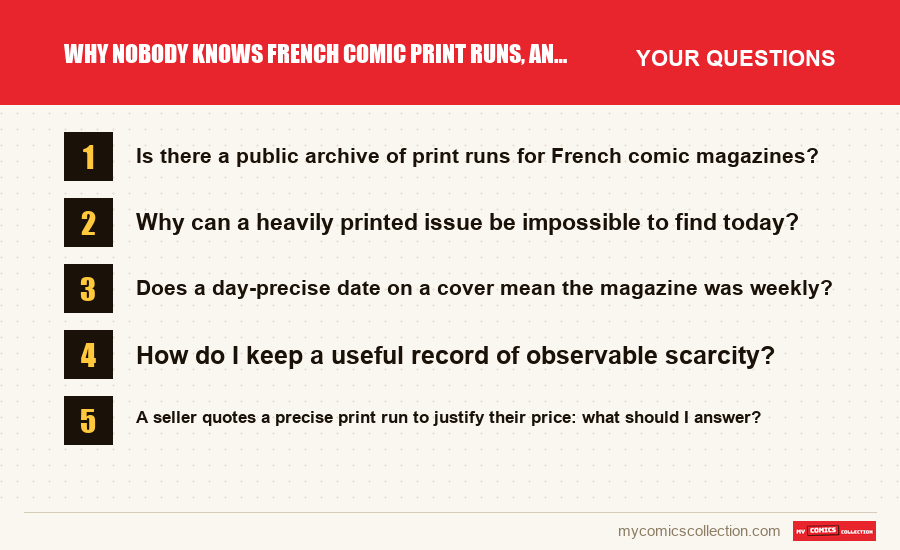
No accessible archive gives printed quantities issue by issue. The figures belonged to the commercial management of the publishing houses and their distributors: internal documents that were never deposited in accessible collections. Academic work on the children's press gives orders of magnitude by period, not data usable at the level of the issue.
Because print run and survival are two different things. An issue sold on the newsstand to children was, in a high proportion of cases, read, lent, damaged and then thrown away. A title printed in smaller numbers but bought by readers who filed their magazines leaves more copies in good condition in circulation today.
No. A date to the day indicates newsstand rotation management, not a short periodicity. Spécial Strange carries day-precise dates on a good part of its issues while appearing at a much more spaced-out pace than a monthly. To know the actual periodicity, compare the dates of consecutive issues.
Each month, note the missing issues you see offered, with their declared condition and the observed price range, and do not draw conclusions before six months. Then sort by blocks of ten issues: the segments that almost never appear stand out on their own. This record measures current availability, never the original production.
Ask which year and which issue the figure applies to, and what its source is. A figure valid for a magazine's launch says nothing about an issue published fifteen years later. Bring the discussion back to what can be checked: the issue's contents, its completeness and its condition.