An estimation tool from the American market rests on four supports: a series identified without ambiguity, a known print quantity, a condition described in a shared language, and enough comparable sales to reveal a trend. For a French issue, none of the four holds. Estimating a French comic therefore means replacing an inherited figure with a method: identify the object precisely, measure its completeness, then observe how often copies of it actually change hands.
You have a stack of French magazines and one simple question: what is all of this worth. The temptation is to look up the matching American issue, find its value somewhere, and then apply a discount because it is a translation. That reasoning seems careful. It is wrong at the first step, and not for a matter of taste: American tools measure quantities that, on the French side, do not exist in a usable form. Better to know what you can measure instead.
As always on this guide, only verified information (creators, issue numbers, dates) is stated as fact; the analysis is our own, with no reproduction of any panel or protected dialogue.
What an American estimation tool assumes
The tools used to price an American comic book are not guesswork set out in a table. They work because four things are stable upstream. The series is a closed entity, whose name and number designate a single object in the world. The quantity put on the market is known, at least to the right order of magnitude. The condition is described in a vocabulary that buyer and seller share before they talk. And enough copies of the same object sell, often enough, for a trend to emerge from the noise.
Remove any one of these supports and the tool does not degrade gracefully, it goes silent: it keeps producing a figure, but that figure no longer measures anything. The French issue removes all four at once. This is not a weakness of the French market, it is a difference in kind between two editorial objects. Let us take the conditions one by one, with what can actually be checked in the catalogue of French-language magazines.
First condition: an identified series
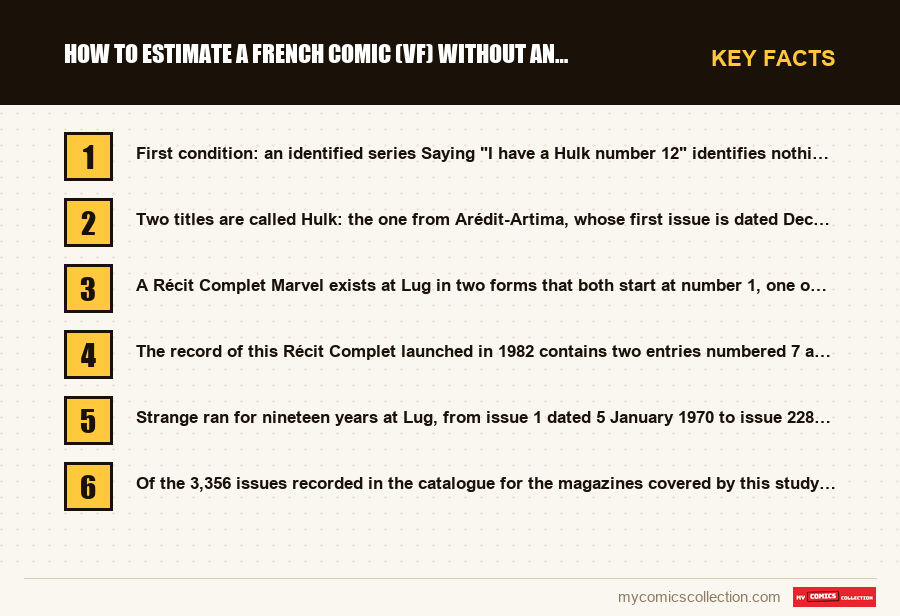
Saying "I have a Hulk number 12" identifies nothing in French. Two titles are called Hulk: the one from Arédit-Artima, whose first issue is dated December 1976 and which stops in September 1983, and the one from Semic, launched in April 1992 and finished in December 1996. Both are numbered from 1, and both run to twenty-nine issues. The name, the number and even the length of the series are identical: only the publisher and the launch year separate two books that share neither format, nor paper, nor original readership.
The case is not isolated, and sometimes a single publisher is the cause. A Récit Complet Marvel exists at Lug in two forms that both start at number 1, one opened in 1982 with a story titled "Serval", the other in February 1984 with "Le prix de l'honneur". A buyer who announces "number 1" without specifying which one is not hiding anything; he simply does not know there are two. No value scale indexed on a title-plus-number pair can arbitrate that.
Worse: the numbering itself is not always a clean sequence. The record of this Récit Complet launched in 1982 contains two entries numbered 7 and two numbered 14, and none at all for issues 11 and 13. In L'Araignée from Lug, some issues are logged in square brackets, the sign of a position reconstructed rather than read from the cover. A French issue is therefore not necessarily a rank in a sequence: it is an object to identify in hand, by its publisher, its year and what it contains.
Second condition: a known print quantity
The catalogue of French magazines describes publications: a date, a story title, a writer, an artist. It describes no quantity, and that silence is not an omission waiting to be filled, it is the state of the documentation. An estimate that claims to start from the scarcity of a French issue therefore starts from a figure that no one will provide.
What remains measurable, and works in the same direction, is the commercial life span of the title. Strange ran for nineteen years at Lug, from issue 1 dated 5 January 1970 to issue 228 dated 5 December 1988: a magazine that lasts that long saturated the newsstands, and its common issues can still be found without effort. Conversely, a title stopped after two or three years never had time to settle among readers, and that is where the difficulty of completing it today comes from. Longevity does not replace a print quantity, but it can be checked, and it points in the right direction.
Third condition: a condition described in a common language
A shared condition scale does not describe a condition in general; it describes the deviations from a reference object: a single format, a regular thickness, two staples, a flexible cover. French magazines do not form that object. They are sometimes monthly and thick, sometimes small-format pocket books, sometimes oversized volumes, and a sizeable share of the copies circulating today are bound collections issued by the publisher, grouping several issues under a hardback cover. The same defect carries very different weight depending on the format.
There is a specificity that no imported scale anticipates: the French issue is a newsstand periodical, with a letters page, sometimes game pages, sometimes a detachable centerfold insert. These pages are often missing, because they were made to be cut out. A copy missing its supplementary pages remains readable, but for a collector seeking the magazine rather than the story, it is no longer the same object.
The practical consequence: describe the copy with facts, not a grade. Is the spine split at the fold, are the staples rusted, is the cover rubbed at the corners, is a first name written in the top right, is the paper cockled from the damp of a cellar, is the central booklet present. Six observations of this kind tell a French buyer more than any abbreviation borrowed from another market.
Fourth condition: a market deep enough
A price trend emerges when the same object sells regularly. For most French issues, that is not the case: sales are spaced out, often in lots, often between collectors who know one another, and an isolated copy can stay for months without any visible equivalent. You are therefore not observing a market, you are observing a succession of opportunities.
The lack of documentation compounds the scarcity of transactions. Of the 3,356 issues recorded in the catalogue for the magazines covered by this study, close to two hundred have no identified writer and a few more have no identified artist. Yet a creator's signature is precisely one of the engines of value on the American side. When the information is missing for about one issue in fifteen, it cannot serve as the basis for a ranking. Sources, moreover, disagree on attributions from that period, when the work was often collective and went uncredited.
Do you collect this series?
Track what you own, what you are missing and what your collection is worth. 7-day trial.
Start my trial →
What weighs on the value of a French issue
These four findings do not leave us empty-handed; they reorder the criteria. In order of weight, here is what actually moves the value of a French magazine.
First, exact identification: publisher, launch year, and the number actually printed on the cover. Special markings are part of the identification, not background: Strange Spécial Origines includes numbers such as 133 bis dated 5 January 1981, or 229 hors série in 1989. Next, physical completeness, central booklet and supplementary pages included, then material condition described as above. Then comes the issue's position in the life of the title: a first issue, a last issue, or an issue that marks a change of publisher, such as the move from number 228 to 229 of Strange, is sought after because it closes or opens a chapter. Last comes identifiable content, which matters when it carries a story readers are looking for, and local depth, meaning how often a copy like yours shows up around you.
How to form a reasonable view, in practice
The method that works is the dullest one: build your own reference, because no one has built it for you. Each time you see a copy of a title you follow pass by, note four things: the publisher, the number, one or two condition observations, and whether the sale went through. Within a few months you have what no table will give you: the real frequency of appearances and the usual gap between what is asked and what is accepted.
Three rules make this reference usable. Compare only issues with the same publisher and launch year, otherwise you add together two different objects. Prefer several sightings spread over time to a single opportunity, especially if it surprised you. And always separate the price of a lot from the price of a single copy: a lot is negotiated on bulk and bulk, a single copy on its condition.
Mistakes that distort a French estimate
The most frequent is to import an American value and then correct it. The result looks reasoned, but it carries a scarcity, a condition and a market that have nothing to do with the French issue on your table. Always start again from the French object.
The second is to read a cover number as a rank. An issue carrying a bis or hors série marking is not the neighboring number, and two copies can show the same figure in different series. The third is to treat a bound collection as a single issue, or the reverse: these are two markets, with two audiences. The fourth, more discreet, is to estimate the content rather than the magazine. A famous story has often appeared several times in French, in several formats, in different titles: what sells is the issue, not the story.
Before buying, before selling
When buying, do three things in this order: check the publisher and the year on the back cover or in the masthead, leaf through to confirm that the central booklet and supplementary pages are there, then ask the seller how long the copy has been for sale. An issue offered for a long time tells you something its displayed price does not.
When selling, describe rather than grade, photograph the back and the corners rather than the front cover alone, and state plainly what is missing. Collectors of these magazines know that a perfect copy is rare, and a declared defect does less damage than one discovered later. If you do not know the depth of the market for your title, leave your listing up for several weeks: it is the only experience that will teach you something reliable about what enthusiasts of this or that character in French versions are really looking for.
Frequently asked questions
No, because there is no equivalence between objects. A French magazine grouped several episodes drawn from different series, in a format and a quantity of its own. Converting would mean transposing the scarcity of one issue onto another that has neither the same distribution, nor the same audience, nor the same average condition today.
Look at the publisher named on the cover or in the masthead, then at the publication date. Hulk from Arédit-Artima starts in December 1976, the one from Semic in April 1992: the date settles it at once. Without a readable date, the format and the quality of the paper place it in time, and the title of the main story lets you confirm it in the catalogue.
Yes, to someone who collects the magazine rather than the story. Those pages were part of the periodical and were meant to be used, so they were often cut out. A copy that still has them is considerably harder to find than the same copy without them, and that difference shows up at resale far more than a small rub on the cover.
It is not the same issue. Strange Spécial Origines, for example, includes a 133 bis dated 5 January 1981: the marking signals a release outside the regular rhythm, with its own content. Treat it as a separate number in your tracking, or you will believe you own a number you do not have, and your series will stay incomplete without your noticing.
Allow a few months and at least three sightings of a comparable issue, with the same publisher and launch year. Below that, you are measuring an anecdote. What matters is not the number of observations but their consistency: three copies of the same title described in the same terms are worth more than twenty records mixing different editions.