Selling a collection of French comics is decided before the listing goes up. You have to inventory issue by issue, choose between selling in one block and splitting into coherent sets, describe a condition without embellishing it, and admit what you do not know about an issue's contents. A serious buyer will always ask the same questions about gaps, staples and centre pages. A frank listing succeeds more often than a flattering one.
A pile of Lug or Semic magazines built up over twenty years does not turn into a sale overnight. A seller who simply photographs six covers and writes "complete collection, good condition" is setting up weeks of painful exchanges, sometimes a return, often a buyer who disappears after the first precise question. The useful work comes beforehand, and it is long: it means knowing exactly what you hold, and writing it down without telling yourself a story.
As always on this guide, only verified information (creators, numbers, dates) is stated as fact; the analysis is our own, with no reproduction of panels or protected dialogue.
Inventory first, announce afterwards
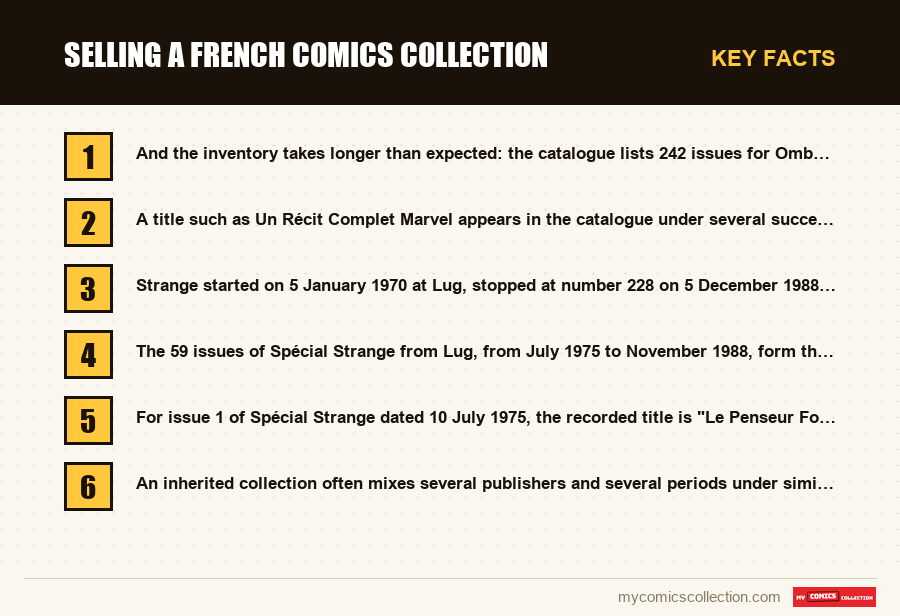
Taking inventory is not an administrative formality, it is the sale itself. As long as you do not know whether your series is complete, you can neither answer a buyer nor choose how to transfer it. And the inventory takes longer than expected: the catalogue lists 242 issues for Ombrax, published from 10 February 1966 to 10 March 1986, and checking twenty years of monthly magazines one by one easily takes several evenings.
Work by series, not by box. Take out a pile, note every issue present, and above all mark the absences: a gap you have identified is worth more than a gap the buyer discovers. The long series of the Lug era do not lend themselves well to approximate counting, because a regular monthly produces sequences that look continuous when three issues are missing in the middle.
An incomplete inventory costs you in two ways. First in negotiation: faced with a vague list, an experienced buyer assumes the worst and offers accordingly, because they factor in the risk you have left them. Then in dispute: when the description promises a continuous run and the parcel contains unreported gaps, the seller ends up arguing over a refund that is hard to refuse.
One issue number is not enough to identify a magazine
This is the most costly trap in the French market, and it is far from anecdotal. A title such as Un Récit Complet Marvel appears in the catalogue under several successive blocks: a Lug series opened at number 1 in 1982, another also opened at number 1 in February 1984, then a continuation picked up at number 21 in February 1989. Announcing "Récit Complet Marvel number 2" therefore describes nothing precise.
The opposite case also exists, and it is reassuring. Strange started on 5 January 1970 at Lug, stopped at number 228 on 5 December 1988, and the relaunch continued at number 229 from 5 January 1989: the numbering was not reset to zero, so a Strange issue number is unique even though the publisher changed along the way. Knowing which situation your series is in keeps you from writing an ambiguous listing.
In practice, state three things systematically for each set you offer: the exact title as printed on the cover, the issue number, and the year shown on the magazine. This trio resolves almost every ambiguity, including those you have not spotted.
In one block, or in coherent sets
Both options are defensible, they simply do not appeal to the same buyer. Selling in one block settles everything at once: a single contact, a single collection, no parcel management. The trade-off is that whoever takes the whole run also buys what they do not want, and they know it; they value the set according to what they think they can resell, not according to your most sought-after pieces.
Splitting into coherent sets takes far more work and attracts motivated buyers. Coherent does not mean "twenty issues picked at random": it means a segment that makes sense to a collector, for example a complete series from start to finish, or the entirety of a uniform editorial period. The 59 issues of Spécial Strange from Lug, from July 1975 to November 1988, form that kind of identifiable set.
Between the two, one simple rule: only break up a complete set if you are prepared to handle the leftovers. Removing three issues from a followed series to sell them separately turns the remainder into an incomplete series, and therefore a lot that is much harder to move. If you are short on time, the block is often the sensible choice, and there is no shame in owning that.
Describing a contents listing nobody details
A French magazine of this period does not contain one episode but three or four, sometimes more. Yet public records, including the catalogue this guide draws on, generally keep only one story title per issue. For issue 1 of Spécial Strange dated 10 July 1975, the recorded title is "Le Penseur Fou" (French title), with Jean Frisano, John Buscema and Ross Andru on art: that is accurate, but it is not the full contents.
The consequence is direct for a seller: you cannot claim that a French issue contains the first French appearance of a given character, nor that it matches a particular American issue, unless you have the copy in hand and are reading the table of contents. Many listings state this kind of thing without having checked, and that is exactly what comes back to bite them.
Good practice is to copy the contents of the copy, as printed, for the issues where you expect something, and to write for the others that the detailed contents have not been recorded. An experienced buyer reads that sentence as a sign of seriousness, not as a gap.
Describing a condition without flattering it
Sellers almost always err in the same direction, because they look at magazines they have loved. The remedy is not to guess a grade, it is to describe observable facts: blunted corners, a reading crease on the spine, yellowed edges, rusted staples, a water mark at the foot, a name written in pen on the cover, detached centre pages. Each of these points can be verified in ten seconds and is not open to debate.
Three defects weigh particularly on magazines of this generation, and they often go unnoticed in a quick description. Staple rust, which stains the paper around the fold and keeps spreading. A sunned spine, bleached by years standing upright on a shelf near a window, visible only when comparing two copies. And a detached centre section, which only shows when the magazine is opened flat.
When a lot is mixed, do not give an average. Describe the worst copy in the lot and say the others are above it: the buyer then knows the worst case, and you cannot be caught out. A listing that promises less than the reality closes quickly and without comebacks.
Do you collect this series?
Track what you own, what you are missing and what your collection is worth. 7-day trial.
Start my trial →
Photographing what really matters
A cover photo proves very little, yet it is the only one you will find in most listings. What a buyer wants to see is the spine laid flat to judge the folding and sun-bleaching, the edge of the block from top to bottom, the foot of the magazine where damp leaves its marks, and a close-up of the staples. Four targeted views are worth more than twelve covers lined up side by side.
Work in daylight, without flash, on a plain matte background, with the magazine laid flat and not held in the hand. For a lot, photograph the stacks so that the edges are legible: you should be able to count the announced issue numbers. And if a defect exists, photograph it openly, close up. A shown defect reassures; a guessed defect worries.
The inherited collection, whose history you do not know
Recovering a parent's magazines puts you in a particular situation: you hold the objects but not their history. You do not know whether the series was bought at the newsstand month by month or completed in bulk much later, nor how long the boxes spent in a garage. In that case, the only solid stance is to say so. "Collection received by inheritance, storage conditions unknown before a given year" is a sentence serious buyers respect.
Start with a rough survey before any sorting: open the boxes, note the titles present and the ranges of numbers, and set aside any idea of value at this stage. An inherited collection often mixes several publishers and several periods under similar titles, such as Hulk published in France by Arédit-Artima in 1976 and then under the same name by Semic in 1992: without the year printed on the magazine, the mix is invisible.
Also resist the temptation to clean, repair or flatten anything. Tape over a tear, an iron-pressed cover, replaced staples: these well-meant interventions degrade the object and then have to be declared, which penalises more than the original defect. If you are not sure, do not touch.
The questions a serious buyer will ask
They are always the same, and preparing the answers in writing saves a great deal of time. Is the series continuous, and which issues are exactly missing? Have the magazines been read, and how many times? How and where were they kept, and for how long at your place? Are there inscriptions, newsagent's deposit stamps, price stickers stuck on?
Then come the publishing questions, often decisive. Is this the original print run or a reprint carrying the same title? Are special issues and bound albums included in the announced lot? Are any supplements or inserts still present? The catalogue itself sometimes keeps traces of these grey areas: some entries for L'Araignée at Lug are recorded with an issue number in square brackets, a sign that the actual numbering of the magazine is uncertain.
Answer everything, including with "I do not know". A seller who writes that they do not know whether a supplement was kept comes across as reliable; a seller who asserts without checking gets caught one time in two, and that one time costs more than all the others combined. See also our other guides on French publications.
Packing forty-year-old paper
Packing is not the final step of a sale, it is the last chance to ruin it. A stapled magazine from the late 1970s is fragile at three points: the corners, the folded spine and the staples. Each copy must therefore travel flat, individually protected, and wedged so that it cannot slide inside the parcel.
The principle is simple: one sleeve per magazine, a rigid board on either side of the stack, no empty space in the box, and an outer package larger than the contents so that the corners never touch the wall. Adhesives must never touch the paper. For a bulky lot, several medium parcels protect better than one heavy parcel, whose own weight crushes the contents.
Finally, document the shipment. Photograph the contents wedged before closing, note the issue numbers sent, and keep proof of posting. This is not distrust of the buyer, it is the only way to settle cleanly any dispute over a parcel that arrives damaged, and it closes off a preparation job that will already have cost you days.
Frequently asked questions
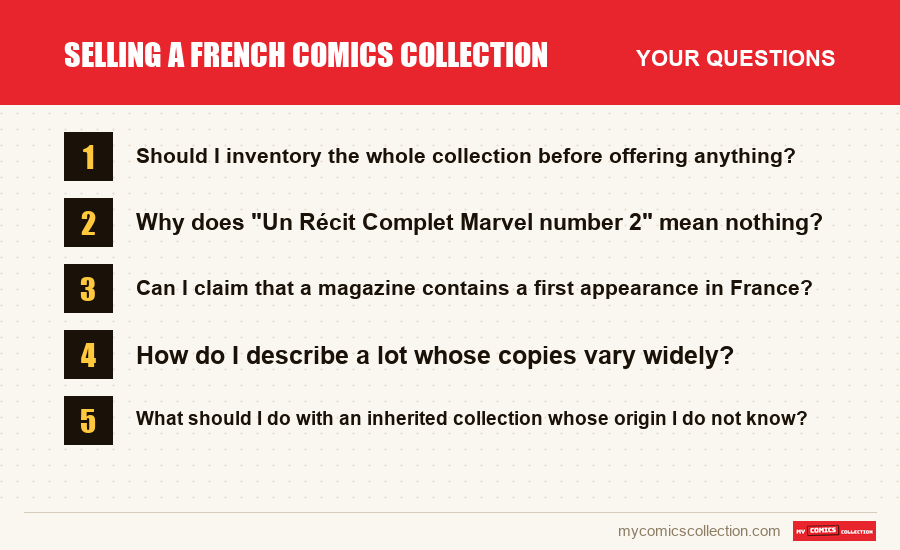
Yes, at least by series and range of numbers. Without an inventory, you cannot say what is missing, so you cannot answer the first serious question you are asked. Counting also reveals duplicates and series that are more advanced than you thought, which changes how you divide the lots.
Because that title appears in the catalogue under several blocks: a series opened at number 1 in 1982 at Lug, another opened at number 1 in February 1984, and a continuation from number 21 in 1989. Always state the cover title, the issue number and the year printed on the magazine.
Not without the copy in hand. Public records give only one story title per issue, whereas a magazine published three or four. Open the magazine, read the table of contents, and copy it out. Otherwise, write that the full contents have not been recorded: that is accurate and it protects the sale.
Describe the most damaged copy and state that the others are above it. An announced average will inevitably disappoint half the expectations. List the observable defects rather than giving an overall judgement: rusted staples, sun-bleached spine, detached centre section, name written on the cover. These statements can be checked and are not negotiable.
State it explicitly in the description: it is information, not an admission of weakness. Note the titles and ranges of numbers, record the year on each magazine so you do not confuse two publishers under the same name, and above all do not clean anything: an improvised repair costs more than the defect it is meant to hide.