No ranking of the most sought-after French-language comics holds up, because the print runs were never published and the contents listings of the kiosk magazines remain incomplete. What can be verified are the factors that create demand: the age of a title, the brevity of a run, the position of an issue within its series, the brief passage of a creator, the issues that were left off the lists, and the ones whose content is documented nowhere.
You have probably come across a list of French comics "to own", copied from one forum to the next and given without any justification. The problem is not that it is wrong; it is that it rests on nothing measurable. The French kiosk publishers never disclosed their print runs, unsold copies went to pulping without any count, and the catalogue of contents stays patchy even for the best-documented titles. In other words, a ranking of demand is intuition dressed up as knowledge. What follows does the opposite: it takes the factors that can be read in the record of the series, and says for each one what it explains and what it leaves open.
As always on this guide, only verified information (creators, issue numbers, dates) is stated as fact; the analysis is our own, with no reproduction of panels or protected dialogue.
Why a quantified ranking of demand does not exist
To rank issues by demand, you would need two sets of numbers: how many copies were printed, and how many collectors are looking for them. The first figure was never made public by the French kiosk publishers. The second does not exist anywhere in aggregated form: searches happen privately, through want lists exchanged between collectors, and no institution compiles them.
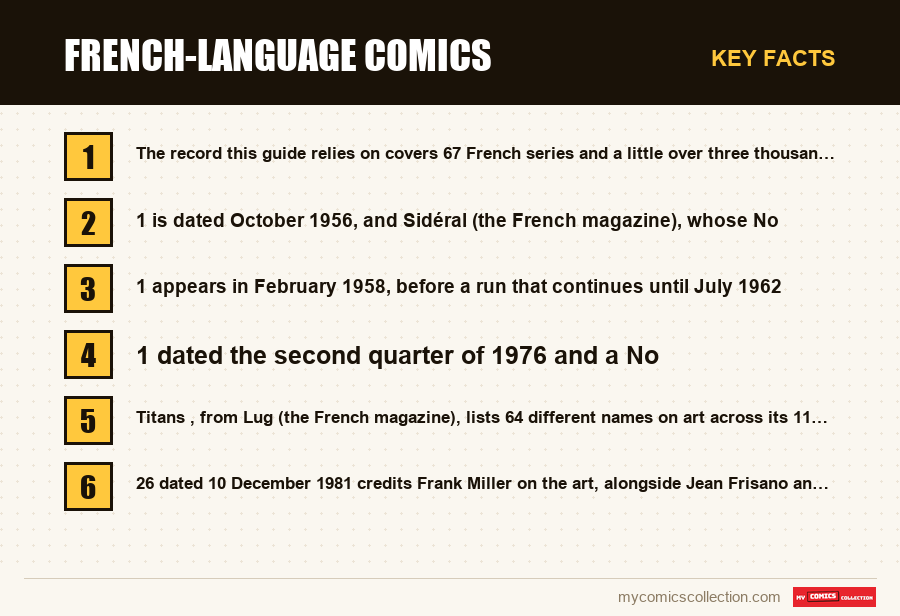
What can really be established is the structure of a publication. The record this guide relies on covers 67 French series and a little over three thousand three hundred issues, each with its number, its cover date, a story title and its credits. That is enough to reason about the causes of scarcity, and far too little to claim an order. A demand factor is not a rank: it tells you in which direction to look, not which issue to buy first.
What follows is therefore a reading grid. Six factors, each with its blind spot. Their value lies precisely in how they combine: an issue that ticks four of them behaves differently on the market than a title that ticks none, without our needing to rank them.
Age: a filter on survival, not on interest
The simplest factor is also the least open to dispute: the older an issue, the less chance it has of surviving sixty years of attics, moves and flea markets. The oldest titles in the record date from the mid-1950s, with a Big Boy (the French magazine) whose No. 1 is dated October 1956, and Sidéral (the French magazine), whose No. 1 appears in February 1958, before a run that continues until July 1962.
What age explains: physical scarcity. Poor paper, staples that rust, a format that fit no shelf, a children's reading habit followed by abandonment. Copies in good condition from those years are few because the object was not designed to last, and nobody kept it expecting that it would.
What it does not explain: appetite. A rare issue that nobody is looking for remains hard to sell. The series of the 1950s often mixed science fiction, westerns and crime stories that few current collectors follow, and their rarity does not turn mechanically into demand. Age is a condition, not an engine.
Short runs: few issues, few copies
A series that stops early leaves behind a limited body of work, often distributed over a small area and for a short period. Le Démon from Arédit (the French publisher) gives a clear case: twenty issues between a No. 1 dated the second quarter of 1976 and a No. 20 from January 1983. Seven years for twenty issues is a pace so slow that the title never had time to settle into the habits of a kiosk reader.
What brevity explains: the difficulty of reconstituting a set. On a long series, gaps fill up through accumulation, because lots keep circulating. On a series of twenty issues appearing one or two a year, complete lots hardly exist: nobody had the chance to follow the run from start to finish, and the copies end up scattered.
What it does not explain: the internal hierarchy. In a short run it is tempting to think that everything is worth the same, since everything is rare. That is not the case: the first issues circulated more, because the distribution of a new title is always wider than that of a fading one. Brevity makes the series hard to complete; it does not tell you which issue of the batch will resist your search the longest.
Position in the run: what the market knows how to name
Demand concentrates on positions a buyer can name without knowing anything about the content. The start of a series, its end, and sometimes a tight segment whose nickname circulates. It is a mechanism of information, not of quality: people look for what they know how to name.
What position explains: the asymmetry of search. Two equally rare issues are not equally sought if one carries an immediate landmark and the other is an ordinary number in the middle of a long run. A collector who is just starting knows how to ask for the beginning of a series; it takes years before they realize that a middle issue deserves the same attention.
What it does not explain: real rarity. Position is a matter of notoriety, and notoriety can work against the buyer. A known landmark is sought, and therefore displayed, and therefore sometimes better kept than its neighbors, since it was sorted and shelved earlier. Conversely, an issue from the middle of a series, read and then left in a pile, may have become considerably harder to find in good condition without anyone noticing.
Creators passing through: a single signature in a title
French magazines put together their contents by drawing on a stock of translated material, which produces credits of a variety that no American publication of the same volume reaches. Titans, from Lug (the French magazine), lists 64 different names on art across its 119 issues. In this mosaic, some signatures surface only once.
A measurable example: in Spécial Strange (the French magazine), No. 26 dated 10 December 1981 credits Frank Miller on the art, alongside Jean Frisano and John Byrne. This is a case that creates targeted demand: a collector who follows an artist looks for the French issue where that artist appears, without needing a ranking to point it out.
What this factor explains: the searches that follow no series. They come from fans of an artist, not of a title, and they target issues nobody would have classed as important. What it does not explain: the actual content. The record carries only one story title per issue, whereas a French magazine often published three or four. A recorded credit says that a creator appears in the contents, not on which story, nor on how many pages. That check is made on the copy itself, not on a list.
Do you collect this series?
Track what you own, what you are missing and what your collection is worth. 7-day trial.
Start my trial →
Issues that escaped the lists
This is the most misunderstood factor, and perhaps the most useful. Some issues do not fit neatly into a numbering, and bibliographies lose them along the way. The record keeps track of them in two distinct ways.
The first is the reconstructed number. At Arédit, issues of Captain America and of Gamma la bombe qui a créé Hulk (the French magazine) appear with a number in square brackets, meaning it was restored because it is not printed on the cover, one of them being noted as hardcover. The second is the grouped counter: at Sagédition, Superman Poche (the French magazine) counts fourteen issues that carry a double number.
The consequences are very concrete. A buyer who wants the "complete series" of this Superman Poche is not looking for one hundred and ten objects, but noticeably fewer, and a seller acting in good faith may announce gaps that do not exist. Conversely, an issue with no printed number circulates without an identity: it is sold as a duplicate, or not sold at all, because neither the buyer nor the seller knows how to name it.
What this factor explains: the finds. These are the objects that are still bought with indifference, rather than the known landmarks. What it does not explain: their future value. An issue the lists ignore can stay ignored indefinitely, because demand presupposes a community able to name the object. Searching in this area is a bet on documentation yet to come, and it should be taken as such.
Issues whose content is documented nowhere
The last factor, and the most puzzling: issues whose date is known but whose contents are not. Across the whole record, forty-four issues have no story title attached. These blanks are not spread at random, and that is what makes them usable.
In Spidey (the French magazine), they form a continuous sequence, from No. 10 of November 1980 to No. 15 of April 1981: six consecutive issues whose content remains to be established. In L'Insolite (the French magazine), five issues out of twenty-five are concerned. In Eclipso (the French magazine), the gap lies elsewhere, on eight cover dates left in suspense.
What this factor explains: the differences in appraisal between two honest sellers. When the content of an issue is described nowhere, each seller announces it with what they have in front of them, and the descriptions diverge without anyone lying. This is also what makes these issues interesting to acquire: you are buying an object of which you will become the source of information.
What it does not explain: whether there is anything in them. A blank in the documentation signals a gap in the record, not a gem. The missing episode may well have no particular interest, and the only way to know is to open the copy and read the contents page by page.
Why these six factors refuse to be ranked
At this stage the temptation is to weight them: so much for age, so much for brevity, and out comes a rank. It must be set aside for a substantive reason. The six factors do not measure the same thing. Three concern supply, meaning the number of copies still in circulation: age, brevity, uncertain numbering. Three concern demand, meaning a collector's ability to name the object: position, passing signature, documentation of the content. A single rank would add them together as if they were commensurable.
There is something more troubling. Supply factors can be deduced from the record; demand factors depend on what collectors know at a given moment, and that moves. A clearer numbering brings into the lists objects that were not there before, so it creates demand where there was none. A ranking published today would describe the state of knowledge and present it as the state of the market. That is exactly the error repeated by the lists that circulate.
Using it to decide, rather than following a list
Here is how the grid works on a lot, an ad or an inherited pile. Count the factors present instead of looking for a rank. An old issue, from a short run, whose number is reconstructed and whose contents are described nowhere accumulates the four strongest signals, and deserves to be bought before a landmark from the start of a series that you will find more easily.
Then distinguish what you are buying. A famous object is a comfort purchase: it is easy to find, easy to resell, easy to compare. An obscure object is a patience purchase, which assumes that you document what you have, if only for yourself. Both are legitimate, but mixing them in a single decision produces the classic regrets of the collector, who pays dearly for what was easy and lets pass what will not come back.
Finally, keep your own record. The position of an issue in your collection matters more than its position in a list written by someone who does not own your set. Note the dates, the legible credits and the actual contents of the issues you have, starting with those whose content is documented nowhere. And if your holdings revolve around a character, the pages devoted to Thor or to the Fantastic Four give the editorial landmarks you need to place a French magazine within a wider set.
Frequently asked questions
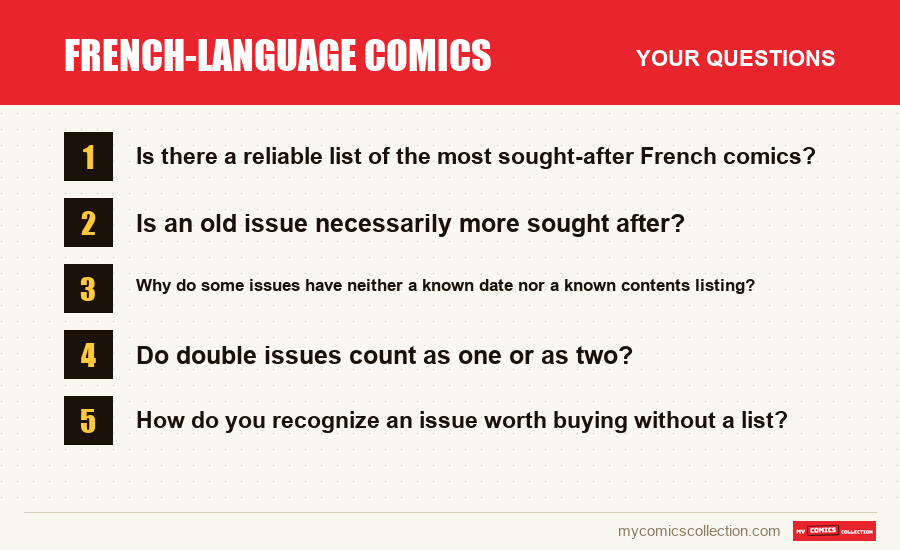
No, and for a verifiable reason: the print runs of the French kiosk magazines were never published, and no body compiles collectors' searches. A list that announces an order describes the habits of whoever wrote it. The factors of scarcity, on the other hand, can be read from the structure of the publications and remain usable.
No. Age reduces the number of surviving copies, because the paper and staples of these small formats age badly. It does not create the appetite. French series from the mid-1950s mixed science fiction, westerns and crime stories that few collectors follow today: rare, they sell slowly.
Because these magazines were catalogued late, from copies in hand. When a cover carries no number, or when no collector has described the contents, the catalogue entry stays incomplete. In Spidey this concerns a sequence running from No. 10 to No. 15; in Eclipso, eight dates are missing.
As one object. Superman Poche at Sagédition comprises fourteen issues announced under a double number, from 51-52 to 108-109: a single volume carries both counters. A buyer who reasons in counters believes they are missing issues that never existed, and a seller can announce a gap in good faith.
By counting the signals instead of looking for a rank. Age, short run, reconstructed numbering, undocumented contents: four signals accumulated on the same object are worth more than a famous landmark that will turn up elsewhere. Then check the condition, which remains the factor on which you can most quickly go wrong.